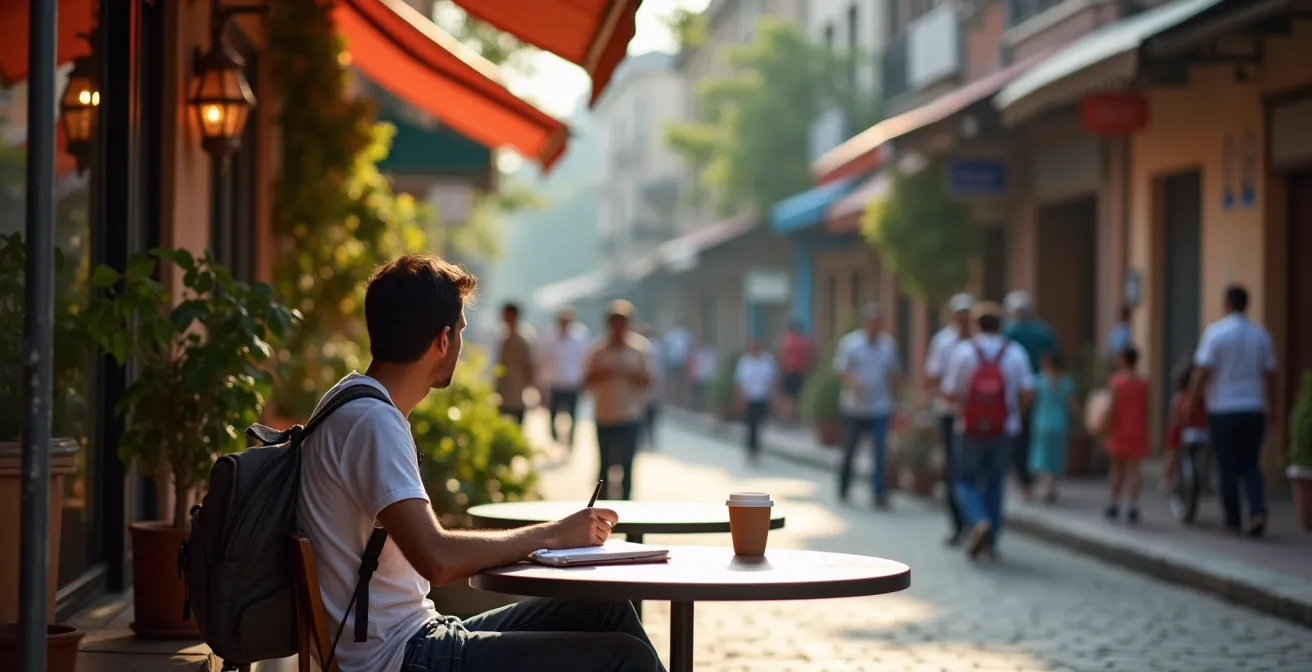
Let’s be honest. You’ve had that feeling. You return from a whirlwind trip to a celebrated city, your camera roll overflowing with photos of monuments, museums, and panoramic views. Yet, as the post-vacation glow fades, a nagging emptiness sets in. You saw everything on the list, but did you feel anything? You have the pictures to prove you were there, but the memories themselves feel thin, like a collection of postcards rather than a lived experience. This is the great paradox of modern travel: we have unprecedented access to the world, yet we often feel more disconnected from it than ever.
The tourism industry has sold us a lie. It has packaged cities into digestible, marketable products—”top 10″ lists, hop-on-hop-off bus routes, and skip-the-line passes. This model treats cities not as living, breathing organisms, but as a series of attractions to be consumed and ticked off a list. It encourages a frantic pace that prioritizes quantity over quality, leaving no room for spontaneity, serendipity, or genuine connection. We’ve become tourism consumers, not explorers. But what if the goal wasn’t to collect landmarks, but to learn how to read a city? What if the most rewarding experiences are found not in the places Google Maps recommends, but in the spaces between them?
This article is a manifesto for the disillusioned traveler. It is a rejection of superficial sightseeing and an argument for a deeper, more conscious form of urban exploration. We will deconstruct why the conventional model fails—economically, psychologically, and ethically. More importantly, we will equip you with the mindset and strategies to transform your travels from a passive act of consumption into an active, meaningful engagement with the urban world.
For those who prefer a visual immersion into the spirit of exploring the less-traveled path, the following video captures an adventure into the world’s least-visited country. It serves as a powerful inspiration for breaking away from the crowds and finding meaning in the unexpected.
To navigate this new approach to urban travel, we’ve structured this guide to first diagnose the problems inherent in checklist tourism and then provide actionable strategies for a more profound experience. The following sections will guide you from understanding the system’s flaws to mastering the art of contemporary urban exploration.
Table of Contents: A New Philosophy for Urban Exploration
- Why Your City Tour Ticket Money Doesn’t Reach the Locals?
- How to Find Hidden Gems That Google Maps Doesn’t Show You?
- See It All or Feel It All: Choosing Between Quantity and Quality?
- The Burnout Trap: Why 8-Hour Sightseeing Days Ruin Your Vacation
- How to Balance Must-See Sites With Aimless Wandering in 24 Hours?
- Why Your Airbnb Rental Might Be Pushing Locals Out of the City?
- The Ethical Trap of “Ghetto Tourism” in Developing Urban Centers
- What Is Contemporary Urban Tourism and Why Should You Try It?
Why Your City Tour Ticket Money Doesn’t Reach the Locals?
Let’s start with the money. That all-inclusive tour package or ticket for the panoramic city bus? It feels like a direct investment in the place you’re visiting, but the hard truth is often the opposite. This phenomenon is called tourism leakage, and it’s one of the dirtiest secrets of the travel industry. It refers to the massive portion of tourism revenue that never reaches the local economy. Instead, it “leaks” out to overseas-owned airlines, hotel chains, tour operators, and imported food and drink suppliers. It’s a system designed to create the illusion of local experience while channeling profits to multinational corporations.
The numbers are staggering. In many developing regions, a shocking 80% of tourism revenue can leak out of local economies, leaving communities with the social and environmental costs of tourism without reaping the economic benefits. The impact is not just financial; it creates a dependency that stifles local entrepreneurship and reinforces economic inequality. A report from The Travel Foundation starkly illustrates this disparity: it takes 96 cruise ship tourists to generate the same local economic benefit as just four adventure travelers who engage directly with local businesses. By participating in the pre-packaged tourism economy, you may be unintentionally perpetuating a system that harms the very culture you’ve come to appreciate.
Action Plan: A Traveler’s Checklist for Positive Local Impact
- Vet your vendors: Before booking, research if your accommodation is locally owned versus part of an international chain. Prioritize family-run guesthouses over faceless conglomerates.
- Choose small-scale tours: Opt for small-group tours that explicitly state they work directly with and employ local community members and guides. Ask who owns the company.
- Break free from the bubble: Actively skip all-inclusive resorts and other forms of “enclave tourism” that are designed to isolate you from the local economy and culture.
- Track your spending: Make a conscious effort to spend your money at businesses that are visibly local. Aim for a majority of your spending to support family-run restaurants, independent shops, and local markets.
- Buy authentic souvenirs: Purchase crafts and goods directly from artisans at local markets rather than from airport shops or international franchise stores selling mass-produced trinkets.
How to Find Hidden Gems That Google Maps Doesn’t Show You?
Google Maps is a liar. Not because its data is wrong, but because its purpose is to show you the most efficient, predictable, and commercially sanctioned version of a city. It directs you along the main arteries, the paved tourist routes lined with chain stores and souvenir shops. It is a tool for navigation, not discovery. True exploration begins where the algorithm ends. The most authentic parts of a city are rarely signposted; they are revealed by observing the subtle clues left by local life—what urban planners call desire paths. These are the worn-down shortcuts in a park, the unofficial alleyways, the routes people take not because they were told to, but because it’s the most natural way to live.
To become an “urban reader,” you must learn to see these desire paths. Instead of asking “What’s the quickest way to the museum?”, ask “Where do people go for lunch around here?”. Follow the scent of a bakery down a side street. Listen for the sound of children playing or music coming from a courtyard. Look for the hand-painted signs, the overflowing window boxes, and the doorways that are well-used. These are the markers of a living neighborhood, not a tourist district. The goal is to shift your mindset from a destination-oriented traveler to a process-oriented explorer. The journey between the “points of interest” becomes the point of interest itself.
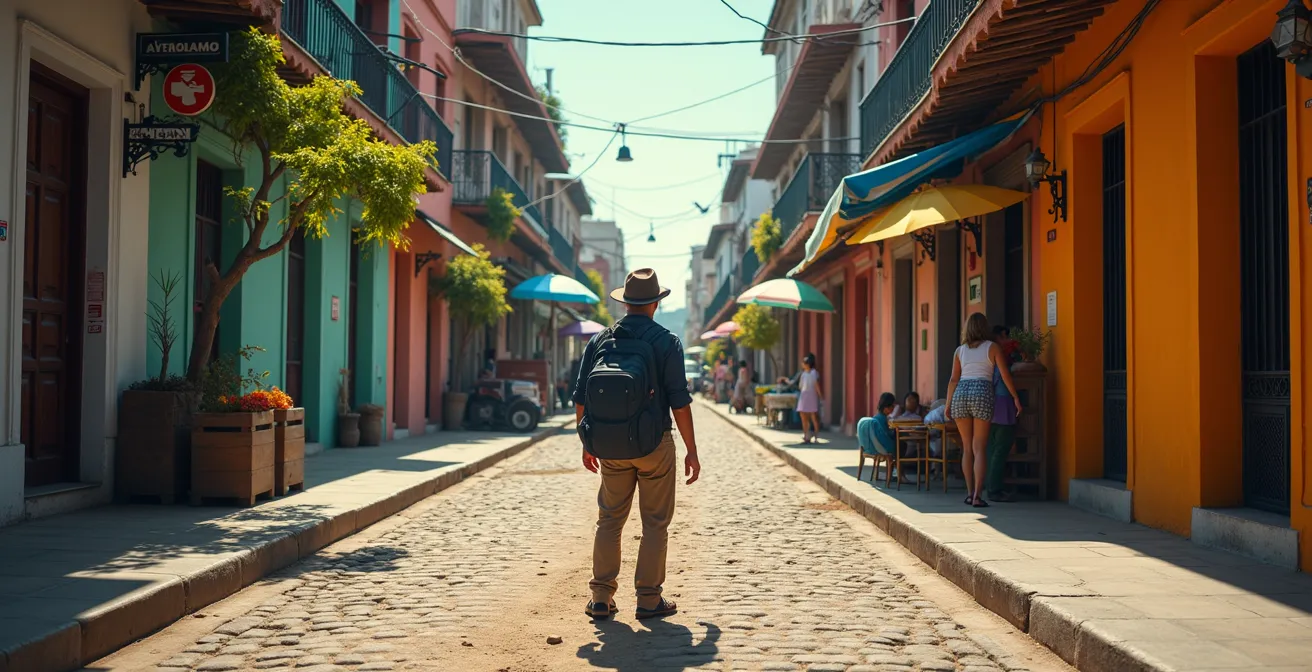
This approach requires a level of trust and a willingness to be temporarily lost. It means embracing uncertainty. As travel creator Drew Binsky, who has visited every country in the world, often demonstrates, real connection happens when you abandon the plan. He advocates for using social media to connect with locals *before* you arrive and hiring them directly for a day, asking them to show you *their* city, not the one in the guidebooks. This is how you find the hidden gems—by seeking out the people who hid them in plain sight.
See It All or Feel It All: Choosing Between Quantity and Quality?
Your brain is actively working against your frantic sightseeing itinerary. The relentless race to “see it all”—cramming three museums, two monuments, and a cathedral into a single day—is the surest way to remember almost nothing of substance. This isn’t a philosophical opinion; it’s a matter of cognitive science. The culprit is a psychological principle known as the Peak-End Rule, pioneered by Nobel laureate Daniel Kahneman. His research demonstrates that our memory of an experience is not an average of every moment. Instead, we disproportionately remember two things: the most emotionally intense point (the “peak”) and the final moment (the “end”).
What does this mean for travel? It means that a 10-hour day of lukewarm sightseeing will be remembered less fondly than a 3-hour experience that had one moment of breathtaking beauty or a wonderfully relaxing conclusion. The duration of the experience is almost irrelevant to how we remember it. By packing our days, we dilute the potential for creating strong “peak” moments. We’re too rushed, too tired, and too overstimulated to be truly present. We end the day exhausted and overwhelmed—a negative “end” that taints the memory of the entire day. According to psychological research on travel memories, the happiness you feel at the end of a trip is a far more powerful predictor of your overall remembered happiness than the trip’s duration.
The choice is not between seeing the Eiffel Tower and seeing nothing. It is a choice of focus. Do you want a collection of blurry mental snapshots, or a few, crystal-clear, emotionally resonant memories? The modern explorer understands this trade-off. They don’t try to conquer a city; they choose to connect with one small part of it. They would rather spend an entire afternoon in a single neighborhood, culminating in a memorable meal at a local cafe, than race across town to get a blurry photo of another landmark they won’t remember visiting in a year.
The Burnout Trap: Why 8-Hour Sightseeing Days Ruin Your Vacation
The concept of “vacation burnout” sounds like a ridiculous contradiction, a first-world problem of the highest order. Yet, it is a very real consequence of the “checklist” approach to travel. We save up for months, plan for weeks, and then execute our vacations with the militant efficiency of a military campaign. The result? We return home more exhausted than when we left, in desperate need of a vacation from our vacation. This isn’t just a feeling; it’s a neurological reality. The constant novelty, decision-making, and navigation required by intensive travel puts a significant cognitive load on our brains.
While new experiences are crucial for creating memories, the brain requires downtime to process and consolidate them. Non-stop activity prevents this vital process. Research on the neuroscience of rest reveals a fascinating truth: when we are doing “nothing”—sitting in a park, staring out a cafe window, aimlessly wandering—our brains are incredibly active. This is when the “default mode network” kicks in, allowing us to connect disparate ideas, solve problems, and, most importantly for a traveler, convert short-term experiences into long-term memories. An over-scheduled itinerary robs us of these crucial moments of consolidation. You are literally preventing your brain from making the memories you’re working so hard to create.
The solution is not to be lazy, but to be intentional about rest. It’s about embracing scheduled spontaneity. This means actively blocking out chunks of your day—2 to 3 hours at a time—with no plan other than “explore.” It means building “pause points” into your day, like a commitment to sit in a specific cafe for 30 minutes and just observe. By consciously planning for unstructured time, you give your brain the space it needs to breathe, process, and truly absorb your surroundings. It transforms rest from a sign of failure (not seeing enough) into a strategic tool for a richer, more memorable experience.
How to Balance Must-See Sites With Aimless Wandering in 24 Hours?
Let’s be pragmatic. You’ve traveled thousands of miles to Paris; you are going to see the Eiffel Tower. The idea of completely ignoring iconic landmarks is as unrealistic as it is joyless. These sites are often “must-sees” for a reason—they are marvels of history, art, and engineering. The trap is not in visiting them, but in treating them as the sole purpose of your visit. The modern explorer uses a different strategy: the Anchor & Explore method. This approach treats a famous landmark not as a destination to be ticked off, but as an anchor point—a starting point for genuine neighborhood exploration.
Case Study: The “Anchor & Explore” Method
The principle is simple: after you’ve visited your “must-see” site, you commit to spending the next 2-3 hours exploring the 1-kilometer radius around it. Instead of immediately hopping on the metro to the next landmark, you walk in the opposite direction of the tourist crowds. Travel creators and seasoned explorers report this is where the magic happens. In the shadow of the Colosseum, you might find a tiny, family-run trattoria that has been serving the same cacio e pepe recipe for 50 years. A few blocks from the Louvre, you might stumble upon a hidden arcade filled with artisan workshops. This method allows you to satisfy your desire to see the famous sites while pushing you into the authentic, living fabric of the city that thrives just beyond the tourist bubble.
This strategy re-frames the purpose of the landmark. It is no longer just a photo opportunity. It becomes the center of a small, self-contained universe you can explore for an afternoon. You begin to see the landmark not as an isolated object, but as part of a living ecosystem. You notice the bakery that provides pastries for the museum staff, the small park where local office workers have lunch, the schoolyard full of children playing in the shadow of a centuries-old cathedral. You see life, not just a monument.
Why Your Airbnb Rental Might Be Pushing Locals Out of the City?
The “live like a local” promise of platforms like Airbnb was seductive. It offered a vision of authentic travel, a chance to inhabit a real neighborhood instead of a sterile hotel room. But for many cities, this dream has curdled into a nightmare of gentrification, displacement, and the erosion of community. The problem lies in the conversion of long-term housing for residents into short-term rentals for tourists. When investors or landlords realize they can make significantly more money renting an apartment by the night rather than by the month, they have a powerful incentive to push out long-term tenants.
This creates a cascade of negative effects. It reduces the available housing stock for locals, driving up rents and making it unaffordable for residents—especially service workers, artists, and young families—to live in their own city. This leads to the phenomenon of “ghost hotels,” entire residential buildings that have been hollowed out and converted into unregulated hotels. Urban studies consistently demonstrate that a high density of short-term rentals leads to the closure of essential local services like grocery stores, schools, and doctor’s offices, which are replaced by souvenir shops and tourist-trap restaurants. The very “local character” that attracted travelers in the first place is systematically destroyed by their presence. The neighborhood becomes a transient, commercialized shell of its former self.
This doesn’t mean every host is a villain or that using such platforms is inherently evil. The issue is one of scale and regulation. As a conscious traveler, the responsibility falls on you to question the impact of your stay. Are you renting a spare room in an occupied home, thereby providing a local with direct income? Or are you staying in a professionally managed, multi-property portfolio apartment that has been permanently removed from the local housing market? Your choice of accommodation is one of the most significant ethical decisions you make as a traveler, with a direct and tangible impact on the lives of the people who call that city home.
The Ethical Trap of “Ghetto Tourism” in Developing Urban Centers
The desire for “authentic” experiences can lead travelers down a dark and ethically murky path. So-called “poverty tourism,” “slum tours,” or “ghetto tourism” are often marketed as ways to see the “real” side of a city and understand social issues. While the intention may be one of education or empathy, the execution often turns human beings and their struggles into a tourist attraction. It risks transforming poverty into a spectacle, where visitors gaze upon hardship from the sanitized safety of a tour bus, taking photos as if the residents were exhibits in a zoo. This kind of voyeuristic observation is not connection; it is exploitation.
The fundamental problem with many of these tours is the lack of agency and control for the residents themselves. Who is telling the story? Who is profiting from it? Are the residents being fairly compensated, or is a foreign-owned tour company capitalizing on their circumstances? As Rebecca Armstrong of The Travel Foundation urges, these are the questions we must ask.
Before booking, ask who profits, who tells the story, and whether the residents have a genuine choice and voice in this interaction.
– Rebecca Armstrong, The Travel Foundation
However, not all community-based tourism is unethical. The key distinction lies in empowerment and exchange. Successful, ethical models are almost always community-led and community-owned. They are programs where residents control the narrative, set the terms of the interaction, and retain the majority of the profits. These initiatives often shift the dynamic from passive observation to active participation. Instead of just looking, visitors might participate in a workshop, contribute to a community project, or purchase goods directly from artisans. The goal is mutual exchange and respect, not one-way consumption. It’s the difference between touring poverty and supporting a community’s journey towards prosperity on their own terms.
Key Takeaways
- Reject the Checklist: The goal of travel is not to collect landmarks, but to create meaningful memories. Prioritize depth over breadth.
- Vote with Your Wallet: Actively seek out and support locally owned businesses, from guesthouses to restaurants, to ensure your money benefits the community you’re visiting.
- Embrace Unstructured Time: Schedule “do nothing” time into your itinerary to allow your brain to process experiences and create lasting memories. It’s a strategic necessity, not a luxury.
What Is Contemporary Urban Tourism and Why Should You Try It?
So, if checklist tourism is broken, what’s the alternative? It’s a philosophy we can call Contemporary Urban Tourism or, more simply, the art of becoming an “urban reader.” This is a mode of travel that rejects passive consumption in favor of active, conscious engagement. It’s less about where you go and more about the mindset you bring. It’s about seeing the city not as a static backdrop for your photos, but as a dynamic, layered text that is waiting to be read. The goal is not just to see the city, but to understand its grammar, its syntax, its hidden stories.
Being an urban reader means shifting your focus from the monumental to the mundane. Instead of just admiring the famous architecture, you learn to read the architectural styles of different eras to understand the city’s history of boom and bust. Instead of just eating at a famous restaurant, you explore a local market and ask vendors about the ingredients to understand the region’s agricultural heritage. As travel creator Drew Binsky puts it, “The goal is not to stay longer, but to engage deeper by participating in local life rather than just observing it from a distance.”
This practice involves developing new skills. It means learning how to observe details: the different types of graffiti that mark turf wars or artistic movements, the way public spaces are used by different generations at different times of day, the layers of peeling paint and posters on a wall that tell a story of time. A powerful technique is thematic mapping: spend a day documenting just one thing—street art, unique doorways, ghost signs, or a specific architectural style. This focused approach forces you to see the city in a new way, to notice patterns and narratives that would otherwise be invisible. It’s an active, creative process that transforms you from a tourist into a temporary anthropologist, co-authoring your own unique story of the city.
Frequently Asked Questions about Ethical Urban Travel
What are ethical alternatives to traditional Airbnb rentals?
Consider homestays where you rent a room in an occupied home, which ensures your money goes directly to a resident. Look for certified B-Corps accommodations, which are legally required to consider their social and environmental impact. Prioritize locally-owned guesthouses, independent hotels, or community-owned cooperatives that reinvest profits back into the neighborhood.
Why does the “Ghost Hotel” phenomenon matter to travelers?
When entire buildings become de facto hotels through short-term rental platforms, they often bypass hospitality regulations, avoid hotel taxes that fund local services like sanitation and public transport, and, most importantly, remove long-term housing from the market for residents. This ultimately degrades the authentic neighborhood experience travelers seek by replacing locals with a transient population, turning a living community into a sterile tourist zone.