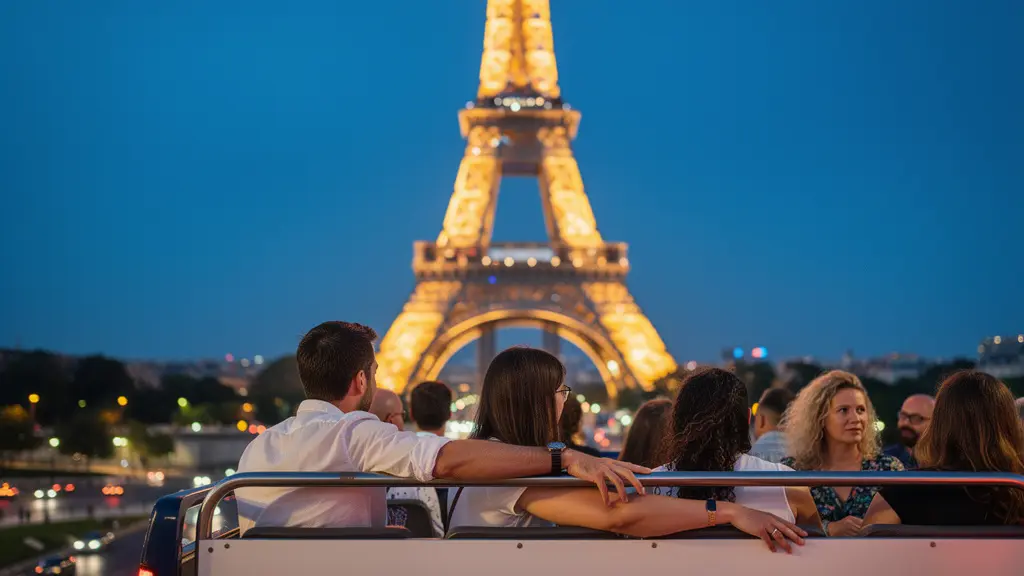
Nine landmarks. Two hours. One open-top bus weaving through the City of Light after dark. From my seat on the upper deck last autumn, I watched a first-time visitor from Texas grip the railing as the Eiffel Tower came into view, its iron lattice glowing gold against the night sky. She turned to her daughter and said: “This is why we came.” That moment—multiplied across Place de la Concorde, the Louvre pyramid, and a detour past Moulin Rouge—is exactly what draws visitors to the Paris night bus experience.
9 Landmarks in 2 Hours: What You Will See
- Eiffel Tower (Trocadéro viewpoint, hourly sparkle)
- Arc de Triomphe (floodlit from Champs-Élysées approach)
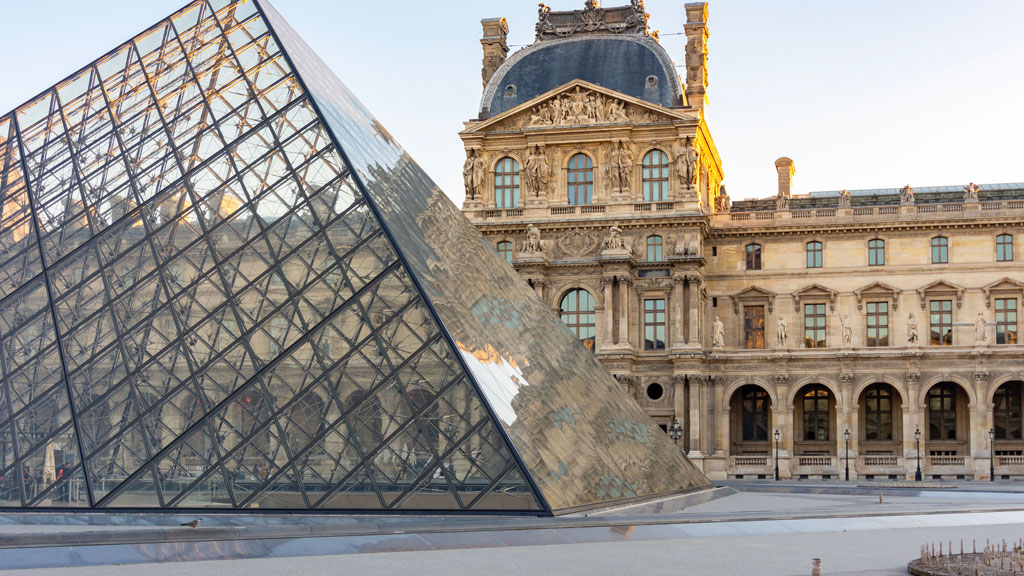
- Louvre Museum (glass pyramid illumination)
- Opéra Garnier (gilded Beaux-Arts façade)
- Place de la Concorde (obelisk and fountains)
- Place Vendôme (jewellers’ square by night)
- Les Invalides (Napoleon’s golden dome)
- Champs-Élysées (tree-lined avenue lighting)
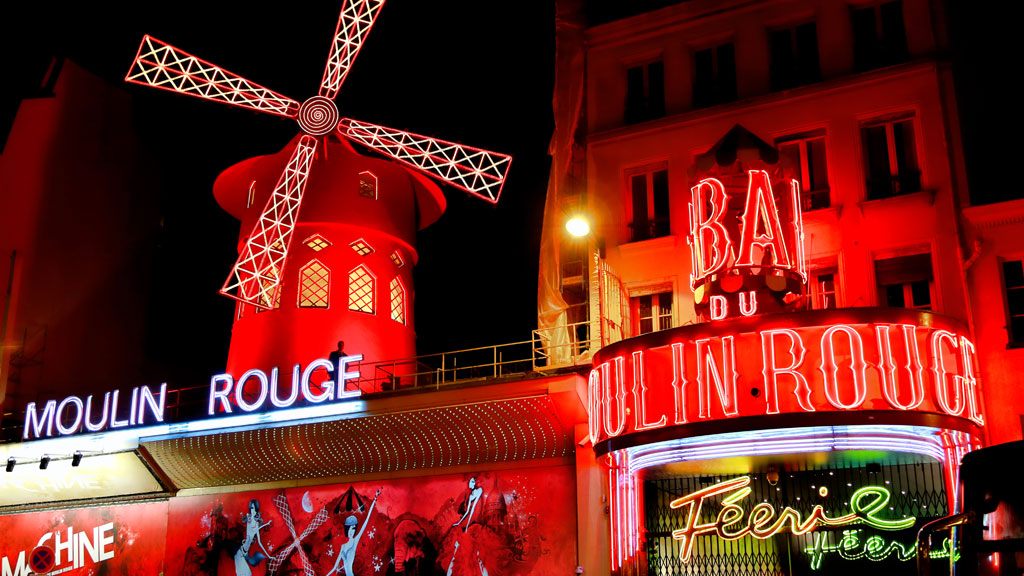
- Moulin Rouge (iconic red windmill in Pigalle)
What You Will Discover
The Complete Route: 9 Illuminated Landmarks You Will See
The route begins at Place du Carrousel, right beside the Louvre. Within minutes, the bus swings past Opéra Garnier—and here is where first-time visitors often miss something spectacular. The golden roof catches the floodlights in a way that photographs beautifully, but only if you are looking up. I have seen entire groups miss it because they were still fiddling with their phones.
From Opéra, the bus threads through Place Vendôme. The octagonal square is quieter than the Champs-Élysées, but the luxury jewellers’ windows create this soft, amber glow that feels distinctly Parisian. Honestly? It is one of my favourite stretches, even though guidebooks rarely mention it.
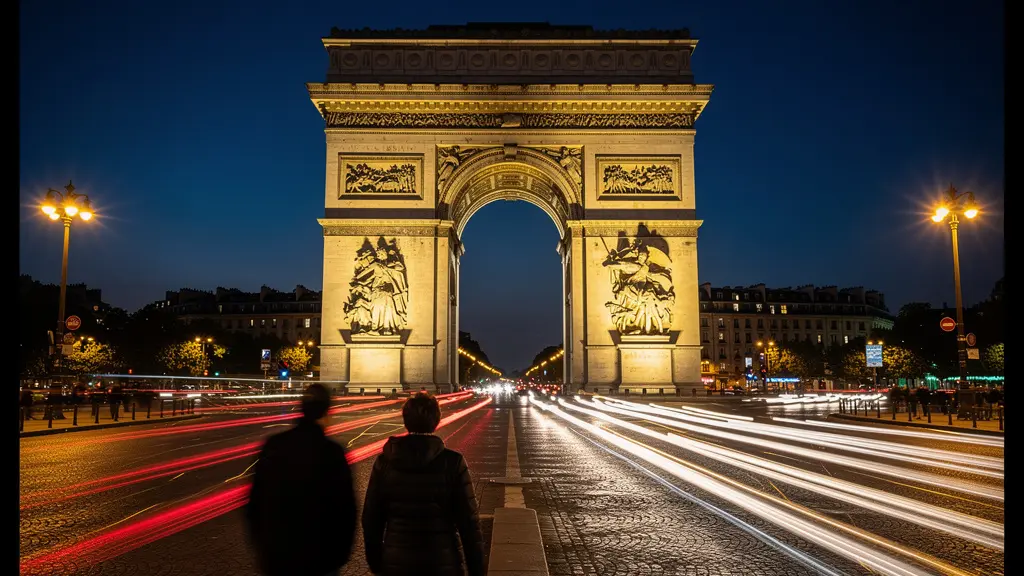
The Champs-Élysées approach builds anticipation. Tree-lined, glittering with over one million LEDs during the winter season according to City-Paris.fr‘s 2025 lighting schedule, the avenue leads your eye directly to the Arc de Triomphe. The bus loops around the monument—close enough to see the eternal flame flickering at its base.
Route coverage note: This list reflects the standard evening route. Minor variations may occur due to traffic or special events. The core nine landmarks remain consistent year-round.
After the Arc, the route drops south toward Trocadéro for the Eiffel Tower views, then curves past Les Invalides with its unmistakable golden dome—Napoleon’s final resting place, glowing against the night. The return leg hugs the Seine, passes Place de la Concorde with its ancient Egyptian obelisk and illuminated fountains, before a quick detour north to Moulin Rouge in Pigalle. That red windmill. Unmissable.
What Makes Each Landmark Unforgettable at Night
Having taken this tour multiple times across different seasons, what surprised me most was how night transforms landmarks I thought I knew. The Louvre by day is crowded, overwhelming, magnificent in an exhausting way. The Louvre at night? The glass pyramid glows like a lantern. The courtyard empties. You see the geometry.
I accompanied Sarah, a 34-year-old teacher from Boston, on her first Paris visit last summer. She had three days and legs tired from walking. She initially dismissed the night bus as “too touristy”—her words. By the time we rounded Trocadéro and the Eiffel Tower filled her camera frame, she had changed her mind entirely. She described the Arc de Triomphe photo she captured as her trip highlight.
The Eiffel Tower sparkle deserves special attention. According to the official Eiffel Tower illumination schedule, the tower sparkles for five minutes at the beginning of each hour after sunset—20,000 flashing bulbs against 336 golden projectors. Miss this by five minutes and you will wait another hour. First-time visitors often tell me their biggest regret was not checking the timing beforehand.
If you want deeper context for historical landmarks before your visit, a bit of background reading transforms what you see from pretty lights into meaningful history.
-
Departure from Place du Carrousel (Louvre area) -
Opéra Garnier and Place Vendôme -
Champs-Élysées approach and Arc de Triomphe loop -
Trocadéro and Eiffel Tower views -
Les Invalides golden dome -
Seine, Louvre return, Place de la Concorde -
Moulin Rouge detour and return to start
Booking a Paris Night Bus Tour locks in your seat for the full two-hour circuit. Arrive ten minutes early—upper deck seats fill quickly, especially in summer.
Timing Your Tour: Sunset Magic vs Full Darkness
I always recommend the later departure in summer. The sunset over the Seine as you approach the Eiffel Tower is worth waiting for. But here is the counterintuitive truth: earlier departures in winter offer something special too.
According to sunset times data for Paris, twilight lasts roughly 50 minutes in June but compresses to just 38 minutes in December. That winter twilight creates intense colour gradients—blues and oranges that photograph remarkably well from a moving bus.
| Factor | Sunset Departure | Full Darkness Departure |
|---|---|---|
| Photography | Colour gradients, softer light | Dramatic contrast, sparkle emphasis |
| Eiffel Sparkle | Catch one sparkle mid-tour | Guaranteed sparkle visibility |
| Temperature | Warmer, especially summer | Cooler, bring layers |
| Crowds | Busier at landmarks | Quieter streets |
| Best Season | Summer (long twilight) | Winter (crisp contrast) |
Timing tip: In summer, aim for a departure around 9:30pm to catch the 10pm and 11pm Eiffel sparkles during your route. In winter, earlier departures (around 6pm) let you see the Champs-Élysées Christmas illuminations at peak brightness before midnight.
Your Questions About the Paris Night Bus Experience
Your Night Tour Questions Answered
Is it really worth it if I have already seen these landmarks during the day?
Yes. Frankly, I would argue the night versions are superior. The Louvre without crowds, the Arc de Triomphe without traffic noise drowning your thoughts, the golden dome of Les Invalides glowing against black sky—these are different experiences entirely. The bus format means you cover ground that would exhaust you on foot, especially after a full day of sightseeing.
What happens if it rains?
Open-top buses operate rain or shine. The lower deck offers cover, though you sacrifice the panoramic views. In my experience, light rain actually enhances the photographs—wet streets reflect the monument lighting beautifully. Heavy downpours are another matter. Check the forecast and bring a waterproof layer regardless.
Can I take decent photos from a moving bus?
You can, with caveats. The bus slows significantly at key viewpoints—Trocadéro, Arc de Triomphe loop, Place de la Concorde. Use burst mode. Brace your elbows on the seat in front. Accept that some shots will blur. The best photos come at designated stops, not while the bus is in motion on the Champs-Élysées.
Is the audio guide worth using?
It depends on your priorities. The commentary adds historical context that makes the landmarks meaningful rather than just pretty. Kids’ channels are available in English and French for families. That said, some passengers prefer to simply watch and photograph without narration. Both approaches work.
What should I wear on the upper deck?
Layer up. Even in summer, the breeze on a moving open-top bus at 10pm can surprise you. In winter, treat it like an outdoor activity: hat, scarf, gloves. The moment that stays with me from December tours is always the same—visitors shivering by Les Invalides, wishing they had brought another layer.
The Next Step for Your Paris Evening
Before You Board: Quick Checklist
-
Check the Eiffel Tower sparkle schedule for your visit date
-
Choose departure time based on sunset (summer: later; winter: earlier)
-
Arrive at Place du Carrousel 10 minutes early for upper deck access
-
Pack an extra layer—the open deck gets breezy after dark
-
Charge your phone—you will want those photos
Nine landmarks, two hours, one bus. The route has not changed much over the years, but Paris at night never gets old. The question is not whether the tour covers enough ground—it does. The question is whether you will catch the Eiffel sparkle or miss it by three minutes because you were still finding your seat.