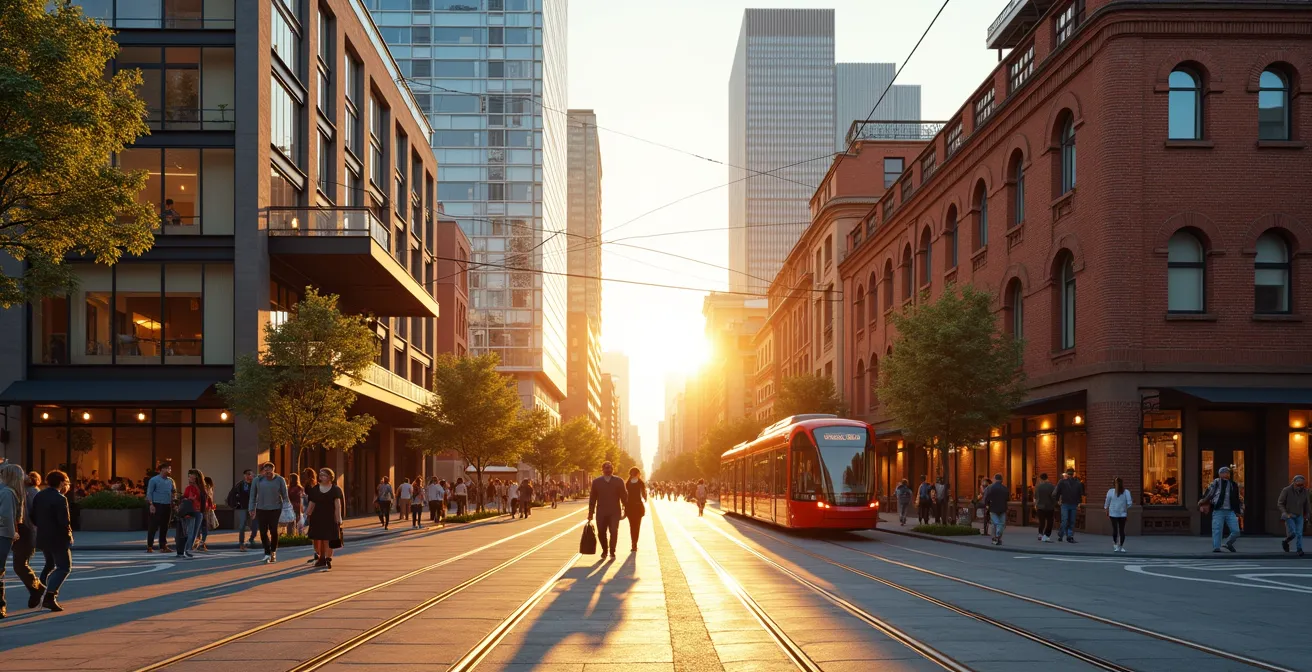
Contemporary urban tourism is not about visiting modern buildings; it’s about learning to read a city’s living, evolving systems.
- Authentic experiences are found in observing daily life systems, like public transit and local markets, not just landmarks.
- A city’s future is revealed more by its creative hubs and adaptive reuse projects than by its skyline.
Recommendation: Skip the capital’s main square and explore the second city’s innovation district to truly understand where the world is heading.
You’ve been there before. You land in a new city, armed with a list of “must-see” monuments and historical sites. You spend days ticking boxes, moving from one crowded landmark to the next, only to feel like you’ve merely scratched the surface, consuming a pre-packaged version of a place. Many guides will tell you to find “hidden gems” or visit trendy cafes, but this often leads to a different kind of checklist, one curated by algorithms rather than genuine discovery.
But what if the goal wasn’t to see the past, but to understand the future? Contemporary urban tourism is a paradigm shift. It’s an approach for the modern traveler who is more interested in the forces shaping tomorrow than the relics of yesterday. It moves beyond the simple binary of old versus new and reframes travel as an active investigation into a city’s living ecosystem. This isn’t about ignoring history; it’s about seeing it as one layer in a complex, dynamic urban landscape.
This guide offers a new blueprint for city travel. It’s for the curious observer who wants to decode the pulse of a metropolis. We’ll explore why second cities often offer a clearer vision of the future, how public transit can be your most insightful museum, and where to find the true heart of a city’s creative and culinary scenes. It’s time to stop being a tourist and start being an urbanist.
To navigate this new approach to urban exploration, this article is structured to guide you from foundational concepts to practical application. The following sections will provide a comprehensive look into how you can transform your city travels into deeply insightful experiences.
Table of Contents: A Guide to Reading the Modern City
- Why Visiting the Second Largest City Is Often Better Than the Capital?
- How to Use Public Transit to Feel the Real Pulse of a Modern City?
- Modern Architecture Tour or Historical Walk: Which Reveals the City’s Future?
- The Ethical Trap of “Ghetto Tourism” in Developing Urban Centers
- Where to Find the Tech and Creative Hubs in Any Major Metropolis?
- The Social Media Mistake That Ruins Authentic Travel Experiences
- Street Stalls or Fine Dining: Where Should You Spend Your Budget?
- How to Navigate a Vibrant Culinary Scene Without Falling for Tourist Traps?
Why Visiting the Second Largest City Is Often Better Than the Capital?
Capitals are often trapped in their own success, becoming living museums preserved for tourism. While they offer grandeur, the real laboratory for a country’s future is frequently its second city. These hubs, like Chicago, Lyon, or Manchester, are often the epicenters of industrial and now digital transformation. Unburdened by the weight of being a national symbol, they have the freedom to experiment, innovate, and redefine themselves. They are less about performing for visitors and more about building a functional, forward-thinking life for their residents.
Visiting a second city allows you to witness an urban ecosystem in a state of dynamic flux. You’ll find old industrial zones being reborn as creative districts, a more accessible and less saturated arts scene, and a cost of living that encourages grassroots innovation. These cities often have a “chip on their shoulder” that fuels a unique cultural energy and a strong sense of local identity. They have to work harder to attract talent and investment, which makes their strategies for growth more visible and interesting to observe.
For the contemporary urbanist, the appeal is clear: you get a more authentic and less filtered view of a nation’s direction. For example, Chicago’s tourism recovery in 2024 reached a 90% pre-pandemic rate, outpacing many global capitals by focusing on its unique architectural heritage and vibrant neighborhood life rather than just a single central landmark. This demonstrates a resilience and dynamism that is characteristic of the world’s most compelling second cities. They are not just places to visit; they are blueprints of the future to be read.
How to Use Public Transit to Feel the Real Pulse of a Modern City?
The most authentic museum in any major city is not a building, but its public transit system. It is the city’s circulatory system, a space where every demographic converges, revealing the true social and economic fabric of the metropolis. For the contemporary urban tourist, mastering the subway, bus, or tram network is not just about efficient travel; it is an act of immersion. It’s where you observe the daily rhythms, the unspoken social codes, and the incredible diversity that defines modern urban life. The journey itself becomes a destination.
To use transit as an observation tool, go beyond simply getting from A to B. Pay attention to the shifts in language, fashion, and advertising as you move from one neighborhood to another. Notice the patterns of commute—where do the workers in the financial district live? Where do students congregate? The transit map is a socio-economic diagram in motion. The scale of these systems is immense; for instance, the New York City subway system rebounded to 1 billion trips in 2024, a testament to its role as the backbone of the city.
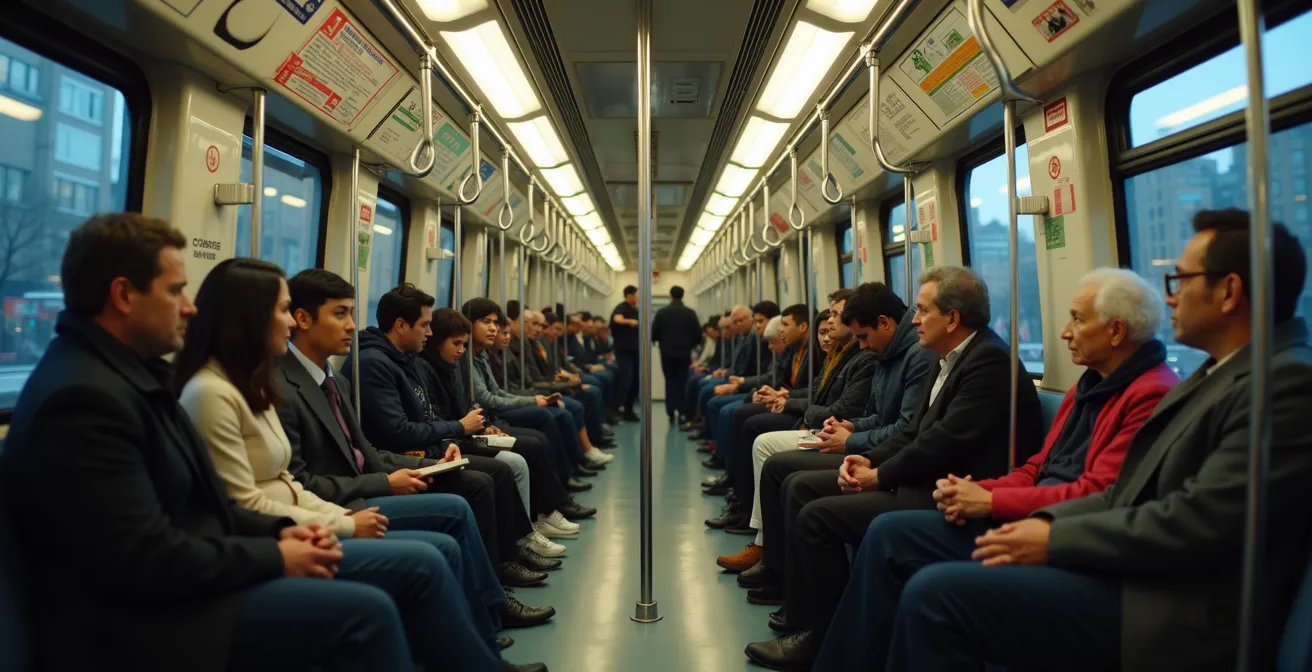
As this cross-section of urban life shows, a single subway car can tell you more about a city’s character than any guidebook. It’s a space of forced intimacy and shared experience, a real-time poll of the city’s mood. By choosing to ride with the locals, you are opting out of the curated tourist bubble and plugging directly into the city’s vibrant, chaotic, and authentic pulse.
Modern Architecture Tour or Historical Walk: Which Reveals the City’s Future?
The debate between modern architecture and historical preservation is a false choice. The most forward-thinking cities are not the ones that erase their past, nor those that are embalmed by it. They are the ones that foster a dynamic conversation between the two. For the contemporary urbanist, the most revealing architectural “tour” is one that looks for the seams—the points of connection, conflict, and innovative synthesis between old and new.
The future of urban architecture is not just about shiny new skyscrapers; it is about adaptive reuse. This practice, where old industrial buildings, warehouses, or even churches are repurposed into housing, offices, or cultural centers, is a powerful indicator of a city’s commitment to sustainable, creative growth. It shows a city that values its history enough to integrate it into its future, creating a rich, layered urban fabric. This is where the true character of a city is forged.
Case Study: Chicago Loop’s Adaptive Reuse Success
Chicago’s Loop district demonstrates how adaptive reuse drives urban renewal, with over $430 million in building permits during Q4 2024. The renovation of a 39,000-square-foot LEED Platinum office space within a historic building exemplifies the trend of companies reinvesting in heritage architecture while incorporating sustainable technology. This blend of preserved structures and modern infrastructure attracted 1.3 million cultural visitors in that quarter alone, proving that the future isn’t about replacing the old, but reimagining it.
Instead of choosing between a historical walk and a modern architecture tour, seek out the projects that do both. A city’s approach to these challenges reveals its long-term priorities and values. The following table illustrates different architectural strategies and what they signify about a city’s trajectory.
| Approach | What It Reveals | Example Cities | Future Impact |
|---|---|---|---|
| Adaptive Reuse | Balance of heritage & innovation | Madrid, Paris | Sustainable growth model |
| Infrastructure Projects | Long-term urban priorities | Tokyo, Singapore | Connectivity & resilience |
| Temporary Urbanism | Community-driven change | Bangkok, Istanbul | Flexible public spaces |
| Social Housing Design | Equity commitments | Amsterdam, Copenhagen | Inclusive development |
The Ethical Trap of “Ghetto Tourism” in Developing Urban Centers
The desire for “authentic” experiences can lead travelers down a morally ambiguous path. So-called “favela tours,” “slum tours,” or “ghetto tourism” promise a raw, unfiltered look at a city’s reality, but they often cross the line from observation into voyeurism. This practice, known as poverty tourism, can reduce complex communities and their struggles to a spectacle for consumption. It risks turning people’s homes and lives into a human zoo, where the visitor’s brief, uncomfortable thrill is prioritized over the residents’ dignity and privacy.
The core ethical problem lies in exploitation. Does the tour company have genuine roots in the community? Do the profits stay local, or are they extracted by outside operators? Are the “guides” residents sharing their own stories, or are they performing a script for tourists? True contemporary urbanism demands a level of engagement that is respectful, reciprocal, and empowering to local communities, not one that commodifies their poverty. The goal is to support local economies, not to simply observe hardship from the safe distance of a tour bus.
Instead of seeking out poverty as an attraction, the ethical traveler should look for genuine community-based initiatives. This means supporting businesses owned by locals, attending cultural events organized by the community, and engaging with people on their own terms. Before participating in any community-focused tour, it’s crucial to ask the hard questions.
Action Plan: Community-Based Tourism Verification Checklist
- Verify if tour guides are residents of the community being visited.
- Check if profits remain within the neighborhood through local ownership.
- Confirm educational content was developed with community input and consent.
- Ensure photography policies respect the privacy and dignity of residents.
- Look for established partnerships with local businesses, artisans, and social projects.
Where to Find the Tech and Creative Hubs in Any Major Metropolis?
The innovation that will define a city’s next decade isn’t happening in the tourist-clogged city center. It’s brewing in the repurposed warehouses, the university-adjacent neighborhoods, and the former industrial zones that are now buzzing with startups, artist studios, and co-working spaces. These tech and creative hubs are the real engines of a modern city’s economy and culture. Finding them is key to understanding where a city is headed, not just where it has been.
So how do you locate these often-unmarked zones of innovation? Forget the tourist map. Instead, follow the trail of capital, talent, and policy. Look for areas with a high concentration of independent coffee shops, art galleries, and venture capital offices. Search online for local tech meetups, creative conferences, or “digital nomad” forums. Often, the presence of a major university or a design school acts as an anchor, creating a surrounding ecosystem of talent and new ideas. These hubs are rarely designed for tourists; they are functional workplaces, which makes observing them all the more insightful.
Case Study: Bangkok’s Innovation Through Visa Policy
Policy is a powerful, often invisible, force in shaping these hubs. Bangkok, for instance, became a leader in Tourism Policy innovation by extending visa exemptions to 93 countries with 60-day stays. This strategic move directly fueled its emergence as a Southeast Asian tech hub. The flexible visa policy attracted thousands of digital nomads and tech entrepreneurs who set up temporary bases in former industrial districts, accelerating the transformation of these areas into vibrant innovation clusters. It’s a prime example of how looking at policy changes can help you predict where the next creative hotspot will emerge.
Finding these hubs is a form of urban archaeology focused on the future. It requires looking past the polished facade of the city and seeking out the spaces where things are being made, both digitally and physically. This is where you’ll find the city’s true creative energy and get a glimpse of its developing identity.
The Social Media Mistake That Ruins Authentic Travel Experiences
In the age of the algorithm, the greatest threat to an authentic travel experience isn’t the tourist trap—it’s your own phone. Social media has created a powerful pressure to perform our travels for an online audience. We hunt for the perfect “Instagrammable” spot, frame our experiences through the lens of a future post, and spend more time curating the moment than actually living it. The data is clear: platforms like YouTube actively influence travel decisions for 59% of travelers under 35, creating a feedback loop of replicated experiences.
This creates a subtle but profound shift in mindset. We move from being a participant in the life of a city to being a director of our own travel movie. The focus is no longer on genuine connection or discovery, but on creating a flawless, shareable narrative. This performance of authenticity is, ironically, the most inauthentic thing a traveler can do. It places a digital filter between you and the real, messy, and unpredictable beauty of the world.
As one researcher astutely points out, the problem lies in our priorities. Michael W. Lever, writing in the International Journal of Tourism Cities, notes:
The issue isn’t posting, it’s prioritizing the performance of authenticity for an online audience over genuine participation in the moment.
– Michael W. Lever, International Journal of Tourism Cities
The solution is not a complete digital detox, but a conscious shift in behavior. Use social media as a tool for research before you go, but be radically present when you are there. Put the phone away in the cafe. Talk to the person next to you at the bar. Get lost without consulting a map. The most memorable moments of travel are rarely the ones that are perfectly framed for a screen; they are the unplanned, imperfect, and unshareable ones.
Key Takeaways
- Contemporary urban tourism is about decoding a city’s future by observing its living systems, not just its historical monuments.
- The most authentic experiences are often found in “second cities” and by using public transit as a tool for cultural immersion.
- Ethical travel means avoiding poverty tourism and actively supporting community-owned businesses and initiatives.
Street Stalls or Fine Dining: Where Should You Spend Your Budget?
The culinary landscape of a city offers one of the most direct routes into its culture, but it presents a constant dilemma for the traveler: should you spend your budget on cheap, authentic street food or on a high-end, chef-driven dining experience? The contemporary urbanist knows the answer is not one or the other, but a strategic allocation of both. Each offers a different, but equally valuable, window into the city’s soul.
Street food and local markets are the domain of everyday life. This is the food of the people, honed over generations, offering an unpretentious and direct taste of local flavors and traditions. It’s fast, affordable, and deeply connected to the rhythm of the street. A morning spent at a local market or a lunch eaten at a bustling street stall provides high-yield cultural immersion for a low financial investment. It’s where you see what locals eat on their way to work, how they shop for their families, and the ingredients that form the foundation of the entire culinary scene.
On the other hand, a city’s fine dining and chef’s counter restaurants represent its culinary ambitions. This is where innovation happens. Chefs reinterpret traditional dishes, experiment with new techniques, and express a creative vision for the future of the local cuisine. A special meal at one of these establishments is less about daily life and more about experiencing the pinnacle of artistic and technical skill. It provides a different kind of insight—a look into the creative economy, agricultural supply chains, and the city’s place in the global conversation on food.
The key is to balance your budget and your time to experience both ends of the spectrum. Use the following matrix to guide your decisions based on what you’re seeking from each meal.
| Dining Type | Best For | Average Cost | Cultural Immersion | Time Investment |
|---|---|---|---|---|
| Street Food | Lunch/Quick Bites | $5-15 | High (local flavors) | 15-30 min |
| Local Markets | Breakfast/Snacks | $10-25 | Very High | 1-2 hours |
| Chef’s Counter | Special Experience | $75-150 | Medium-High | 2-3 hours |
| Fine Dining | Evening Events | $100-300 | Variable | 2-4 hours |
How to Navigate a Vibrant Culinary Scene Without Falling for Tourist Traps?
Navigating a city’s food scene is the final test for the contemporary urbanist. This is where all the principles of observation and critical thinking come into play, because for every authentic, delicious meal, there are a dozen tourist traps lying in wait. These establishments are masters of illusion, often located in prime real estate and designed to look the part, but they lack the one essential ingredient: a connection to local life.
The most powerful strategy for avoiding these traps is the “One Block Over” principle. Tourist-facing restaurants cluster on main squares and high-traffic streets. By simply walking one or two blocks away from these epicenters, you dramatically increase your chances of finding places that cater to a local clientele. The food will be better, the prices fairer, and the atmosphere more genuine. This isn’t just a theory; it’s a data-backed reality of urban life.
Case Study: The “One Block Over” Success in NYC Tourism
New York City’s tourism industry, which supports 380,000 jobs, demonstrates this principle perfectly. A 2024 analysis showed that restaurants just one block away from major hubs like Times Square had prices that were 40% lower and served a significantly higher percentage of local patrons. The study also found that tourists who ventured into these adjacent neighborhoods reported 73% higher satisfaction with their authentic experiences. It’s a clear lesson: the best experiences are often just around the corner, hidden in plain sight.
Beyond geography, you can learn to read the subtle signals of a tourist trap. Is the menu laminated and translated into five languages? Are there aggressive promoters outside trying to lure you in? These are red flags. Instead, look for places with handwritten daily specials, menus that reflect the local language, and a bustling lunch crowd of office workers on a weekday. Observe how the staff interact with each other; if they are speaking the local language amongst themselves, it’s a very good sign. Trust your senses and your observation skills over any glossy advertisement.