In summary:
- Most travelers visit historical sites but fail to understand them, leading to a feeling of unfulfillment.
- The key isn’t just to “do research,” but to build a “narrative scaffold” before you go, focusing on core historical turning points.
- Actively manage “cognitive fatigue” by limiting visits to one major site per day and using strategic breaks to reset your brain.
- Learn to read architecture and artifacts as a text, asking “why” they exist, to unlock the stories of past civilizations.
- The goal is to move beyond collecting facts and start building a mental model of the past, turning travel into true learning.
You stand before the Roman Forum, a sprawling landscape of fractured columns and weathered stone. You know it’s important. You snap a photo, read a plaque about the Senate House, and move on, a vague sense of duty fulfilled. Yet, as you walk away, a familiar disappointment settles in: you’ve *seen* it, but you haven’t truly *understood* it. The stones remain silent, their stories locked away. This experience is the common plight of the culture-focused traveler, an intellectual tourism that often ends in a checklist of famous names and places without the deep connection sought.
The conventional advice is to “read a guidebook” or “hire a tour guide.” While useful, these are merely tools, not a strategy. They often lead to a passive reception of facts, a temporary flood of information that evaporates as quickly as it came. The real challenge isn’t a lack of information, but a lack of a framework for processing it. We treat a visit to a profound historical site like a trip to the supermarket, grabbing items off a list, rather than like a conversation with the past.
But what if the key was not to accumulate more facts, but to adopt a different cognitive approach? This guide proposes a new perspective: viewing a historical landmark not as a static monument, but as a complex text waiting to be deconstructed. It’s about shifting from a passive observer to an active investigator. To do this, you need a mental toolkit—a way to build a narrative foundation before you arrive, manage your cognitive energy on-site, and ask the right questions to make the stones speak.
This article will provide that framework. We will explore why pre-visit context is non-negotiable, how to use modern tools without feeling isolated, and when to choose a human guide over a book. We’ll delve into the science of museum fatigue and provide strategies to combat it, ensuring that what you learn actually sticks. Finally, we’ll offer a method for learning to read the language of architecture itself, transforming your travels into a profound and lasting educational journey.
Summary: How to Turn a Landmark Visit into a Learning Experience
- Why Visiting Rome Without Reading History Is a Waste of Time?
- How to Use Audio Guides Without Feeling Isolated From Your Group?
- Human Guide or Guidebook: Which Is Best for Complex Historical Sites?
- The Fatigue Error: Why Visiting 3 Museums in One Day Destroys Retention?
- When to Visit Major Landmarks to Have the Place to Yourself?
- Audio Guide or Professor-Led Tour: Which Is Best for Deep Learning?
- Why Hop-On Hop-Off Buses Are the Best Hack for Dispersed Ruins?
- How to Learn About Past Civilizations Through Travel Instead of Books?
Why Visiting Rome Without Reading History Is a Waste of Time?
Arriving in Rome without a basic grasp of its history is like opening a 1,000-page novel at a random chapter. You’ll see words, but you won’t understand the plot, the characters, or the stakes. The ruins of the Forum aren’t just a pile of rocks; they are the physical evidence of seismic shifts in politics, religion, and society. Without context, the Arch of Titus is just a pretty arch. With context, it’s a triumphal monument to a brutal military campaign that reshaped the Western world. This context is what I call narrative scaffolding—a foundational mental structure upon which you can hang the details you discover on-site.
Building this scaffold doesn’t require a Ph.D. in classics. It requires a targeted, “minimum viable knowledge” approach. Instead of trying to memorize a list of emperors, focus on the major turning points. For Rome, understanding the dramatic transition from Republic to Empire explains the power dynamics that built the city. Learning about the Great Fire of 64 AD reveals the logic behind its reconstruction and the use of architecture as propaganda. Knowing why Constantine’s conversion mattered helps you decode the blend of pagan and Christian symbolism everywhere.
This pre-visit preparation transforms your experience from passive sightseeing to active discovery. You start to see the “why” behind the “what.” The sheer scale of the ruins becomes more meaningful when you realize that the Colosseum alone could accommodate 50,000-80,000 people, a testament to the empire’s engineering prowess and its need to manage a massive populace. You also begin to understand the concept of “Architectural Survivor Bias”—that the grand marble structures you see represent only a tiny, privileged fraction of the ancient city, while the wooden tenements of the poor have long vanished.
How to Use Audio Guides Without Feeling Isolated From Your Group?
The audio guide is a double-edged sword. It offers a wealth of expert information, delivered directly to your ears, but it often achieves this by cocooning you in a bubble of sound, effectively isolating you from your travel companions and the living atmosphere of the site. The classic image is a family or group of friends standing side-by-side, each lost in their own narrated world, not sharing the experience at all. However, with a few strategic adjustments, the audio guide can be transformed from an instrument of isolation into a tool for shared discovery.
The goal is to synchronize the experience. Instead of a free-for-all, try the “Sync & Share” method: have everyone in the group press play on the same track at the same time. Listen for a set period, perhaps 5 to 10 minutes, and then pause to discuss what you’ve heard. This simple trick punctuates the passive listening with active engagement. Another effective strategy is the “Designated Reporter Hack,” where you divide the site’s sections among group members. Each person becomes the “expert” for their assigned area, using the audio guide to gather information and then presenting their findings to the others. This fosters collaboration and turns listening into teaching.
Case Study: The Rick Steves Effect at Ephesus
A prime example of a group-friendly audio experience can be found at the ancient site of Ephesus in Turkey. Many visitors report that the freely available Rick Steves podcast guide creates a more engaging group dynamic than the official, paid audio guides on-site. The reason lies in its conversational, story-driven style. It’s designed more like a shared radio program than a dry lecture, with natural pauses and prompts for observation that encourage groups to stop, look, and discuss what they’re seeing together. This transforms the act of listening from a solitary activity into a collective journey of discovery.
Ultimately, the most effective use of an audio guide in a group setting involves a conscious effort to integrate it into a shared experience. Set checkpoints every 30 minutes to reconvene and share “aha!” moments. This ensures that technology serves the group’s connection to the site, rather than severing it.
Human Guide or Guidebook: Which Is Best for Complex Historical Sites?
Once you’ve decided to seek external knowledge, you face a classic dilemma: the rich, interactive experience of a human guide versus the self-paced, detailed repository of a guidebook. Neither is inherently superior; their value is entirely dependent on the context of the site, your prior knowledge, and your learning style. A human guide excels at weaving a narrative, answering spontaneous questions, and pointing out subtle details you would otherwise miss. They can read a group’s energy and adapt their delivery, making them ideal for complex, scattered sites like Pompeii or the Egyptian Valley of the Kings, where a book cannot easily direct your attention across a vast landscape.
This is where a professional guide can truly shine, using their expertise to bring the story to life.
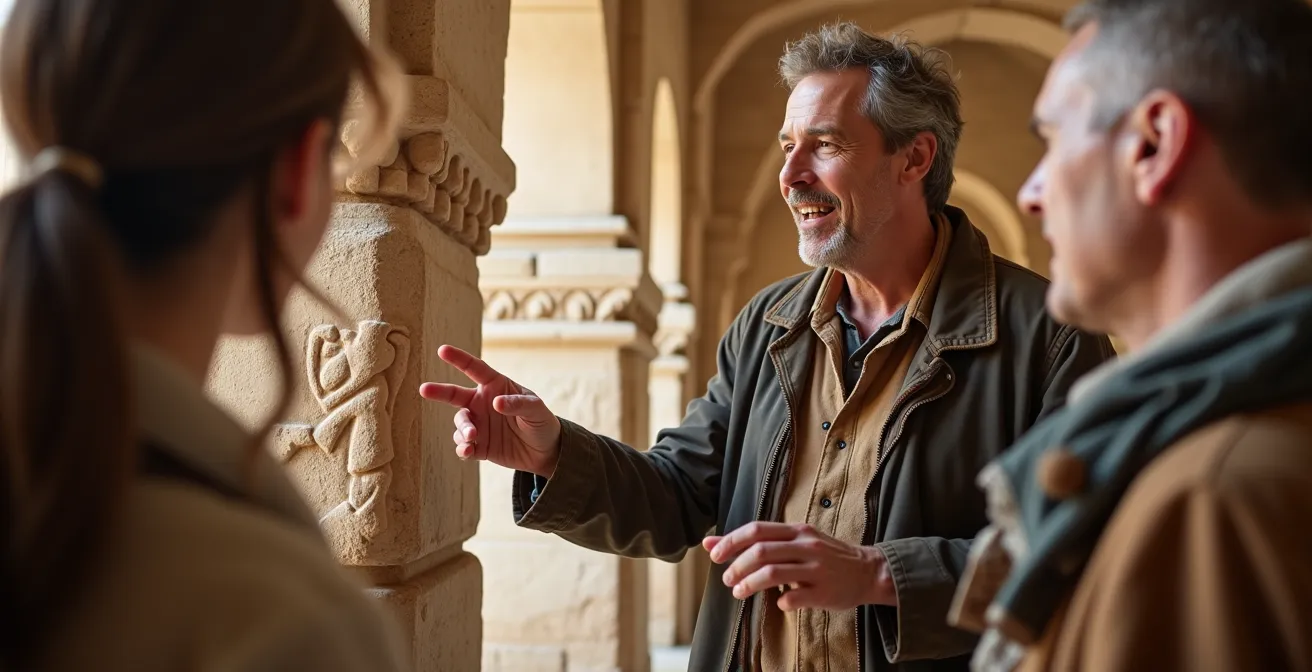
As this image suggests, a great guide doesn’t just recite facts; they use gestures, tone, and interaction to connect you emotionally and intellectually to the place. They are storytellers who can tailor the narrative to your specific interests, a feat no static text can accomplish. Conversely, a guidebook is the perfect tool for the knowledgeable traveler who wants to dive deep at their own pace. For a more contained, single-period site like the Pantheon or a well-curated museum, a good book allows you to spend as much time as you want with a particular artifact or architectural feature, free from the schedule of a tour.
The choice is a strategic one. To make the best decision, you must assess several factors. The following matrix can serve as a practical decision-making tool.
| Factor | Human Guide Best | Guidebook Best |
|---|---|---|
| Site Complexity | Scattered ruins, multiple periods | Intact, single-period structures |
| Prior Knowledge | Limited background | Strong foundational knowledge |
| Learning Style | Auditory, interactive | Visual, self-paced |
| Time Available | 2-3 hours maximum | Full day exploration |
| Budget | $30-50 per person acceptable | Under $20 preferred |
The Fatigue Error: Why Visiting 3 Museums in One Day Destroys Retention?
There is a pervasive travel myth that the more you see, the more you’ve accomplished. This leads to the infamous “three museums in a day” marathon—a grueling march through the Louvre, Musée d’Orsay, and Centre Pompidou before dinner. While it may look good on an itinerary, this approach is the enemy of genuine understanding. The culprit is a well-documented phenomenon known as “museum fatigue” or, more broadly, cognitive fatigue. Our brains are not passive sponges; they are active processors with a finite amount of energy for focused attention and memory encoding.
Research into this area is clear and consistent. Scientific studies show retention is highest during the first 60-90 minutes of a museum visit. After that, our ability to absorb new information, appreciate nuance, and form lasting memories plummets. We switch from deep engagement to “scan mode,” our eyes glazing over masterpieces as our brain focuses on finding the nearest exit or café. Pushing past this point is not just inefficient; it’s counterproductive. It dilutes the memory of the truly impactful things you saw at the beginning and replaces it with a hazy feeling of exhaustion.
The solution is to treat museum visits like high-intensity workouts: short, focused, and with planned recovery. The “one major site per day” rule is not a sign of laziness; it is a sign of a serious learner. To make the most of that one visit, and to enable a potential second, shorter visit later in the day, you must employ “cognitive palate cleansers.” These are activities that engage different parts of your brain, allowing your visual and analytical processors to rest and reset.
Action Plan: Your Cognitive Palate Cleanser Checklist
- Engage with Nature: Take a 20-minute walk in a nearby park. Focusing on natural, non-curated scenery helps reset your visual processing system.
- Shift Sensory Input: Listen to instrumental music for 15 minutes. This engages auditory regions of the brain, giving the visual and analytical parts a much-needed break.
- Embrace Tactile Activity: Spend some time doing a simple, physical activity like sketching a detail you remember or writing in a journal. This shifts the cognitive load from reception to creation.
- Practice Focused Observation: For each museum, adopt the “1 Masterpiece, 1 Story, 1 Detail” rule. Intentionally limit your focus to find one work that resonates, learn its story, and notice one tiny detail others might miss.
- Schedule Like a Pro: Treat your visit like a scheduled workout. Set a timer for a 90-minute maximum of high-intensity viewing, followed by a planned “recovery” period (your palate cleanser).
When to Visit Major Landmarks to Have the Place to Yourself?
The experience of a historical landmark is profoundly shaped by the environment in which you see it. Standing alone in the Pantheon as a beam of light illuminates the oculus is a quasi-religious experience. Shuffling through the same space elbow-to-elbow with a thousand other tourists, overwhelmed by the cacophony of chatter and camera clicks, is an exercise in frustration. While complete solitude is rarely possible at world-famous sites, strategic timing can dramatically alter the tourist-to-ruin ratio in your favor, transforming a crowded ordeal into an intimate encounter.
The most powerful strategy is the most obvious, yet least practiced: go at the extremes of the day. Arriving 30 minutes before the official opening time often places you at the front of the line, granting you a precious 15-20 minutes of relative calm before the main wave of tour buses descends. Similarly, entering in the last 1-2 hours before closing allows the crowds to thin out as people leave for dinner. The golden hour light of early morning or late afternoon also offers a photographic and atmospheric bonus that the harsh midday sun cannot match.
Beyond the time of day, consider the time of year and week. Visiting in the “shoulder season” (the months just before and after peak season, like April-May and September-October in Europe) offers a sweet spot of pleasant weather and fewer crowds. The day of the week also matters. Many major city museums offer late-night hours one day a week, which can be surprisingly tranquil. Conversely, be aware of free-entry days, which, while budget-friendly, guarantee the largest crowds. A small entrance fee is often a worthy price for a more serene and meaningful experience.
Audio Guide or Professor-Led Tour: Which Is Best for Deep Learning?
The choice between an audio guide and a live expert is not just about budget or convenience; it’s a fundamental decision about the *type* of learning you want to achieve. An audio guide is a master of structured, factual knowledge—the “what.” It delivers a perfected, linear narrative, ensuring you receive the essential information about a site’s history, construction, and key features. This makes it an outstanding tool for building a foundational understanding, especially on a first visit. It allows you to control the pace and manage your cognitive load effectively.
A professor-led tour, however, is designed for something else entirely: contextual understanding—the “why.” A true expert guide doesn’t just deliver a script. They facilitate a dynamic, adaptive discussion. They can pivot based on a question, draw unexpected connections between a carving on a column and a political event a century later, and challenge your assumptions through Socratic dialogue. This type of interaction is cognitively demanding but is the gateway to deep learning. It moves you from a passive recipient of facts to an active participant in an intellectual inquiry.
The following table breaks down this distinction, helping you align your choice with your learning objectives.
| Aspect | Audio Guide | Professor-Led Tour |
|---|---|---|
| Knowledge Type | Structured facts (the ‘what’) | Contextual understanding (the ‘why’) |
| Delivery Method | Linear, perfected narrative | Dynamic, adaptive discussion |
| Interaction Level | One-way information transfer | Socratic dialogue and Q&A |
| Best For | First visit foundation building | Second visit deep exploration |
| Cognitive Load | Self-paced, manageable | Intensive, challenging |
Case Study: The Layered Learning Approach at the Acropolis
The most effective learners often don’t choose one or the other; they use both in a strategic sequence. A common strategy reported by visitors to the Acropolis in Athens demonstrates this “layered learning” approach. On day one, a visitor might use an audio guide to absorb the layout and fundamental facts, such as the 5th-century BCE construction of the Parthenon. They build their factual foundation. Then, they return on day two for a tour with an archaeologist. This expert doesn’t just repeat the facts; they use them as a launchpad to discuss the complex realities of Athenian democracy or challenge common assumptions about architectural symbolism. This two-visit strategy uses each tool for its greatest strength, resulting in a much deeper and more durable understanding.
Why Hop-On Hop-Off Buses Are the Best Hack for Dispersed Ruins?
For the serious cultural traveler, the hop-on hop-off bus often carries a stigma. It’s seen as the tool of the superficial tourist, a bright red symbol of a rushed, check-list-driven itinerary. While this can be true, this perspective overlooks the unique strategic advantage these buses offer when dealing with a specific type of historical site: the large, geographically dispersed archaeological park. Sites like the Roman Forum and Palatine Hill in Rome, or the sprawling temple complexes of Angkor in Cambodia, are not single monuments; they are ancient cityscapes, covering vast areas.
Attempting to traverse these sites entirely on foot is a recipe for physical and cognitive exhaustion. You can easily spend more energy walking under the hot sun between points of interest than you do actually observing and learning about them. This is where the hop-on hop-off bus becomes a brilliant logistical hack. It functions as an external circulatory system for the site, conserving your most precious resources: time and mental energy. By using the bus to cover the long, often uninteresting distances between major clusters of ruins, you arrive at each key location fresh and ready to engage.
Think of it as a tactical transport system. You’re not there for the canned commentary; you’re there for the efficient movement. You can use your guidebook or a specialized audio guide to provide the intellectual content, while the bus provides the physical conveyance. This strategy allows you to piece together a coherent visit of a site that is otherwise too daunting to tackle in a single, focused session. It allows you to connect the dots between the Colosseum, the Forum, and the Capitoline Hill without sacrificing half a day and most of your energy to the journey between them.
Key Takeaways
- True understanding of historical sites comes from building a mental model, not just memorizing facts.
- Combat “museum fatigue” by limiting yourself to one major site per day and taking strategic “cognitive palate cleanser” breaks.
- Choose your learning tool (guide vs. guidebook vs. audio guide) based on the site’s complexity and your specific learning goals for that visit.
How to Learn About Past Civilizations Through Travel Instead of Books?
The ultimate goal of this entire approach is to reach a state of “architectural literacy.” This is the ability to walk into a space and read the building itself—its materials, scale, and design—for clues about the society that created it. Books provide the indispensable foundation, the narrative scaffolding, but the site itself offers a different, more visceral kind of text. It’s the difference between reading the sheet music and hearing the symphony performed in a grand hall. Learning to read this physical text is how you graduate from tourist to investigator.
This literacy begins with asking “why?” Why are the columns of the Parthenon Doric (simple, masculine) while those in a later Roman temple might be Corinthian (ornate, showy)? This reveals a shift from communal pragmatism to a display of imperial wealth. Why are the doorways in a Minoan palace so small, while the gates of a Roman city are monumental? This speaks to different conceptions of power, privacy, and public life. You can practice “Reverse-Engineering” from a single detail: start with a piece of pottery and repeatedly ask “why” it was made that way—its material, its decorations, its function—to unravel a web of trade routes, social customs, and technological capabilities.
Observing large-scale systems is equally revealing. The sophisticated water management of a Roman aqueduct, for instance, doesn’t just show engineering skill; it reveals a conquering mentality, a civilization confident in its ability to bend nature to its will. By comparing the soaring verticality of a Gothic cathedral, which pulls the eye towards the heavens and the afterlife, with the grounded, human-scale horizontal lines of a Greek temple, you learn more about their respective worldviews than any textbook could tell you alone. This is learning through osmosis, absorbing the values and priorities of a civilization through the spaces they inhabited.
Books give you dimensions; standing inside the Pantheon gives you a true sense of scale and awe.
– Archaeological interpretation principle, Headout Travel Guide
By adopting these frameworks, your next journey can be transformed. No longer a passive spectator, you become an active participant in a dialogue with history. Start applying this cognitive toolkit on your next trip and begin the rewarding process of truly understanding what you see.