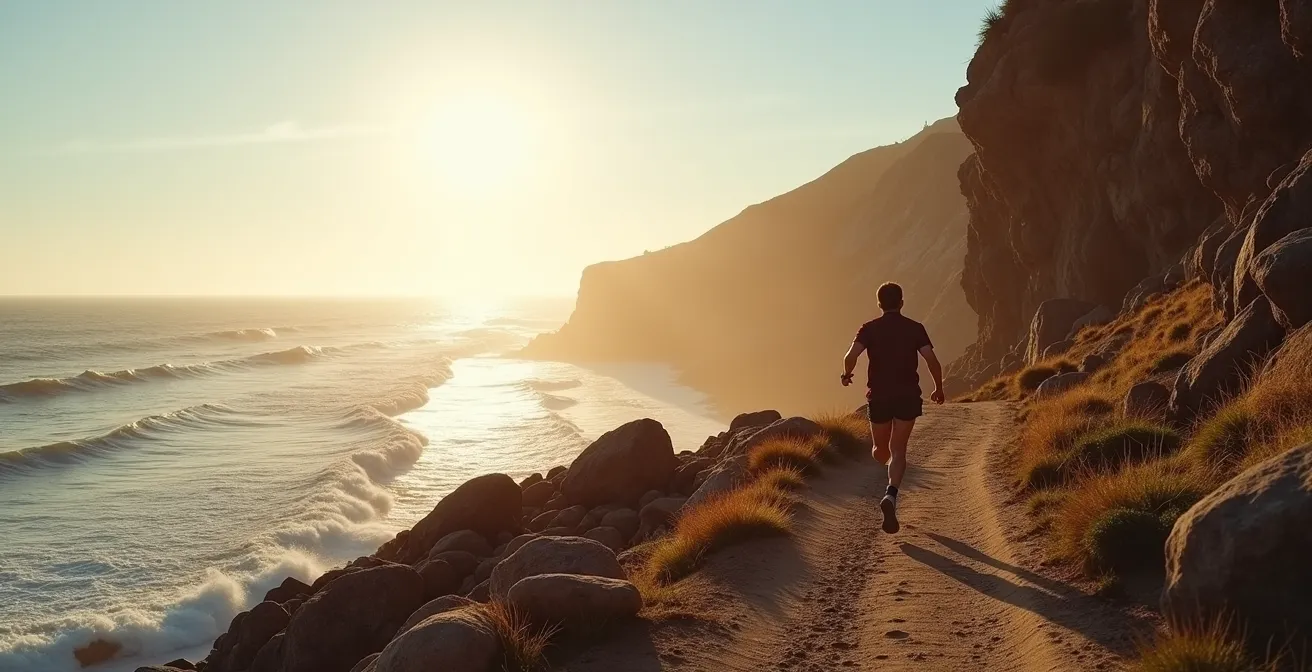
Most athletes see nature as a beautiful backdrop for their training. This is a mistake. True performance breakthroughs come not from the view, but from understanding how to use nature as an active training partner. This guide decodes the specific environmental triggers—sand, altitude, and even awe-inspiring sunsets—that force physiological and neurological adaptations, transforming any landscape into a precision tool for pushing your physical and mental boundaries.
For the driven athlete or active traveler, the allure of a dramatic landscape is powerful. We seek out towering peaks, vast deserts, and wild coastlines not just for the view, but for the challenge. Yet, we often treat these environments as mere scenery, a more inspiring version of the local park or gym. We run on the beach, hike a mountain, and feel invigorated, attributing it to “fresh air” or a change of pace. This perspective, while pleasant, misses the profound physiological mechanisms at play.
The common advice to “get outdoors” is a platitude. The real key to unlocking your potential lies in a more scientific approach. It’s about recognizing that every natural surface, every change in altitude, and every sensory input is an “environmental trigger.” These triggers are not passive; they actively demand a response from your body, forcing it to adapt in ways that static, predictable training environments never can. This is where true growth occurs—at the intersection of environmental demand and physiological adaptation.
This article moves beyond the generic benefits of outdoor exercise. We will deconstruct how specific natural settings challenge your body and brain. We’ll explore the biomechanics of running on shifting sands, the neurological impact of awe, and the cognitive discipline required to navigate a technical trail without succumbing to distraction. By the end, you will no longer see a landscape as a backdrop; you will see it as a sophisticated training apparatus, ready to be leveraged for your next breakthrough.
For those who prefer a condensed visual summary, this video outlines the core principles of using varied workouts to challenge your body, a concept that pairs perfectly with the environmental adaptations we explore below.
To guide you through this paradigm shift, this article is structured to decode the science behind training in nature’s most challenging classrooms. From the ocean’s edge to mountain summits, you will learn to see, and use, the world differently.
Contents: How to Leverage Natural Environments for Peak Performance
- Why Does Running by the Ocean Feel Easier Than Running in a City?
- How to Adjust Your Stride for Sand, Rock, and Snow?
- Altitude or Sea Level: Which Environment Maximizes Endurance Gains?
- The Scenery Distake: Why Looking at the View Causes Ankle Sprains?
- When to Train in Desert Settings to Avoid Heat Stroke?
- Why Watching a Sunset at 2,000m Changes Your Brain Chemistry?
- How to Get the ‘Edge Shot’ Without Actually Risking Your Life?
- How to Improve Teamwork Coordination Through Group Travel Challenges?
Why Does Running by the Ocean Feel Easier Than Running in a City?
The sensation of ease when running by the ocean is a fascinating paradox of sports psychology. It’s a conflict between perceived exertion and actual physiological output. Psychologically, several factors make the run *feel* easier. The rhythmic, repetitive sound of the waves can induce a meditative state, promoting a “flow” that distracts from physical discomfort. The vast, open horizon reduces feelings of claustrophobia common in urban environments, creating a sense of freedom and limitless potential. This powerful mental boost can lower your perceived effort, even when your body is working hard.
However, from a biomechanical standpoint, running on sand is significantly more demanding than on pavement. The unstable surface forces your body to recruit smaller, stabilizing muscles in your feet, ankles, and hips that are often dormant during city runs. This increased proprioceptive demand—the need for your brain to constantly sense and adjust your body’s position—is an intense workout. In fact, running in water, an extreme version of this, is known to be far more taxing than running on land.
The illusion of ease is therefore a testament to the power of the mind. While your muscles and cardiovascular system are being pushed harder, the positive sensory inputs of the coastal environment provide a powerful analgesic effect. You are getting a superior workout while your brain is convinced you’re on a rejuvenating jog. This disconnect is the first key to understanding how to leverage nature: the environment can manipulate your psychological state to help you push past physical barriers you thought were your limit.
How to Adjust Your Stride for Sand, Rock, and Snow?
Adapting to varied natural terrains is not intuitive; it’s a learned skill that requires conscious adjustments to your biomechanics. Treating a sandy beach like a paved road is a recipe for inefficiency and injury. Each surface presents a unique set of forces and demands a specific “environmental trigger” response. The key is to shift from a single, habitual running form to a dynamic, adaptive movement pattern that responds in real-time to the ground beneath you.
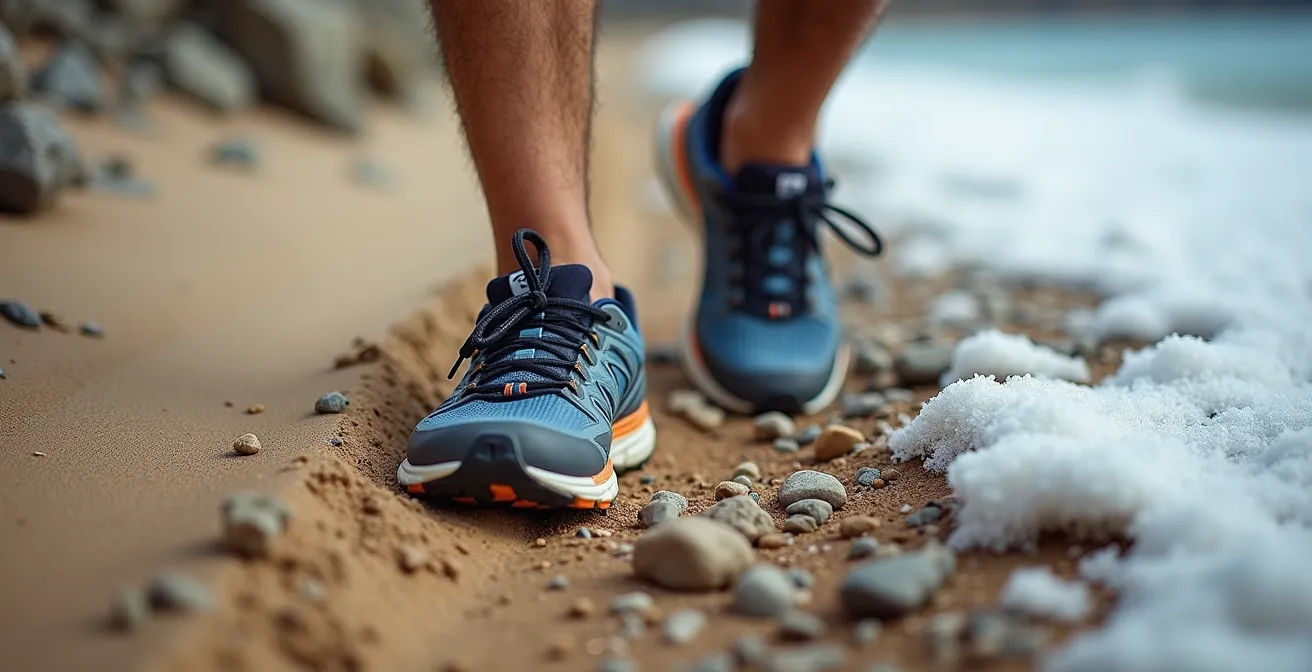
As the image above illustrates, the point of contact between your foot and the ground is where the entire kinetic chain begins. On soft surfaces like sand or snow, the ground dissipates energy. A long, bounding stride that works on pavement becomes counterproductive, as you’ll waste energy digging in rather than propelling forward. The solution is to shorten your stride and increase your cadence (foot turnover). This creates a more stable base and keeps your center of mass over your feet, minimizing wasted energy. On technical, rocky trails, the challenge is unevenness. Here, your focus must shift to a lighter, more precise foot placement and a highly engaged core to manage constant, unpredictable shifts in balance.
These adjustments are not just about efficiency; they are about building a more resilient and “intelligent” body. The constant micro-corrections demanded by these surfaces dramatically increase proprioceptive demand, essentially training your nervous system to be faster and more accurate. The following table breaks down the specific mechanical shifts required for each terrain, based on data from athletic performance studies.
| Terrain Type | Stride Length | Cadence | Energy Cost | Key Muscles Engaged |
|---|---|---|---|---|
| Soft Sand | 30% shorter | 10-15% higher | 1.5-2x normal | Calves, hip stabilizers |
| Rocky Trail | Variable | Adaptive | 1.3x normal | Ankle stabilizers, core |
| Deep Snow | 40% shorter | 20% higher | 2-3x normal | Quads, glutes, hip flexors |
Mastering these shifts transforms your run from a simple cardiovascular exercise into a full-body neuromuscular workout. You’re not just building endurance; you’re building a smarter, more adaptable athletic machine. A comparative analysis of running surfaces confirms these dramatic differences in energy cost and muscle engagement.
Altitude or Sea Level: Which Environment Maximizes Endurance Gains?
The classic debate between altitude and sea-level training often misses a crucial third option: a strategic combination of both. For decades, the “Live High, Train High” model was the standard for endurance athletes seeking to boost red blood cell production. However, the downside is significant: the lack of oxygen at altitude makes it impossible to train at the same intensity as at sea level, leading to detraining of the musculoskeletal system. This led to the development of a more nuanced approach: the “Live High, Train Low” (LHTL) protocol.
The LHTL model offers the best of both worlds. By sleeping at high altitude, the body is stimulated to produce more erythropoietin (EPO) and, subsequently, more red blood cells to improve oxygen-carrying capacity. By descending to sea level for high-intensity training sessions, athletes can push their muscles and cardiovascular system to their absolute max, a feat impossible in a low-oxygen environment. This combination creates systemic endurance through blood adaptation while building muscular power and speed.
A fascinating and potent evolution of the “Train Low” component involves aquatic training. Underwater running, for instance, provides an intense, low-impact resistance workout that perfectly complements the stress of land-based training. As coach Alberto Salazar, a pioneer in this field, noted, this method is not an alternative but a vital component of a complete program.
We don’t consider it an alternative to running outside. We consider it as important as running outside. It helps us become stronger by running against the resistance of the water and it helps us recover from our dry land training.
– Alberto Salazar, Coach of the Oregon Project
The case of Salazar’s Oregon Project athletes is a powerful example. They combined sleeping in altitude chambers with underwater treadmill training at sea level. This allowed them to maintain high training volumes and intensities with reduced injury risk, leading to significant VO2 max improvements. Research from Texas A&M University demonstrates that this type of training leads to significant increases in leg and upper body lean muscle mass, a benefit that pure land-based running struggles to match. The ultimate environment for endurance gains is therefore not a single location, but a dynamic system that leverages the best of both worlds.
The Scenery Distake: Why Looking at the View Causes Ankle Sprains?
One of the great ironies of training in spectacular settings is that the primary attraction—the breathtaking view—is also one of the greatest risks. This phenomenon, which we can call the “Scenery Distake,” is a leading cause of falls and ankle injuries among trail runners and hikers. It stems from a fundamental limitation of the human brain: the inability to effectively split focus between a complex motor task (navigating uneven terrain) and a captivating visual stimulus (the landscape). When your attention shifts to the horizon, your brain momentarily de-prioritizes the crucial task of scanning the ground immediately ahead for obstacles.
This is a battle of cognitive load management. Your brain has a finite amount of processing power. Navigating a technical trail requires constant, rapid-fire calculations: assessing root placements, rock angles, and surface stability. This is a high-load cognitive task. Appreciating a panoramic vista is also a high-load task, engaging parts of the brain associated with awe and spatial reasoning. Attempting to do both simultaneously overloads the system. The result is a critical delay in proprioceptive feedback. For a split second, you don’t notice the loose rock or the off-camber tree root, and by the time you do, it’s too late. The ankle rolls.
As one professional trail runner describes, learning to manage this distraction is a non-negotiable skill:
When I first started trail running, I was constantly distracted by beautiful views and ended up with multiple ankle injuries. Learning to compartmentalize my attention – scheduling specific ‘view breaks’ at safe spots – completely changed my injury rate. Now I stop at predetermined safe zones to fully appreciate the scenery rather than trying to multitask.
The solution is not to ignore the scenery, but to manage your attention with discipline. This involves consciously separating “running time” from “viewing time.” You must train your brain to remain locked on the immediate path while in motion, and only allow yourself to look up and around when you have intentionally stopped in a safe, stable location. This disciplined approach turns a major liability into a well-earned reward. To operationalize this, a systematic gaze method can be highly effective.
Your Action Plan: The Gaze Method for Trail Safety
- Count 10 steps while focusing your gaze on the trail 3-5 meters ahead.
- On the 10th step, allow yourself a brief, one-second glance at the horizon or scenery.
- Immediately return your focus to the trail in front of you for the next sequence of steps.
- Repeat this disciplined “scan-and-return” pattern throughout your run on non-technical sections.
- Practice this method on familiar, easy terrain before attempting it on highly technical or exposed trails, where 100% focus is required.
When to Train in Desert Settings to Avoid Heat Stroke?
Training in desert environments offers unique benefits for building resilience and mental toughness, but it also presents a lethal risk: exertional heat stroke. This is not simply a matter of feeling hot; it’s a medical emergency where the body’s core temperature rises uncontrollably, leading to organ failure. The key to safely harnessing the desert’s challenge lies in understanding the principle of adaptive stress and respecting the body’s acclimatization timeline.
The primary rule is to avoid the peak environmental load. This means training is strictly limited to the very early morning hours, before sunrise, or late in the evening, well after sunset. Midday training is not a question of toughness; it’s a gamble with your life. During these cooler periods, the ambient temperature is manageable, allowing you to focus on the physical effort without battling overwhelming solar radiation and extreme heat. Is it better to train in the morning or evening? Morning is often preferable as the ground has had all night to cool, whereas in the evening, surfaces like rock and asphalt can radiate heat long after the sun has set.
Proper heat acclimatization is a non-negotiable physiological process. It takes the body approximately 10 to 14 days of consistent, progressively increasing exposure to heat to make the necessary adaptations. These include a higher sweat rate, a lower salt concentration in sweat, and an increased plasma volume, all of which improve the body’s ability to cool itself. Attempting a high-intensity workout in the desert without this acclimatization period is exceptionally dangerous. Start with short, low-intensity sessions (e.g., 20-30 minutes of light jogging) and gradually increase duration and intensity over the two-week period.
Finally, hydration must be proactive, not reactive. In the desert’s dry air, sweat evaporates so quickly that you may not realize how much fluid you are losing. It’s crucial to pre-hydrate before your session and carry more water than you think you’ll need, supplemented with electrolyte tablets or powders to replace lost salts. Monitoring your heart rate is also a critical tool; a heart rate that remains unusually high during rest periods is a clear sign that your body is struggling to cope with the heat stress and it’s time to stop.
Why Watching a Sunset at 2,000m Changes Your Brain Chemistry?
The profound sense of peace and clarity felt while watching a sunset from a high-altitude peak is not mere poetic sentiment; it is a tangible neurochemical response to a specific set of environmental triggers. This experience, often described as “awe,” is a powerful psychological state that scientists are beginning to understand has measurable effects on our brains and perception. It’s the ultimate mental recovery tool, provided by nature itself.
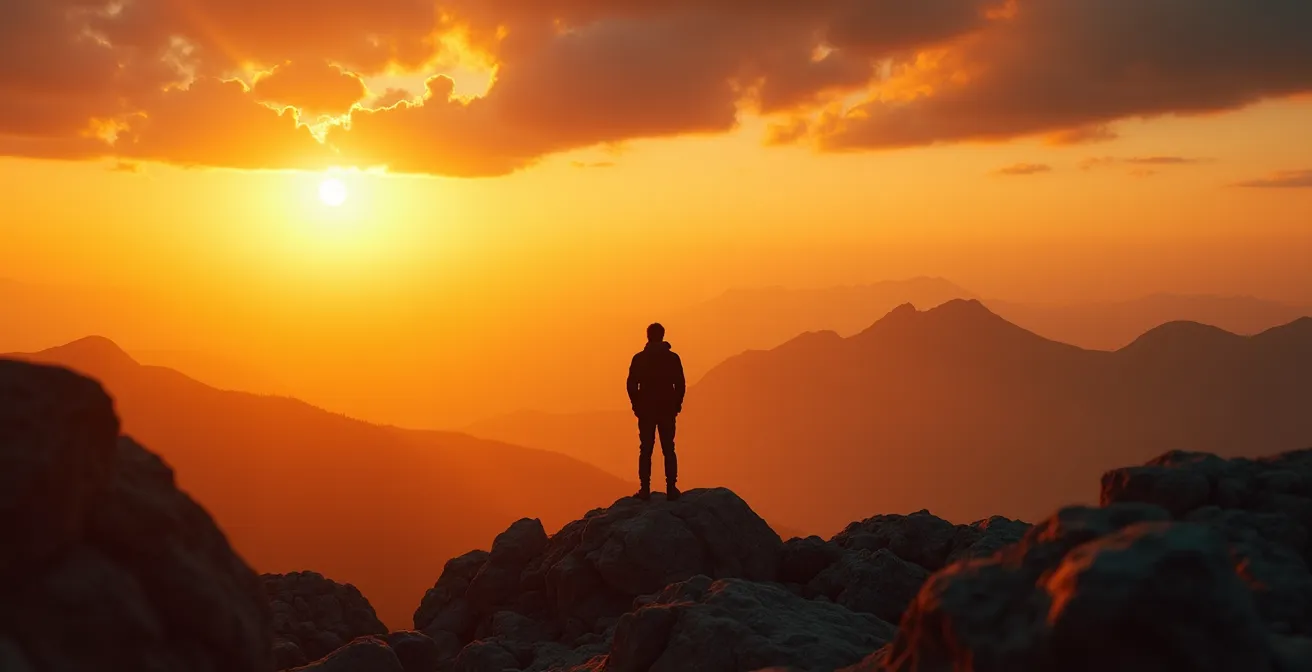
The experience of awe is typically triggered by encountering something vast and beyond our normal frame of reference—like a panoramic mountain view at 2,000 meters. This sense of “vastness” forces a cognitive shift. As your brain tries to process the immense scale of the landscape, your sense of self diminishes. This phenomenon, known as the “small self,” has been linked to a decrease in activity in the Default Mode Network (DMN), the part of the brain associated with self-referential thoughts and rumination. In essence, the grandeur of the sunset quiets the nagging, anxious inner monologue, creating mental space and clarity.
Simultaneously, this experience can trigger the release of neurotransmitters associated with well-being. The beauty of the colors and the quiet grandeur can boost dopamine and serotonin levels, inducing feelings of pleasure and calm. It also actively reduces stress by lowering cortisol. The result is a powerful cocktail of positive brain chemistry that promotes mental recovery, enhances creativity, and solidifies the positive emotions associated with the physical effort it took to get there. This reinforces the motivation to undertake such challenges again.
Interestingly, these awe-inspiring moments can even alter our perception of time. As psychological research on awe experiences indicates, participants often report feeling they have more time available after such an event. This “time expansion” effect can further reduce feelings of stress and pressure, contributing to a profound sense of well-being that lasts long after the sun has dipped below the horizon.
How to Get the ‘Edge Shot’ Without Actually Risking Your Life?
In the age of social media, the “edge shot”—a photo of someone perched precariously on a cliff edge or mountain ridge—has become a coveted trophy for the active traveler. These images are designed to evoke a sense of daring, freedom, and mastery over a dramatic landscape. However, the pursuit of this shot often leads to reckless behavior and tragic accidents. The secret of professional adventure photographers is that the most breathtaking edge shots are almost always an illusion, created through clever techniques that prioritize safety above all else.
The most common and effective technique is the use of forced perspective and lens compression. A photographer using a telephoto lens (e.g., 70-200mm) can stand a significant, safe distance away from their subject. This long focal length has a powerful effect: it compresses the background, making distant mountains or landscapes appear much closer and larger behind the subject. When the subject is positioned near an edge, this compression makes the drop-off look more immediate and dramatic than it truly is, creating a high-stakes visual without any actual high-stakes risk.
Case Study: The ‘Hidden Ledge’ Technique
Professional adventure photographers frequently use what is known as the ‘hidden ledge’ technique. This involves positioning the subject on a wide, perfectly safe ledge that is just below the camera’s line of sight. From the camera’s angle, the subject appears to be standing or sitting on a knife-edge precipice, while in reality, they have several feet of solid ground in front of them, completely out of the frame. This, combined with telephoto lens compression from a safe vantage point, creates the illusion of extreme exposure while the entire crew operates with full safety protocols, including anchor points and backup systems if necessary.
The choice of lens fundamentally alters the perception of risk in the final image. A wide-angle lens, used up close, will actually exaggerate distance and make the scene feel less dangerous. Conversely, a telephoto lens creates the heart-stopping compression that makes these shots so compelling. Understanding this technical aspect is crucial for both photographers and subjects. It allows for the creation of powerful imagery without anyone ever needing to put themselves in a genuinely hazardous position.
Key Takeaways
- Your body’s adaptation to unpredictable, natural surfaces (sand, rock) builds neuromuscular intelligence and resilience far more than static gym training.
- Mental breakthroughs are a real, neurochemical event. Experiences of awe, like a mountain sunset, measurably reduce stress and alter your perception of time.
- The most effective training leverages a system, not a single location. Combining high-altitude living with low-altitude, high-intensity training (like aquatic running) maximizes gains.
How to Improve Teamwork Coordination Through Group Travel Challenges?
Group travel challenges, from multi-day treks to adventure races, are often viewed as shared experiences. From a sports psychology perspective, they are much more: they are living laboratories for team dynamics. Placing a group in a demanding, unfamiliar natural environment strips away the veneers of office hierarchies and social norms, revealing the raw, instinctual patterns of communication, leadership, and trust. As MovNat founder Erwan Le Corre points out, modern life has distanced us from these fundamental behaviors.
We all have these instinctual movement patterns built into our primal memories. The problem is that in today’s world, we’ve moved beyond these instinctual patterns into specialized movements and skills.
– Erwan Le Corre, Founder of MovNat
Natural challenges force a return to these primal patterns. When a team has to navigate a difficult river crossing or a technical ridge, roles emerge organically. The person with the best spatial awareness might naturally take the lead in route-finding. The calmest member under pressure may become the group’s emotional anchor. These roles often have little to do with official titles back in the civilized world. This process reveals the team’s true strengths and weaknesses in a way no corporate team-building exercise ever could.
A powerful example of this principle in action is the training regimen of the Bondi Rescue Lifeguards.
Case Study: Team Dynamics Revealed by Underwater Rock Running
The elite Bondi Rescue Lifeguards in Australia use underwater rock running as a core team coordination exercise. In this incredibly demanding challenge, teams form a human chain to move a heavy rock (around 45 pounds) along the ocean floor. The lead person carries the rock while the others hold onto their shoulders, all while managing shared breath-holds. This exercise instantly reveals team dynamics that are invisible in other settings. Natural leaders who can communicate non-verbally emerge, communication patterns shift under extreme physical stress, and levels of trust become immediately apparent through the physical connection and reliance on one another for safety.
These challenges work because they create a state of shared vulnerability and interdependence. To succeed, team members must communicate clearly, trust each other implicitly, and subordinate individual ego to the group’s goal. The shared struggle and subsequent triumph forge a powerful bond, building a resilient, coordinated team that has been tested not by theory, but by a tangible, real-world challenge.
By learning to decode the demands of the environment, you transform every trip into an opportunity for growth. The next step is to consciously select your next destination not just for its beauty, but for the specific physical and mental challenge it presents. Evaluate the terrain, the altitude, and the elements, and build a journey designed to push your specific limits.