In summary:
- Most snorkeling frustrations stem from a misunderstanding of gear and physiology, not a lack of skill.
- Permanent mask fogging solutions involve removing manufacturing residue, a one-time process.
- Longer breath-holds are achieved by training your body to tolerate CO2, not just by holding your breath.
- Mastering buoyancy and environmental awareness is the true mark of a pro, protecting both you and the reef.
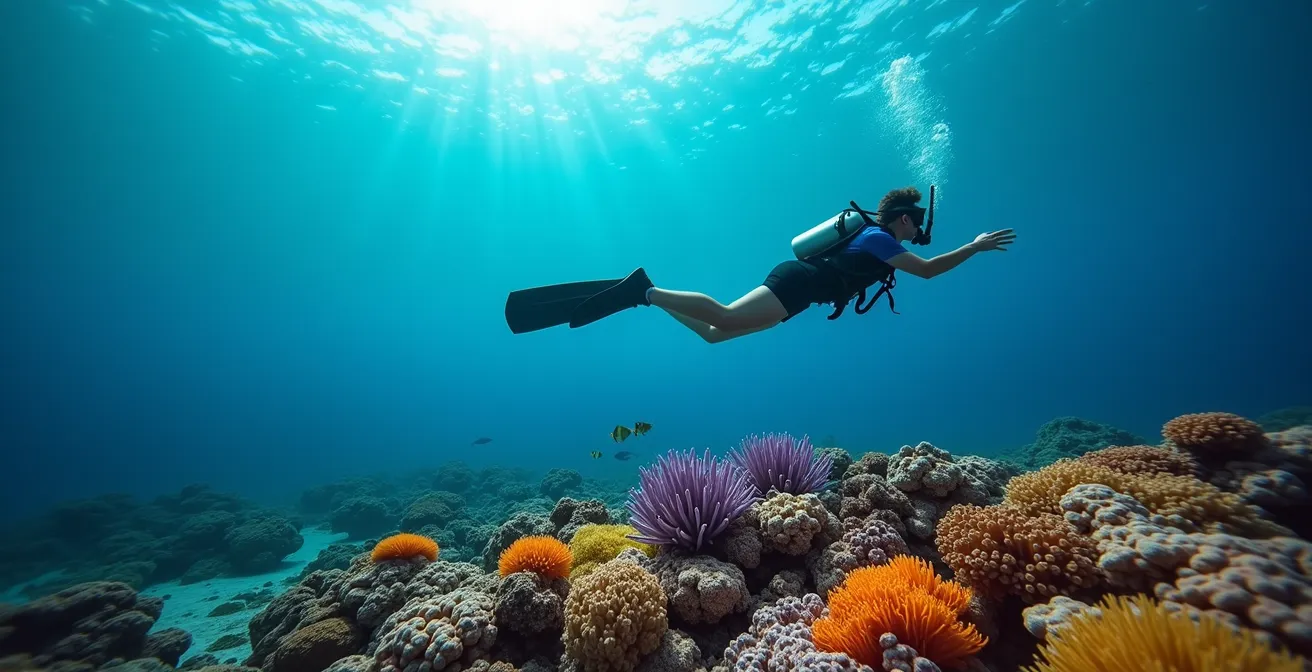
The image is idyllic: you, floating effortlessly over a vibrant coral reef, a silent observer in an alien world. The reality for many is a constant battle: a mask that fogs relentlessly, a snorkel that fills with water, and frustratingly short dives to catch a fleeting glimpse of a fish. You’ve likely heard the standard advice—spit in your mask, relax your breathing—but these are temporary fixes for deeper issues.
The transition from a casual to a proficient snorkeler isn’t about buying more expensive gear; it’s about understanding the principles behind it. It’s about learning the physics of why your mask fogs and the physiology of why you feel the urge to breathe. This isn’t just about comfort; it’s about safety, efficiency, and ultimately, a more profound connection with the marine environment.
This guide moves past the common platitudes. We will dissect the technical reasons for common failures and provide the systematic, pro-level solutions. You will learn not just *what* to do, but *why* it works, empowering you to solve problems independently and elevate your in-water experience. By understanding the science of your gear and your body, you can finally leave the frustrations at the surface.
This article provides a structured approach to mastering the key skills that separate amateurs from pros. Below is a summary of the techniques we will cover to transform your next snorkeling outing.
Summary: A Technical Guide to Pro-Level Snorkeling Skills
- Why Does Your Mask Fog Up and How to Fix It Permanently?
- How to Hold Your Breath Longer to Dive Down for a Closer Look?
- Full-Face Mask or Traditional Set: Which Is Safer for CO2 Build-up?
- The Drifting Error That Pushes Snorkelers Too Far From Shore
- When to Snorkel to Get the Best Visibility of the Day?
- How to Breathe Underwater Without a Heavy Tank on Your Back?
- How to Control Your Floatation to Avoid Kicking the Coral?
- How to Visit Coral Reefs Without Damaging What You Came to See?
Why Does Your Mask Fog Up and How to Fix It Permanently?
Mask fog is the single most common complaint among snorkelers, yet the reason is often misunderstood. It’s not just about your face being warm; it’s about physics and chemistry. Condensation occurs when warm, moist air from your breath and face hits the cooler surface of the mask lens. However, the primary culprit, especially with new masks, is a layer of silicone residue left over from the manufacturing process. This film provides a perfect surface for microscopic water droplets to cling to, creating the dreaded fog. According to diving equipment specialists, it’s believed that virtually 100% of new masks will fog without proper pre-treatment because of this residue.
The permanent fix, therefore, is to remove this layer. This is a one-time procedure. The most effective method is to use a non-gel, white toothpaste. Apply a small amount to the inside of the dry lens and scrub it firmly with your finger for several minutes. Rinse thoroughly. This abrasive action physically removes the silicone film. For tempered glass lenses (check with the manufacturer), a quick pass of a lighter flame across the inside of the lens will also burn off the residue, though this requires caution.
Once pre-treated, your daily anti-fog routine becomes much more effective. Commercially available defogging solutions work best, but the old trick of using baby shampoo or even saliva works on the same principle: they create a surfactant layer. This ultra-thin film prevents the water vapor from forming tiny, vision-obscuring droplets, instead causing it to sheet off in a transparent layer. Apply a small amount to a dry lens, rub it in, and give it a very light rinse just before entering the water.
How to Hold Your Breath Longer to Dive Down for a Closer Look?
The desire to dive down for a closer look is a natural progression. The limiting factor is breath-hold, and improving it is a matter of physiology, not just willpower. The common misconception is that the urge to breathe comes from a lack of oxygen. In reality, it’s driven by the buildup of carbon dioxide (CO2) in your blood. As the PADI Freediver Training Program materials explain, it is this CO2 buildup that triggers the diaphragm to contract, creating that powerful, often uncomfortable, urge to breathe.
The build-up of carbon dioxide in the body gives us the urge to breathe – not a lack of oxygen.
– PADI Freediver Training Program, PADI Freediving Course Materials
Therefore, to extend your breath-hold, you must train your body in two ways: to be more efficient with oxygen and to become more tolerant of CO2. The first step is proper breathing preparation. Before a dive, avoid hyperventilating (taking rapid, deep breaths). This purges CO2 but doesn’t significantly increase oxygen, tricking your body into a delayed breath response, which can be dangerous. Instead, practice slow, deep “diaphragmatic” or “belly” breaths. Inhale slowly for 5 seconds, focusing on expanding your abdomen, then exhale for 10 seconds. This calms your heart rate, reduces oxygen consumption, and prepares you mentally.
With practice, your body’s chemoreceptors become less sensitive to CO2, pushing the urge to breathe further away. While beginners may struggle to reach 30 seconds, it’s useful to know what trained professionals can do. For instance, PADI certification standards show that master freedivers can comfortably achieve a static breath-hold of 3 minutes and 30 seconds. This demonstrates the immense potential of dedicated training in breath-hold techniques, all centered on managing CO2.
Full-Face Mask or Traditional Set: Which Is Safer for CO2 Build-up?
The rise of the full-face snorkel mask has been controversial. Marketed for its panoramic view and “natural” breathing, it has also been linked to safety concerns, primarily revolving around the buildup of carbon dioxide. When you exhale, the air is rich in CO2. In a well-designed traditional snorkel, this exhaled air is expelled from the top of the tube. In a full-face mask, your exhaled breath fills the mask itself. If the ventilation system is poorly designed, you can begin to re-breathe your own exhaled air, leading to an accumulation of CO2. This can cause headaches, dizziness, confusion, and in serious cases, loss of consciousness.
A 2020 report from the Divers Alert Network (DAN) highlighted this issue, noting that since their introduction, there have been multiple incidents involving full-face masks. The report points out that while the exact causes can be unclear, the design itself creates a potential for problems if not properly engineered and certified. The key issue is the management of “dead air space”—the volume of air that can be re-breathed. This is where a direct comparison becomes critical for safety.
The following table, based on principles outlined in safety analyses like the DAN report, breaks down the core differences.
| Feature | Traditional Mask & Snorkel | Full-Face Mask |
|---|---|---|
| Dead Air Space | Minimal (J-tube design) | Variable, potentially dangerous in poor designs |
| Equalization Capability | Easy nose pinching | Impossible – limits to surface only |
| CO2 Buildup Risk | Low with proper breathing | Higher in uncertified models |
| Recommended For | Active snorkelers, all depths | Calm surface observation only |
The critical takeaway is that full-face masks make it impossible to pinch your nose, preventing you from equalizing the pressure in your ears. This fundamentally limits their use to surface observation only. For any snorkeler wishing to dive down, even a few feet, a traditional mask and snorkel set is the only safe and practical option.
The Drifting Error That Pushes Snorkelers Too Far From Shore
One of the most insidious dangers in snorkeling is the “drifting error.” Focused on the spectacle below, a snorkeler can be slowly and imperceptibly pushed by wind and currents, ending up much farther from their entry point than intended. This is not a failure of swimming ability, but a failure of situational awareness. A professional approaches the water with a systematic site assessment, understanding the environmental forces at play before even getting wet. This is a learned skill that transforms you from a passive visitor into an active, aware participant in the environment.
The core of this skill is establishing a mental map and continuously verifying your position against it. This involves looking up and around as much as you look down. Relying on a single landmark is a common mistake; the professional technique involves triangulation, using at least two or three fixed points on shore to gauge your position and movement. A palm tree, a specific rock formation, and a building corner create a “positional triangle” that makes any drift immediately obvious. The antidote to drifting is not to swim harder, but to observe smarter.
Adopting a pre-entry checklist elevates this from a casual glance to a professional discipline. By consciously evaluating the conditions, you can anticipate drift, plan your route, and ensure a safe return with energy to spare. This process should become as automatic as putting on your fins.
Your Pro-Level Site Assessment Plan
- Assess Wind & Current: Observe flags, trees, and surface water ripples to determine wind direction. Note the movement of floating debris to gauge the current’s speed and direction.
- Know the Tide: Check a local tide chart. Are you entering on an incoming, outgoing, or slack tide? This will be the most powerful force affecting your drift.
- Identify Shore Landmarks: Before entering, select three distinct, fixed landmarks on shore. These are your reference points for triangulation throughout your snorkel.
- Set Positional Alarms: Use a waterproof watch to set a 15-minute timer. Every time it goes off, stop, surface, and consciously check your position against your landmarks.
- Plan Your Exit Strategy: Based on the current, plan your snorkel path. The general rule is to start by swimming against the current, allowing it to assist you on your return journey when you are more tired.
When to Snorkel to Get the Best Visibility of the Day?
Crystal-clear water is the goal of every snorkeler, but visibility is a dynamic variable influenced by several environmental factors. Arriving at the beach at the wrong time can mean the difference between 50-foot visibility and a murky, disappointing experience. A pro-level snorkeler knows how to read the conditions and the forecast to maximize their chances of optimal clarity.
The single biggest factor influencing near-shore visibility is tidal movement. The best time to snorkel is typically during slack high tide—the period when the tide is at its highest and the water movement ceases for a short while before turning. During this time, sediment has had a chance to settle, and the incoming high tide has brought in clearer water from offshore. Conversely, low tide and the periods of strong tidal flow (both incoming and outgoing) tend to stir up sand and silt from the bottom, significantly reducing visibility.
Weather plays an equally crucial role. Wind creates surface chop and waves, which not only makes snorkeling less comfortable but also churns up sediment in shallow areas. Aim for days with wind speeds under 10 knots. Furthermore, recent rainfall is a major spoiler. Runoff from the land carries silt, pollutants, and fresh water into the ocean, creating a murky layer that can persist for days. Always check the 48-hour weather history; a calm, sunny day might still have poor visibility if it was preceded by a heavy storm.
Finally, consider the time of day and location. Early mornings (around 6-8 a.m.) often offer the calmest conditions before the daily sea breeze picks up. This time also has the added benefit of fewer crowds. When choosing a location, look for the leeward, or sheltered, side of an island or headland, which will be protected from the prevailing wind and waves. By combining knowledge of tides, wind, rain, and topography, you can strategically choose when and where to go for the best possible underwater views.
How to Breathe Underwater Without a Heavy Tank on Your Back?
The allure of breathing underwater without the cumbersome weight and certification requirements of scuba has led to the rise of “tankless” diving systems. These typically fall into two categories: Surface-Supplied Air (SSA), often called hookah systems, and mini-scuba tanks. Hookah systems use a floating compressor that pumps air down a long hose to a regulator, allowing you to breathe freely at shallow depths. Mini-scuba tanks are small, refillable cylinders with an integrated regulator that provide a few minutes of underwater breathing time.
While these systems seem like a simple shortcut, they operate on the same principle as scuba: you are breathing compressed air. This introduces critical safety rules that are non-negotiable and often overlooked by casual users. The single most important rule in any form of compressed air diving is to never, ever hold your breath. As you ascend, even from a depth of a few feet, the compressed air in your lungs expands according to Boyle’s Law. If you hold your breath, this expansion can cause a life-threatening lung overexpansion injury (pulmonary barotrauma).
This point is so critical that it is the first rule taught in any diving certification. The Divers Alert Network (DAN), the leading authority on dive safety, emphasizes its importance for all compressed air sources.
Never hold your breath on compressed air – this rule applies to ANY form of compressed air including Hookah systems and mini-tanks.
– DAN (Divers Alert Network), DAN Annual Diving Report 2020
These systems are not toys; they are specialized diving equipment. They require a thorough understanding of the risks involved, including barotrauma, equipment failure, and running out of air. Without proper training in compressed air theory and emergency procedures, users place themselves at significant risk. The freedom from a tank is not freedom from the laws of physics.
How to Control Your Floatation to Avoid Kicking the Coral?
One of the clearest signs of an expert snorkeler or diver is their buoyancy control. They hang motionless in the water, observing life without effort, their bodies perfectly horizontal and their fins far from any delicate marine life. Amateurs, by contrast, often struggle, kicking frantically to stay in position, their fins dangerously close to fragile corals. This skill, known as maintaining trim, is the pinnacle of snorkeling proficiency. It’s not about being a strong swimmer; it’s about being a smart floater.
The foundation of this control is your breath. Your lungs are your natural buoyancy compensator. A full inhalation makes you more buoyant and causes you to rise slightly; a full exhalation makes you sink. By using subtle, partial breaths, you can make micro-adjustments to your depth, allowing you to hover effortlessly. This requires a calm, relaxed state, linking back to the breathing techniques for breath-holding.
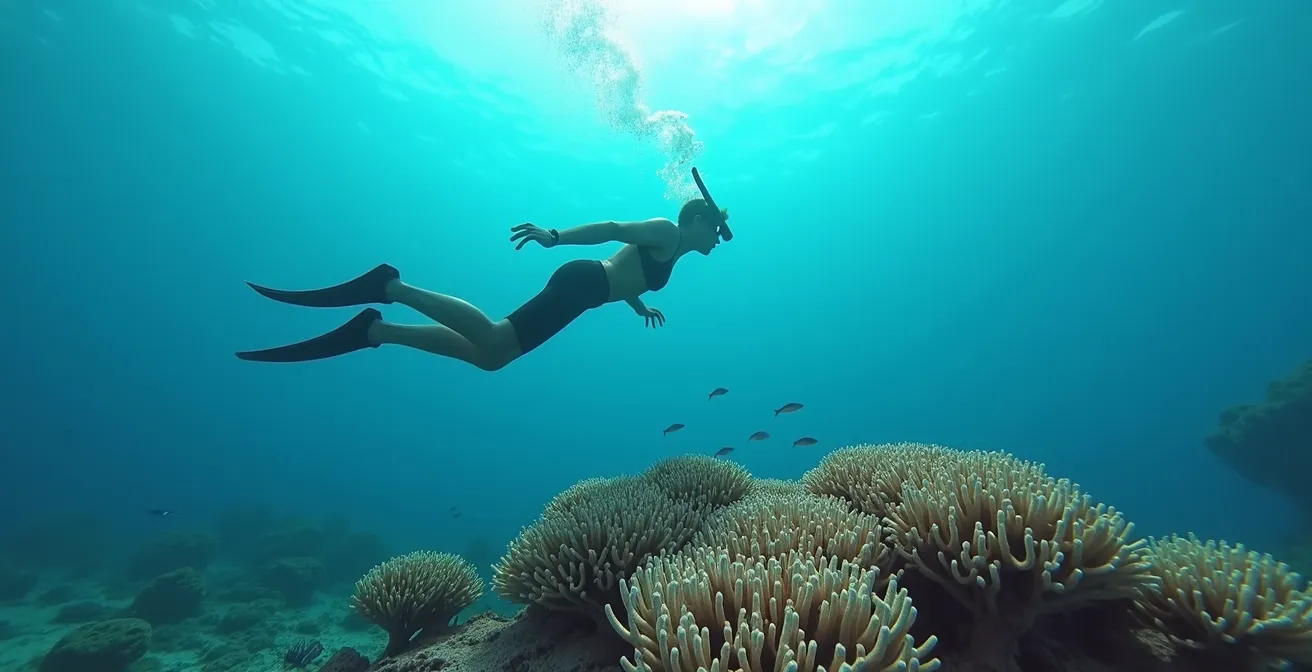
The second pillar is body position, or trim. The ideal position is perfectly horizontal, parallel to the surface and the reef below. This is the most hydrodynamic position, reducing drag and allowing you to move with minimal effort. Keep your arms streamlined at your sides, not flailing. Any weighting should be minimalist; if you’re not wearing a wetsuit, you should need no weight at all. If you wear a buoyant wetsuit, adding just 1-2 pounds of weight can be enough to help you achieve neutral buoyancy at the surface.
Finally, propulsion must be deliberate and efficient. Use slow, powerful kicks originating from your hips, with straight legs and flexible ankles, like a freediver. Avoid the rapid, bent-knee “bicycle kick,” which is inefficient and stirs up sediment. For fine-tuned positioning, use your hands in a gentle, figure-8 “sculling” motion. Mastering these elements allows you to become a silent, graceful observer rather than a clumsy intruder.
Key Takeaways
- Permanent mask clarity is achieved through a one-time pre-treatment to remove manufacturing residue, not just daily defogging.
- The key to longer breath-holds is not willpower but physiological training to increase your body’s tolerance to CO2 buildup.
- The ultimate snorkeling skill is buoyancy control, using breath and body position to achieve neutral buoyancy and protect the reef.
How to Visit Coral Reefs Without Damaging What You Came to See?
Graduating to a pro-level snorkeler involves more than just technical skill; it involves a shift in mindset from a passive tourist to an active steward of the ocean. Every action you take, both in and out of the water, has an impact on the fragile ecosystems you’ve come to admire. The ultimate mark of a pro is leaving a place better than you found it, ensuring its health for future generations.
This begins with gear choices. Traditional chemical sunscreens contain oxybenzone and octinoxate, which are known to cause coral bleaching. The professional choice is to opt for reef-safe, mineral-based sunscreens (with zinc oxide or titanium dioxide) or, even better, to cover up with a full-body rash guard or dive skin. This eliminates the need for sunscreen on your torso and arms entirely, drastically reducing the chemical load you introduce to the water.
Your economic choices on land are just as important. Support tour operators with legitimate eco-certifications who follow responsible practices, such as providing proper briefings, maintaining small group sizes, and contributing to local conservation. When possible, pay park fees and make donations to local marine conservation organizations. This provides the financial resources necessary for the management and protection of marine protected areas.
Finally, you can actively contribute to science and conservation. Simple actions like carrying a mesh bag and safely removing any floating plastic you encounter make a tangible difference. You can also participate in citizen science projects. Apps like iNaturalist allow you to document the species you see, providing valuable data for scientists. If you observe signs of coral bleaching or disease, you can report it to organizations like Reef Check. By adopting this guardian mindset, your visit becomes a positive force for the environment you love.
By applying these technical and ethical principles, you can fundamentally transform your snorkeling. Go beyond the surface, leave the frustrations behind, and become a capable, confident, and conscientious guardian of the underwater world.