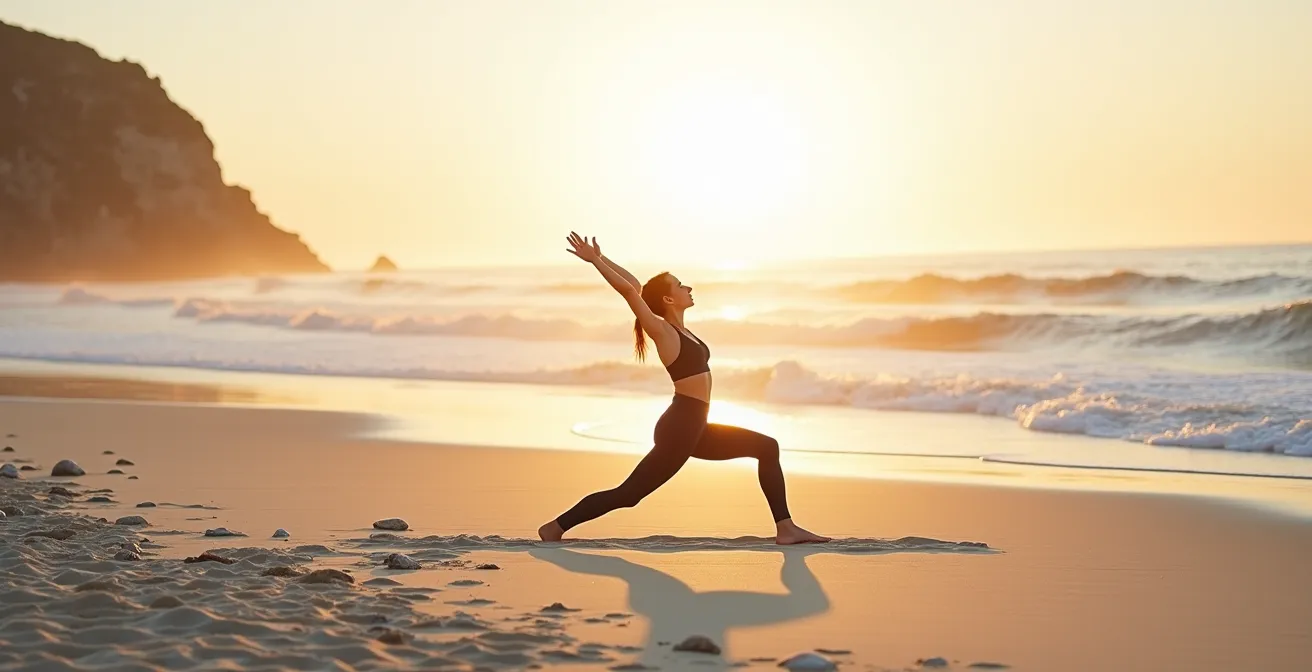
A truly restorative beach vacation is not a location you find, but a wellness system you design.
- Success depends on environmental engineering—strategically choosing towns with the right wellness infrastructure.
- Mastering bio-rhythmic training—timing your activity with natural cycles—is key to maximizing energy and avoiding burnout.
Recommendation: Use the “Activate, Restore, Connect” (ARC) framework to structure your next trip for a guaranteed physical and mental reset.
You know the feeling. You return from a week-long seaside vacation feeling more tired than when you left. The promise of sun-drenched rejuvenation dissolved into lethargic days on a beach towel, leaving you with a tan but no real energy boost. The common advice—”try some beach yoga” or “go for a run on the sand”—is well-intentioned but misses the point. These are just isolated activities, not a cohesive strategy for recovery. You end up feeling aimless, getting dehydrated, and returning to daily life without the deep-seated reset you craved.
But what if the secret to a transformative beach holiday wasn’t about *what* you do, but *how* you design the entire experience? The key is to stop thinking about your vacation as a passive escape and start engineering it as an active wellness system. It’s about leveraging the unique coastal environment—from the texture of the sand under your feet to the timing of your workouts—to systematically rebuild your energy, fix burnout, and forge a stronger connection between mind and body. This isn’t about forcing a grueling boot camp into your break; it’s about making smart, strategic choices that turn relaxation into powerful restoration.
This guide provides the blueprint. We’ll deconstruct the elements of a powerful seaside retreat, showing you how to build your own personalized system for peak wellness. You’ll learn how to select the right location, structure your days for optimal energy, and use a simple framework to ensure you come back not just rested, but truly recharged from the inside out.
Summary: How to Turn a Seaside Vacation Into an Active Wellness Retreat?
- Why Walking Barefoot on Sand Is the Best Free Therapy for Feet?
- How to Find Beach Towns With Great Gyms and Trails?
- Surfing or SUP: Which Core Workout Suits Your Fitness Level?
- The Dehydration Error That Ruins Your Energy for Evening Activities
- When to Train on the Beach to Avoid Heat Exhaustion?
- Why Being Near Water Lowers Your Heart Rate Instantly?
- How to Turn a Park Bench Into a Full-Body Workout Station?
- How to Design a Restorative Trip That Actually Fixes Your Burnout?
Why Walking Barefoot on Sand Is the Best Free Therapy for Feet?
The foundation of your active retreat starts literally from the ground up. Walking barefoot on sand, or “earthing,” is far more than a pleasant sensation; it’s a powerful biomechanical workout. The unstable surface forces the tiny proprioceptor nerves and stabilizing muscles in your feet and ankles to work overtime, building strength and balance that is impossible to replicate on flat, hard pavement. This isn’t just a feeling; research demonstrates that it takes 2.1 to 2.7 times more energy to walk or run on sand than on a hard surface. This turns a simple stroll into a significant, low-impact conditioning session.
This increased effort engages your entire posterior chain, from your calves to your glutes and lower back, improving your posture and gait. The sand also acts as a natural exfoliant and a form of reflexology, stimulating nerve endings and promoting circulation. You’re not just walking; you’re receiving a free, full-body therapeutic treatment. By starting your day with this simple practice, you’re not just exercising; you’re awakening your body’s sensory systems and preparing it for the day’s activities.
To maximize these benefits, move beyond simple walking. A structured foot therapy routine can dramatically improve mobility and prevent injury. Start with short durations and gradually increase as your feet adapt, turning the beach into your personal physical therapy studio.
- Begin with 3-minute barefoot walks to activate proprioceptors without overload.
- Practice toe-splaying exercises: spread your toes as wide as you can for 10 seconds, and repeat 10 times.
- Perform arch domes by lifting your foot’s arch while keeping the heel and toes grounded. Hold for 5 seconds.
- Enhance ankle mobility by writing the alphabet in the sand with your big toe.
- Once adapted, you can progress to using ultra-minimalist shoes for longer 15-minute sessions to maintain sensory input with a layer of protection.
How to Find Beach Towns With Great Gyms and Trails?
A successful active retreat depends on smart environmental engineering. The most beautiful beach in the world won’t serve your wellness goals if it’s surrounded by a desert of fast-food chains and has no safe places to move. You need to actively scout and select a destination with the right “wellness infrastructure.” This means looking beyond the hotel brochure and investigating the town’s commitment to an active lifestyle. Does it offer a variety of trails? Are there accessible gyms or outdoor fitness parks? Is the water clean and safe for swimming?
Your mission is to find a location that makes being active the easy and obvious choice. Look for towns with dedicated coastal running paths, marked hiking trails with varied elevation, and public-access fitness stations. A thriving community of local runners, surf schools, or outdoor yoga classes is a huge green flag, indicating a culture that supports your goals. This proactive research phase is the single most important step in designing your trip, as the right environment removes friction and provides constant motivation.
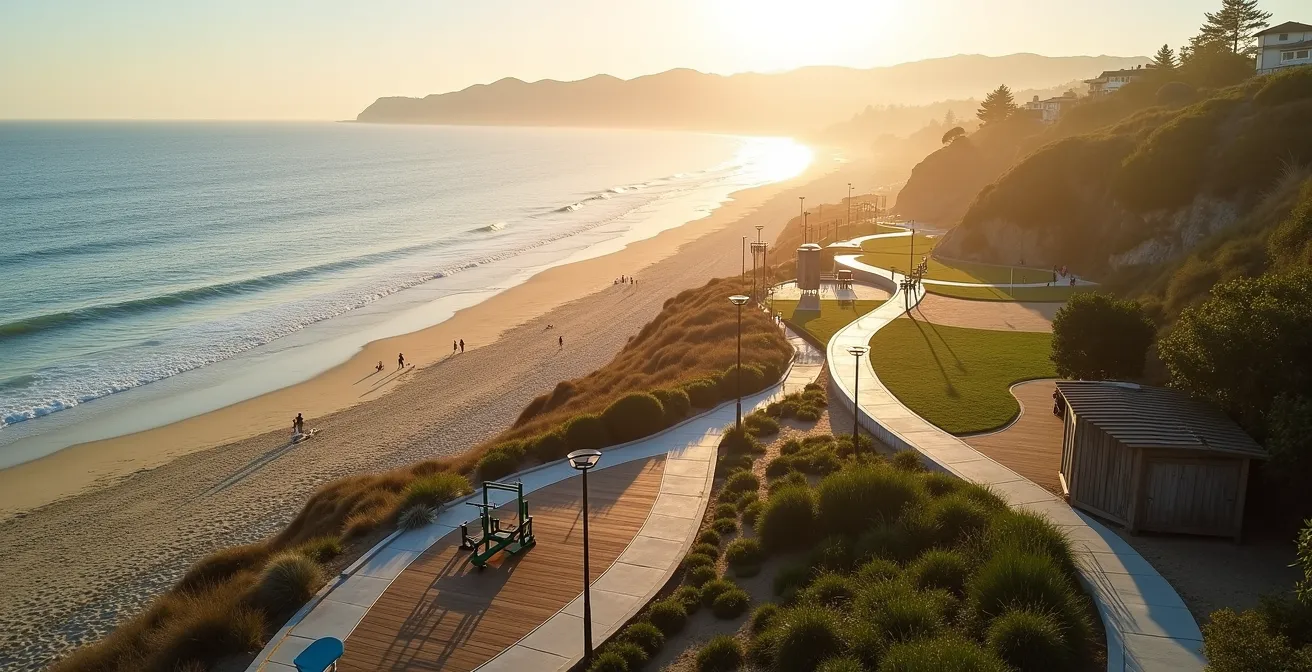
The image above illustrates the ideal setup: a seamless integration of natural beauty and fitness infrastructure. To make your selection process more systematic, use a scorecard to evaluate potential destinations. This removes the guesswork and ensures your chosen location is perfectly aligned with your wellness objectives. The following table provides a clear framework for this analysis.
This scorecard, based on a model used to assess holistic coastal wellness destinations, helps you weigh the critical factors for an active trip.
| Criteria | What to Look For | Red Flags | Score Weight |
|---|---|---|---|
| Trail Variety | Coastal paths, forest trails, elevation options | Single paved path only | 25% |
| Gym Access | Day passes available, 24/7 options, multiple facilities | Members-only, limited hours | 20% |
| Blue Space Quality | Clean water, lifeguards, not overcrowded | Pollution warnings, no safety measures | 30% |
| Healthy Food Infrastructure | Farmers markets, health stores, fresh seafood | Fast food only, no local produce | 15% |
| Community Activity | Beach yoga classes, running clubs, surf schools | No organized activities | 10% |
Surfing or SUP: Which Core Workout Suits Your Fitness Level?
Once you’ve chosen your active playground, it’s time to select your tools. Water sports are a fantastic way to engage your core and build functional strength, but not all are created equal. The choice between surfing and stand-up paddleboarding (SUP) isn’t just a matter of preference; it’s a strategic decision based on your fitness level and goals. Understanding the different physical demands will help you choose the activity that delivers the workout you’re actually looking for.
Surfing is an explosive, high-intensity interval workout. The majority of your time is spent paddling and waiting for waves, but the act of catching a wave and standing up requires a burst of anaerobic power engaging your entire core, back, and shoulders. It’s fantastic for building rotational strength and explosive power, but beginners may find that the actual “workout” time is very low, with as little as 5% of a session spent riding.
Stand-Up Paddleboarding (SUP), on the other hand, is an isometric and endurance-based workout. From the moment you stand on the board, your core is engaged to maintain balance. Paddling provides a continuous, low-impact cardiovascular and strength-training session that targets your obliques, lats, and deep stabilizing muscles. It’s a meditative yet challenging activity, perfect for building core stability and endurance with nearly 90% of the time spent in active engagement.
To make an informed decision, compare these activities side-by-side, along with another great option like sea kayaking, based on their specific fitness benefits. This data-driven approach ensures you pick the right challenge for your body.
The following comparison, drawn from an analysis of seaside recreational activities, breaks down the core focus and caloric burn for each sport.
| Activity | Core Focus | Time to Workout | Calorie Burn/Hour | Best For |
|---|---|---|---|---|
| Surfing | Explosive power, rotational strength | 5% actual workout for beginners | 250-500 | HIIT training, anaerobic conditioning |
| SUP | Isometric stability, endurance | 90% continuous from first hour | 300-450 | Core endurance, balance, meditation |
| Sea Kayaking | Upper body, back strength | 100% continuous | 350-500 | Cardiovascular endurance, upper body power |
The Dehydration Error That Ruins Your Energy for Evening Activities
The most common saboteur of an active beach vacation isn’t muscle soreness; it’s dehydration. The combination of sun, wind, and physical activity rapidly depletes your body’s fluid and electrolyte levels. Most people make a critical error: they wait until they feel thirsty and then chug large amounts of water. This approach is ineffective and often too late. By the time you feel thirsty, you’re already dehydrated, leading to headaches, fatigue, and a complete crash in energy just when you want to enjoy a sunset run or an evening out.
The solution is to adopt a strategic hydration protocol. This means being proactive, not reactive. It involves front-loading your hydration, sipping consistently throughout the day, and actively replenishing lost electrolytes. Think of it as fueling your body’s engine before it starts to sputter. A common mistake is only drinking plain water, which can further dilute your electrolyte balance when you’re sweating heavily. Integrating a simple, homemade electrolyte drink is a game-changer for maintaining sustained energy.
Instead of guessing, follow a structured plan. This protocol ensures your body stays balanced, your energy remains high, and you have the stamina for all the activities you’ve planned, from sunrise to sunset.
- Pre-beach preparation: Drink 500ml of water 2 hours before you arrive at the beach.
- Morning routine: Front-load your hydration by drinking 250ml every 30 minutes until 11 am.
- Peak sun strategy: During the hottest part of the day, sip 100ml every 15 minutes. Never chug large amounts, as your body can’t absorb it efficiently.
- Post-activity recovery: Immediately after a workout or swim, consume a DIY electrolyte drink. A simple and effective mix is water with a pinch of sea salt, a squeeze of lemon, and a teaspoon of maple syrup or honey.
- Evening preparation: To ensure you have energy for dinner and evening activities, have another electrolyte drink about 2 hours beforehand.
When to Train on the Beach to Avoid Heat Exhaustion?
Enthusiasm is your greatest asset on an active vacation, but it can also be your biggest risk. Charging into a high-intensity workout on the beach at 2 p.m. is a recipe for heat exhaustion, not fitness gains. To train effectively and safely in a coastal environment, you must practice bio-rhythmic training—syncing your workout schedule with the sun and temperature cycles. Your body needs time to acclimatize to the heat, and pushing too hard too soon will leave you depleted for days.
The golden rule is to schedule your most intense activities during the coolest parts of the day: sunrise and sunset. The early morning offers cool air and low-angled sun, perfect for high-intensity interval training (HIIT), beach sprints, or long runs. The evening provides a similar window as temperatures drop, ideal for a second moderate-to-high intensity session. Mid-day, when the sun is at its peak and the thermal load is highest, should be reserved for rest, indoor gym sessions, or light activities like swimming in the cool ocean.
By respecting the rhythm of the day, you work with your environment, not against it. This strategic scheduling allows you to maintain high energy levels, prevent over-training, and ensure you can perform at your best without risking your health.
Case Study: Heat Acclimatization at Myrtle Beach
Beach yoga and wellness programs in Myrtle Beach provide a proven model for safe heat adaptation. Their schedules designate optimal training windows: sunrise sessions from 6-8 am are used for high-intensity work, while mid-morning from 9-10 am is reserved for moderate water activities. Restorative practices are held during sunset sessions from 6-8 pm. The programs have found that it takes most participants 3 to 5 days to fully acclimatize to the heat. By progressively increasing the intensity over this period, they have successfully prevented exhaustion while maintaining an impressive 95% participant completion rate for their programs.
Why Being Near Water Lowers Your Heart Rate Instantly?
The restorative power of the ocean goes far beyond a pretty view. The phenomenon known as “Blue Space” science explains why being near water has a measurable and instantaneous calming effect on our nervous system. When you look at the vast, non-threatening horizon of the ocean, your brain enters a state of soft fascination, which reduces cortisol levels and lowers your heart rate. It’s an evolutionary response; our ancestors knew that a clean water source signified safety and life.
But the effect is also chemical. The air in coastal areas, particularly where waves are breaking, is rich in negative ions. While “positive ions” (the kind emitted by electronics) can make us feel tense and drained, negative ions have the opposite effect. They are believed to increase the flow of oxygen to the brain, resulting in higher alertness, decreased drowsiness, and more mental energy. In fact, research has found that coastal air can contain up to 2,000 negative ions per cubic centimeter, compared to just a few hundred in a typical city office. This makes the simple act of breathing by the sea a powerful therapeutic tool.
You can actively harness this effect by practicing mindful grounding techniques. Instead of passively sitting on the beach, engage all your senses to deepen the connection and amplify the restorative benefits. This turns a simple break into an active meditation, allowing you to fully absorb the healing properties of the blue space.
Try this 5-sense meditation technique next time you’re by the water:
- Find a comfortable seated position facing the ocean.
- Sight: Identify 5 things you can see (the rhythm of the waves, the line of the horizon, birds, cloud patterns, the texture of the sand).
- Feeling: Notice 4 things you can feel (the breeze on your skin, the warmth of the sun, the fine mist from the spray, the texture of the sand beneath you).
- Hearing: Listen for 3 things you can hear (the crash and retreat of the waves, the calls of seabirds, the sound of the wind).
- Smell: Detect 2 things you can smell (the distinct salty air, the scent of sunscreen or nearby seaweed).
- Taste: Notice 1 thing you can taste (the subtle salt in the air that settles on your lips).
- Breathe deeply and hold this multi-sensory awareness for at least 5 minutes.
How to Turn a Park Bench Into a Full-Body Workout Station?
Your fitness opportunities aren’t limited to the gym or the sand. One of the best signs of a well-designed active town is the presence of simple park benches along its boardwalks and trails. For a savvy traveler, a humble bench isn’t just a place to rest; it’s a versatile, full-body workout station waiting to be used. This is about hacking your environment and seeing the potential for movement everywhere.
A bench provides the perfect platform for a huge range of bodyweight exercises. Its different heights—the seat and the backrest—allow you to modify classic movements to increase or decrease the difficulty. You can perform incline push-ups to build chest strength, decline push-ups to target your shoulders, or box jumps for explosive power. It’s the ideal tool for Bulgarian split squats to isolate your glutes and quads, or for tricep dips to build upper body strength. The possibilities are endless.
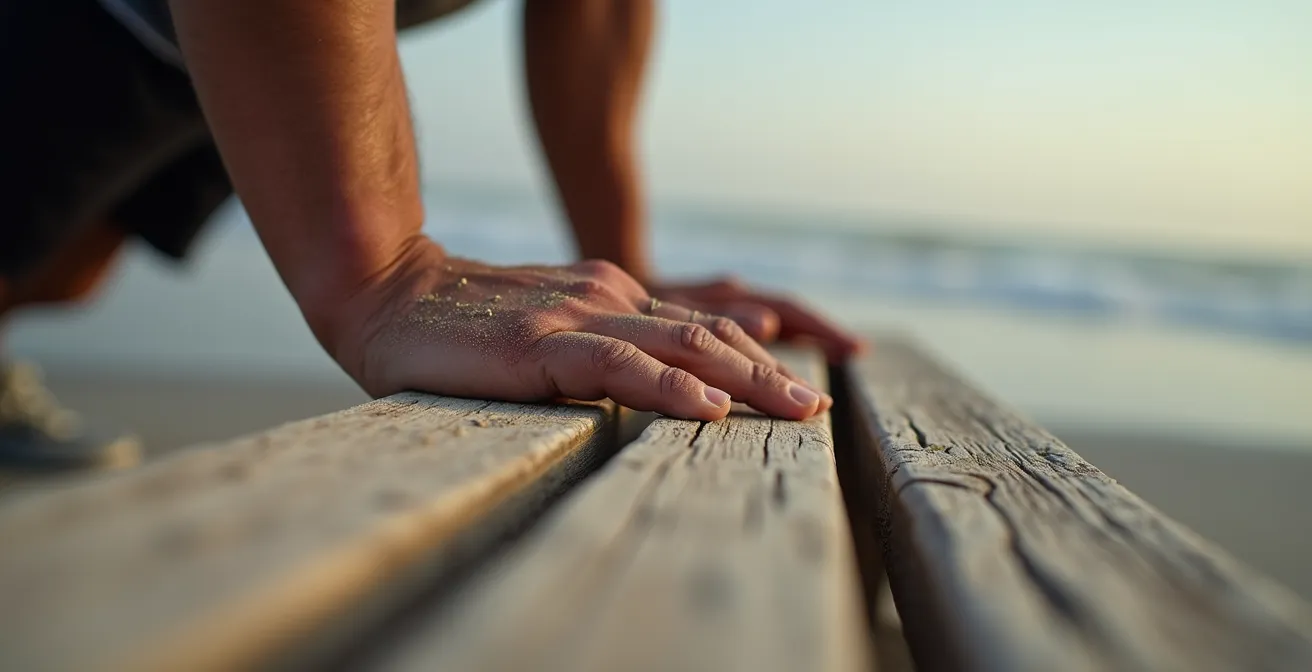
By learning a few key circuits, you can get a killer workout done in 20-30 minutes with zero equipment, all while enjoying the fresh sea air. This approach gives you ultimate freedom and flexibility, ensuring you can stick to your fitness goals no matter where you are. All it takes is a little creativity and a solid plan.
Your Boardwalk Bodyweight Action Plan: 3 Intensity Levels
- HIIT Circuit (20 min): For a quick, high-intensity blast, perform 30 seconds of box jumps, 30 seconds of burpees to a bench jump-up, and 30 seconds of fast step-ups. Rest for 30 seconds and repeat the entire circuit for 5 rounds.
- Strength Circuit (25 min): To build muscle, perform 12 slow and controlled Bulgarian split squats on each leg, followed by 15 decline push-ups (feet on the bench). Finish with 10 single-leg hip thrusts on each side (shoulders on the bench). Rest for 90 seconds and repeat for 4 rounds.
- Mobility Session (15 min): Use the bench for deep stretching. Hold a thoracic spine extension over the bench back for 60 seconds. Perform an elevated hip flexor stretch for 60 seconds on each side, and use the bench edge for 60-second calf stretches. Finish with seated spinal twists.
Key Takeaways
- Design your trip as a holistic wellness system, not a series of random activities.
- Bio-rhythmic training—syncing your workouts with the sun and heat—is more important for sustained energy than the activity itself.
- The “Activate, Restore, Connect” (ARC) framework is the ultimate blueprint for structuring a trip that truly fixes burnout.
How to Design a Restorative Trip That Actually Fixes Your Burnout?
We’ve covered the individual components of an active seaside retreat, but the real magic happens when you assemble them into a cohesive, restorative system. A trip that genuinely fixes burnout isn’t an accident; it’s a deliberate design. The most effective way to structure this is by using the ARC framework: Activate, Restore, and Connect. This simple yet powerful model ensures you’re balancing energy expenditure with deep recovery each day.
Activate: Start your day with movement. This is your sunrise beach walk, your bench workout, or your morning SUP session. The goal is to energize your body, stimulate your metabolism, and connect with your environment early in the day. Restore: This is the crucial, often-neglected phase. Schedule dedicated time in the afternoon for true restoration. This could be a 5-sense meditation by the water, a nap in the shade, or taking advantage of a hotel’s hydrotherapy circuit. This is not passive laziness; it’s an active process of physical and mental recovery. Connect: End your day with connection. This can mean connecting with yourself through journaling, connecting with a partner over a healthy meal, or connecting with nature during a tech-free sunset walk. This phase grounds you and solidifies the day’s benefits.
By cycling through Activate, Restore, and Connect each day, you create a rhythm that prevents depletion and fosters deep rejuvenation. The benefits of this structured approach don’t have to end when you check out. A crucial part of the system is creating a protocol for re-entry into daily life to make the positive changes stick.
The ARC Method in Action: Amrit Ocean Resort
Amrit Ocean Resort’s 3-day burnout recovery program offers a powerful real-world example of the ARC framework. The Activate phase includes sunrise beach walks and gentle movement classes. The Restore phase is built around their 40,000-square-foot hydrothermal circuit, featuring contrast therapy pools and dedicated meditation spaces. Finally, the Connect phase offers tech-free sunset sessions and guided journaling workshops. Participants in this structured program report an 85% improvement in stress levels, with benefits sustained long-term through post-retreat integration protocols.
To make your recovery last, follow this pre- and post-trip protocol:
- Pre-Trip (1 week before): Delete work apps from your phone, set a comprehensive out-of-office message, and fully delegate all responsibilities.
- Pre-Trip (2 days before): Begin a “digital sunset” routine by putting away screens at 8 pm. Practice one restorative activity daily.
- During Trip: Consciously follow the ARC method each day—morning activation, afternoon restoration, and evening connection.
- Post-Trip Buffer Day: Do not open work emails. Use this day to review trip insights and identify one key habit you want to continue.
- Integration Week: Implement your chosen habit daily and schedule a weekly 2-hour “micro-retreat” for yourself.
Your next vacation has the potential to be the most powerful wellness tool you’ve ever used. Start designing your active retreat today by using the ARC framework to build a trip that will leave you stronger, more energetic, and truly restored.