In summary:
- Transitioning to sailing is a full-body engagement, shifting you from a passive passenger to an active pilot who works with the elements.
- Success depends on a mental shift towards “resource discipline”—meticulously planning water, food, and even luggage space.
- Choosing the right vessel (monohull vs. catamaran) and crew setup (hiring a skipper) are key first decisions for safety and comfort.
- True seamanship blends technology with traditional skills, using sensory navigation and understanding tides to move efficiently and safely.
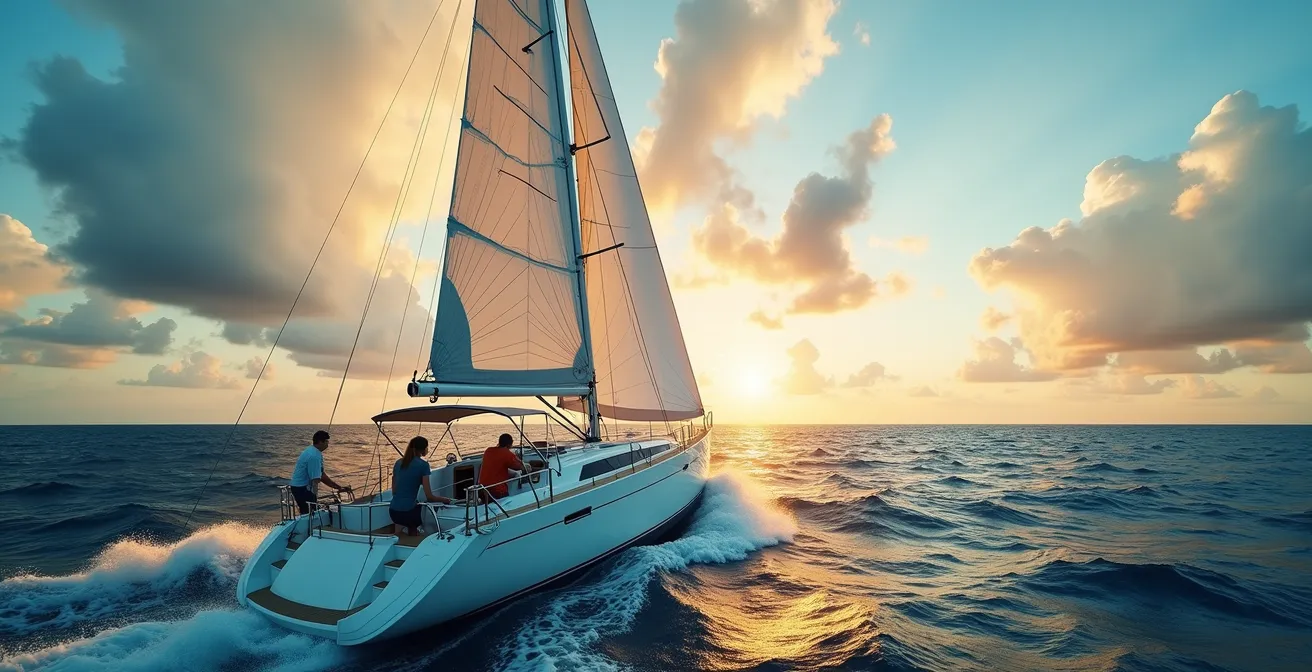
The constant drone of an engine, the faint smell of diesel, the feeling of gliding over the water rather than being part of it. For many who love the sea, the motor cruising experience can eventually feel detached, like watching a film instead of living it. You’re a passenger on a powerful machine, insulated from the very elements you came to enjoy. The desire for a more intimate, quiet, and profound connection with the ocean often leads to a single, compelling question: what would it be like to sail?
Making the leap from a motor yacht to a sailboat is far more than a simple change of vessel. It’s a fundamental shift in philosophy. The common advice revolves around learning knots or reading weather charts, but this only scratches the surface. The real transition is about recalibrating your body and mind to engage in a constant, kinetic feedback loop with the wind and waves. It’s about trading raw power for intelligent cooperation with nature.
But if the core of this transition isn’t just technical skill, what is it? The key lies in embracing the concept of embodied seamanship. This means understanding that sailing is a physical dialogue. Your body becomes a sensor, feeling the heel of the boat, the tension on a line, the subtle shifts in wind direction. It’s about moving from being a button-pusher to becoming an integral part of the machine, where every adjustment has a tangible, physical consequence.
This guide is designed to navigate that transition. We will explore the physical demands that make sailing a genuine workout, the critical decisions about boat type and crew, and the mindset of resource discipline required for life at sea. We will also cover the essential skills of working with, not against, the elements, empowering you to move from passive observer to active, confident sailor.
This article provides a comprehensive roadmap for your journey from motor to mast. Explore the sections below to understand the key facets of this rewarding transition, from the physical engagement onboard to the practicalities of planning your first voyage.
Summary: From Motor Cruising to Active Sailing
- Why Sailing Is a Workout and Not Just a Tan Session?
- Captain Yourself or Hire a Skipper: Which Is Safer for New Sailors?
- Monohull or Catamaran: Which Is Better for a Sensitive Stomach?
- The Luggage Mistake That Makes Life in a Cabin Unbearable
- How to Calculate Water and Food Rations for a Week at Sea?
- Surfing or SUP: Which Core Workout Suits Your Fitness Level?
- How to Time Your Passage to Use the Tide Instead of Fighting It?
- How to Navigate Coastal Waters Safely Without Relying Solely on Electronics?
Why Sailing Is a Workout and Not Just a Tan Session?
The image of sailing is often one of relaxation—lounging on deck with a cool drink. While those moments exist, they are the reward for genuine physical effort. Unlike a motor cruiser where your main activity is steering, active sailing engages your entire body in a dynamic, ever-changing environment. It is a functional, full-body workout that builds strength, endurance, and balance. The constant motion of the deck requires your core and leg muscles to fire continuously just to stay stable.
Every maneuver is a physical task. Hoisting the mainsail is a powerful pulling motion, engaging your back, shoulders, and biceps. Grinding a winch to trim the genoa is a high-intensity upper-body exercise. Even steering—or helming—isn’t passive; it requires sustained isometric contractions in your core, shoulders, and back to hold a course against the pressure of wind and waves. This constant physical dialogue with the boat and the elements is what makes sailing so immersive.
The caloric demand is significant and proves the point. Depending on the conditions and the intensity of the activity, studies show that competitive sailing burns between 295 and 431 calories per hour. During more intense maneuvers like tacking or jibing in strong winds, this can skyrocket. The key movements involved include:
- Hoisting sails: A full-body pulling motion engaging the lats, biceps, and core.
- Grinding winches: A powerful rotational movement that works the forearms, shoulders, and back.
- Trimming sails: Requires constant core engagement and leg stabilization to counteract the boat’s heel.
- Helm control: Activates deep postural muscles for stability and control.
- Maneuvers (tacking/jibing): Combines cardiovascular effort with full-body coordination and explosive strength.
This physical engagement is the very essence of the transition. You are not merely a passenger; you are the engine. Your body provides the power, your mind provides the strategy, and the wind provides the fuel. It’s a workout with the ultimate view.
Captain Yourself or Hire a Skipper: Which Is Safer for New Sailors?
Once you’ve embraced the physical nature of sailing, the next logical question is one of command and control. Do you take the helm yourself from day one, or do you entrust your safety to an experienced professional? For a new sailor transitioning from the relative simplicity of a motor cruiser, the learning curve can be steep. While certifications provide a theoretical foundation, nothing replaces hands-on experience in real-world conditions.
Hiring a licensed skipper or instructor for your first few sailing trips is the single most effective way to bridge this gap safely. A good skipper is more than just a chauffeur; they are a mentor. They can provide real-time coaching on sail trim, helm feel, and decision-making, contextualizing the theory you’ve learned. This mentorship accelerates your learning and builds confidence far faster than trial and error. It allows you to focus on specific skills without the overwhelming responsibility of ensuring everyone’s safety.
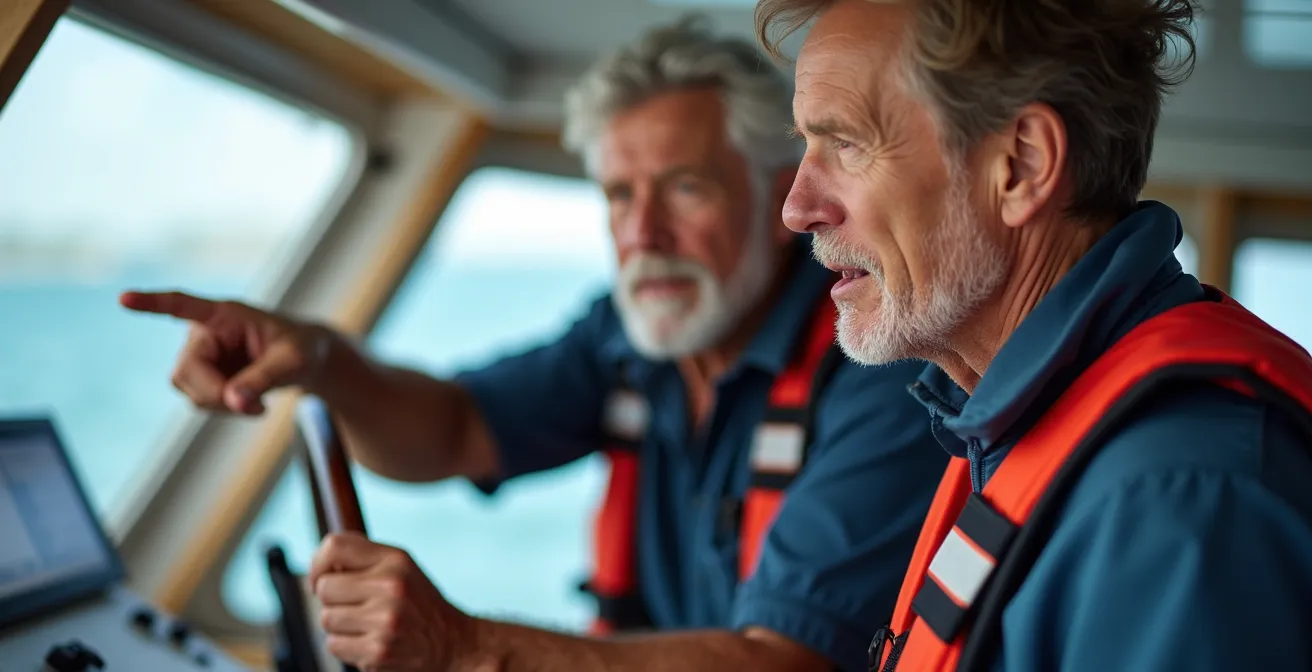
This approach allows for a gradual assumption of responsibility. You can start by managing one aspect—like trimming the jib—and slowly expand your duties as your confidence grows. The skipper remains the ultimate safety net, ready to step in if conditions become challenging.
Case Study: The Value of Mentorship
Experienced sailors Beryl Chalmers and Simon Palmer made the reverse transition—from sail to power—after 30 years. Their key insight, which applies directly here, was the immense value of hiring an instructor for their first trips on the new vessel. It helped them understand the nuanced differences in boat handling. For a motor cruiser moving to sail, a skipper can explain the ‘why’ behind the boat’s heeling, the feel of an impending stall, and the timing of a tack—concepts that are foreign to a powerboat user. They recommend starting with shorter-duration charters with a skipper before committing to longer, self-captained voyages.
Ultimately, the goal is to become a self-sufficient captain. But starting with a professional guide isn’t a sign of weakness; it’s a strategic investment in your own competence and safety.
Monohull or Catamaran: Which Is Better for a Sensitive Stomach?
One of the most immediate physical differences between motor cruising and sailing is the motion. A heavy, wide-beamed motor yacht often feels solid and stable, plowing through waves. A sailboat, by contrast, is designed to dance with them. This motion, particularly the side-to-side rolling of a monohull, is a primary cause of seasickness, or mal de mer. For those with a sensitive stomach, choosing the right type of sailboat is not a trivial matter; it can make or break the entire experience.
The two primary options for a charter are the traditional monohull and the twin-hulled catamaran. A monohull sails at an angle of heel (typically 15-25 degrees) and has a deep, rhythmic rolling motion. For some, this slow, predictable roll is manageable. For others, it’s a direct path to nausea. A catamaran, on the other hand, stays almost completely flat. Its motion is a quicker, sometimes jerky pitching movement, but it lacks the deep roll that triggers seasickness in many people.
This difference in motion and living space is critical. On a monohull, the main living areas are below the waterline, often with less ventilation. On a catamaran, the saloon and galley are on the main deck level between the hulls, offering panoramic views and excellent airflow—two key factors in staving off seasickness. A recent analysis highlights these differences clearly.
| Factor | Monohull | Catamaran |
|---|---|---|
| Motion Type | Rhythmic rolling (side to side) | Quick pitching (fore and aft) |
| Predictability | Slower, deeper rolls | Faster but more predictable motion |
| Living Space Location | Below deck, near engine | Deck level with better ventilation |
| Heel Angle | 15-25 degrees typical | Minimal heeling, stays level |
| Survey Results | Higher seasickness rates | 92% hardly or not bothered |
However, real-world experience adds important nuance, as one sailor’s account reveals:
A charter sailor who tested both boats in identical conditions reported: ‘The catamaran’s motion was stable and erratic simultaneously. I could leave a bottle on the table and it stayed put, but walking around felt like balancing on a subdued mechanical bull. The same people prone to seasickness on monohulls were still prone on the catamaran while underway, but at anchor, the catamaran’s stability really shone – several crew who usually get queasy from a monohull’s gentle roll at anchor had no issues on the cat.’
– Savvy Salt Charter Guide
For the first-time sailor, a catamaran often presents a gentler introduction to life afloat, especially at anchor. The trade-off is a different sailing “feel” that some purists dislike. The best choice depends on your crew’s sensitivity and your ultimate sailing goals.
The Luggage Mistake That Makes Life in a Cabin Unbearable
The transition from a spacious motor cruiser to a sailboat brings a stark new reality: space is the ultimate luxury. Nowhere is this more apparent than in the cabins. A common mistake for first-timers is packing as one would for a hotel or a large cruise ship, with large, rigid suitcases. This single error can make life below deck frustrating and chaotic. Hard-shell luggage doesn’t collapse, consuming precious floor space and turning a cozy cabin into an obstacle course.
This is where the sailor’s mindset of resource discipline begins. It’s not just about what you pack, but *how* you pack it. The philosophy shifts from “pack for every contingency” to “every item must be multi-purpose and easily stowed.” Soft-sided duffel bags or backpacks are non-negotiable. Once unpacked, they can be rolled up and tucked away, instantly freeing up the cabin. This small change has a massive impact on livability.
As one expert notes, the entire packing philosophy must be inverted. This perspective is crucial for anyone coming from a world of ample storage.
The ‘pack for every contingency’ approach of a hotel or large cruise ship vacation contrasts sharply with the sailor’s philosophy of multi-purpose items and ruthless minimalism
– Marine Industry Expert, Yachting.com Motor Boat Guide
To adopt this minimalist approach, focus on a packing hierarchy designed for efficiency and space-saving. Think in terms of volume, versatility, and stowability. A well-packed bag is the first step to a harmonious life onboard.
- Choose soft-sided luggage: Duffel bags or backpacks are essential as they can be collapsed and stowed away when empty.
- Use compression packing cubes: These compartmentalize clothing and can reduce volume by up to 50%, making them easier to fit into small lockers.
- Decant toiletries: Eliminate rigid plastic bottles by transferring liquids into small, soft, travel-sized containers.
- Go digital with reading: An e-reader replaces multiple physical books, saving significant weight and space.
- Pack versatile clothing: Prioritize quick-dry, multi-purpose items (e.g., a sarong that is also a towel, a shirt that provides sun protection) over single-use outfits.
By embracing this ruthless minimalism, you are not just saving space; you are adopting a core principle of good seamanship: efficiency and foresight.
How to Calculate Water and Food Rations for a Week at Sea?
Continuing with the theme of resource discipline, nothing is more critical on a sailboat than the management of fresh water and food. Unlike a motor cruiser with large tanks and potentially a watermaker, many charter sailboats have a finite supply. Running out of water at sea is not an inconvenience; it is a serious safety issue. Therefore, meticulous planning, or provisioning, is a non-negotiable seamanship skill.
The first step is to calculate your baseline needs. A standard rule is to budget 3 liters of water per person per day. This covers drinking, cooking, and minimal personal hygiene. For a crew of four on a seven-day trip, this means a minimum of 84 liters. However, a prudent skipper always adds a buffer for emergencies, such as being delayed by weather. A 3-day emergency supply is a common and wise precaution, bringing the total to 120 liters for our example crew.

Beyond simple volume, the strategy extends to the types of food you bring. The goal is to select items that are energy-dense, require minimal cooking water, and are easy to prepare in a moving galley. One-pot meals are a sailor’s best friend, as they reduce both water usage for cooking and for washing up. Wraps are often a better choice than pasta, and canned goods packed in their own liquid can be a smart way to conserve fresh water. Your provisioning plan is a direct reflection of your foresight and preparedness.
To ensure a safe and comfortable voyage, a smart provisioning strategy is essential. This checklist provides a framework for planning your food and water needs effectively.
Your Action Plan: Smart Provisioning Strategy for Sailing
- Calculate base needs: Allot 3L of water per person per day and add a 3-day emergency buffer to your total.
- Choose low-water foods: Opt for items like wraps instead of pasta and use canned goods that come with their own liquid.
- Select energy-dense options: Pack nuts, dried fruits, and energy bars that provide high energy for their weight and require no refrigeration.
- Plan one-pot meals: Design a menu that simplifies cooking in rough weather and minimizes water needed for cleaning.
- Store provisions strategically: Use waterproof containers and distribute weight evenly throughout the boat to maintain proper balance and trim.
This methodical approach to provisioning is a cornerstone of safe sailing. It transforms the galley from a simple kitchen into the logistical heart of the vessel, ensuring the crew remains hydrated, fed, and safe.
Surfing or SUP: Which Core Workout Suits Your Fitness Level?
The active sailing lifestyle doesn’t stop when you drop anchor. The secluded coves and pristine beaches you can access are perfect playgrounds for watersports. For the motor cruiser transitioning to sailing, this is an opportunity to deepen the physical connection with the water. Two of the most popular and rewarding options are surfing and stand-up paddleboarding (SUP), both of which are excellent core workouts. However, they suit different fitness levels and, crucially, have very different logistical implications for a sailboat.
Surfing is an explosive, high-skill sport. It offers an incredible adrenaline rush but has a steep learning curve and requires specific wave conditions that may not be available at every anchorage. Furthermore, rigid surfboards are bulky and difficult to store on most sailboats, consuming valuable deck space.
Stand-up paddleboarding, especially with modern inflatable boards (iSUPs), presents a much more practical and versatile option. The learning curve is gentle, allowing for immediate enjoyment. You can paddle in calm, flat water for a meditative workout or tackle small waves for more of a challenge. An iSUP, when deflated and rolled up, is incredibly space-efficient. This blend of a great workout and practicality makes it a favorite among cruisers.
Case Study: The Inflatable SUP Advantage for Sailors
An analysis of watersports storage on sailing vessels highlights the practicality of inflatable SUPs. When deflated, an iSUP occupies less than 2 cubic feet of storage—roughly the size of a large sleeping bag. This makes it about 10 times more space-efficient than a traditional surfboard. It still provides a fantastic full-body workout, with leisure paddling burning upwards of 500 calories per hour, while also serving as a utility craft to explore shallow areas inaccessible to the sailboat.
The choice ultimately depends on your priorities. If you are a dedicated surfer willing to sacrifice space, a surfboard might be worth it. But for most sailors seeking a versatile, efficient, and effective workout, the inflatable SUP is the clear winner.
| Activity | Calories/Hour (130 lbs) | Calories/Hour (175 lbs) | Storage on Sailboat | Learning Curve |
|---|---|---|---|---|
| Stand-Up Paddleboarding | 374 (leisure) – 735 (intensive) | 500 (leisure) – 1,125 (racing) | Inflatable SUP: minimal space | Low – immediate enjoyment |
| Surfing | 180 | 240 | Rigid board: significant space | High – requires specific conditions |
| SUP Yoga | 233-540 | 300-700 | Same inflatable SUP | Medium – builds on SUP basics |
How to Time Your Passage to Use the Tide Instead of Fighting It?
Perhaps the most profound shift from motor cruising to sailing is in your relationship with the elements. A powerful motor yacht can often brute-force its way against a foul tide or current. A sailboat, with its lower speed, cannot. A 2-knot current against you can cut a 6-knot sailing speed by a third, dramatically extending passage times and putting the boat and crew under unnecessary strain. The skilled sailor doesn’t fight the tide; they use it. This requires a new skill: passage timing.
The core of this skill is identifying “tidal gates” on your planned route. These are narrow channels, headlands, or passages where the tidal stream concentrates and runs fastest. Attempting to pass through a tidal gate against the peak flow can be difficult and even dangerous. The goal is to arrive at the gate at “slack water”—the brief period when the tide is turning and the current is weakest. Timing your arrival for this window can save hours and significant effort.
This is where the transitioner from motor cruising has a unique advantage. They are not a purist who shuns the engine. They can use it as a strategic tool, a practice known as motorsailing. As one expert puts it, the engine is a powerful tool for managing tides effectively.
The Motor-Sailor’s Advantage: unlike purist sailors, they have a powerful tool to help manage tides. Calculate when using the engine for an hour to get ahead of a foul tide is more efficient and safer than waiting or fighting it.
– David Harding, Practical Boat Owner – Motor Sailing Guide
Using the engine to maintain a higher average speed can ensure you reach the tidal gate during the slack water window. The strategy involves a few key steps:
- Identify tidal gates on your route using nautical charts or apps like Navionics, looking for areas where currents are noted to exceed 2 knots.
- Calculate slack water times for these gates using tide tables or a navigation app.
- Plan your departure and passage speed to arrive at the gate roughly 30 minutes before slack water, giving you a safety buffer.
- Use motorsailing if needed: keep your sails up for stability and propulsion, but use the engine to maintain the necessary speed over ground (SOG) to meet your schedule.
- Monitor your progress by comparing your boat speed through the water with your GPS-based SOG to confirm you are making headway against any residual current.
By learning to read and use the tides, you are no longer just a traveler. You are a strategist, working in partnership with the ocean’s natural rhythms.
Key Takeaways
- Sailing is an active, physical pursuit that engages your whole body, turning travel into a workout.
- A mindset of “resource discipline” is essential, requiring careful planning of water, food, and storage space.
- Hiring a skipper for initial voyages is a safe and effective strategy for accelerating your learning curve.
How to Navigate Coastal Waters Safely Without Relying Solely on Electronics?
In the world of modern motor cruising, it’s easy to become completely reliant on the glowing screens of the GPS chartplotter. While these tools are incredibly powerful, total reliance on them creates a critical vulnerability. A power failure, a lightning strike, or a simple software glitch can leave an unprepared mariner effectively blind. The true sailor, while appreciative of modern technology, cultivates the skill of sensory navigation—the ability to read the water, the land, and the sky to maintain situational awareness.
This doesn’t mean abandoning electronics. It means using them to augment, not replace, traditional seamanship. It’s about building a mental map of your surroundings that is constantly cross-referenced with what the screens are telling you. This practice of looking up from the chartplotter and out at the world is the cornerstone of safe coastal navigation. A simple but powerful technique to enforce this habit is the “Five-Minute Rule.”
- Every 5 minutes: Look up from your screens and identify one physical landmark (a headland, a tower, a specific buoy).
- Cross-reference: Find that landmark on your paper or digital chart and confirm its position relative to your own.
- Note water color: Observe changes—bright turquoise often means shallow sand, dark green suggests a deeper channel, and brown water indicates silt or mud, often in shallower areas.
- Observe surface texture: Ripples and “overfalls” indicate current flowing over an uneven seabed, while smooth patches can show wind shadows from land.
This constant loop of observation and verification keeps you mentally engaged and prepared for the unexpected. A crucial part of this is preparing a paper chart backup *before* you leave the dock.
Case Study: The Power of the Paper Briefing
A Practical Sailor analysis of successful passages without electronics found a compelling trend. Sailors who prepared paper charts with pre-plotted waypoints, danger bearings, and sketches of their destination harbor had a 95% success rate in reaching their destination safely even after a complete electronics failure. The act of preparing the chart solidifies the passage plan in the skipper’s mind, making them less vulnerable to a single point of failure.
By blending modern tools with these time-tested techniques, you move beyond being a technology operator to becoming a true navigator—one who understands their position not just because a screen says so, but because their own senses confirm it.
This transition from motor to mast is more than a change of hobby; it’s a change in perspective. It invites you to engage with the ocean on a deeper, more physical and elemental level. By embracing the workout, practicing resource discipline, and learning to work with the elements, you transform from a passenger into a true partner in the journey. Your first step is to charter a boat with an experienced skipper and begin this rewarding dialogue with the sea.