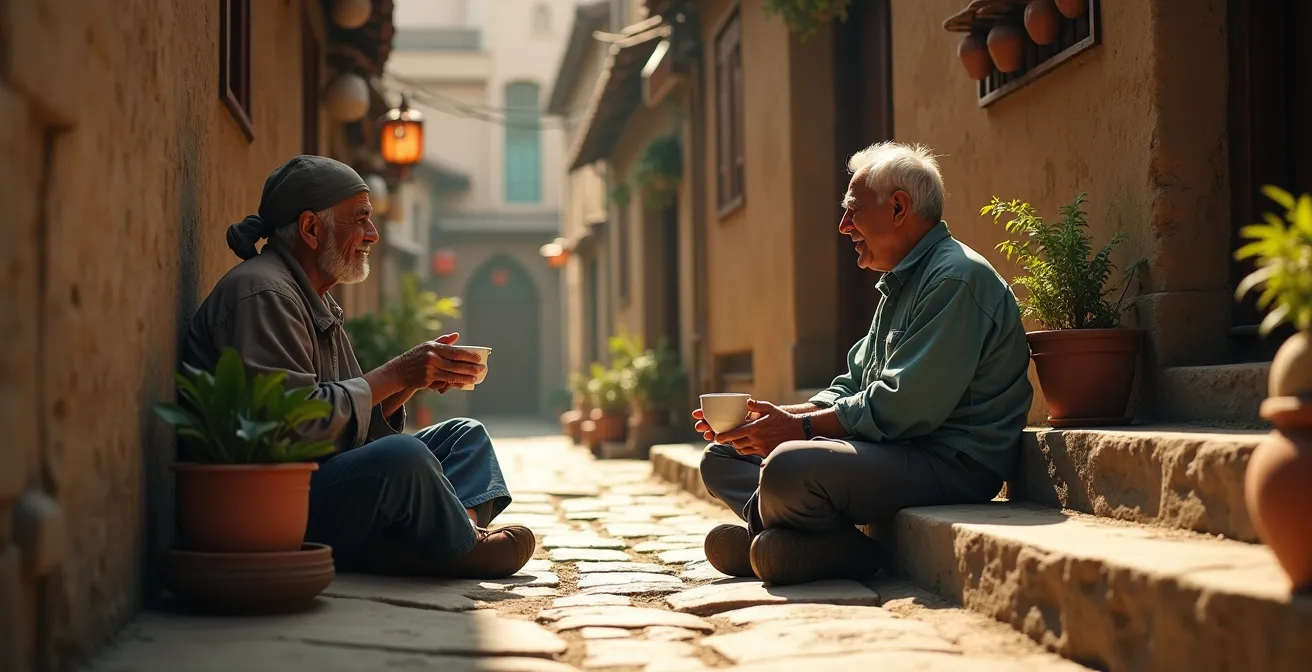
The key to a fulfilling trip isn’t where you go, but shifting your travel goal from the simple consumption of sights to achieving a high “Cultural Return on Investment” (ROI).
- True transformation comes from swapping checklist-driven itineraries for deep, single-location immersion.
- Consciously limiting digital performance for real-world presence is fundamental to authentic experiences.
Recommendation: Begin by measuring the success of your next trip not by the number of photos taken, but by the number of genuine conversations had.
There’s a familiar, lingering sense of anticlimax that many frequent travelers experience upon returning home. You’ve seen the monuments, tasted the sanctioned local dish, and captured the perfect sunset, yet an odd feeling of emptiness remains. The experience feels like a collection of snapshots rather than a cohesive, meaningful story. For years, the conventional wisdom for a “successful” trip has been a frantic race to check items off a list, a model of tourism built on consumption. The more you see, the better the trip. This approach often involves hopping between cities, following crowds to the same five-star-rated locations, and documenting it all for an online audience.
But what if this very model is the source of the dissatisfaction? What if the relentless pursuit of “more” is fundamentally undermining the potential for a trip to be truly transformative? The discourse often pits the “tourist” against the “traveler,” but this is a false dichotomy if defined by superficial actions like packing light or learning to say “hello.” The real distinction is a profound shift in mindset. It’s about moving from an extractive model of travel—where you take photos, stories, and souvenirs—to an immersive one, where you invest your time and attention in a place with the goal of being changed by it.
This transition is about redefining the metrics of success. It’s about consciously seeking a higher Cultural Return on Investment (ROI), where the returns are measured in understanding, connection, and personal growth, not in social media likes or a longer list of countries visited. This guide deconstructs the flawed assumptions of modern tourism and provides a strategic framework to help you design your next journey not as a tourist, but as a genuine traveler seeking depth and meaning.
This article will explore the systemic reasons why traditional travel leaves you feeling hollow and offer actionable strategies to redesign your approach. From engaging with local communities respectfully to mastering the art of the short, immersive trip, you will discover how to turn any vacation into a transformative experience.
Summary: How to Transition From a Tourist to a Traveler on Your Next Trip?
- Why Traditional Sightseeing Leaves 60% of Travelers Feeling Empty?
- How to Connect With Locals Without Being an Intrusive Tourist?
- Group Tours vs. Solo Travel: Which Delivers Better Cultural ROI?
- The Social Media Mistake That Ruins Authentic Travel Experiences
- How to Pack a Transformative Experience Into a 4-Day Weekend?
- The “Bucket List” Mindset That Concentrates Crowds in One Spot
- Why Changing Hotels Every 2 Days Kills Your Cultural Experience?
- How to Engage With Local Cultures Without Being a Disrespectful Outsider?
Why Traditional Sightseeing Leaves 60% of Travelers Feeling Empty?
The feeling of emptiness after a whirlwind tour of a city’s top ten sights is not an individual failing; it’s a systemic outcome of the traditional tourism model. This model operates on a principle of extractive consumption. It treats a destination like a supermarket, where experiences are products to be collected and consumed as quickly as possible. The primary goal is quantity—seeing the Eiffel Tower, the Louvre, and Notre Dame in a single day—which inherently devalues the quality and context of each experience. This approach turns travel into a checklist, where the act of “seeing” a place is reduced to proving you were there.
This shallow engagement is a growing concern. In fact, recent research reveals that 45% of travelers are concerned their travel experiences are not authentic. This anxiety stems from the realization that they are merely observing a place from behind a velvet rope or a tour bus window. The interaction is transactional, not relational. You pay for a ticket, take a photo, and move on. There is no room for serendipity, no opportunity for genuine human connection, and no time for the quiet observation that leads to understanding. The destination remains a backdrop for your photos rather than a living, breathing culture that you can participate in.
Ultimately, this model fails because it ignores the fundamental human desire for meaning. A trip’s value is measured by its “shareability” online, not by its personal impact. The memories created are thin because the experiences themselves lacked depth. When you treat travel as a scavenger hunt for photo opportunities, you return with a full camera roll but an empty feeling, because you haven’t actually connected with the soul of the place. The shift to a traveler’s mindset begins with rejecting this premise and seeking depth over breadth.
How to Connect With Locals Without Being an Intrusive Tourist?
The line between a curious traveler and an intrusive tourist is thin, and crossing it often happens unintentionally. The key to fostering genuine connections is to abandon the mindset of seeking out “locals” as if they are tourist attractions. Instead, the goal is to create opportunities for organic interactions by integrating into the daily life of a place. One of the most effective strategies for this is the ‘Third Place’ principle, a concept borrowed from urban sociology referring to environments outside of home (first place) and work (second place).
This means identifying a local, non-touristy café, a small park, a neighborhood pub, or a library and becoming a temporary regular. By showing up at the same spot for your morning coffee or evening drink for several days in a row, you shift from being an anonymous outsider to a familiar face. This consistency breaks down barriers naturally. The staff begins to recognize you, other regulars may nod in greeting, and simple conversations can emerge organically. This approach respects the local rhythm and allows connections to form on their terms, not on a traveler’s demanding schedule. It’s about being present and available for connection, not forcing it.
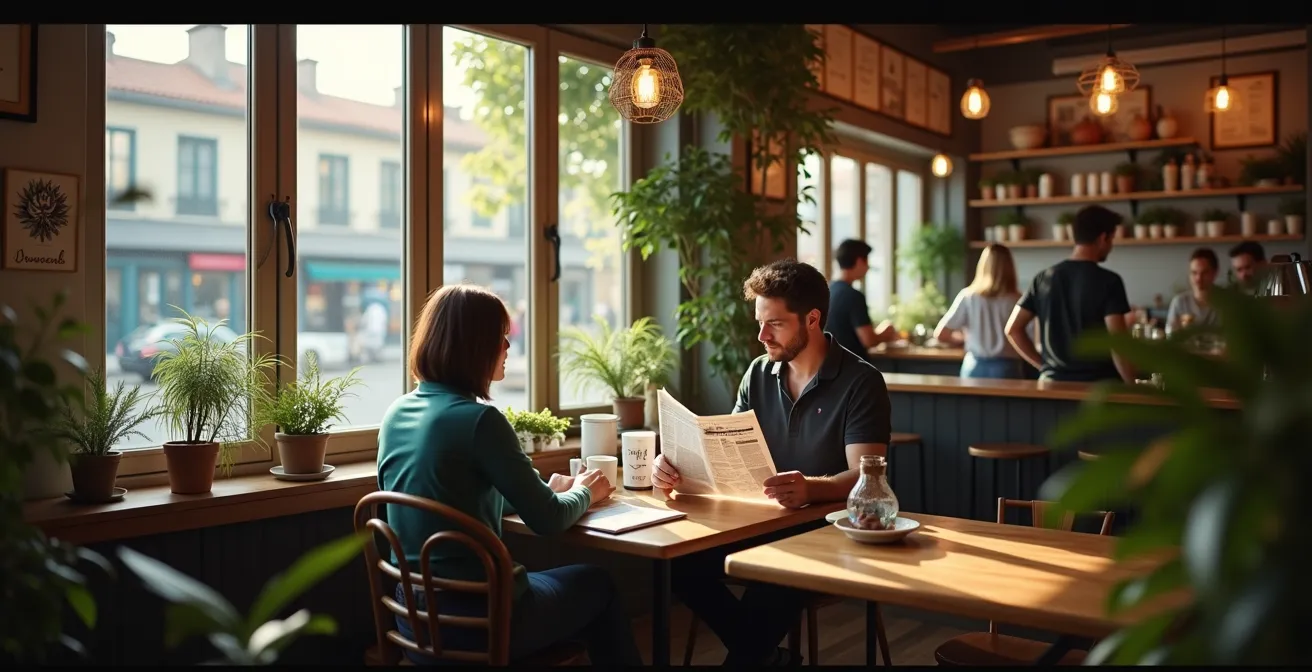
This shift from active pursuit to passive availability is central to the traveler’s ethos. It repositions the purpose of the journey from an external quest for sights to an internal one for understanding. As one travel analyst aptly puts it:
People use travelling as a way to learn about themselves as much as about their surroundings, whereas tourists use travelling as an escapism, a way to forget about themselves as much as the surroundings they’ve left behind
– An Adventurous World Travel Blog, The difference between tourists and travellers
By establishing a temporary ‘third place’, you are not escaping your life; you are actively creating a small piece of it within a new context. This simple act opens the door to insider knowledge, unexpected friendships, and a much deeper, more respectful understanding of the local culture.
Group Tours vs. Solo Travel: Which Delivers Better Cultural ROI?
The debate between group tours and solo travel often revolves around convenience versus freedom. However, when viewed through the lens of Cultural Return on Investment (ROI), the analysis becomes more nuanced. The choice is no longer just about logistics; it’s a strategic decision that directly impacts the depth of your cultural immersion. This is a critical calculation, especially when considering that 62% of travelers feel a trip is wasted if they don’t experience the local culture. Wasted potential is the ultimate low ROI.
Traditional group tours, by their nature, often yield a lower Cultural ROI. They provide a pre-packaged, sanitized version of a destination, where interactions are mediated by a guide and the itinerary is too rigid to allow for spontaneous discovery. The economic benefits often “leak” out to foreign-owned tour companies, bypassing the local community. While they offer high logistical ease, they create a “bubble” that insulates you from the very culture you came to experience.
Solo travel, on the other hand, offers the potential for the highest Cultural ROI. It forces you to be resourceful, engage directly with locals for navigation and recommendations, and be open to serendipitous encounters. Every dollar you spend is more likely to directly support local businesses. However, this high potential return comes with higher risk and effort—it demands significant planning, self-reliance, and a willingness to step far outside your comfort zone. A third option, the hybrid approach, allows for a strategic mix, such as traveling solo but booking specific, locally-run day tours for activities that require specialized knowledge or access.
To make an informed decision, it’s helpful to break down the trade-offs systematically. The following analysis compares these travel styles across key dimensions that contribute to your overall Cultural ROI.
| Aspect | Group Tours | Solo Travel | Hybrid Approach |
|---|---|---|---|
| Economic Impact | Often subject to ‘economic leakage’ with foreign-owned companies | Direct spending benefits local communities | Mix of both depending on choices |
| Cultural Immersion | Limited by structured itineraries | Freedom for spontaneous interactions | Best of both worlds |
| Local Engagement | Mediated through guides | Direct personal connections | Varied opportunities |
| Logistical Ease | High – everything arranged | Low – self-managed | Moderate – strategic planning |
| Cost Efficiency | Group rates but less flexibility | Variable, potentially higher | Optimized spending |
Ultimately, the “best” choice depends on your personal goals for Cultural ROI. If your priority is maximum immersion and you are willing to manage the logistics, solo travel is unparalleled. If you seek a balance, the hybrid model allows you to strategically outsource logistics while preserving opportunities for authentic engagement.
The Social Media Mistake That Ruins Authentic Travel Experiences
In the age of digital connectivity, the single greatest threat to an authentic travel experience is not a bad hotel or a tourist trap; it’s the impulse to perform your trip for an online audience. This behavior, driven by social media, transforms travel from an act of personal discovery into a public performance. The focus shifts from being present in the moment to capturing content that validates the experience for others. This fundamental change in motivation is a primary driver of low Cultural ROI, as the traveler’s attention is directed outward (to the screen) instead of inward (to the experience).
When a destination becomes a backdrop for a photoshoot, genuine engagement becomes impossible. The goal is no longer to connect with a place but to extract an aesthetically pleasing image from it. This “performative travel” creates a filter between you and reality. Instead of savoring the taste of a street food dish, you’re worrying about the best camera angle. Instead of listening to a local musician, you’re recording a 15-second clip for your story. This constant documentation fragments your attention and prevents the deep, uninterrupted immersion required for a transformative experience. Travel analysts have observed that travelers focused on performative documentation spend significantly less time in meaningful engagement with the culture around them.
Escaping this trap requires more than just willpower; it requires a structured approach to digital discipline. This isn’t about abandoning technology altogether, but about re-establishing its role as a tool, not the main event. It involves setting clear boundaries to protect your presence and attention. The goal is to experience the destination first and share it later—if at all. This deliberate separation allows you to process your journey on your own terms, free from the pressure of external validation. By implementing a framework, you can reclaim your trip from the demands of the algorithm and reinvest your focus in the real world unfolding in front of you.
How to Pack a Transformative Experience Into a 4-Day Weekend?
A common misconception is that a transformative travel experience requires a multi-week expedition to a remote location. This belief overlooks a more critical variable: experience density. A 4-day weekend focused on deep, immersive activity can yield a far higher Cultural ROI than a 10-day trip spent rushing between cities. The key is to trade breadth for depth, focusing on a single neighborhood or a specific cultural theme rather than trying to “see” an entire country. This concentrated approach is what the modern traveler craves; in fact, an overwhelming 98% of travelers say experiences are the most important factor when choosing where to go.
To achieve high experience density on a short trip, you need a strategic framework. Instead of a random assortment of activities, a structured “micro-immersion” plan allows you to build layers of understanding in a compressed timeframe. This isn’t about a rigid, minute-by-minute itinerary, but rather a thematic guide for each day that ensures a progression from context to participation and finally, to reflection. A successful short trip is an exercise in intentionality. You must resist the “fear of missing out” (FOMO) that drives the tourist checklist and instead embrace the “joy of going deep” (JOGD).
By dedicating a long weekend to a single, well-defined purpose—whether it’s understanding a city’s street art scene, exploring its culinary traditions through markets and cooking classes, or tracing its history through niche museums and local architecture—you create a cohesive narrative. This depth of focus allows for richer memories and a more profound connection to the place than a superficial survey of its most famous landmarks. The following template provides a model for structuring a 4-day micro-immersion journey.
- Day 1 – Context: Your first day should be dedicated to understanding the “why” of your destination. Visit a niche local history museum (not the main national one), join a specialized walking tour led by a historian or journalist, or visit a cultural center to get a primer on the local socio-political landscape. This provides the foundational knowledge for everything you will experience next.
- Day 2 – Participation: Shift from observer to participant. Take a hands-on workshop that is genuinely part of the local culture—a cooking class with a home chef, a pottery or craft lesson with a local artisan, or even a language exchange meetup. This creates direct, peer-to-peer interaction.
- Day 3 – Observation: This is your day for unstructured exploration and serendipity. Spend your time in non-tourist neighborhoods. Wander through a local market without a shopping list, sit in a park and people-watch, or use public transportation to simply see where it takes you. The goal is to observe the un-curated, everyday rhythm of life.
- Day 4 – Reflection: Before rushing to the airport, dedicate the final morning to processing your experience. Go to a local café, put your phone away, and write in a journal, sketch, or simply sit and think about what you’ve learned and how it has impacted you. This act of reflection is what cements the transformation.
The “Bucket List” Mindset That Concentrates Crowds in One Spot
The “bucket list” is perhaps the most potent symbol of the extractive tourism model. It reduces the immense cultural and geographical diversity of the world to a finite, marketable checklist of “must-see” places. While seemingly harmless, this mindset is a primary driver of overtourism, a phenomenon that degrades destinations, frustrates locals, and ultimately delivers a hollow experience for the traveler. The goal becomes collection, not connection. The question is no longer “What can I learn here?” but “Did I get the photo?” This concentrates millions of visitors into the same few square kilometers, creating immense strain on infrastructure and culture.
Venice is the quintessential case study. With a resident population of around 250,000, the city struggles under the weight of an estimated 20 million tourists annually. This has led to protests from locals and the implementation of a controversial €5 entry fee to manage the crowds. The bucket list imperative to “see Venice” has turned a living city into a theme park on the verge of collapse. The irony is that the very thing bucket-listers seek—an authentic Venetian experience—is being destroyed by their collective presence. The traveler’s mindset offers a solution: seek the alternative. Instead of contributing to the problem in Venice, a traveler might explore Bologna or the smaller coastal towns of the Veneto region, discovering equally rich culture without the destructive crowds.
This desire to escape the herd is growing, as recent tourism research indicates 56% of travelers want to explore destinations off the beaten path. This represents a significant shift toward a more sustainable and rewarding form of travel. Breaking free from the bucket list requires a conscious re-evaluation of your travel motivations. It means seeking out experiences rather than just locations. Instead of “I want to see the Taj Mahal,” a traveler might think, “I want to understand Mughal architecture” or “I want to experience daily life in Uttar Pradesh.” This shift in framing opens up a world of possibilities beyond the crowded icons, leading to more unique, personal, and sustainable journeys.
Key Takeaways
- The feeling of post-trip emptiness stems from a “tourist” model of travel focused on consumption, not a “traveler” model focused on immersive investment.
- True cultural connection is rarely forced; it’s fostered by slowing down and becoming a “temporary regular” in local ‘third places’ like neighborhood cafes.
- The best travel style (solo, group, or hybrid) depends on your desired “Cultural ROI,” balancing logistical ease with the potential for authentic immersion.
Why Changing Hotels Every 2 Days Kills Your Cultural Experience?
The fast-paced, multi-city itinerary is a hallmark of the tourist mindset—if it’s Tuesday, this must be Belgium. This “hotel hopping” approach, where you change location every one or two nights, is one of the most effective ways to destroy any chance of a meaningful cultural experience. It keeps you in a perpetual state of transit, spending more time packing, unpacking, checking in, and navigating to the next stop than actually engaging with any single place. Your brain is constantly occupied with logistics, leaving no mental space for observation, reflection, or serendipity. You experience a series of superficial first impressions without ever reaching a deeper second layer.
This rapid movement prevents the formation of temporary roots, which are essential for achieving a high Cultural ROI. You never have the chance to establish a ‘third place’, build a rapport with the local bakery owner, or discover the hidden park that isn’t in the guidebook. You remain a perpetual stranger, skimming the surface of multiple locations but understanding none. This approach prioritizes the quantity of pins on a map over the quality of the experience at any single pin. It is the geographic equivalent of speed-reading a library; you can say you’ve “been through” all the books, but you haven’t absorbed any of their stories.
A far more effective strategy for deep immersion is the “Hub and Spoke” model. This involves choosing one city or town as a central base (the hub) for a longer period (5-7 days) and using it to take day trips (the spokes) to surrounding areas. This model drastically reduces logistical friction and cognitive load, freeing up your time and energy to invest in your base location. It allows you to develop a routine, become a familiar face, and truly get to know the rhythm of one place, all while still offering the variety of exploring nearby sights. It is a powerful method for balancing depth with discovery.
Action Plan: Implementing the Hub and Spoke Model
- Choose your hub: Select a central location with excellent transport links to serve as your base for at least 5-7 days.
- Map your spokes: Identify several compelling day-trip destinations within a 1-2 hour travel radius from your chosen hub.
- Build local rapport: Engage with your accommodation staff and other local service providers for insider tips and recommendations.
- Establish a routine: Become a familiar face by frequenting a local café or market, creating opportunities for organic interaction.
- Explore your neighborhood: Dedicate evenings to deeply exploring the immediate area around your accommodation rather than rushing to new zones.
How to Engage With Local Cultures Without Being a Disrespectful Outsider?
The desire to engage with local culture is the primary driver for those transitioning from tourist to traveler. A recent study found that for 51% of leisure travelers, experiencing a destination as a local is a high priority. However, this intention must be paired with a strong ethical framework to avoid being patronizing, intrusive, or disrespectful. True engagement is not about “going native” or treating a culture as an exotic commodity. It is about approaching it with humility, curiosity, and a conscious effort to be a positive presence—both socially and economically.
Respectful engagement begins long before you arrive. It involves pre-trip preparation that goes beyond booking flights. This means learning about the country’s current social and political climate, understanding its basic history, and learning more than just a handful of pleasantries in the local language. Reading a novel by a local author or watching a film from that country can provide more cultural insight than a dozen guidebooks. This foundational knowledge demonstrates a genuine investment in the culture and helps you navigate interactions with greater sensitivity.
Once there, respect is shown through your actions. It means dressing modestly in conservative areas, asking for permission before photographing people, and paying fair prices to local artisans without aggressive haggling that devalues their work. It means prioritizing locally-owned guesthouses, restaurants, and tour operators over international chains, ensuring your money directly supports the community you are visiting. The most profound shift is moving from a position of judgment to one of curiosity. Instead of asking “Why do they do it this way?”, a traveler asks “What can I learn from the way this is done?” This simple change in perspective is the foundation of all respectful and meaningful cultural exchange.
Frequently Asked Questions on How to Transition From a Tourist to a Traveler
How can I show respect through my economic choices while traveling?
Prioritize locally-owned businesses over international chains, pay fair prices without aggressive haggling over small amounts, and learn local tipping customs to show appreciation for services.
What pre-trip preparation shows cultural respect?
Read novels by local authors, watch films from the country, understand current social and political issues, and learn basic phrases beyond just ‘hello’ and ‘thank you’ to demonstrate genuine investment in the culture.
How should I approach photography and sharing stories about locals?
Always ask permission before photographing people, request consent before sharing their stories online, avoid narratives that exoticize or stereotype, and focus on human connections rather than just aesthetic content.