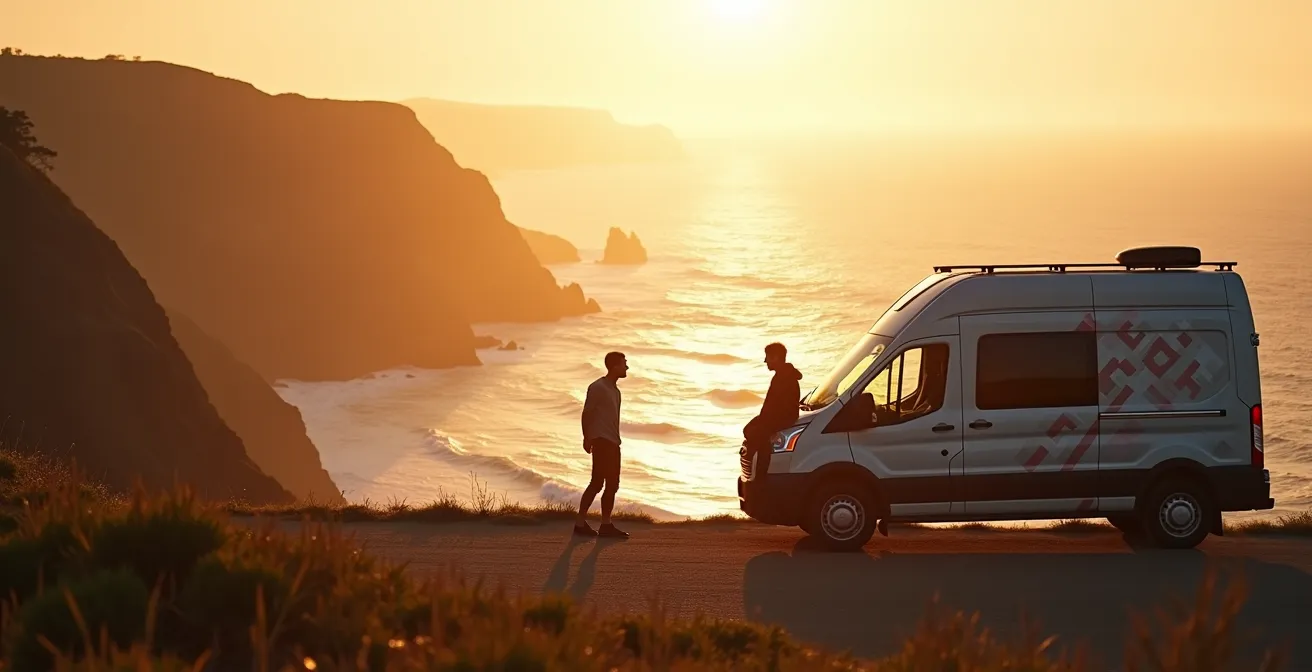
The secret to a successful couples’ van trip isn’t romance; it’s mastering the boring, unsexy logistics that social media never shows you.
- Tiny annoyances, like wet towels or messy packing, escalate into major conflicts in a cramped space if you don’t have a system.
- Success is redefined not by perfect photos, but by your ability to laugh together when plans inevitably fall apart.
Recommendation: Before you go, agree on practical micro-habits for daily chores (like condensation control and one-pot meals) to prevent logistical friction from ruining your trip.
The Instagram posts wrote a beautiful story. You and your partner, silhouetted against a fiery sunset, clinking coffee mugs as the ocean mist rolls in. The hashtag #VanLife promised freedom, connection, and a romantic adventure for the ages. You rented the van, packed your bags, and hit the road, ready to live the dream. Then, reality hit. The van is smaller than your bathroom at home, everything smells faintly damp, and your partner’s habit of leaving dirty socks on the floor has suddenly become a crime against humanity.
Let’s be honest: the expectation gap between the curated fantasy of van life and the gritty reality of living in a metal box on wheels is vast. Most advice will tell you to “communicate” and “be flexible,” which is true but spectacularly unhelpful when you’re arguing about whose turn it is to empty the toilet. The real challenge isn’t the big stuff; it’s the constant, grinding friction of small, poorly managed logistics. Those seemingly insignificant details are the trip-killers.
But what if the key to survival—and even deeper connection—wasn’t about grand romantic gestures, but about mastering the mundane? This guide isn’t about finding the most picturesque sunset. It’s a realist’s handbook for creating the “unsexy systems” that prevent tiny annoyances from escalating into trip-ending arguments. We’ll focus on the practical, the procedural, and the nitty-gritty details that actually make or break a couple’s road trip.
This article will guide you through the essential systems you need to establish, from managing hygiene without a proper bathroom to finding legal places to sleep without getting a ticket. We’ll explore the practicalities of packing, cooking, and ultimately, redefining what a successful trip even looks like.
Summary: A Practical Guide to Van Life as a Couple
- Why Finding a Shower Is the Hardest Part of Van Life?
- How to Find Legal Overnight Spots Without Getting Fined?
- Factory RV or DIY Van: Which Offers Better Insulation?
- The Condensation Mistake That Makes You Wake Up Wet
- How to Pack Your Van So You Don’t Spend Hours Moving Boxes?
- How to Plan Meals That Only Require One Pot?
- How to Pack for a ‘No-Facilities’ Beach Day Without Overloading?
- What Defines a Successful Road Trip and How to Achieve It?
Why Finding a Shower Is the Hardest Part of Van Life?
Before your trip, the idea of skipping a shower for a day or two sounds rustic and liberating. After a 7-mile hike in the summer heat, however, that liberating feeling quickly gives way to a very real, very potent aroma. In a confined space, little things become magnified, and as one van life couple notes, dirty socks become 10,000 times more annoying. The constant hunt for a shower isn’t just about cleanliness; it’s about maintaining sanity and personal space in an environment that has neither.
This is your first test in what we call “logistical intimacy.” It’s not romantic, but creating a functional hygiene system is crucial. The goal is to feel human without relying on a full bathroom. Some seasoned van-lifers admit to going days without a proper shower after a sweaty hike, and “nobody knows.” Their secret lies in a well-honed system of alternatives.

Your anti-funk toolkit should become second nature. Here are the essentials for your system:
- The Grab-and-Go Bag: Keep a gallon-sized Ziploc bag packed with all your toiletries. When you find a shower at a campsite, gym, or truck stop, you just grab your bag and go without a frantic search.
- Baby Wipes Are Your Friend: A full-body wipe-down with antibacterial wet wipes can be a surprisingly effective “shower” between real ones. Don’t be shy; use as many as you need.
- Embrace Dry Shampoo: It might feel strange at first, but after a few weeks, your scalp adjusts. Dry shampoo is a lifesaver for extending the time between hair washes and can actually make your hair healthier.
Building this simple hygiene protocol removes a significant daily “friction point.” It’s one less thing to stress about, freeing up mental energy to actually enjoy your trip instead of worrying about where your next wash is coming from.
How to Find Legal Overnight Spots Without Getting Fined?
Nothing sours the romance of waking up to a beautiful sunrise like a sharp rap on the window from a police officer. Finding a legal, safe, and free (or cheap) place to park for the night is one of the biggest recurring stressors of van life. The dream is “wild camping” on a secluded beach, but the reality often involves navigating a confusing patchwork of local ordinances, “No Overnight Camping” signs, and the risk of hefty fines.
This is where another “unsexy system” becomes your best friend: a multi-tool approach to finding your nightly resting spot. Relying on just one method is a recipe for a stressful evening of aimless driving. For example, while Europe is generally well-suited for free camping in places like beach car parks or side roads, it’s not a given. Some dedicated networks, known as “Aires,” offer a reliable alternative. These spots are specifically for campervans, and Aires are often free or cost just a few Euros per night, providing a safe harbor when wild camping feels too risky.
Your overnight parking system should be a combination of digital tools and advance planning:
- Leverage Technology: Before you even lose cell service, consult apps. Tools like Park4Night, Outdooractive, and LVM GEO are crowdsourced databases of legal wild camping spots, official campsites, and everything in between. Even Instagram communities can be a source of local knowledge.
- Know the Rules: “Wild camping” doesn’t mean parking anywhere you please. It means stopping at freely selected locations where it is explicitly permitted. Always research the specific regional and local regulations before settling in for the night.
- Have a Backup Plan: Research official campsite facilities in your target area in advance. Knowing you have a paid, guaranteed spot as a fallback option removes the desperation from the search.
Decide on your strategy together before you’re tired and hungry. Is tonight a free spot on a quiet road, or is it worth paying for a campsite to use their facilities? Making this a calm, daily planning ritual transforms a major source of anxiety into a manageable part of the adventure.
Factory RV or DIY Van: Which Offers Better Insulation?
The perfect van temperature is a myth. You’ll either be freezing your toes off on a surprisingly cold desert night or sweating through your sheets during a humid coastal morning. Insulation is the invisible force that dictates your comfort level and, by extension, your mood. For first-timers, the choice between a professionally manufactured RV and a custom-built DIY van often hinges on this very factor.
A factory RV offers a known quantity. It comes with standard insulation designed for moderate climates, but it also has inherent weaknesses like thermal bridges—parts of the metal frame that transfer cold or heat directly inside. A DIY van, on the other hand, allows you to customize the insulation for your specific travel plans, whether that’s four-season mountain exploration or humid summer road trips. This choice directly impacts your budget and comfort.
This table breaks down the key differences to help you understand the trade-offs.
| Aspect | Factory RV | DIY Van |
|---|---|---|
| Initial Investment | Higher upfront cost | Variable based on build quality |
| Insulation Quality | Standard factory specs | Customizable to climate needs |
| Thermal Bridges | Present in metal frames | Can be addressed in custom build |
| Winter Performance | Adequate for moderate climates | Can be optimized for extreme cold |
| Moisture Management | Built-in ventilation systems | Requires careful planning |
Ultimately, neither option is perfect. A factory RV might be less efficient in extreme weather, while a DIY van’s performance depends entirely on the quality of the build. As one couple learned during their 8-month journey through Europe in their Ford Transit conversion, living in a van is a constant learning process. The key is to know your vehicle’s limitations and plan accordingly, rather than fighting against them.
The Condensation Mistake That Makes You Wake Up Wet
There are few things more miserable than waking up to find your sleeping bag damp, your windows dripping, and a distinct chill in the air. This isn’t from a leak; it’s from you. The simple act of breathing releases a surprising amount of moisture, and in a small, sealed metal box, that moisture has nowhere to go. Condensation is the silent relationship killer, turning your cozy nest into a damp, mold-prone cave.
Ignoring condensation is a rookie mistake with frustrating consequences. It’s a cousin to other water-related blunders, like the common RVer error of overfilling the greywater tank and having dirty dishwater back up into the sink. These are “unsexy problems” that require an “unsexy system” to solve. Your anti-condensation protocol should be a non-negotiable daily ritual.
Here is your step-by-step moisture control system:
- Crack a Window or Vent: Even when it’s cold, you need airflow. Cracking a window or running a roof vent fan on low overnight allows moist air to escape.
- Use Your Fan: Always run an exhaust fan while cooking and for a few minutes after. Boiling pasta can release an incredible amount of steam into your small space.
- Establish a ‘Wet Zone’: Designate a specific spot, ideally with good ventilation, for hanging damp towels and clothes. Never leave them in a pile on the bed or seats.
- Squeegee Ritual: Make it a morning habit. While one person makes coffee, the other squeegees the condensation from the inside of all the windows. It takes two minutes and prevents major moisture buildup.
Managing moisture is a team effort. By turning it into a simple, shared daily chore, you prevent the long-term problems of mold and dampness, and you eliminate another potential source of friction. It’s a perfect example of “logistical intimacy” in action.
How to Pack Your Van So You Don’t Spend Hours Moving Boxes?
In a campervan, every item you own lives in three places: where it’s supposed to be, on the floor, or in a box you have to move five times a day. The “I’ll just put this here for now” approach quickly devolves into chaos. You’ll spend more time playing a frustrating game of Tetris with your belongings than you will enjoying the view. Disorganization is a major friction point, leading to lost items and frayed nerves, especially when you’re on a schedule.
As many first-time RVers learn the hard way, feeling flustered is easy when you’re trying to pack up, clean, and hit a checkout time. The key isn’t to have less stuff; it’s to have a ruthless organization system where everything has a designated home and can be accessed easily. Your goal should be to minimize the number of times you have to move one thing to get to another.
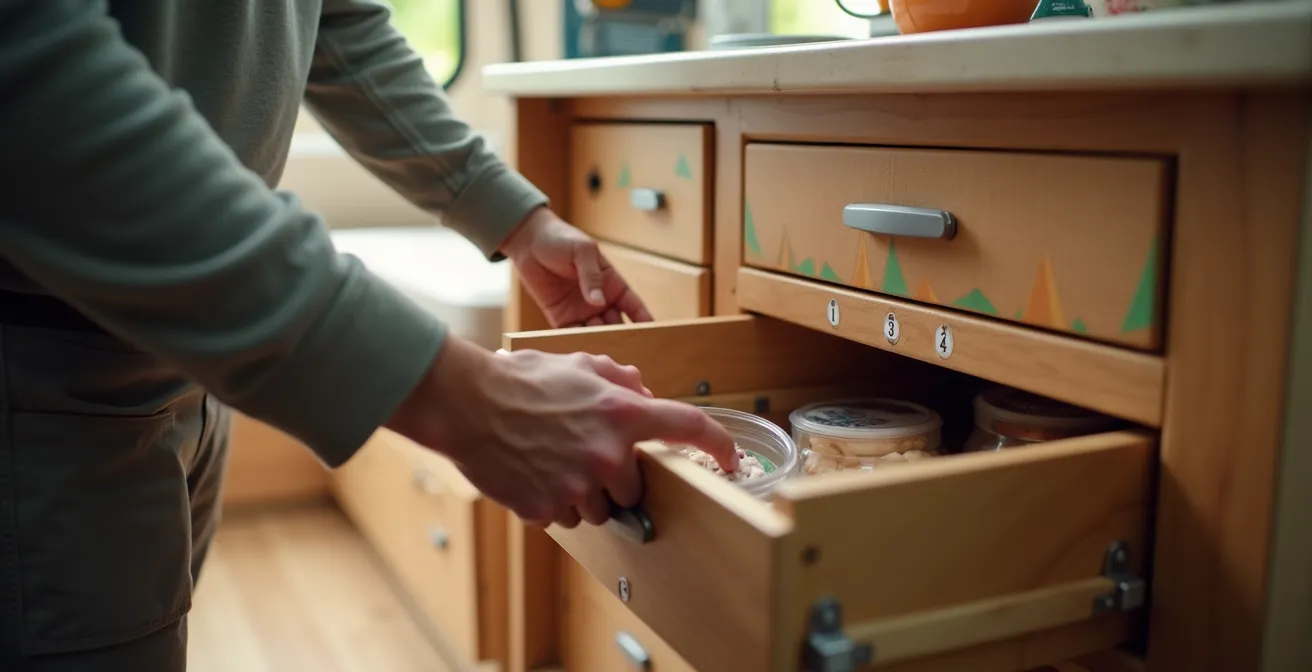
A smart packing system is built on clear rules and designated zones:
- Create Activity Zones: Group items by function. All kitchen supplies go in one area, sleeping gear in another, and outdoor equipment (chairs, hiking boots) in a third.
- Implement the ‘One-Touch Rule’: For frequently used items (coffee mugs, headlamps, jackets), you should be able to grab them with one touch, without moving anything else.
- Use Bins and Checklists: Use plastic bins to compartmentalize larger storage areas. And as advocated by the Checklist Manifesto, use a checklist for packing up and setting down. It seems simple, but it prevents you from forgetting to latch a cabinet or secure a loose item before driving.
Your Action Plan for a Clutter-Free Van
- Identify Touchpoints: List every item you’ll need daily (coffee, phone charger, toothbrush) and weekly (laundry soap, fresh towels).
- Inventory & Purge: Gather all your planned items. For each one, ask: “Is this essential, or just nice to have?” Be brutal.
- Establish Zones & Rules: Designate kitchen, sleep, and outdoor zones. Implement a strict “one in, one out” rule for any new purchases.
- Prioritize Accessibility: Place daily-use items in “one-touch” spots. Relegate less-used items to deeper storage.
- Create Checklists: Develop a “Pre-Drive” checklist (latch cabinets, secure items) and a “Campsite Setup” checklist. Laminate them.
When you’re not constantly searching for the salt or tripping over a stray shoe, you have more mental bandwidth to deal with the real challenges of the road. This isn’t just about being tidy; it’s about eliminating a constant, low-grade source of stress.
How to Plan Meals That Only Require One Pot?
The fantasy: whipping up a gourmet meal on a two-burner stove while gazing at the mountains. The reality: a tiny, cramped kitchen space, a minuscule fridge, and a sink the size of a cereal bowl. Washing a single large pot is a chore; washing three is a logistical nightmare that can easily end in a soapy, passive-aggressive standoff. Simplifying your cooking is not about sacrificing flavor; it’s about preserving your sanity.
The one-pot meal strategy is a cornerstone of peaceful van life cohabitation. It minimizes cleanup and forces you to be creative with your ingredients. The first step is to decide on your dining strategy: will you cook all your meals, eat out at cafes, or a mix of both? Even if you plan to eat out, every van comes with standard equipment for morning coffee and a simple breakfast, so some level of kitchen logistics is unavoidable.
A successful one-pot system relies on preparation and a well-stocked “Flavor Toolkit.”
- Prepare Batch Components: At the beginning of the week (or whenever you have access to a larger kitchen space), pre-cook core ingredients. Think a big batch of quinoa, roasted vegetables, or shredded chicken. You can then mix and match these components for quick, varied meals.
- Build a ‘Flavor Toolkit’: Your secret weapon for making simple food taste amazing. Keep a small box with essentials like a good olive oil, specialty hot sauce, dried herbs, spices, and a tube of tomato paste. These take up little space but provide maximum impact.
- Plan for Arrival Days: The first night at a new spot is often the most chaotic. Plan to have an extremely simple, pre-cooked, or no-cook meal for these days to avoid a stressful cooking experience when you’re already tired.
As vegan van life couple Eamon and Bec have shown, it’s possible to create incredible meals with limited space and equipment. By focusing on smart preparation and a few key flavor enhancers, you can enjoy delicious food without the stress and mess, making dinner a time for connection, not conflict.
How to Pack for a ‘No-Facilities’ Beach Day Without Overloading?
You’ve found the perfect, secluded beach. There are no crowds, no snack bars, no bathrooms—just sand, sun, and sea. This is the dream. The challenge? Everything you need for the day, from water to towels to snacks, has to be carried from the van. Overpacking means a miserable, sweaty trek; underpacking means a short, uncomfortable stay. Packing for an off-grid day trip requires a minimalist mindset.
As National Geographic’s camping experts wisely advise, it’s crucial to think carefully about how each inch of space is used in a van. This philosophy must extend to your daypack. The temptation to bring everything “just in case” is strong, but it’s a trap. Ask yourself honestly: “Do I really need three swimsuits and four sweatshirts? No. You don’t.” Consider what will genuinely make the day enjoyable, and ditch everything else.
Your minimalist beach day system should follow these rules:
- Create a ‘Base Camp’: The van is your base camp. Leave the main supplies there. This includes the big cooler, extra clothes, and bulk food.
- Pack a Single ‘Go-Bag’: For the actual trip to the beach, pack one minimalist bag per person or one shared bag. It should contain only the essentials for a few hours: water, a snack, sunscreen, a towel, and a book.
- Apply the ‘Double-Duty’ Rule: Every item you bring should ideally have at least two functions. A sarong can be a towel, a dress, and a sunshade. A wide-mouth water bottle can carry water on the way there and pack out trash on the way back.
- Master Your Shoe Strategy: It sounds trivial, but it’s not. Decide where your sandy shoes will live before you get back to the van. Having a designated “dirty shoe box” near the door keeps sand out of your bed and away from your living space.
By treating the van as your secure home base and only taking what you absolutely need, you make these spontaneous excursions more enjoyable and less of a logistical burden. It’s a small shift in mindset that has a huge impact on your daily freedom.
Key Takeaways
- Embrace “Unsexy Systems”: Success in a van isn’t about romance, it’s about agreed-upon systems for mundane tasks like condensation, hygiene, and parking.
- Master “Logistical Intimacy”: True connection comes from collaborating smoothly on daily chores, not from perfectly staged sunset photos.
- Redefine Success: A great trip is measured by your shared ability to laugh when things go wrong, not by an absence of problems.
What Defines a Successful Road Trip and How to Achieve It?
After navigating the challenges of finding showers, parking spots, and a semblance of personal space, you might wonder what a “successful” road trip even looks like. It’s not a trip free of problems. Even an experienced RV couple with 15 years on the road admitted to having their single worst day of driving in a decade because they ignored their own proven strategies (like avoiding big cities on weekdays and stopping by 3:30 PM). If it can happen to them, it will happen to you.
Success, therefore, is not the absence of adversity. A successful road trip is defined by your resilience as a team. It’s about your shared ability to handle the inevitable setbacks—the flat tire, the broken fridge, the terrible weather—without letting them derail your entire experience. It’s about shifting your mindset from expecting perfection to embracing the adventure, flaws and all.
This is the final, and most important, system to implement: a framework for emotional resilience.
- Laugh. Just Laugh: When plans fall apart, your first instinct might be to blame someone. Resist it. Force a laugh. It will feel unnatural at first, but it breaks the tension and helps you see the humor in the situation.
- Adapt Your Environment: Stuck at a less-than-scenic campsite because of pouring rain? Don’t mope. Close the curtains, put on your favorite music, and break out a cheese platter. As one wise van-lifer put it, “Wine tastes just as delicious inside a campervan as outside.”
- Create a Daily Highlight Reel: End each day by sharing one positive moment, no matter how small. It could be a great cup of coffee, a funny road sign, or a beautiful bird you saw. This simple habit retrains your brain to focus on the good, even on a tough day.
Ultimately, a campervan trip is a crash course in partnership. By letting go of the Instagram-perfect fantasy and embracing the messy, hilarious, and challenging reality, you give yourselves the freedom to have a genuinely unforgettable adventure. The goal isn’t to survive the trip without killing each other; it’s to finish it more connected, more resilient, and with better stories to tell.