In summary:
- True marine exploration without a scuba certificate is possible by shifting from a tourist’s mindset to a naturalist’s approach.
- Modern technology like advanced glass-bottom boats and surface-supplied air systems offer deep, immersive experiences without certification.
- Developing “aquatic literacy”—understanding tides, animal behavior, and safety—is more important than any single piece of equipment.
- Responsible exploration techniques, such as buoyancy control and using reef-safe products, are essential to protect the ecosystems you visit.
The shimmer of sunlight on the water’s surface holds a universal allure, a promise of a vibrant, hidden world just below. For many ocean lovers, the dream of exploring coral gardens and swimming alongside colorful fish feels just out of reach, gated by the requirements of SCUBA certification. The common advice—”just go snorkeling”—can feel like a consolation prize, leaving you floating on the periphery while the real mysteries remain unexplored. You might assume that without a tank on your back, you’re destined to be a surface-level spectator.
This guide is built on a different premise. We’ll set aside the notion that deep exploration is exclusively for certified divers. Instead, we’ll embrace the mindset of a marine naturalist: someone who uses knowledge, observation, and accessible technology to engage with the ocean in a meaningful and responsible way. This is about transforming from a passive tourist into an active observer. It’s about developing your “aquatic literacy” to understand the rhythms of the sea, from the grand sweep of the tides to the subtle warnings of a venomous creature.
The key isn’t to find a lesser alternative to diving, but to discover a different, equally rewarding path to underwater discovery. We’ll explore how modern innovations have turned simple boat tours into scientific expeditions and how you can breathe underwater with surprising freedom. You’ll learn not only *how* to see more, but *what* to look for, turning every trip to the coast into a genuine exploration. This journey will equip you with the skills to control your movements, protect fragile ecosystems, and truly connect with the marine world on your own terms.
This article will guide you through the practical steps and mindset shifts needed to unlock the ocean’s wonders without a C-card. Follow along to discover the tools, techniques, and knowledge that will transform your next coastal visit into an unforgettable adventure.
Summary: A Guide to Underwater Exploration for the Uncertified
- Why Glass-Bottom Boats Are No Longer Just for Kids?
- How to Breathe Underwater Without a Heavy Tank on Your Back?
- Wild Spotting or Conservation Aquarium: Which Is More Educational?
- The Venomous Mistake: Why You Should Never Touch a Cone Snail?
- When to Go Rock Pooling to Find the Most Creatures?
- How to Control Your Floatation to Avoid Kicking the Coral?
- Why Your Ears Hurt Underwater and How to Equalize Correctly?
- How to Visit Coral Reefs Without Damaging What You Came to See?
Why Glass-Bottom Boats Are No Longer Just for Kids?
Dismissing glass-bottom boats as a simple seaside novelty is a common mistake. The vessels of today have evolved far beyond the small, murky windows of the past. Modern boats are better described as floating observatories, equipped with advanced technology that transforms a passive ride into an immersive educational experience. They offer a unique opportunity for the non-diver to become an active observer, peering into complex ecosystems from a comfortable and dry vantage point. The key is to choose an operator that prioritizes education over mere sightseeing.
Today’s top-tier tours often feature expansive, high-definition viewing panels, climate-controlled chambers, and even gyroscopic stabilization for a smooth, clear view of the world below. Many employ marine biologists or naturalists as guides, providing expert commentary that builds your aquatic literacy. You’re not just looking at “fish”; you’re learning to identify species, understand their behaviors, and appreciate the intricate relationships within the reef. This guided observation is an invaluable first step in learning to read the marine environment.
Case Study: The Evolution of Key West’s Floating Observatories
An excellent example of this evolution is seen with operators like Fury in Key West. Their modern vessels allow passengers to explore North America’s only living coral reef in detail. Through massive viewing windows, guests can clearly see over 300 species of fish and impressive coral formations like elkhorn and brain coral. The experience is elevated by experienced crews who lead informative eco-tours, highlighting the most fascinating marine life and explaining the dynamics of the island waters, turning a simple boat trip into a genuine learning expedition.
By selecting a tour that offers this level of expertise and technology, you are essentially participating in a mobile marine biology lesson. It’s a perfect way to gain a foundational understanding of a reef’s structure and inhabitants before you even get your feet wet, preparing you for more direct encounters in the future.
How to Breathe Underwater Without a Heavy Tank on Your Back?
The dream of breathing underwater—of achieving true sensory immersion without the cumbersome weight and training of SCUBA—is more accessible than ever. Surface-supplied air (SSA) systems, often known by brand names like SNUBA or hookah diving, bridge the gap between snorkeling and diving. These systems use a long hose to connect your regulator to an air supply (a tank in a raft or on a boat) floating on the surface. This grants you the freedom to explore the water column with ease and tranquility.
The experience is liberating. Unburdened by a tank, you can move more naturally, focusing entirely on the marine life around you. For many, this is the ‘aha moment’ where the underwater world transforms from something you look at to a place you can truly inhabit. These modern tankless diving systems enable exploration to depths of 20-25 feet without needing certification, opening up vast areas of the reef that are inaccessible to the average snorkeler. This depth allows you to hover over coral gardens and observe creatures in their natural habitat from a respectful, yet intimate, distance.
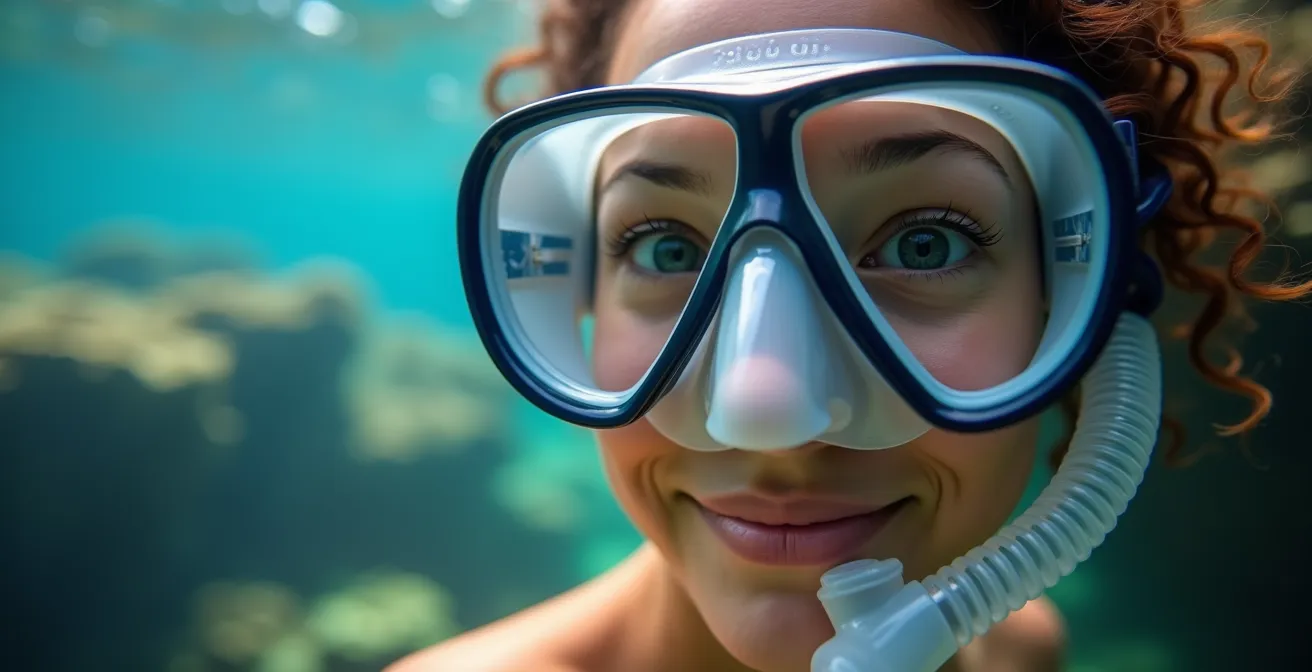
Mastering breathing with an SSA system is straightforward. It begins with getting comfortable with the equipment on dry land and then progressing to shallow water. The core skills involve maintaining a calm, steady breathing rhythm—slightly slower and deeper than normal—and learning to “purge” or clear the snorkel and regulator with a forceful exhale if any water enters. With a brief orientation from a guide, most people feel confident and relaxed within minutes, ready to focus on the breathtaking scenery around them.
Wild Spotting or Conservation Aquarium: Which Is More Educational?
The debate between observing marine life in the wild versus in an aquarium often misses the point. The most effective approach for an aspiring naturalist is not to choose one over the other, but to use them in synergy. Think of a high-quality conservation aquarium as a “living textbook”—a controlled environment where you can build your foundational knowledge before heading out into the unpredictable ocean. This is a crucial step in developing genuine aquatic literacy.
In the wild, a fleeting glimpse of a rare fish might last only seconds. In a well-designed aquarium, you can spend minutes observing that same species up close. You can study its colors, movements, and interactions with its habitat, all with the help of detailed identification plaques and educational displays. This controlled observation primes your brain, so when you do encounter that creature in the ocean, you’ll not only recognize it instantly but also have a deeper understanding of its behavior and role in the ecosystem. This approach transforms wild spotting from a game of chance into an exercise in applied knowledge.
Case Study: The Hybrid Explorer Method of the Nautilus Program
The Nautilus Exploration Program perfectly demonstrates this synergy. Its research vessel uses live-streaming underwater vehicles to explore the deep sea, allowing scientists and the public to observe from anywhere. The program embeds educators on expeditions who share their experiences, enabling learners to practice species identification and understand behaviors through this controlled, remote observation before or after their own wild encounters. It proves that combining structured learning with real-world exploration yields the richest educational outcome.
The key is to choose a facility dedicated to conservation, research, and education, not just entertainment. Look for accreditations from bodies like the Association of Zoos and Aquariums (AZA), active research and rehabilitation programs, and a clear focus on conservation messaging. By supporting these institutions, you are not only enriching your own knowledge but also contributing to the protection of the marine environments you long to explore.
The Venomous Mistake: Why You Should Never Touch a Cone Snail?
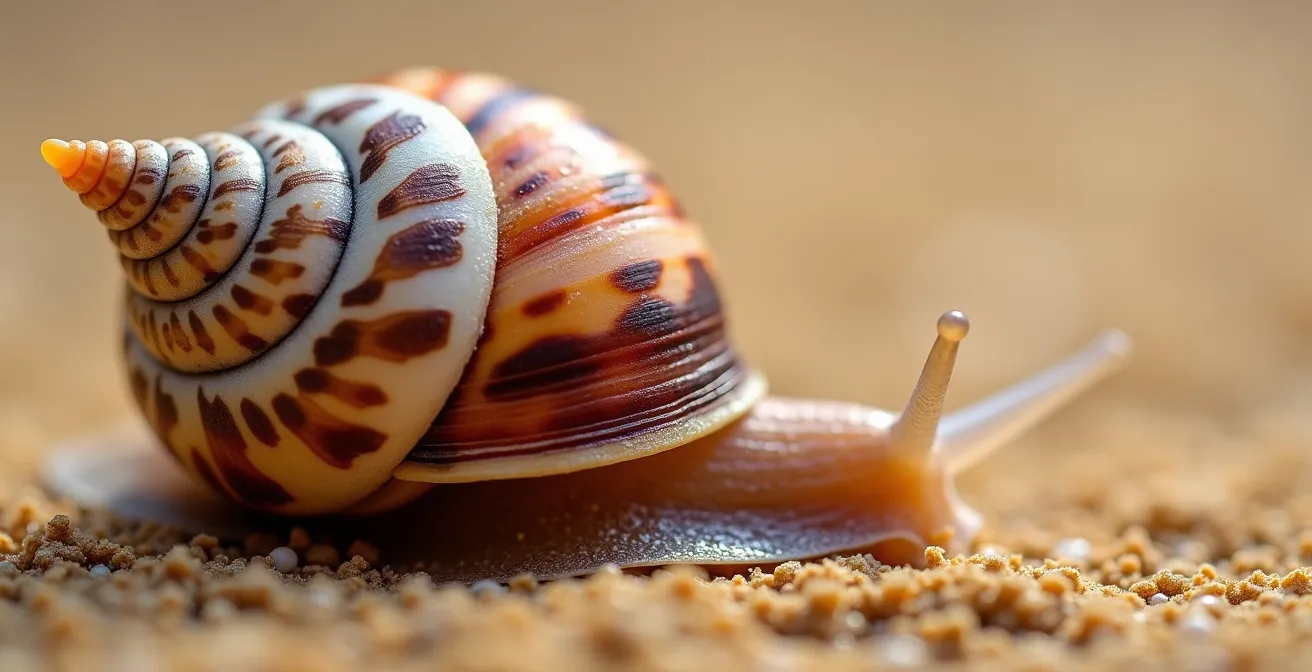
In the intricate world of the reef, curiosity can be a double-edged sword. The urge to touch a beautiful shell or peer into a dark crevice is natural, but it’s a habit that every aspiring marine explorer must unlearn. The cone snail, with its exquisitely patterned shell, is a perfect and potent example of why the number one rule of underwater exploration is “look, don’t touch.” This is not just a guideline; it’s a critical lesson in aquatic literacy—the ability to recognize that beauty can often be a warning.
Cone snails are predatory mollusks that hunt using a venomous, harpoon-like tooth. The venom of some species, particularly the larger ones, is powerful enough to be fatal to humans. Their intricate shell patterns are not an invitation; they are a form of aposematism, or warning coloration, signaling danger. Recognizing such natural warnings is a core skill for any active observer. This principle extends to many other creatures, from the vibrant blue-ringed octopus to the camouflaged stonefish. The safest assumption is that any creature you don’t recognize could be venomous or have a powerful defensive mechanism.
It’s crucial to understand that most marine injuries are defensive, not aggressive. As research shows, defensive marine injuries occur primarily from inadvertent touching or when people stick their hands and feet into crevices and holes where animals hide. By maintaining a respectful distance and keeping your hands to yourself, you eliminate the vast majority of risks. This practice of minimal impact exploration protects not only you but also the delicate creatures of the reef, which can be harmed by the oils and bacteria on human skin, or stressed by being handled.
When to Go Rock Pooling to Find the Most Creatures?
Rock pooling is one of the most accessible and rewarding forms of marine exploration, a micro-safari available on almost any coastline. It requires no special equipment, just a keen eye and, most importantly, a solid understanding of the tides. The secret to a successful rock pooling adventure isn’t luck; it’s timing. Going at the right moment transforms a collection of barren puddles into a series of vibrant, teeming aquariums, each a window into a world that is usually hidden beneath the waves. This is aquatic literacy in its most practical form.
The key is to explore during a low tide, specifically a “spring low tide.” Spring tides have nothing to do with the season; they occur twice a month during the full moon and the new moon, when the gravitational pull of the sun and moon align, creating the highest high tides and the lowest low tides. These extra-low tides expose the lower intertidal zones, areas that are rarely uncovered. It is here, in the deeper pools that remain, that the most fascinating and elusive creatures can be found: sea stars, urchins, nudibranchs, and occasionally even a small octopus.
The principle of using tides for discovery is as old as ocean exploration itself. The groundbreaking HMS Challenger expedition of 1872-1876, which discovered over 4,700 new marine species, relied on systematic sampling timed with optimal tidal conditions. Modern explorers use digital tide charts to pinpoint the exact time of the lowest tide, planning to arrive about an hour before to maximize their exploration window. This methodical approach turns a casual beach walk into a structured and fruitful expedition.
| Zone | Water Coverage | Common Species | Best Viewing Time |
|---|---|---|---|
| Splash Zone | Spray only | Periwinkles, barnacles, lichens | Any low tide |
| High Intertidal | Covered at high tide | Limpets, shore crabs, small anemones | Regular low tide |
| Mid Intertidal | Regular exposure | Mussels, larger anemones, hermit crabs | Spring low tide |
| Low Intertidal | Rarely exposed | Sea stars, urchins, nudibranchs, octopuses | Lowest spring tide only |
How to Control Your Floatation to Avoid Kicking the Coral?
One of the most essential skills for minimal impact exploration is buoyancy control. For snorkelers and users of surface-supplied air systems, this means mastering a state of neutral buoyancy where you can hover effortlessly in the water, propelled by breath and stillness rather than frantic kicking. Poor buoyancy control is the number one cause of accidental reef damage, as errant fins can break decades of fragile coral growth in a single, clumsy kick. Learning to control your position in the water is a sign of a true active observer, someone who respects the environment they have come to admire.
The most powerful tool for a snorkeler’s buoyancy is not their fins, but their lungs. Your lungs act as a natural Buoyancy Control Device (BCD). A full inhalation will cause you to rise slightly in the water, while a slow, controlled exhalation will cause you to sink. By mastering these micro-adjustments, you can navigate over coral heads without touching them and dip down for a closer look at a creature on the sand, all with minimal movement. The ideal position is a horizontal “trim,” with your body straight and parallel to the surface, legs together, and arms at your sides. This streamlined posture minimizes your profile and prevents your fins from dangling down where they can cause damage.
Equipment, particularly a wetsuit, can significantly affect your natural buoyancy. The neoprene in a wetsuit is filled with tiny air bubbles, making it inherently buoyant. For instance, the added floatation from a 3mm wetsuit significantly affects snorkeler buoyancy and positioning, adding approximately 5-8 pounds of positive buoyancy. This can make it difficult to stay horizontal or descend even slightly. To counteract this, a small amount of weight (1-2 pounds to start) on a weight belt can help you achieve neutral buoyancy, where you neither sink nor float with a normal breath. This allows you to hover motionless, becoming part of the scenery rather than an intruder.
Why Your Ears Hurt Underwater and How to Equalize Correctly?
As you descend even a few feet underwater, you’ll feel a building pressure in your ears. This sensation, known as “ear squeeze” or barotrauma, is the most common barrier that prevents snorkelers from enjoying deeper exploration. It’s your body’s direct signal of the immense, invisible force of water. Understanding this feeling and learning how to manage it is a fundamental aspect of sensory immersion and a crucial piece of your developing aquatic literacy. The good news is that it’s an easy problem to solve with the right techniques.
The pain is caused by a pressure imbalance. The water pressure on the outside of your eardrum becomes greater than the air pressure in your middle ear. To relieve this, you must “equalize” by pushing air from your throat into your middle ear via the Eustachian tubes. This should be done early and often as you descend—before you feel any pain. Waiting until it hurts can make equalization difficult or impossible. There isn’t one single method that works for everyone; the key is to find the technique that works best for your body. The most common methods include:
- Valsalva Maneuver: The most widely known method. You simply pinch your nose and gently blow against your nostrils.
- Toynbee Technique: A gentler option. Pinch your nose and swallow. The swallowing motion helps open the Eustachian tubes.
- Frenzel Method: More advanced but very effective. Pinch your nose, close the back of your throat, and make a “K” sound with your tongue.
Your ability to equalize can also be significantly improved before you even enter the water. As a case in point, professional diving instructors recommend a 24-hour pre-dive preparation protocol to ensure easy equalization. This involves staying well-hydrated to thin mucus, and avoiding dairy products and alcohol, which can increase mucus production and block the Eustachian tubes. Using a saline nasal spray on the morning of your exploration can also help keep your sinuses clear, making the entire process smoother and more comfortable.
Key takeaways
- Adopt a Naturalist’s Mindset: Shift from being a passive tourist to an active observer who seeks to understand the marine environment.
- Master Minimal Impact Techniques: Learn skills like buoyancy control and proper equalization to explore gracefully and responsibly.
- Prioritize Education and Preparation: Use aquariums as “living textbooks” and learn to read the tides to maximize your discoveries in the wild.
How to Visit Coral Reefs Without Damaging What You Came to See?
Visiting a coral reef is a privilege. These breathtakingly complex ecosystems are incredibly fragile, and our presence, however well-intentioned, can cause unintended harm. The ultimate expression of the naturalist’s mindset is to leave a place not just as you found it, but to have contributed positively through responsible choices. This final step in your journey is about synthesizing all your skills—your observational abilities, your buoyancy control, your environmental knowledge—into a cohesive practice of minimal impact exploration.
The responsibility begins before you even see the ocean. It starts with choosing the right tour operator—one that uses permanent mooring buoys instead of dropping anchors that can smash coral. It continues with your personal preparation: selecting a reef-safe sunscreen that uses minerals like zinc or titanium oxide instead of harmful chemicals like oxybenzone, which is known to cause coral bleaching. It means securing all your gear—cameras, snorkels, water bottles—so nothing can be accidentally dropped onto the reef below. Every small choice contributes to the collective preservation of these underwater wonders, and with recent seabed mapping data showing the vast extent of vulnerable reef ecosystems, which now cover 23.4% of the mapped global seabed as of 2022, our collective impact is more significant than ever.
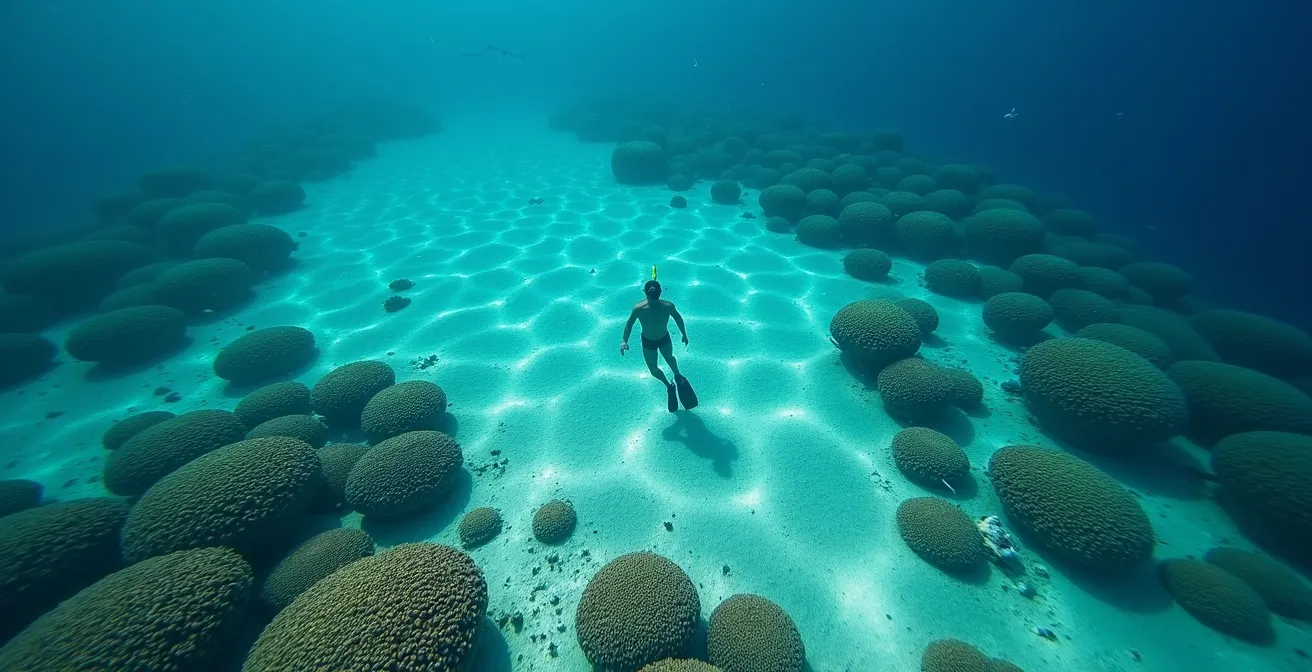
In the water, your practice of minimal impact continues. Always enter and exit the water from sandy patches or designated points, never by walking on the reef itself. Maintain a respectful distance of at least 3 feet from all coral. Remember the skills you’ve developed: use your breath to control your buoyancy, keep your body horizontal, and use slow, deliberate fin kicks far away from coral structures to avoid stirring up sediment, which can smother and kill polyps. This is the culmination of your training as an active observer: present and engaged, but with the lightest possible footprint.
Your Complete Reef Protection Audit Checklist: From Booking to Back on Shore
- Pre-trip operator verification: Confirm the use of mooring buoys instead of anchors and check for recognized certifications like Green Fins or Blue Flag.
- Equipment check: Only use reef-safe sunscreen (zinc/titanium-based) and securely fasten all loose items to prevent dropping them.
- Entry/exit protocol: Enter the water away from coral, always use designated entry points, and never stand on or touch reef structures.
- In-water behavior: Maintain a minimum distance of 3 feet from all coral and control your fin kicks to avoid stirring up sediment.
- Waste management: Use onboard facilities for all waste, secure food wrappers, and never throw anything overboard, including organic waste like fruit peels.
Your journey into marine exploration has just begun. By embracing these skills and adopting this mindset, you are equipped not just to see the ocean, but to understand and protect it. Start planning your next coastal adventure as a conscientious and knowledgeable marine explorer.