
Most tourists judge a wildlife venue on what they see, but true ethics are hidden in an organization’s operational DNA.
- Genuine sanctuaries have a strict no-contact policy; any hands-on interaction is a major red flag for exploitation.
- Ethical vetting requires checking for specific accreditations (like GFAS) and scrutinizing the facility’s purpose—is it rehabilitation or entertainment?
Recommendation: Before booking, investigate the facility’s animal acquisition policy and its long-term conservation goals. If the focus is on visitor experience over animal welfare, walk away.
The desire to connect with wildlife is a powerful, pure instinct. For any animal lover, the thought of seeing a majestic creature up close is a dream. Yet, this dream is exploited by a predatory industry that dresses up cruelty as conservation. You’ve likely heard the basic advice: don’t ride elephants, avoid circuses. But the modern tourist trap is far more sophisticated. It uses words like “rescue,” “sanctuary,” and “eco-friendly” to mask a business model built on the commodification of living beings. These places look professional, their social media is slick, and their stories are compelling. They are designed to fool compassionate people just like you.
The truth is, a facility’s ethics are not determined by the cleanliness of its paths or the friendliness of its staff. They are embedded in its operational DNA: where its animals come from, where its money goes, and whether its ultimate purpose is the animal’s freedom or the visitor’s photo opportunity. This is the non-negotiable line between a genuine haven and a high-grossing prison. The standard checklist is no longer enough. You must become an investigator, trained to spot the subtle red flags that expose an operation’s true character.
This guide is your training. We will move beyond the surface to dissect the systems that define true conservation. You will learn the stark reasons behind the ‘no-touch’ rule, how to vet a facility’s entire operation from your laptop, and how to distinguish real conservation work from a feel-good performance. It’s time to arm yourself with the knowledge to ensure your tourist dollars support genuine rescue, not relentless exploitation.
To navigate this complex landscape, this article provides a clear roadmap. Each section tackles a critical piece of the puzzle, equipping you to make informed and genuinely ethical choices for wildlife.
Summary: A Guide to Ethical Wildlife Tourism
- Why Touching a Wild Animal Is Never Okay in a Real Sanctuary?
- How to Vet a Wildlife Center’s Ethics in 10 Minutes Online?
- Wild Safari or Enclosed Sanctuary: Which Is Better for Conservation?
- The “Eco-Friendly” Label Scam That Fools 80% of Tourists
- How to Find a Volunteer Program That Actually Helps Animals?
- The Feeding Mistake That Destroys Entire Local Food Chains
- Wild Spotting or Conservation Aquarium: Which Is More Educational?
- How to Visit Fragile Ecosystems Without Leaving a Negative Footprint?
Why Touching a Wild Animal Is Never Okay in a Real Sanctuary?
Let’s be unequivocally clear: if you can touch, hold, ride, or take a selfie with a wild animal, you are not in a sanctuary. You are in a tourist trap that profits from animal suffering. This is not a guideline; it is a rigid, non-negotiable red line. The practice of allowing public contact habituates wild animals to humans, rendering them unreleasable and often sentencing them to a life of confinement. Worse, it is the primary driver of a brutal industry where animals are “trained” into submission through psychological and physical abuse. This isn’t speculation; it’s documented fact. Research from World Animal Protection found that 75% of 3,000 elephants in wildlife tourism lived in ‘severely cruel’ conditions, a direct result of their use in rides and other close-contact activities.
A true sanctuary’s mission is to provide a safe, stress-free environment that mimics an animal’s natural habitat as closely as possible. The priority is the animal’s well-being, not the visitor’s entertainment. Direct interaction with the public is intensely stressful for wild animals and serves no conservation purpose. It is purely a commercial transaction. A legitimate facility will enforce strict barriers and minimum safe observation distances, allowing animals to exhibit natural behaviors without the pressure of human presence. Their purpose is rehabilitation for release or, for those who cannot survive in the wild, a peaceful, permanent retirement.
This “hands-off” policy is the single most important indicator of a facility’s ethical integrity. It signifies that the organization’s loyalty is to the animals in its care, not to the wallets of its visitors. The moment an animal becomes a prop for a photograph, it ceases to be a creature respected for its wildness and becomes a commodity.
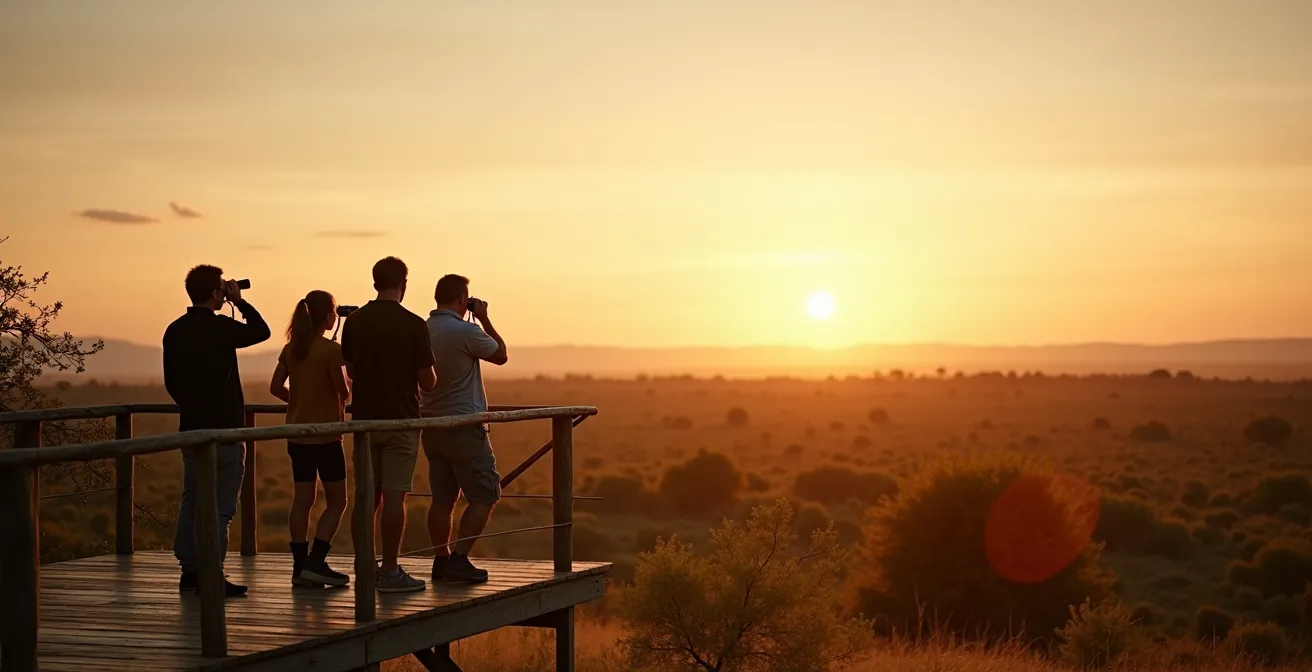
As this image demonstrates, ethical observation is about respect for the animal’s space. The goal is to be a passive, unnoticed observer, not an active participant in the animal’s life. This distance is a sign of respect and the hallmark of a true conservation-focused organization. It ensures that the animals’ welfare is never compromised for a fleeting moment of human entertainment.
Action Plan: On-Site Sanctuary Audit
- Verify no-touch policy: Confirm that strict, enforced barriers and minimum safe distances are maintained between all visitors and animals. Any physical contact is a dealbreaker.
- Check rehabilitation focus: Ask staff directly if the ultimate goal is release. If not, investigate why an animal requires permanent care (e.g., chronic injury, human habituation).
- Investigate acquisition methods: Inquire how the animals arrived. Ethical sanctuaries only accept animals from government authorities or other rescues; they never buy, trade, or breed them.
- Observe animal behavior: Look for natural, relaxed behaviors. Pacing, swaying, self-harm, or performing unnatural tricks are all signs of profound psychological distress (zoochosis).
- Examine housing conditions: Enclosures must be species-appropriate, spacious, and provide enrichment. Most importantly, they must have private areas where animals can retreat from public view entirely.
How to Vet a Wildlife Center’s Ethics in 10 Minutes Online?
In the digital age, deception is easy, but so is investigation. You can uncover the ethical core of most wildlife centers before you ever book a flight. Your most powerful tool is to look for independent, third-party verification. Do not trust a facility’s self-proclaimed “ethical” status or its own glowing testimonials. Instead, search for its name alongside the term “accreditation.” The gold standard is accreditation by the Global Federation of Animal Sanctuaries (GFAS). This isn’t just a plaque on the wall; it’s a rigorous certification that requires adherence to strict standards of animal welfare.
As a key part of their mission, the Global Federation of Animal Sanctuaries provides a reliable “seal of approval” for donors and visitors. A core tenet of their standards is that an organization’s operational decisions must prioritize the welfare of individual animals. Any facility that engages in or supports activities such as breeding animals, allowing direct contact with the public, or using animals for entertainment is immediately disqualified. This provides a clear, verifiable benchmark that separates genuine sanctuaries from what they call “pseudo-sanctuaries”—facilities that prey on public goodwill while buying and selling wildlife for profit.
Beyond accreditation, scrutinize online reviews with a critical eye. Ignore the generic “had a great day” comments and look for specific details that signal either ethics or exploitation. A well-meaning tourist might rave about “cuddling a baby tiger,” not realizing they are describing an animal torn from its mother and destined for a life of abuse. You must learn to read between the lines.
This table contrasts the language used in reviews of exploitative venues with that of ethical sanctuaries. It provides a clear guide to spotting red flags, even when the reviewer’s intent is positive.
| Review Red Flags | Review Green Flags |
|---|---|
| ‘Got to cuddle the baby animals’ | ‘Observed from a safe distance’ |
| ‘The handler let us feed them’ | ‘Learned about conservation efforts’ |
| ‘Great photo opportunities with tigers’ | ‘Impressed by non-interference policy’ |
| ‘Animals performed tricks’ | ‘Animals exhibited natural behaviors’ |
| ‘Could swim with dolphins’ | ‘Watched them in their natural habitat’ |
Wild Safari or Enclosed Sanctuary: Which Is Better for Conservation?
The debate between supporting a wild safari in a national park versus donating to an enclosed sanctuary is often framed as a choice between two competing options. This is a fundamental misunderstanding of their roles. They are not competitors; they are two distinct and equally vital components of a holistic conservation strategy. The wildlife tourism industry is a financial behemoth—a fact that carries both immense risks and incredible potential. With projections showing the wildlife tourism sector will reach $245.3 billion by 2034, where we direct that money has profound consequences.
A helpful way to understand their different functions comes from the conservation group Animal Survival International, which frames the dynamic perfectly:
Safaris (and protected wild spaces) are the ‘macro-investment’ protecting entire ecosystems and gene pools. Sanctuaries are the ‘micro-intervention,’ providing an essential safety net for individual victims.
– Animal Survival International, Ethical Wildlife Tourism Guide
A wild safari in a well-managed national park or conservancy supports the ‘macro’ level. Your park fees fund anti-poaching patrols, habitat preservation, and the protection of entire, functioning ecosystems. This is about preserving biodiversity and genetic health on a landscape scale. An enclosed sanctuary operates at the ‘micro’ level. It is the emergency room and refuge for the individual casualties of human-wildlife conflict, the illegal pet trade, and habitat loss. A true sanctuary provides specialized care for animals that cannot survive on their own.
The best models show how these two approaches are complementary. The Lilongwe Wildlife Centre in Malawi, for example, provides critical refuge and rehabilitation for animals orphaned by the bushmeat trade or injured in conflict zones. At the same time, it actively supports broader initiatives to protect Malawi’s wild spaces. Their strict hands-off policy and focus on animal welfare demonstrate how a sanctuary can fulfill its ‘micro’ role while educating the public and supporting the ‘macro’ conservation goal. The choice isn’t safari *or* sanctuary; it’s about supporting ethical operators in *both* spheres.
The “Eco-Friendly” Label Scam That Fools 80% of Tourists
The terms “eco,” “green,” and “sustainable” have become some of the most powerful—and meaningless—marketing buzzwords in tourism. This practice, known as greenwashing, is a deliberate tactic to mislead well-intentioned travelers. A facility can paint its walls green, use recycled paper for its brochures, and call itself an “eco-park,” all while engaging in horrific animal abuse behind the scenes. These superficial labels are designed to make you feel good about your purchase, but they often mask a deeply unethical operational DNA.
True environmental and ethical commitment is not demonstrated by marketing claims, but by rigorous, independently audited certifications. Just as you learned to look for GFAS accreditation for sanctuaries, you must learn to recognize legitimate certifications for the broader tourism industry. Unverified claims are worthless. Organizations like the Global Sustainable Tourism Council (GSTC) have established comprehensive criteria that include animal welfare, environmental protection, and community support. For traditional zoos and aquariums, accreditations from bodies like the AZA (Association of Zoos & Aquariums), BIAZA (British and Irish Association of Zoos and Aquariums), or WAZA (World Association of Zoos and Aquariums) indicate adherence to a set code of ethics.
The key is to ask: who is holding this facility accountable? Is their “eco-certification” a vanity award they paid for, or is it the result of a stringent, ongoing audit by a respected third party? A legitimate certification requires meeting high standards; a fake one requires a credit card. This distinction is everything.

The visual contrast is stark: one side is artificial, peeling, and hiding a decaying foundation. The other is alive, integrated, and genuinely part of its environment. This is the difference between greenwashing and authentic conservation. One is a cheap sticker, the other is a living system. Do not be fooled by the sticker. Always look for the evidence of a healthy, living system of accountability beneath the surface claims.
How to Find a Volunteer Program That Actually Helps Animals?
The desire to do more than just observe—to actively help—is a noble one. But this impulse has spawned a massive, often exploitative industry known as “voluntourism.” Many programs are cleverly disguised adventure holidays that not only fail to help animals but actively cause harm. They often rely on a steady stream of paying, unskilled volunteers to interact with animals, particularly young ones, to habituate them for a life as a tourist photo prop. The volunteer’s fee funds the exploitation, not the conservation.
A legitimate wildlife volunteer program puts the animals’ needs first, always. The work is often unglamorous and involves minimal to zero direct animal contact. Instead of “socializing” baby animals, you will be cleaning enclosures, preparing specialized diets, collecting behavioral data from a distance, or restoring habitats. The focus is on supporting the facility’s long-term conservation goals, not providing a short-term thrill for the volunteer. Consider the difference: are you there to serve the animals, or are they there to serve you an “experience”?
A prime example of an ethical model is the work of organizations like WorkingAbroad. Since 1997, they have partnered with NGOs focused on real conservation. Their project in Cambodia, developed with indigenous communities, maintains a strict hands-off policy with elephants. Volunteers observe from a distance while supporting habitat conservation and community initiatives. This demonstrates the core principle of ethical volunteering: the program is designed around the needs of the ecosystem and the welfare of the animals, not the entertainment of the volunteer.
Before signing up for any program, scrutinize the daily tasks. This table highlights the difference between work that provides genuine support and activities that are red flags for an exploitative operation.
| Legitimate Volunteer Tasks | Exploitation Red Flags |
|---|---|
| Cleaning enclosures and maintenance | Guiding paying visitors on tours |
| Preparing specialized animal diets | Assisting with animal performances |
| Collecting behavioral observation data | Socializing baby animals for photos |
| Habitat restoration and planting | Helping with breeding programs |
| Educational material development | Direct handling without veterinary purpose |
The Feeding Mistake That Destroys Entire Local Food Chains
The sign “Do Not Feed the Animals” isn’t just a friendly suggestion; it is a critical command for ecosystem preservation. Providing artificial food sources to wildlife, even with the best intentions, can trigger a catastrophic domino effect known as a trophic cascade. A trophic cascade is an ecological phenomenon where the alteration of one part of a food web—often the top or middle—causes a series of spiraling consequences throughout the entire ecosystem. It is a stark reminder that in nature, nothing happens in isolation.
Feeding animals creates an unnatural and unreliable food subsidy. This can cause populations of certain species to explode, throwing the delicate balance of the local food web into chaos. A powerful example comes from research on subsidy cascades, which showed how crop-raiding wild boars in Malaysia, artificially sustained by agricultural foods, caused a 62% decline in forest tree sapling density over 24 years. The boars, thriving on an external food source, spent more time in the forest, where they voraciously consumed seeds and saplings, effectively preventing the forest from regenerating. One “simple” act of providing food had a multi-decade impact on the very structure of the habitat.
Perhaps the most famous example of a trophic cascade is the reintroduction of wolves to Yellowstone National Park. Their return was not just about adding one species; it was about repairing an entire broken system. By preying on elk, the wolves changed their grazing patterns. The elk avoided valleys and gorges, which allowed riverbank vegetation like willow and aspen to recover. This, in turn, led to an increase in songbird populations and provided resources for beavers to build dams. The beaver dams created new wetland habitats for otters, muskrats, and fish. The wolves even changed the course of rivers. It is the ultimate demonstration of ecosystem integrity: every piece is connected, and removing or artificially altering one piece can unravel the entire fabric.
This is why ethical sanctuaries and national parks have such strict rules about food. Feeding a monkey a banana may seem harmless, but you could be inadvertently contributing to the decline of a rare bird species that competes with it for resources. Respect for wildlife means respecting the intricate, often invisible systems that sustain it.
Wild Spotting or Conservation Aquarium: Which Is More Educational?
The goal of an ethical wildlife encounter should be not just to see an animal, but to learn something meaningful about it and its place in the world. Both spotting an animal in its natural habitat and observing one in a high-quality conservation aquarium can be educational, but they teach very different things. The question isn’t which is “more” educational, but what *type* of intelligence they foster.
Wildlife researcher Dr. Stephanie Schuttler offers a brilliant distinction that clarifies their unique educational roles:
Wild spotting teaches ‘contextual intelligence’—understanding an animal’s role in its environment. Aquariums teach ‘biological intelligence’—understanding anatomy, physiology, and species diversity up close.
– Dr. Stephanie Schuttler, Wildlife Sanctuary Research
Wild spotting is an exercise in contextual intelligence. The experience of searching for an animal, understanding its tracks, and observing its behavior within its own environment teaches you about its relationships with other species and its habitat. Even *failing* to see an animal can be a powerful lesson in its rarity, its elusiveness, and the conservation challenges it faces. It fosters humility and respect for nature’s terms.
A high-quality conservation aquarium or zoo, on the other hand, excels at teaching biological intelligence. By providing safe, up-close views of creatures you might never see in the wild, they can illuminate details of anatomy, physiology, and life cycles. A truly educational facility will heavily feature conservation messaging about threats like plastic pollution or climate change, and will be transparent about its own research, rescue, and breeding programs (for release, not for profit). The best ones act as living encyclopedias and vital hubs for species preservation, accredited by bodies like the AZA or WAZA.
Both forms of education are valuable. Contextual intelligence builds an appreciation for ecosystems, while biological intelligence builds an appreciation for the species itself. An ideal approach to lifelong learning involves engaging with both: support well-managed national parks for contextual learning, and accredited, conservation-focused institutions for biological learning.
Key Takeaways
- The “no-touch” rule is the single most important, non-negotiable indicator of an ethical facility.
- Always verify accreditation from third-party organizations like GFAS or AZA; do not trust self-proclaimed “eco” labels.
- True volunteering is unglamorous work that supports animal welfare, not tasks designed for a tourist’s entertainment.
How to Visit Fragile Ecosystems Without Leaving a Negative Footprint?
Your responsibility as an ethical traveler doesn’t end once you’ve chosen a reputable sanctuary or park. It extends to every action you take while visiting. The classic “Leave No Trace” principles are a good start, but in our hyper-connected world, we must also consider our digital footprint. A single geotagged photo of a rare animal can lead poachers to its location or cause a massive influx of tourists that destroys its habitat. Your presence should be that of a ghost: observe, appreciate, and leave the environment exactly as you found it, both physically and digitally.
This “Leave No Trace 2.0” philosophy requires conscious choices. Instead of using a drone, which can cause immense stress to wildlife, invest in a long-lens camera to capture images from a respectful distance. Instead of applying chemical sunscreens that bleach coral reefs, opt for reef-safe alternatives or wear UV-protective clothing. And most importantly, always hire local guides who have a vested, lifelong interest in protecting their own environment. Their knowledge is invaluable, and your payment directly supports the community that acts as the frontline steward of that ecosystem.
A shining example of this holistic approach is the emergence of Wildlife Heritage Areas. This model, a collaboration between World Animal Protection and the World Cetacean Alliance, certifies destinations that center animal well-being, community leadership, and conservation. In these areas, tourism is designed from the ground up to be a force for good. Visitors support wildlife by maintaining respectful distances, they support local communities through direct economic benefit, and they support conservation through their fees. It is proof that tourism does not have to be an extractive industry; it can be a regenerative one.

Ultimately, ethical visitation comes down to an attitude of reverence. It is the understanding that you are a guest in the animals’ home. Your goal is not to conquer or capture, but to quietly witness and appreciate. This mindset, more than any single action, is what ensures you leave a place better, or at the very least, completely untouched by your presence.
By arming yourself with this knowledge—from online vetting to on-site conduct—you transform from a passive tourist into an active agent for conservation. Your choices have the power to starve exploitative operations and fund the vital work of those genuinely dedicated to protecting wildlife. Make those choices count.
Frequently Asked Questions About Ethical Wildlife Tourism
What makes an aquarium visit truly educational versus entertainment?
Educational facilities prioritize conservation messaging about threats like plastic pollution and climate change, showcase their research/rescue efforts, and provide detailed species information. Entertainment-focused venues emphasize spectacle and performances.
How can not seeing an animal during wild spotting be educational?
The experience teaches powerful lessons about rarity, conservation challenges, and the importance of patience and respect for nature’s terms – a humility lesson that guaranteed sightings can never provide.
What certifications indicate legitimate educational value?
Look for AZA (Association of Zoos and Aquariums) or GFAS (Global Federation of Animal Sanctuaries) accreditation, which require strict educational standards and conservation participation.