
The key to avoiding car rental scams is not just finding a low daily rate, but legally preparing for the inevitable upselling and liability traps at the counter and upon return.
- The rental company’s primary goal is to sell you overpriced, high-commission insurance; your credit card likely offers superior, primary coverage for free.
- Meticulous, time-stamped photo and video evidence of the car’s condition is your only true defense against fraudulent damage claims.
Recommendation: Before you travel, contact your credit card company to confirm you have primary rental insurance, and prepare to decline all optional coverage at the counter by default.
The moment of truth for any budget-conscious traveler arrives not at the airport, but at the rental car counter. You stand there, reservation in hand, while a friendly agent explains that your booking doesn’t include “full protection.” Suddenly, the great deal you found online is threatened by a cascade of expensive add-ons: collision waivers, liability supplements, and roadside assistance plans. You’re told that to be truly safe, you need to pay more. This is by design. The car rental industry doesn’t just rent cars; it sells peace of mind at an exorbitant premium, often preying on fear and ambiguity.
Most advice simply tells you to “read the fine print” or “compare prices,” but this is insufficient. These are not simple transactions; they are complex contracts where every clause is engineered for the company’s profit and your potential liability. To navigate this legal minefield, you cannot just be a savvy shopper; you must become a prepared defendant. You must understand that the friendly agent is often a commissioned salesperson, and the paperwork in front of you contains carefully worded contractual traps.
But what if the key wasn’t to argue, but to disarm? What if, instead of fighting at the counter, you arrived with a pre-built defense that makes their upselling tactics irrelevant and protects you from false claims? This is not about finding loopholes; it’s about understanding your existing rights and leveraging the tools at your disposal—from your credit card benefits to your smartphone’s camera—to build an ironclad case in your favor.
This guide will equip you with the defensive strategies of a consumer rights lawyer. We will dissect the most common financial traps, from the insurance hard-sell to phantom damage claims, and provide you with a clear, actionable playbook. You will learn not just what the scams are, but why they work and how to systematically dismantle them, ensuring the price you booked is the price you pay.
Summary: How to Rent a Car Without Getting Scammed on Insurance and Fees?
- Why the “Full Protection” at the Counter Costs 3x Market Rate?
- How to Photograph the Car to Prove You Didn’t Scratch It?
- Airport Convenience or City Savings: Is the Surcharge Worth It?
- The “Full-to-Empty” Scam That Charges You for Gas You Didn’t Use
- When to Upgrade From Economy to Compact for Highway Safety?
- The Off-Road Mistake That Voids Your Rental Insurance Instantly
- How to Handle Passing on a Single-Lane Mountain Road?
- How to Drive Coastal Highways Safely While Enjoying the View?
Why the “Full Protection” at the Counter Costs 3x Market Rate?
The Collision Damage Waiver (CDW) or “full protection” offered at the rental counter is not primarily an insurance product; it’s a massive profit-center. Agents are often heavily incentivized to sell these policies, as their commissions are tied directly to them. The pressure to buy is a sales tactic, not a genuine assessment of your risk. A landmark lawsuit revealed this systematic approach to upselling, where rental employees were allegedly instructed to aggressively push optional products. For instance, a recent federal lawsuit claims that customers were hit with fraudulent charges, with one traveler billed $215 for insurance they had already declined.
The truth is, you likely already have robust coverage. Many travel credit cards include primary rental car insurance as a standard benefit. “Primary” coverage is the gold standard—it pays out before your personal auto insurance, meaning you don’t have to file a claim or risk raising your premiums. To rely on the rental agency’s expensive, often inferior, product is to pay for something you already own. The key is to verify and activate this benefit correctly, which turns their biggest profit-driver into a non-issue for you.
Your Action Plan: Activating Credit Card Rental Insurance
- Confirm Coverage Before Travel: Call the number on the back of your credit card and ask an agent to confirm that your card includes “primary rental car insurance.”
- Check Policy Specifics: Inquire if the coverage is primary (pays first) or secondary (pays after your personal auto insurance). Ask about any exclusions, such as specific countries or vehicle types (e.g., luxury cars, large vans).
- Request Proof in Writing: Ask the credit card provider to email you a letter or a document outlining your coverage benefits. Save this on your phone in case a rental agent disputes your claim of being covered.
- Decline All Counter Coverage: At the rental counter, you must firmly decline the CDW/LDW. Accepting it, even for a single day, can void your credit card’s protection.
- Pay with the Correct Card: The entire cost of the rental must be charged to the credit card that provides the primary insurance benefit.
By preparing this beforehand, you neutralize the entire upselling conversation. When the agent begins the pitch, you can confidently state, “Thank you, but I have primary coverage through my credit card, so I will be declining all optional insurance.” This ends the debate and protects your wallet.
How to Photograph the Car to Prove You Didn’t Scratch It?
The most insidious rental car scam is the fraudulent damage claim. Weeks after you return a car, you receive a bill for hundreds, or even thousands, of dollars for a scratch or dent you are certain you did not cause. Without evidence, this becomes your word against theirs, and the rental agreement you signed gives them the power to charge your card. Your defense against this is not arguing; it is presenting irrefutable, time-stamped proof. You must adopt a process of forensic documentation, treating the car pickup and drop-off like a crime scene investigation where you are the lead detective.

This process creates an undeniable record of the vehicle’s condition while in your possession. A former rental car manager who was falsely accused of causing a £450 scratch successfully fought the charge with this exact method. As he explains, the evidence was indisputable:
A former rental car manager was accused of causing a £450 scratch but successfully disputed the charge using timestamped, geotagged photos showing the exact same mark was already on the car at pickup
– Bea Adventurous
To build your own bulletproof defense, follow this documentation protocol:
- Create a Video Walk-Around: Before you even get in the car, start recording a video on your smartphone. Walk slowly around the entire vehicle, narrating what you see. Say the date and time out loud. Zoom in on every single panel, the roof, the bumpers, the wheels, and the windshield. Point out and describe every existing scratch, ding, or scuff, no matter how small.
- Document the Interior: Continue the video inside the car. Record the condition of the seats (checking for stains or tears), the dashboard, and the headliner.
- Record the Mileage and Fuel: Zoom in on the odometer to record the starting mileage and the fuel gauge to show the fuel level. This is crucial for avoiding mileage or refueling disputes later.
- Repeat at Drop-Off: Perform the exact same video walk-around process when you return the car, preferably in the rental company’s lot. Be sure to capture the final mileage and the full fuel gauge again.
Do not delete these files from your phone for at least three to six months after the rental. If a claim arises, you will have a time-stamped, unassailable file to send, immediately shifting the burden of proof back onto the rental company.
Airport Convenience or City Savings: Is the Surcharge Worth It?
Renting directly from the airport is undeniably convenient, but this convenience comes at a steep, often hidden, price. The rates at airport locations are systematically higher than at off-airport, city-based branches of the same company. In fact, a NerdWallet analysis found it’s 26% more expensive to rent at airports on average. This premium isn’t arbitrary; it’s a direct pass-through of the high “concession fees” that rental companies must pay to the airport authority for the privilege of operating on-site. These fees, along with other local tourism taxes and facility charges, are bundled into your daily rate.
The question is whether this surcharge is worth it. For a solo traveler with a single bag, taking a 15-minute rideshare or shuttle to an off-airport location to save over 25% is a financially sound decision. The savings from a week-long rental can easily exceed $100, more than covering the minimal inconvenience of the extra travel leg. This strategy requires planning: you must book the off-airport location in advance and factor in the time to get there.
However, the calculation changes with context. If you are traveling with small children, multiple large bags, or arriving late at night, the immediate access and simplicity of an airport pickup may outweigh the financial savings. The “value” of the surcharge becomes a trade-off between money and stress. The key is to make this a conscious financial decision, not an automatic default. Before booking, compare the all-in price of an airport rental with the price of a city rental plus the round-trip cost of a taxi or rideshare. Only then can you determine if the airport convenience is a true luxury or an unnecessary expense.
Ultimately, a few minutes of research can reveal significant savings, empowering you to choose based on your specific travel needs and budget, rather than simply accepting the most obvious—and most expensive—option.
The “Full-to-Empty” Scam That Charges You for Gas You Didn’t Use
The “pre-paid fuel” option presented at the rental counter sounds like a convenience. The agent will offer you a “Full-to-Empty” plan, allowing you to return the car with any amount of gas left in the tank. They sell it as a way to save you the time and hassle of refueling before your flight. In reality, it is one of the most common and effective financial traps in the industry. When you accept this offer, you are paying for a full tank of gas at the rental company’s inflated price, which can be significantly higher than local station prices. One analysis found that rental companies typically charge several extra dollars per gallon for this “service.”
The scam has two layers. First, you pay a premium for the fuel itself. Second, it is nearly impossible to return the car with a completely empty tank. This means you are paying for gasoline that you did not use, which goes directly back to the rental company as pure profit. You are essentially giving them a gift of free fuel. The only scenario where this plan makes financial sense is if you are absolutely certain you will return the car running on fumes and have no time to stop, a situation that is extremely rare.
The correct and most cost-effective policy is always “Full-to-Full.” You receive the car with a full tank and are responsible for returning it with a full tank. Your defense against the pre-paid fuel scam is simple but requires discipline:
- Politely Decline: When offered the fuel package, your answer should be a firm, “No, thank you. I’ll be refueling it myself before I return it.”
- Locate a Gas Station: As you drive away from the rental agency, use your phone’s map to identify a gas station near the rental location. Save it for your return trip.
- Refuel and Retain Proof: Before returning the car, fill the tank completely at that nearby station. Crucially, keep the printed gas receipt.
- Document the Gauge: As part of your return documentation process, take a clear, time-stamped photo of the dashboard showing the fuel gauge needle on “Full” and the final odometer reading. Placing the gas receipt on the dashboard for this photo creates irrefutable proof.
If the company later tries to add a refueling charge, you can immediately provide the receipt and the photo as evidence, shutting down the claim instantly.
When to Upgrade From Economy to Compact for Highway Safety?
At the rental counter, the choice between an “Economy” and a “Compact” car often seems like a minor price difference of a few dollars per day. Many budget-conscious travelers default to the absolute cheapest option, but this can be a critical mistake, especially if your itinerary involves significant highway driving or challenging terrain. While both are small, the distinction between these classes often involves more than just legroom; it can impact stability, power, and overall safety at higher speeds. Economy cars are typically lighter and equipped with smaller engines, making them feel less planted and more susceptible to crosswinds on open highways.
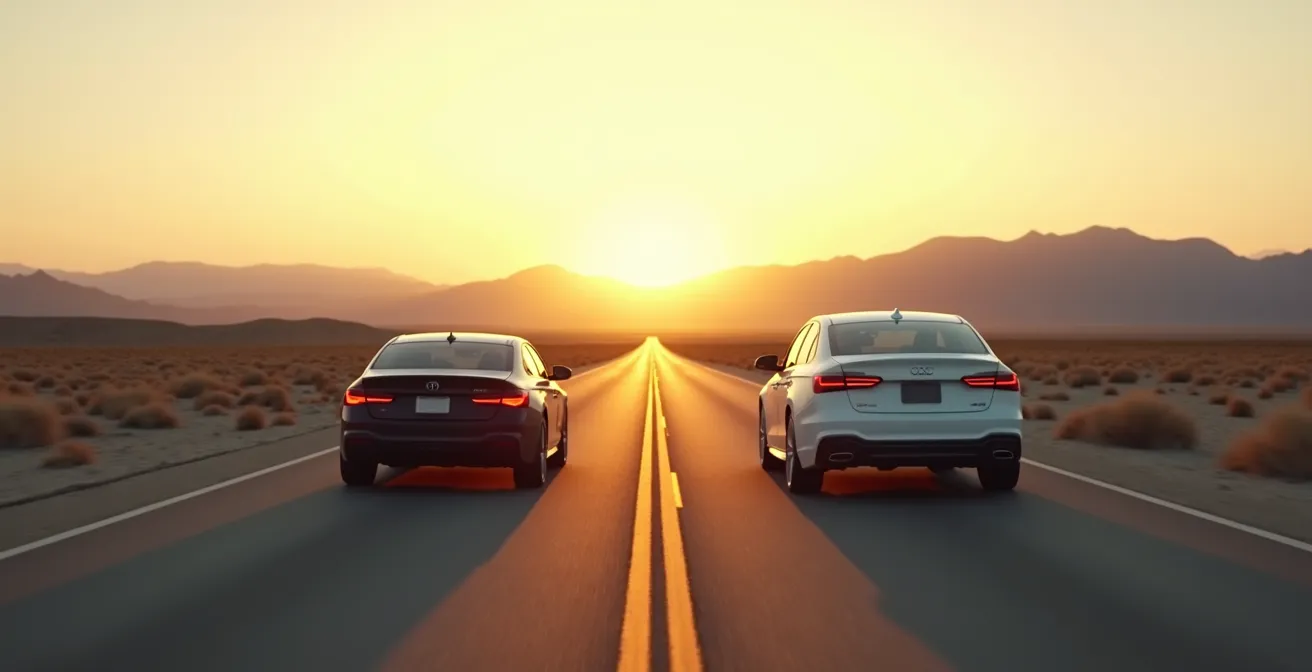
Upgrading to a compact or even a mid-size vehicle for an extra $15 a day can be a worthwhile investment in safety and comfort. A slightly larger car generally offers a longer wheelbase and more weight, contributing to better stability. The engine will also have more power for merging onto fast-moving freeways or climbing steep inclines. This isn’t just about comfort; it’s about having a vehicle that can respond adequately when you need it to. Furthermore, the decision should also factor in practicality. As one operations manager noted when booking for field crews, trying to fit multiple adults and luggage into the smallest car class creates logistical problems and discomfort on long trips. For a family or group of friends, the upgrade is often a necessity, not a luxury.
It’s vital to remember what you are actually renting, as explained by travel expert Chris Raney. The model you see online is just an example.
When you rent a car from major companies in the US, you generally are not renting a specific model but a car class – economy, compact, mid-size, full-size, with SUVs coming in compact, regular size, and luxury variants
– Chris Raney, Yellow Productions YouTube Channel
Therefore, when deciding, don’t just look at the price. Analyze your travel plans. For short city trips, an economy car is perfect. For a cross-country road trip with long stretches of highway, the small premium for a compact or mid-size car is a reasonable price to pay for a safer, more capable, and more comfortable journey.
The Off-Road Mistake That Voids Your Rental Insurance Instantly
Deep within the multi-page rental agreement you sign is a clause that can instantly void all of your insurance coverage—including the expensive policy you might have bought from the rental company. This is the prohibition against driving on “unpaved roads.” As a consumer, you might assume this means avoiding extreme off-roading. From a legal standpoint, however, the definition is dangerously broad. It can include any surface that isn’t tarmac or concrete: a gravel road leading to a scenic viewpoint, a dirt driveway to a vacation rental, or a poorly maintained backroad. If you get a flat tire, damage the undercarriage, or have any kind of accident on such a surface, the rental company can—and often will—declare your contract breached, leaving you 100% liable for the full cost of repairs or even the total value of the car.
Rental companies have become increasingly sophisticated in enforcing this. Many vehicles are equipped with GPS trackers, allowing them to see exactly where the car has been driven. This isn’t the only “gotcha” clause hidden in the fine print. For example, some rental agreements may define vehicles with MSRP over $50K as ‘Exotic’ in their terms, which can void standard credit card insurance coverages without your knowledge. These are contractual traps, plain and simple.
Your defense is twofold: awareness and avoidance. You must operate under the assumption that your rental car is contractually forbidden from leaving paved surfaces. Waivers you sign are filled with these violations, so protecting yourself requires vigilance.
- Read the Exclusions: Always check the waiver for specific violations that void coverage. Common ones include off-road driving, allowing unauthorized drivers, driving while intoxicated, or even using the wrong type of fuel.
- Scout Your Route: If you are visiting a rural or natural area, use satellite map views to check the roads leading to your destination. If they appear to be unpaved, you must find an alternative route or park and walk.
- Understand Coverage Gaps: Be aware that even standard waivers often exclude damage to glass, tires, and the undercarriage unless you purchase a specific, separate protection plan for them.
The allure of a scenic shortcut is not worth the risk of total financial liability. Stick to the pavement, no matter what. It is the only way to ensure your insurance coverage remains intact.
How to Handle Passing on a Single-Lane Mountain Road?
Navigating a single-lane mountain road presents a unique legal and safety challenge where standard traffic rules are secondary to the primary duty of collision avoidance. From a consumer protection standpoint, your goal is not to assert your right-of-way, but to return the rental car with zero damage and zero liability. In any potential conflict on a narrow road, you must prioritize de-escalation and defensive positioning. The common courtesy rule is that the vehicle traveling downhill should yield to the vehicle traveling uphill. The logic is that it is far more difficult and dangerous for the uphill driver to stop and then regain momentum, especially on a steep grade.
However, you should never rely on the other driver to follow this convention. As soon as you see an oncoming vehicle and recognize that the road is too narrow for both to pass, your first action should be to slow down and look for the nearest turnout or wide spot on the road, regardless of whether you are going uphill or downhill. Your objective is to create space and eliminate the risk of a sideswipe or head-on collision. An insurance company investigating a claim for damage in such a scenario would look for evidence of defensive driving. If you stubbornly held your line based on a perceived right-of-way and a collision occurred, you could be found partially at fault for failing to take reasonable action to prevent the accident.
Patience is your greatest legal asset here. It is always better to wait five minutes for a safe passing opportunity than to risk thousands of dollars in damage claims, deductibles, and a potential legal battle. If you meet another car in a narrow section, stop at a safe distance, assess the situation, and be prepared to reverse to the last wide spot you passed if you are in the better position to do so. A friendly wave to the other driver can go a long way in turning a tense situation into a cooperative one.
Remember, in the event of an incident, your rental agreement holds you responsible. Driving with an abundance of caution is not just a safety tip; it is a financial protection strategy.
Key Takeaways
- The “full protection” insurance sold at the rental counter is a high-margin profit-center; your credit card likely offers superior, primary coverage for free if you decline the counter’s offer.
- Your only real defense against fraudulent damage claims is forensic documentation: detailed, time-stamped video and photos of the car’s condition at pickup and drop-off.
- Your rental agreement contains contractual traps designed to void your insurance, with the most common being the prohibition against driving on any unpaved surface, no matter how brief.
How to Drive Coastal Highways Safely While Enjoying the View?
Driving on a scenic coastal highway, like California’s Highway 1 or Italy’s Amalfi Coast, is a bucket-list experience. However, the same features that make it beautiful—the winding curves, sheer drop-offs, and stunning ocean vistas—also make it uniquely hazardous. As the driver, you have a primary responsibility to operate the vehicle safely, which is often in direct conflict with the desire to enjoy the view. From a liability perspective, you must treat the car as transportation between viewpoints, not as a mobile viewing platform. The most critical rule is to only stop at designated pull-offs or official scenic viewpoints. A sudden stop or slowdown in a travel lane to snap a photo is not just dangerous; it is negligent, and in the event of an accident, you would almost certainly be held liable.
Environmental factors also pose a significant financial risk. Salt spray is highly corrosive, and prolonged exposure can lead to claims for undercarriage damage. Furthermore, sand blowing onto the road can reduce traction, and bringing it into the car can lead to significant cleaning fees. Some rental agreements have clauses allowing them to charge for what they deem as ‘excessive stains, trash, dirt, or pet hair’, and a car full of sand easily falls into this category. You must also be hyper-aware of rapidly changing conditions like sudden fog banks rolling in from the sea or intense sun glare reflecting off the water at sunrise and sunset, which can temporarily blind you.
To enjoy the drive without incurring risk or extra cost, adopt a disciplined approach. Use the designated viewpoints for all photography and sight-seeing. Before returning the vehicle, take a few minutes to vacuum out any excess sand and wipe down the interior. This small effort can prevent a hefty cleaning fee. Your primary focus must always remain on the road ahead. The beautiful views will still be there when you have pulled over safely.
Armed with this knowledge, you are no longer just a tourist but an informed and prepared consumer. Approach your next car rental not with suspicion, but with the confidence of someone who knows their rights and, more importantly, knows how to defend them. Drive safely, and drive smart.