
In summary:
- Finding a truly secluded beach is not luck; it’s a planned expedition requiring strategic reconnaissance and logistical knowledge.
- Your primary constraints are physical access, gear limitations, and environmental factors like tides, all of which can be managed with the right framework.
- Success depends on a combination of digital reconnaissance to identify potential targets and the physical readiness to execute the approach and operate self-sufficiently.
There’s a universal moment of disappointment that every traveler knows: arriving at a so-called “paradise” beach only to find it shoulder-to-shoulder with other tourists, the sound of waves drowned out by the chatter. The dream of a pristine, private cove feels increasingly out of reach. Many guides will offer simple advice like “ask a local” or “go in the off-season,” but these are tactics, not a strategy. They are lottery tickets for solitude, not a reliable method for an adventurer who actively seeks it.
But what if the key wasn’t a secret map, but a strategic mindset? What if finding these untouched corners of the world was a solvable logistical problem? The reality is that seclusion is earned, and it is almost always guarded by a barrier of effort. This barrier—be it a rough track, a steep trail, or a tricky tide—is not an obstacle but a filter. It’s what keeps the masses at bay and preserves the prize for those willing to plan and execute a proper expedition.
This guide is your operational framework. We will move beyond simple tips and provide a logistical blueprint for the modern explorer. We will cover the intelligence gathering, the necessary gear for self-sufficiency, the trade-offs between different access methods, and the critical risk mitigation required when you are the sole architect of your adventure. This is how you leave the 99% behind.
This article breaks down the complete operational framework for your next beach expedition. The following summary outlines each critical phase of the mission, from initial reconnaissance to safe exfiltration.
Summary: The Expedition Framework for Finding Hidden Beaches
- Why the Best Beaches Always Require a 30-Minute Hike?
- How to Pack for a “No-Facilities” Beach Day Without Overloading?
- Hiring a Boat or Hiking Down: Which Is Worth the Cost?
- The Safety Kit You Must Carry When No Lifeguard Is on Duty
- When to Start Your Hike Back to Avoid Getting Trapped by the Tide?
- How to Use Satellite View to Spot Swimming Holes Near the Road?
- Why Ground Clearance Matters More Than 4WD on Rocky Roads?
- Do You Really Need a Rugged 4×4 for Your Road Trip?
Why the Best Beaches Always Require a 30-Minute Hike?
The most significant barrier separating a crowded tourist beach from a pristine, secluded cove is almost always a moderate amount of physical effort. This isn’t a coincidence; it’s a natural filtering mechanism. In fact, research on beach tourism patterns reveals that 99% of tourists will not venture beyond easily accessible shores. A simple 30-minute hike acts as a gatekeeper, effectively granting access only to those who value solitude enough to work for it. This “effort filter” means that the moment you lace up your hiking boots, you’ve already left the vast majority of people behind.
Think of it as the first stage of your expedition. The trail is not an inconvenience; it is the price of admission. Every step away from the car park increases your chances of finding an untouched landscape. This journey also fundamentally changes your relationship with the destination. You don’t just arrive; you earn it. The beach becomes a reward, a destination achieved through personal effort, which deepens the sense of discovery and connection. This is the core philosophy: the best places are not hidden by complex riddles but are simply protected by a modest barrier of inconvenience.
This principle is your most powerful tool in finding solitude. When you’re conducting your initial reconnaissance, don’t just look for beaches; look for trails leading to them. The presence of a path, especially one that isn’t a perfectly paved walkway, is a strong indicator that you’re on the right track. The challenge is not the enemy; it’s the signpost pointing you toward your goal.
Therefore, the question isn’t whether you can find a secluded beach, but whether you’re willing to walk for 30 minutes to reach it. If the answer is yes, you’ve already unlocked the first and most important secret.
How to Pack for a “No-Facilities” Beach Day Without Overloading?
When your destination has no shops, no running water, and no shade on demand, your backpack becomes your lifeline. The challenge is to achieve complete self-sufficiency without being weighed down by a monstrously heavy pack. The expedition leader’s mantra here is “multi-use and minimalist.” Every item must justify its weight and, ideally, serve more than one purpose. A heavy cotton towel is a luxury you can’t afford; a lightweight sarong, however, can be a towel, a sun shield, a wrap, and a blanket.
Your packing strategy should be built around a core of non-negotiable systems: hydration, nutrition, sun protection, and waste removal. Water is the heaviest and most critical item. Instead of carrying multiple single-use plastic bottles, an adventurer carries a larger, durable container and, for longer expeditions, a compact water filter. This drastically cuts down on weight and waste. For nutrition, opt for dense, no-mess foods like nuts, dried fruit, and protein bars. Anything that requires utensils or creates greasy waste is a liability.
This photograph illustrates the philosophy perfectly. Focusing on gear with high utility and minimal footprint is key. A single, well-chosen item often replaces three lesser ones.
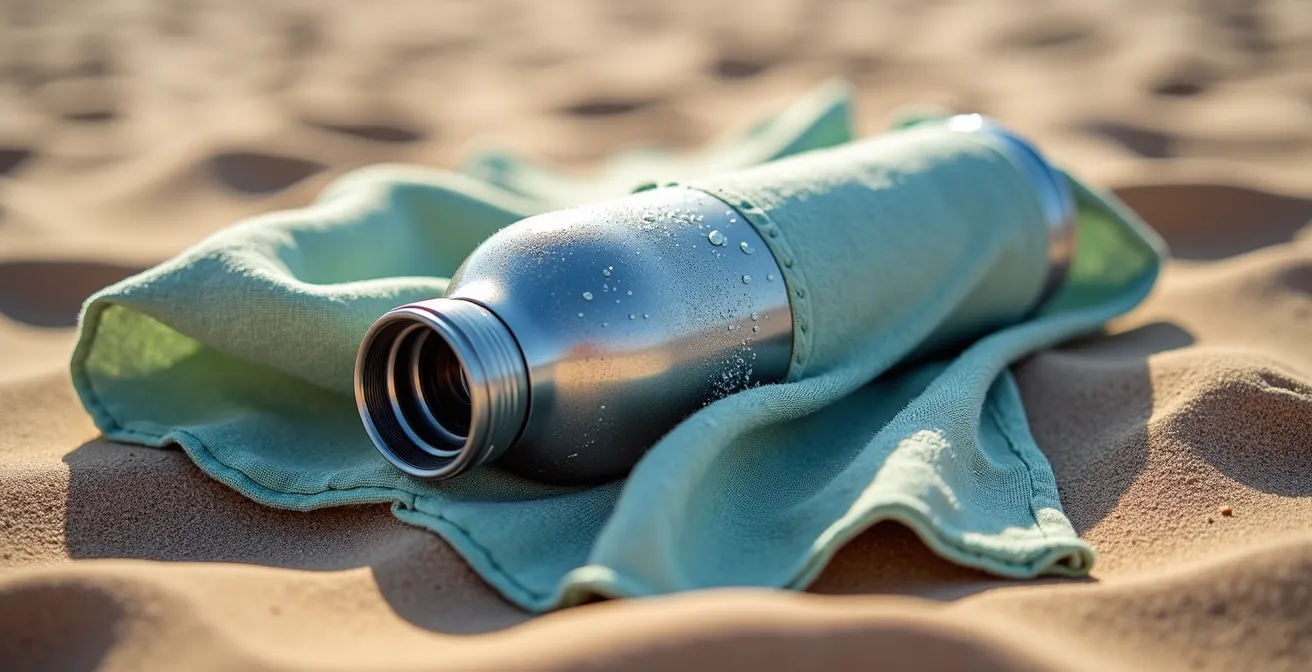
The “Leave No Trace” principle is not just an ethical guideline; it’s a logistical one. Packing is a round-trip equation. You must have a dedicated, sealable bag to pack out everything you bring in, including food scraps. An experienced explorer often packs an extra bag to remove any trash left by others, leaving the pristine location in a better state than they found it.
Case Study: The Leave No Trace Strategy at Oregon’s Secret Beach
Visitors to Oregon’s rugged and remote Secret Beach are a prime example of this ethos in action. They successfully implement zero-impact strategies by not only bringing dedicated trash bags for their own items but also for any litter they might find. Trail users understand the harsh coastal environment, carrying waterproof boots and windbreaker jackets as standard. By strictly adhering to the ‘pack out what you pack in’ principle, they demonstrate that responsible, self-sufficient access is not just possible but essential for preserving these hidden gems.
Ultimately, a light, well-packed bag is a symbol of an experienced adventurer. It shows foresight, discipline, and a deep respect for the environment you’re about to enter.
Hiring a Boat or Hiking Down: Which Is Worth the Cost?
Once you’ve identified a target cove, the next logistical question is the “access vector.” The two most common options for reaching a beach inaccessible by road are hiking and boating, each with a distinct profile of cost, time, effort, and experience. This is not a question of which is “better,” but which is the right tool for the specific mission and the desired outcome. An expedition leader analyzes these trade-offs with a clear head.
Hiking is the purist’s choice. It’s typically free, offers a deep connection with the landscape, and provides the profound satisfaction of earning your destination. However, it demands a high level of physical effort, takes more time, and limits the amount of gear you can carry. A private boat charter or water taxi, on the other hand, is the fast-track option. It requires minimal physical effort, allows for more gear (coolers, chairs), and offers a stunning coastal panorama. The trade-off is significant financial cost and a more detached, “delivered-to-the-doorstep” experience. Kayaking or paddleboarding offers a middle ground, blending physical effort with intimate water-level access, but is highly dependent on sea conditions.
This comparative analysis breaks down the fundamental trade-offs between the primary methods of accessing a secluded beach. Understanding these variables allows you to make a strategic decision based on your personal resources: time, budget, and physical fitness.
| Method | Cost | Time | Effort | Experience Type |
|---|---|---|---|---|
| Hiking | Free | 30-60 min | High | Solitary Journey |
| Private Boat | $200-500 | 15-30 min | Low | Coastal Panorama |
| Water Taxi | $50-100 | 20-40 min | Low | Group Experience |
| Kayaking | $25-40/hr | 45-90 min | Medium | Intimate Water Access |
Case Study: The Multi-Access Strategy at Playa Cocolito, Costa Rica
Playa Cocolito, home to the stunning El Chorro waterfall that cascades directly onto the beach, perfectly illustrates the value of having multiple access options. Visitors can choose between a challenging 2+ hour hike from the town of Montezuma or a more leisurely horseback ride along the coast. The hike offers an immersive experience through forests, with opportunities for wildlife spotting. The horseback approach provides a completely different, sweeping perspective of the coastline. Both methods lead to the same pristine reward, demonstrating that the “best” access vector is entirely dependent on the type of journey the adventurer seeks.
Choosing your access vector is the most significant tactical decision you’ll make after identifying your target. It defines the entire character of the day’s expedition, so choose wisely based on your goals.
The Safety Kit You Must Carry When No Lifeguard Is on Duty
Operating in an environment without a safety net requires a shift in mindset from passive beachgoer to proactive expedition leader. When there is no lifeguard, you are the lifeguard. When there are no medics, you are the first responder. Your safety kit is not an afterthought; it is a critical piece of operational gear. The contents should be tailored to the specific risks of a remote marine environment, which are different from a standard household first-aid kit.
Forget the dozens of cartoon-character bandages. Your primary concerns in a remote coastal setting are specific: marine stings, cuts from sharp coral or rocks, and the inability to call for help. A well-prepared adventurer’s kit is therefore focused on “mitigation and signaling.” You need the tools to deal with the most likely injuries—tweezers for sea urchin spines, a small bottle of vinegar for certain jellyfish stings—and, most importantly, a reliable way to signal for help if things go truly wrong. A mirror and a whistle are low-tech, infallible tools that should be in every pack. For true remote expeditions, a waterproof Personal Locator Beacon (PLB) is the ultimate insurance policy.
This layout represents the essential, non-negotiable gear for self-reliant beach safety. Each item serves a specific, critical function in an environment where you are your own first responder.
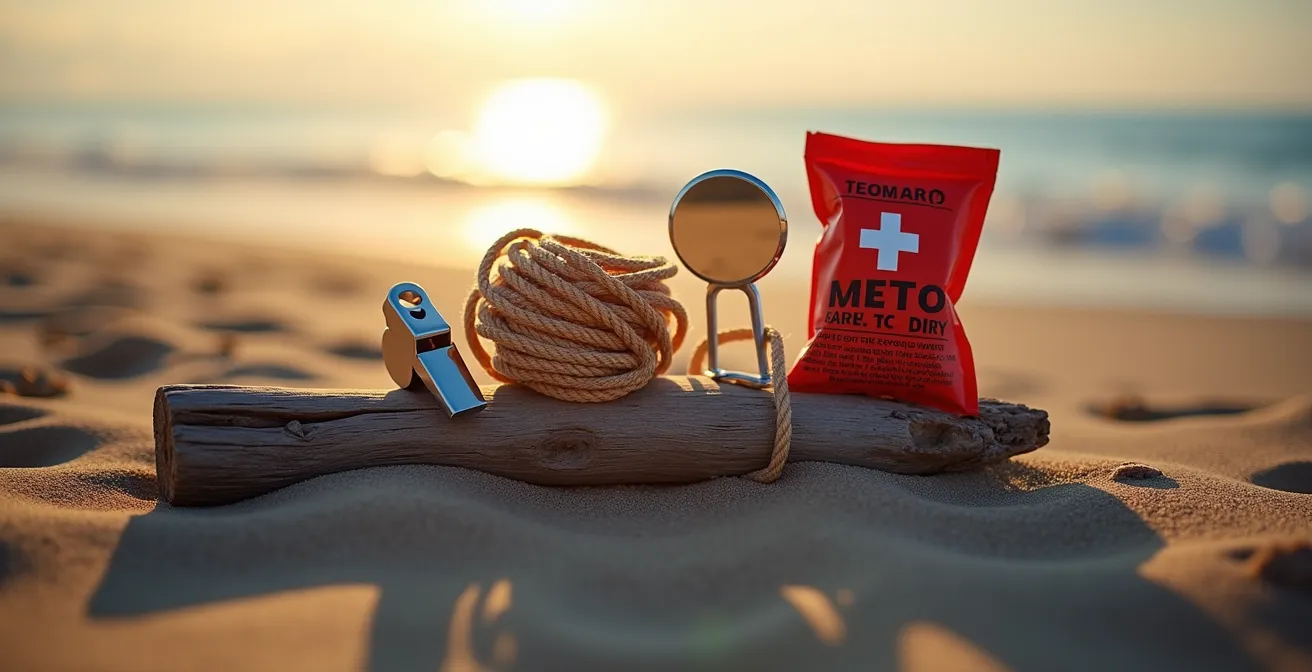
Beyond the kit itself is knowledge. You must know how to use these items. Do you know that applying fresh water to a jellyfish sting can actually make it worse by causing more venom to be released? Do you know how to clean and dress a coral cut to prevent infection? This knowledge, paired with the right tools, forms your comprehensive safety system. Before you step onto the trail, you must be confident in your ability to handle the most probable scenarios.
Action Plan: Assembling Your Marine First-Aid Kit
- Assess the specific risks: Research the local marine life. Are jellyfish, sea urchins, or sharp coral common in the area?
- Acquire specific treatments: Purchase and pack a small bottle of vinegar or prepare a thermos of hot water for treating stings, as recommended by local experts. Pack high-quality, fine-point tweezers.
- Add wound care: Include an antiseptic solution (not just wipes) and sterile dressings for cleaning and covering cuts from rocks or coral.
- Prepare for signaling: Add a signal mirror and a loud, pea-less whistle to your kit. Test them to ensure you know how they work.
- Consider a communication lifeline: For truly remote or solo trips, invest in and register a waterproof emergency communication device like a PLB or satellite messenger. Ensure its battery is charged.
Treating your safety kit with this level of seriousness is what separates a hopeful tourist from a competent adventurer. It is the ultimate expression of preparation and respect for the power of the wild.
When to Start Your Hike Back to Avoid Getting Trapped by the Tide?
Of all the forces of nature an adventurer must respect, the tide is perhaps the most deceptive. It moves with relentless, predictable power, and misjudging it can turn a paradise cove into a dangerous trap. The question of when to leave is not a matter of convenience; it’s a critical point of “exfiltration timing.” Your plan for getting out must be as solid as your plan for getting in. Never turn your back on a rising ocean; you must know its schedule better than your own.
The biggest mistake is assuming tidal movement is linear. It is not. The tide moves fastest during the middle of its cycle. A principle known as the “Rule of Twelfths” provides a crucial framework: the water level can rise or fall by up to 3/12ths of its total range in the third and fourth hours of its six-hour cycle. This is the danger zone. A path that was perfectly dry an hour ago can become a surging channel of water in minutes. Therefore, you must know the exact time of the next high tide before you even set foot on the beach.
A practical, low-tech method used by experienced coastal explorers is to observe the previous high tide mark on the cliffs or rocks as soon as you arrive. This clear line of wetness, debris, or discoloration shows you the ocean’s maximum reach. Your gear, your resting spot, and your entire operation must remain well below (on a falling tide) or well above (on a rising tide) this line. Use it as your non-negotiable safety boundary. When planning your return, ensure your exit path will not be cut off long before the tide reaches this peak. Always give yourself a generous buffer, especially if your hike out involves crossing any low-lying sections of the beach.
In the end, the tide is the ultimate authority on the beach. It dictates your arrival and commands your departure. Respect its schedule, and you will be granted safe passage. Ignore it at your peril.
How to Use Satellite View to Spot Swimming Holes Near the Road?
The most powerful tool in the modern explorer’s arsenal is not a physical map, but the satellite imagery available on any smartphone. This “digital reconnaissance” phase is where you can identify potential targets from hundreds of miles away. It’s a skill that transforms you from a passive tourist hoping to stumble upon a good spot into a strategic planner actively seeking them out. You’re looking for anomalies—clues in the landscape that hint at a hidden gem.
The process begins by scanning the coastline in satellite view. Your first targets are the tell-tale colors: look for patches of bright turquoise or light blue water close to the shore, which often indicate a shallow, sandy bottom perfect for swimming. Contrast this with the deep, dark blue of the open ocean. Next, you must assess accessibility. Toggle to the terrain or topographic view to analyze the steepness of the land between the nearest road and the water. A gentle green slope is a promising sign; a wall of dense, brown contour lines indicates an impassable cliff.
Once you’ve identified a promising spot, zoom in and look for faint, thin lines snaking through the vegetation. These are often unofficial “social trails” made by other adventurers—your access path. The final step is to cross-reference with road view and look for potential parking. A small, unmarked dirt pull-off near the head of a social trail is a classic sign that you’ve found a local secret. Some mapping services even offer historical imagery, allowing you to see how sandbars and access points change with the seasons, giving you an even greater strategic advantage before you arrive.
This digital skill is what allows you to arrive at a region with a pre-vetted list of high-potential targets, dramatically increasing your chances of a successful find and minimizing time wasted on fruitless searching.
Why Ground Clearance Matters More Than 4WD on Rocky Roads?
On the rugged tracks that often lead to the best-secluded beaches, many travelers mistakenly believe that a “4WD” badge is the ultimate key to access. An experienced expedition leader knows better. While four-wheel drive is useful for traction on loose surfaces like sand or mud, the single most important factor on uneven, rocky trails is ground clearance. This is the vertical distance between the ground and the lowest point of your vehicle’s undercarriage. It’s the difference between gliding over an obstacle and getting high-centered with a damaged oil pan.
A rock or rut that a standard sedan must painstakingly navigate around, a vehicle with high ground clearance simply drives over. This capability dramatically expands your operational range and reduces the stress of off-road driving. On many unmaintained coastal roads, the primary challenge isn’t a lack of traction but the presence of large rocks, deep ruts, and high crowns in the middle of the track. A 4WD system won’t help you if a critical component of your vehicle is scraping against the earth. For this reason, beach driving experts consistently recommend a minimum of 7.5 inches of ground clearance, even for capable 4x4s.
This principle is perfectly demonstrated on the 4×4 beaches of the Outer Banks, North Carolina. While a 4WD or AWD system is required for access, veterans of these beaches know that success hinges just as much on two other factors: high ground clearance to navigate deep, soft sand ruts, and—crucially—lowering tire pressure to 18-20 psi. Deflating the tires increases the footprint on the sand, providing flotation much like a snowshoe. A driver who understands the interplay of clearance and tire pressure will succeed where a novice with an expensive 4×4 but overinflated tires will fail.
So before your next expedition, look beyond the drivetrain. Find out your vehicle’s ground clearance measurement. That single number is a more honest indicator of your off-road potential than any marketing badge.
Key Takeaways
- True seclusion is not found by chance; it is a direct result of overcoming a barrier of effort and applying logistical knowledge.
- Your operational limits are defined by non-negotiable physical laws: tidal patterns dictate your schedule, and vehicle ground clearance determines your reach. Master them or be stopped by them.
- Self-sufficiency in a remote environment is achieved through a minimalist, multi-use packing strategy where every item is chosen with foresight and purpose.
Do You Really Need a Rugged 4×4 for Your Road Trip?
Not always, but the vehicle you choose fundamentally defines your operational range and the types of expeditions you can undertake. A rugged 4×4 with high ground clearance is the master key that unlocks the most remote and challenging access roads. However, not having one doesn’t mean you’re confined to the pavement. It simply means you must be more strategic in choosing your access vectors and be prepared to combine driving with other methods.
The “end of the pavement” is not an endpoint; it is a transition point. For the adventurer in a standard vehicle, this is where the expedition truly begins. Your strategy becomes one of parking at the furthest accessible point and switching to a different mode of transport. This could be hiking the final few miles, or using a mountain bike to cover distance on a dirt track more quickly. Another powerful strategy is timing. By planning your visit during low tide, the beach itself can become a temporary highway, often wider and firmer than the rough track running parallel to it.
If a specific destination is known to require a high-clearance vehicle, consider tactical rental. Platforms that allow you to rent capable vehicles from private owners can be a cost-effective way to secure the right tool for a single day’s mission without the cost of ownership. Most importantly, even with the “right” vehicle, preparation is paramount. Every adventurer, regardless of their ride, should carry essential recovery gear. A simple shovel and a set of traction boards are lightweight insurance policies that can turn a trip-ending situation into a minor delay. Driving on a beach or rough track is a skill; the vehicle is just one part of the system.
Ultimately, the most capable vehicle is the one driven by a prepared mind. Know your limits, have a backup plan, and understand that the adventure often starts when the road stops. Armed with this strategic framework, your next expedition awaits. Begin your reconnaissance.