Escaping the “Disneyland Effect” in popular national parks isn’t about finding a secret season; it’s about executing a superior logistical operation.
- Master complex permit systems by treating release dates like strategic targets, not lotteries.
- Anticipate operational friction by calculating park driving times at 1.5x Google Maps estimates.
- Engineer solitude by deploying to trails during “anti-peak” windows, like pre-dawn astronomical twilight.
Recommendation: Shift your mindset from a passive vacationer to an active mission planner. Your goal is to analyze and outmaneuver predictable crowd dynamics to reclaim the wilderness.
The image is deeply ingrained in the modern adventurer’s mind: a line of cars snaking through Yellowstone, a forest of selfie sticks at Zion’s Angels Landing, or a crowded viewpoint where the main event is jockeying for a photo. This is the “Disneyland Effect”—when our cathedrals of nature feel more like crowded theme parks. The standard advice is predictable: go in the off-season, wake up before sunrise, or visit less popular parks. While valid, these tips are tactical patches on a strategic problem. They don’t address the core frustration for those who want to experience the iconic grandeur of a Banff or a Yosemite without the crush of humanity.
But what if avoiding the crowds isn’t a matter of luck, but of superior logistics? What if you could approach your trip not as a hopeful tourist, but as a wilderness strategist, turning crowd patterns into predictable variables you can actively outmaneuver? The key isn’t just to be earlier; it’s to operate on a different schedule entirely, using precision, planning, and a deep understanding of park dynamics to engineer solitude. This is not about avoiding popular parks; it’s about reclaiming them.
This guide provides a strategic framework for that mission. We will deconstruct the psychological benefits of true immersion, provide a blueprint for securing the most elusive permits, analyze the core logistical choices you must make, and arm you with the on-the-ground timing strategies to have the trail all to yourself. It’s time to stop letting the crowds dictate your experience and start planning a trip that delivers the profound connection with nature you seek.
Summary: A Strategic Framework for Your Next National Park Mission
- Why 3 Days in a National Park Lowers Cortisol More Than a Spa?
- How to Secure High-Demand Park Permits 6 Months in Advance?
- In-Park Lodge or Campervan: Which Offers the Best Nature Access?
- The Mileage Mistake That Ruins National Park Road Trips
- When to Start Your Hike to Have the Trail Entirely to Yourself?
- Why Watching a Sunset at 2,000m Changes Your Brain Chemistry?
- Certified Eco-Guide or Solo Hike: Which Is Safer for the Environment?
- How to Visit Fragile Ecosystems Without Leaving a Negative Footprint?
Why 3 Days in a National Park Lowers Cortisol More Than a Spa?
The deep-seated need to escape to nature is more than a feeling; it’s a biological imperative. While a spa offers temporary relief, deep immersion in a natural environment triggers a powerful and lasting physiological reset. The practice of “forest bathing” or shinrin-yoku isn’t a fleeting wellness trend; it’s a scientifically validated method for stress reduction. In fact, a landmark study confirms that forest walking reduced plasma cortisol levels significantly compared to walking in an urban setting. This isn’t just about fresh air; it’s about your brain processing a complex, non-threatening sensory environment—the sound of wind, the smell of pine, the texture of moss—which shifts the nervous system from a “fight or flight” state to “rest and digest.”
Achieving this state requires more than a quick stop at a viewpoint. A true reset follows a protocol of sustained immersion. A strategic three-day plan might involve slow, meditative walks on day one to engage the senses, followed by varied sessions near water features and scenic vistas on day two. The culmination on day three could involve finding a “sit spot” and remaining still for an extended period, allowing your nervous system to fully down-regulate. The goal is to limit your walking speed to a meditative 1-2 km/hour, a pace that forces mindfulness and breaks the hurried rhythm of daily life. This sustained, multi-day exposure is what creates a more profound and lasting impact on stress levels than a single, isolated treatment ever could.
How to Secure High-Demand Park Permits 6 Months in Advance?
The first battle in your logistical operation is fought online, months before you pack your bags. The days of spontaneous trips to iconic backcountry sites are over. The competition for permits is fierce, and data from the Department of Interior shows Recreation.gov saw over 10 million reservations in 2022, nearly double the volume from 2020. Viewing this as a lottery is a recipe for failure. Instead, you must approach it as a strategic challenge with knowable rules of engagement. Each park and permit type—from Half Dome cables to backcountry campsites—operates on a different system, and understanding the mechanics is your primary advantage.
Whether it’s a rolling window, a lottery, or a fixed release date, success requires a specific strategy. You must know the exact second a permit becomes available and be prepared with multiple devices, pre-filled information, and sometimes, a team of friends all trying for the same dates. The following strategic breakdown offers a clear guide to the most common systems and the best approach for each.
| Permit Type | Release Window | Success Rate | Best Strategy |
|---|---|---|---|
| Rolling Window | Daily at 7am EST | 15-20% | Multiple devices, auto-refresh |
| Lottery System | Monthly drawings | 5-10% | Apply for multiple dates |
| Fixed Release | Specific date 6 months prior | 25-30% | Team coordination approach |
| Walk-up Permits | Day before/same day | 40-50% | Arrive 2+ hours before office opens |
Even with low success rates, a prepared approach dramatically increases your odds. For lottery systems, applying for less popular mid-week dates can be a winning move. For fixed releases, coordinating with a group to have multiple people trying for the same permit is a common and effective tactic. And for the high-risk, high-reward walk-up permits, the strategy is simple endurance: show up hours before the ranger station opens. Success is about preparation, not luck.
In-Park Lodge or Campervan: Which Offers the Best Nature Access?
Your choice of accommodation is a cornerstone of your operational strategy, defining your mobility, flexibility, and proximity to your objectives. It’s a trade-off between comfort and access. An in-park lodge offers convenience and amenities, but tethers you to a fixed location and its associated crowds and parking challenges. A campervan, on the other hand, is a mobile base camp, providing unparalleled freedom to position yourself for prime light and early trail access.
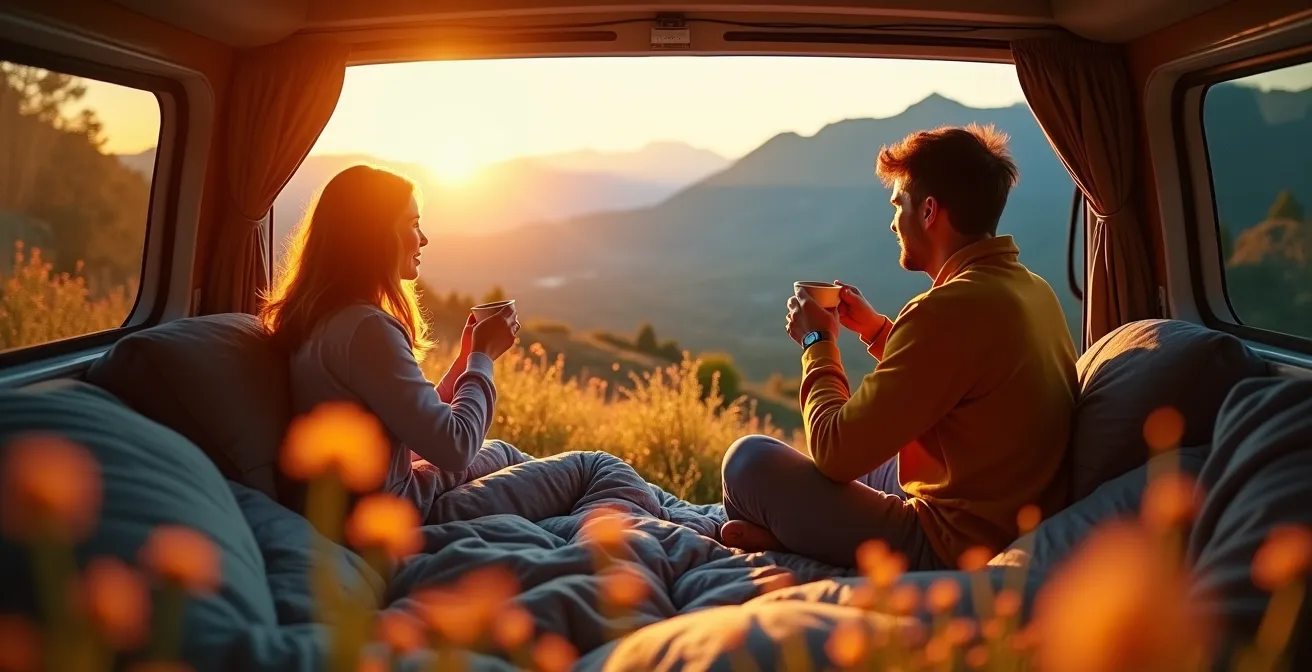
The optimal choice depends entirely on your mission’s priorities. A golden hour photographer requires the flexibility of a campervan to be at a remote viewpoint before dawn, long before the lodge guests have finished breakfast. Conversely, a wildlife watcher may benefit from a historic lodge strategically located near known animal corridors, which often offer exclusive guided tours at dawn and dusk. For the solitude seeker, neither might be the best option; dispersed camping in an adjacent National Forest offers the ultimate seclusion. The key is to match your lodging to your primary goal.
- Solitude Seekers: Opt for dispersed camping in National Forest areas adjacent to parks for ultimate privacy and zero cost.
- Comfort Prioritizers: Book historic lodges for nature immersion combined with amenities and valuable interpretive programs.
- Budget Travelers: A hybrid approach works best. Combine free BLM camping with one strategic in-park lodge night for a hot shower and a reset.
The Mileage Mistake That Ruins National Park Road Trips
One of the most common logistical failures in a national park trip is underestimating driving time. Parks are vast, roads are winding, and speed limits are low for a reason. Relying on standard GPS estimates is a rookie mistake that can cascade into a ruined itinerary. Experienced road trip planners know that actual park driving times average 1.5x Google Maps estimates due to wildlife-induced traffic jams (“bison jams”), stops at scenic pullouts, and lower speed limits. A calculated 2-hour drive can easily become 3 hours, throwing off your hiking start times and sunset plans.
The strategic solution is to minimize transit time and maximize park time by adopting a hub-and-spoke model instead of a linear, point-to-point route. This involves establishing a multi-night base camp in a central location to explore a region, rather than changing accommodations every night. This approach drastically reduces the daily logistical burden of packing and unpacking, converting wasted time into valuable exploration hours.
Case Study: The Hub-and-Spoke Model in Utah’s Mighty Five
Travel blogger Val documented how establishing a 3-night base in Torrey, Utah allowed exploration of both Capitol Reef and parts of Canyonlands without daily packing. This hub-and-spoke approach reduced driving by 40% compared to changing hotels nightly, while increasing actual park time from 4 to 7 hours per day. The strategy particularly excelled when combined with pre-dawn departures to popular viewpoints.
By building a 50% buffer into all driving estimates and designing your itinerary around a central hub, you move from being reactive to traffic and delays to being in command of your schedule. This mileage calculus is fundamental to a successful operation.
When to Start Your Hike to Have the Trail Entirely to Yourself?
The most common advice for avoiding trail crowds is to “start early.” This is vague and ineffective. Your competition is also starting early. The strategic hiker thinks in terms of specific light conditions and crowd behavior patterns. The key insight is that research on national park visitor behavior reveals 95% of visitors don’t go more than a mile down any trail. This statistic is your opportunity. The goal is not just to be first, but to operate in windows the crowds ignore.
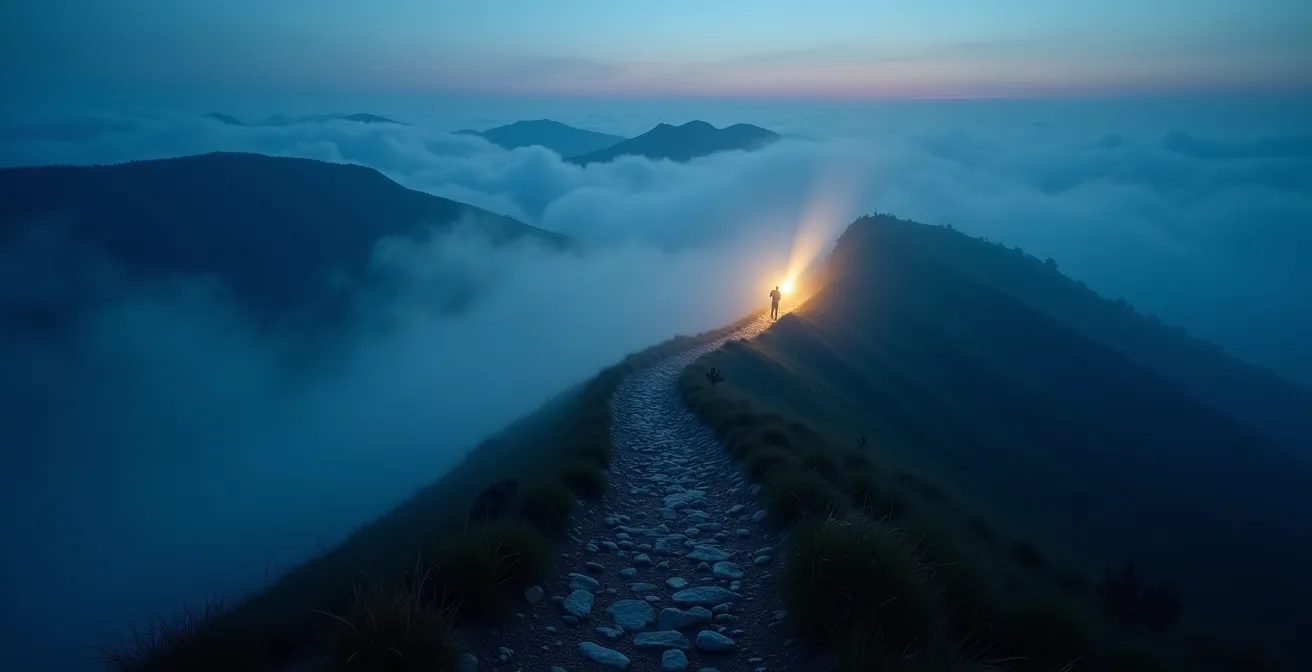
True solitude is found in the margins. Instead of aiming for sunrise, you should calculate astronomical twilight for your location and be on the trail, headlamp on, during the pre-dawn blue hour. By the time the “early bird” hikers arrive for sunrise, you are already miles down the trail, deeply immersed in the wilderness. Another highly effective, counter-intuitive strategy is targeting “anti-peak” windows. This is often on weekdays between 2-4 PM, after the morning rush has finished and before the sunset-seekers have arrived. The trail traffic can drop by over 90% during this time.
For popular sunset hikes, the strategy is reversed: start 3 hours before sunset, not 1. This allows you to reach the viewpoint, claim a prime spot, and enjoy the changing light in peace before the main wave of people arrives. Using tools like the heat maps on AllTrails can also reveal the least-busy time slots for specific trails, giving you a data-driven advantage. Engineering solitude is about precision timing, not just an early alarm.
Why Watching a Sunset at 2,000m Changes Your Brain Chemistry?
The profound sense of awe experienced while watching a sunset from a high-altitude viewpoint is not just an emotional event; it’s a potent neurochemical reaction. The combination of physical exertion to reach the summit, the expansive panoramic view, and the specific quality of light works in synergy to alter your brain chemistry. This experience goes beyond simple relaxation, triggering a cascade of positive physiological responses. While nature at any elevation is beneficial, high-altitude exposure seems to amplify the effects, creating a powerful impact on the nervous system.
The benefit is measurable. Beyond the well-documented cortisol reduction, exposure to these environments can boost key neurotransmitters. A 2025 systematic review in Frontiers in Public Health found that forest environments can improve serotonin concentration by 34%, a chemical crucial for mood regulation. This effect is compounded at altitude.
Case Study: The “Triple Effect” on High-Altitude Stress Reduction
Research conducted in China’s Panda Valley National Forest Park at varying elevations demonstrated that participants experiencing sunset views above 2,000m showed enhanced parasympathetic nervous system activity and reduced sympathetic response. The combination of altitude, panoramic views, and the physical effort required to reach viewpoints created a ‘triple effect’ on stress reduction, with benefits lasting up to 7 days post-exposure.
This “triple effect” is what makes a summit sunset so transformative. The physical effort primes the body, the panoramic view engages the ‘soft fascination’ that restores cognitive function, and the altitude may enhance the physiological response. It’s an earned experience that registers far more deeply than a passively observed pretty view.
Certified Eco-Guide or Solo Hike: Which Is Safer for the Environment?
As a conscious visitor, a critical strategic question arises: what is the lowest-impact way to experience a fragile ecosystem? The choice between hiring a certified eco-guide and venturing out as an experienced solo hiker presents a complex environmental trade-off. There is no simple answer; the “better” option depends on which impact factor you prioritize. A solo hiker creates a minimal footprint in terms of trail erosion and wildlife disturbance, assuming they are highly skilled in Leave No Trace principles. However, a guided group, while having a larger physical footprint, provides a crucial multiplier effect for conservation.
A good eco-guide does more than just lead the way; they are educators and conservation conduits. A percentage of their fees often goes directly to park conservation, and their teachings instill responsible practices in a dozen people at once. The following table breaks down the environmental advantages of each approach.
| Impact Factor | Certified Eco-Guide Group | Experienced Solo Hiker | Environmental Advantage |
|---|---|---|---|
| Trail Erosion | Higher (8-12 people) | Minimal (1 person) | Solo |
| Wildlife Disturbance | Moderate (noise from group) | Low (if following protocols) | Solo |
| Conservation Funding | 10-20% of fees to parks | Only entrance fee | Guided |
| Education Impact | Multiplier effect on group | Individual only | Guided |
| Emergency Response Need | Lower (guide expertise) | Higher (if unprepared) | Guided |
If you choose to hire a guide, your responsibility shifts to due diligence. Not all “eco-tours” are created equal. You must vet their commitment to conservation beyond marketing claims. A truly responsible outfitter will be transparent about their practices and contributions.
Action Plan: Vetting an Eco-Guide’s True Environmental Commitment
- Ask what percentage of their tour fees goes directly to local conservation efforts or park foundations.
- Inquire about their direct involvement: do their guides participate in trail maintenance days, and how many hours annually?
- Clarify their specific policy on wildlife encounters, particularly the mandatory distances they enforce.
- Question their stance on geotagging and social media posts, especially concerning sensitive or fragile locations.
- Request to see their Leave No Trace Master Educator or Trainer certifications and ask how that training is implemented daily.
Key Takeaways
- Treat park planning as a logistical operation, not a casual vacation, to gain a strategic advantage.
- Master permit schedules and calculate all travel time with a 1.5x buffer to avoid critical planning failures.
- Engineer solitude by hiking during “anti-peak” windows, like pre-dawn astronomical twilight, and venturing beyond the first mile where 95% of visitors stop.
How to Visit Fragile Ecosystems Without Leaving a Negative Footprint?
With the National Park Service reporting over 325 million visitors in 2023, the collective impact on fragile ecosystems is staggering. The philosophy of “Leave No Trace” is the absolute minimum standard of behavior; it is the baseline, not the goal. For the strategic visitor, the objective must evolve from simply minimizing negative impact to actively creating a positive one. This means shifting from a mindset of passive consumption of scenery to one of active stewardship during your visit. This approach requires a small amount of planning but leaves both the ecosystem and the visitor in a better state.
This “Leave a Positive Trace” ethos can be integrated directly into your itinerary. It involves tangible actions that contribute directly to the park’s health. For example, scheduling a half-day to volunteer with a trail maintenance crew can be booked in advance via the park’s official channels. On every hike, you can carry an extra bag with the specific goal of packing out one pound of trash that isn’t your own. Your economic choices matter, too; consciously booking with lodges and outfitters certified by “1% for the Planet” ensures a portion of your spending directly funds environmental initiatives.
Even your digital footprint can be managed for positive impact. Instead of geotagging a fragile alpine meadow with its precise location on social media, use a generic tag like “Western USA.” When you spot a plant you don’t recognize, use an app like iNaturalist; if it’s an invasive species, your data point becomes valuable intelligence for park rangers. These are not grand gestures, but small, deliberate actions that, when multiplied across thousands of conscious visitors, create a powerful force for preservation.
Your next great wilderness adventure begins not at the trailhead, but at the planning table. Use this framework to engineer an experience that respects the wild and revitalizes your spirit. Start planning your operation today.