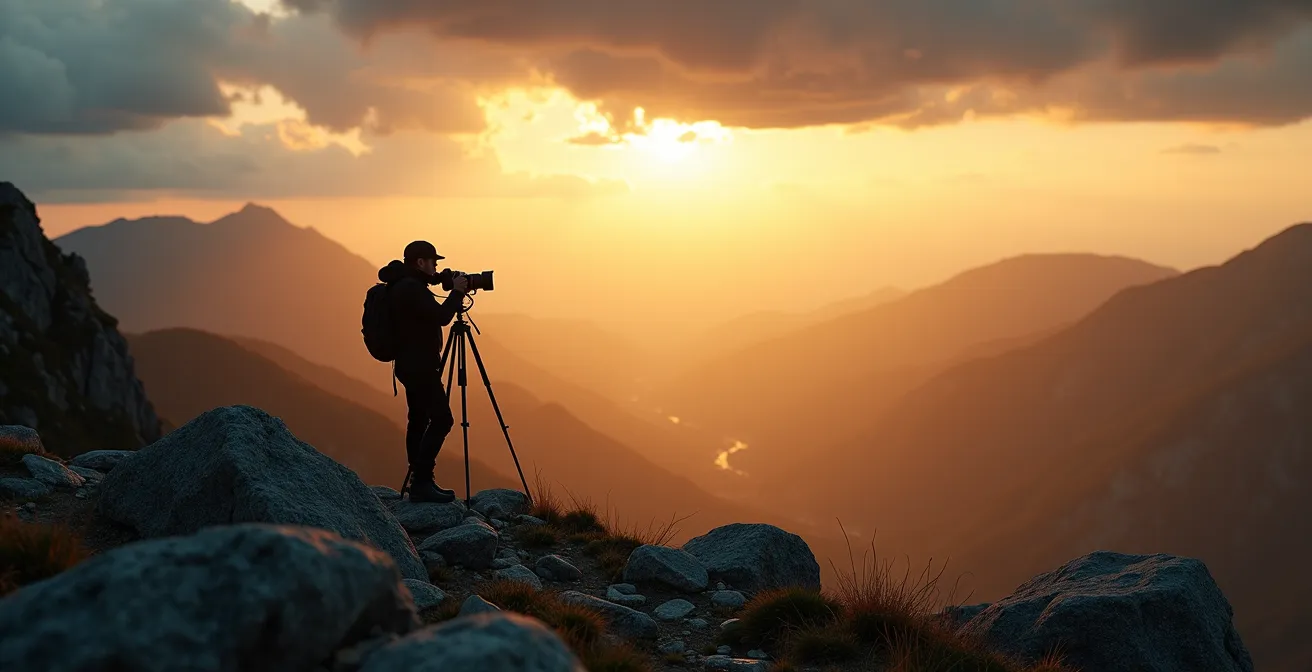
The common belief that you must choose between capturing a great photo and living the moment is a false dichotomy; the highest form of landscape photography is an act of deep presence.
- Your camera can be a tool for focused observation, enhancing your perception of the environment rather than obstructing it.
- Ethical practice—understanding your physical and psychological impact—is not a limitation but the foundation for more powerful, authentic images.
Recommendation: Shift your goal from “taking a picture” to engaging in an “environmental dialogue,” where your photography becomes the result of your connection to the landscape, not the reason for it.
The scene is achingly familiar. You stand on a precipice, the sky ablaze with the fleeting magic of sunset. A profound sense of wonder washes over you, but it’s immediately chased by a frantic anxiety. You raise your camera, fumbling with settings, desperately trying to bottle the lightning of the moment. By the time you look up from your screen, the peak color has faded, and a quiet sense of loss settles in. You have the photo, but you missed the experience. This conflict between capturing and living is the central struggle for any traveler with a camera.
Conventional wisdom offers a checklist of solutions: use a tripod, shoot at golden hour, follow the park rules. While technically sound, this advice misses the fundamental point. It treats photography as an extractive process—something you *take* from the landscape. It fails to address the internal state of the photographer and the subtle, cumulative impact our quest for the perfect shot has on the very wilderness we revere. We’ve been taught the mechanics of the camera, but not the art of seeing.
But what if the camera wasn’t a barrier between you and the world, but a bridge? What if the act of composing a shot, of truly studying the light and landforms, could be a meditative practice that deepens your connection instead of severing it? This is the core of a more profound approach: a philosophy where technical skill and ethical awareness merge. It’s about understanding that the most breathtaking images are not taken, but received—the byproduct of a patient, respectful dialogue with the environment.
This guide moves beyond the basics to explore that dialogue. We will delve into the science of awe, the strategy of solitude, and the techniques that allow you to create powerful images without sacrificing your presence or your principles. It’s time to learn how to see again, with or without the camera to your eye.
To navigate this journey from a photographer to a conscious observer, this article is structured to build your skills layer by layer. The following sections will guide you through the why, where, what, and how of creating meaningful landscape photography.
Summary: How to Photograph Breathtaking Landscapes Without Ruining the Moment?
- Why Watching a Sunset at 2,000m Changes Your Brain Chemistry?
- How to Scout Unique Viewpoints That Aren’t Swarmed by Influencers?
- Drone or Camera: Which Gear Is Best for High-Altitude Landscapes?
- The Erosion Damage Caused by ‘Just One Photo’ Off the Trail
- When to Arrive at Popular Spots to Get the Golden Hour Alone?
- Why 3 Days in a National Park Lowers Cortisol More Than a Spa?
- How to Get the ‘Edge Shot’ Without Actually Risking Your Life?
- How to Plan a National Park Trip That Avoids the ‘Disneyland’ Effect?
Why Watching a Sunset at 2,000m Changes Your Brain Chemistry?
That feeling of your-self shrinking before a vast mountain range or a fiery celestial display is more than just a fleeting emotion; it’s a complex neurochemical event. Scientists call this state “awe,” and it has profound, measurable effects on your body and mind. Understanding this isn’t just academic—it’s the key to realizing what you’re truly seeking with your camera. It’s not just a beautiful picture; it’s the physiological imprint of that moment. Awe is the reward for being truly present.
Researchers define awe through two core appraisals, as Dacher Keltner and Jonathan Haidt explained in their foundational work on the subject:
Two appraisals are central and are present in all clear cases of awe: perceived vastness, and a need for accommodation, defined as an inability to assimilate an experience into current mental structures.
– Dacher Keltner & Jonathan Haidt, Approaching awe, a moral, spiritual, and aesthetic emotion
“Vastness” can be physical—the sheer scale of a canyon—or conceptual, like a revolutionary idea. “Accommodation” is the cognitive scramble that happens when your brain can’t neatly file the experience away. This mental stretching is what makes awe transformative. It literally forces you to expand your worldview. The result? A diminished sense of self, increased feelings of connection, and tangible health benefits. For instance, research from UC Berkeley shows that experiences of awe are correlated with lower levels of pro-inflammatory cytokines, suggesting a direct link between this emotion and physical health.
As a photographer, recognizing the triggers of awe is your first creative task. It’s not about finding a pretty scene, but about identifying elements of vastness and cognitive challenge. Your goal is to translate that feeling—that perceptual shift where the self becomes small and the world becomes large—into a two-dimensional frame. When you focus on capturing the feeling rather than just the view, your photography transforms from documentation into an expression of a powerful human experience.
How to Scout Unique Viewpoints That Aren’t Swarmed by Influencers?
The iconic viewpoints—the ones geotagged into oblivion—are often the least likely places to experience the genuine awe we just discussed. Awe requires a quiet mind, and it’s hard to find that when you’re jostling for tripod space. The art of modern landscape photography, therefore, is increasingly the art of strategic scouting. It’s about trading the obvious for the personal, and the crowded for the contemplative. This doesn’t mean you need to be a world-class mountaineer; it simply means using smarter tools and a different mindset.
The stampede to popular spots is driven by a feedback loop of social media. To break free, you must deliberately step outside of it. This means abandoning popular location-discovery apps as your primary tool and embracing methods that reward curiosity. Instead of searching for “best photo spots,” search for trail reports, geological surveys, or even local hiking forums. The goal is to build a map based on topography and potential, not on pre-packaged compositions.
Engaging with a park’s staff is one of the most underutilized strategies. A ranger won’t give you a list of their secret spots, but they will respond to intelligent questions. Ask about “trails with good morning light that face east” or “areas where the autumn foliage is less visited.” This shows you’ve done your homework and are seeking an experience, not just a trophy shot. This shift in approach is a crucial part of the environmental dialogue; you are asking the landscape (via its stewards) for permission and guidance.
To help you move beyond the obvious, here is a comparison of common scouting tools versus their more effective alternatives. As the data shows, a slight shift in your planning process can yield dramatically different results.
| Tool Type | Popular Choice | Alternative Option | Unique Advantage |
|---|---|---|---|
| Digital Maps | Google Earth | USGS Topographic Maps | Shows elevation contours and terrain features |
| Trail Apps | AllTrails | Komoot | Focuses on lesser-known paths |
| Planning | Instagram locations | Local ranger intelligence | Real-time conditions and hidden spots |
| Timing | Golden hour | Blue hour/Weather events | Dramatic light with solitude |
Drone or Camera: Which Gear Is Best for High-Altitude Landscapes?
The gear debate in high-altitude environments is no longer just about focal lengths and sensor sizes; it’s a fundamental choice between ground and air. The drone offers a god’s-eye view, unlocking compositions previously impossible. The traditional camera forces a grounded, more intimate perspective. As a conscious photographer, the decision isn’t about which is “better,” but which tool is appropriate for the environment, the moment, and your ethical framework. High altitude demands not just technical proficiency, but also environmental reverence.
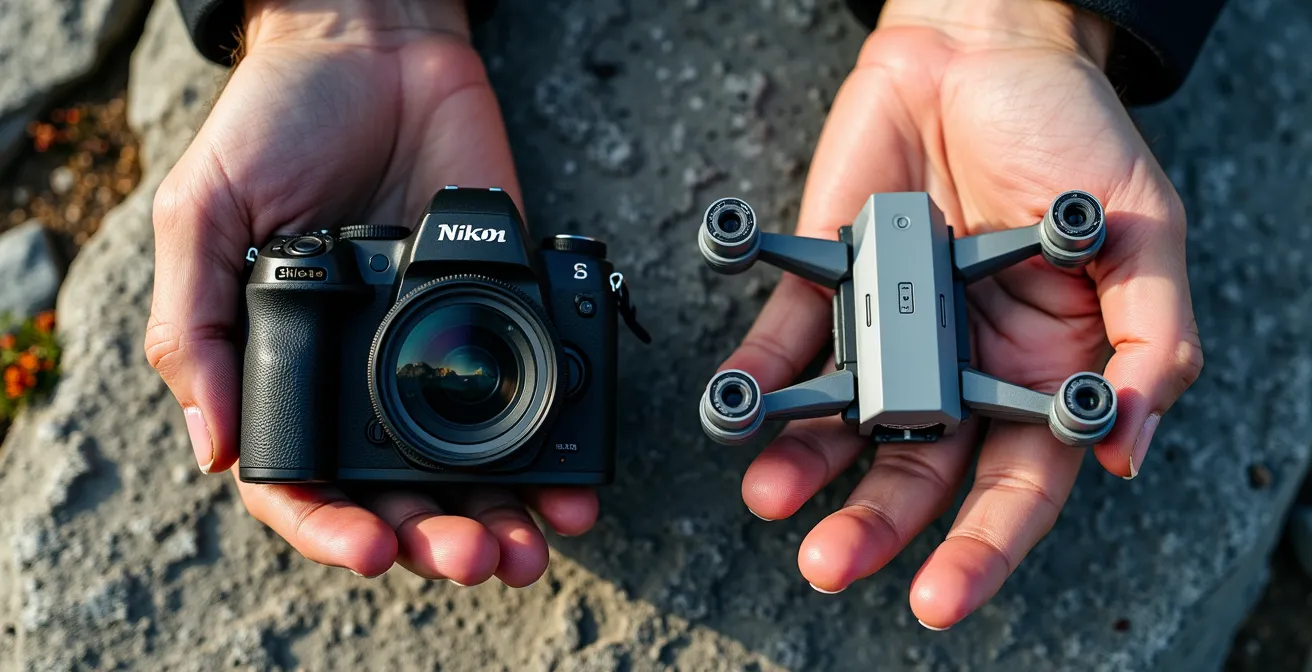
Drones present a significant ethical challenge, particularly in protected areas like national parks. In the United States, for instance, the National Park Service has restricted their use due to serious concerns. The auditory and visual presence of a drone shatters the natural soundscape, impacting the experience of other visitors. More critically, it induces stress in wildlife. Studies have shown that even a distant drone can cause significant physiological reactions. For example, black bears experience a spike in heart rate when a drone is present, even if they show no outward signs of distress. This “silent” impact is a crucial part of your ethical footprint.
A traditional camera, by contrast, demands a different kind of work. It forces you to engage with the terrain on its own terms. You must physically move your body, read the contours of the land, and find the composition that exists from a human perspective. This process is inherently slower and more deliberate. It fosters the “environmental dialogue” we are aiming for. Instead of imposing a view upon the landscape, you are discovering one within it. This grounded approach often leads to more personal and emotionally resonant images because they are born from a physical, tangible interaction with the place.
The choice is not absolute. A licensed and permitted drone flight for a specific scientific or conservation project is one thing; a hobbyist flight over a herd of elk is another. For the photographer seeking to deepen their connection with nature, the traditional camera often proves to be the more powerful tool—not for its technical limits, but for the mindful process it encourages. It prioritizes the experience of being in the landscape over the abstraction of viewing it from above.
The Erosion Damage Caused by ‘Just One Photo’ Off the Trail
The phrase is a quiet justification, a mantra of the well-intentioned photographer: “It’s just one photo.” We step off the designated path to get a cleaner foreground, to avoid a distracting sign, or to capture that perfect solitary frame. The harm seems negligible. But in fragile high-altitude ecosystems, the concept of “just one” is a dangerous illusion. The true damage lies in the cumulative effect, an invisible erosion driven by thousands of individual footsteps. Your ethical footprint is measured not just in what you leave behind, but also in the delicate life you displace.
Consider cryptobiotic soil. This dark, crusty layer of earth is a living community of cyanobacteria, mosses, and lichens. It’s the literal glue holding many arid and alpine landscapes together, preventing erosion and creating a foundation for other plants to grow. It is incredibly fragile and slow to form. In fact, environmental research demonstrates that some cryptobiotic soil crusts can take decades, or even centuries, to recover from the damage of a single footstep. That “one photo” can leave a scar that outlasts the photographer’s own lifetime.
Case Study: The Unseen Cost of a Single Flight
The impact is not limited to soil. In 2021, a single drone flew over the Bolsa Chica Ecological Reserve during nesting season. While the operator was likely just seeking a compelling image, the perceived threat from the aerial object caused a mass panic among the resident terns. Thousands of birds fled their nests in unison. The result was the abandonment of over 1,500 eggs. The pursuit of one photograph, one flight, led to the loss of an entire generation for that colony. This tragic event illustrates how a seemingly minor intrusion can have catastrophic, cascading consequences for wildlife.
This is why park rules and designated trails exist. They are not arbitrary restrictions designed to inconvenience photographers; they are carefully planned conservation measures based on decades of ecological science. Staying on the path is the most fundamental act of respect you can show the landscape. It is a conscious decision to prioritize the health of the ecosystem over a marginal improvement in your composition. The most powerful landscape photos are not those taken from a forbidden spot, but those that convey a deep love and respect for a place that is healthy and whole.
When to Arrive at Popular Spots to Get the Golden Hour Alone?
The “golden hour” is the worst-kept secret in photography. The hour after sunrise and before sunset offers sublime, warm light, but at popular locations, it also guarantees a crowd. The key to capturing that magical light without the masses is not to avoid it, but to out-think the crowd. This requires a strategy of choreographed solitude, where you manipulate time and position to create your own private window within the busiest periods. It’s about understanding the herd mentality and deliberately moving against it.
Most photographers are creatures of comfort. They target sunset because it doesn’t require a pre-dawn alarm. By simply choosing sunrise over sunset, you can often cut the crowd by more than half. The light is just as beautiful—often crisper and clearer—and the experience is infinitely more serene. The early start is a small price to pay for the feeling of having a world-class landscape all to yourself. This simple shift is the first and most effective tactic in your arsenal.
Another powerful strategy is to work the fringes of the main event. The “blue hour”—the period just before sunrise or after sunset when the sky has a deep, saturated blue hue—is often ignored. Photographers pack up the moment the sun is gone, but this is when a different kind of magic happens. City lights in distant valleys begin to twinkle, and the landscape takes on a quiet, contemplative mood. Similarly, a short walk—often just 50 to 100 meters away from the main viewpoint—can reveal unique compositions and a surprising degree of solitude. The best shot is rarely from the exact spot where the parking lot path ends.
- Target Sunrise, Not Sunset: The majority of casual visitors and photographers aim for the evening. The pre-dawn effort filters out all but the most dedicated.
- Work the Blue Hour: Arrive earlier and stay later than everyone else. The moments before the sun rises and after it sets offer unique, moody light and far fewer people.
- Embrace “Bad” Weather: A forecast of clouds or a storm will deter most people, but this is when the most dramatic and emotional light often appears. A break in the clouds can create spotlight effects and intense color.
- Find Micro-Solitude Zones: Simply walk a short distance away from the primary cluster of tripods. A slightly different angle can provide a unique composition and a sense of isolation.
- Visit During Shoulder Seasons: Late autumn and early spring offer unique conditions—lingering snow, nascent green, dramatic skies—with a fraction of the summer or peak fall crowds.
Why 3 Days in a National Park Lowers Cortisol More Than a Spa?
We often think of a trip to a national park as a vacation, an escape. But a growing body of scientific evidence suggests it’s more accurate to see it as a form of therapy. A sustained immersion in a natural environment—a practice sometimes called “forest bathing” or *shinrin-yoku*—has been shown to produce significant physiological changes, most notably a reduction in stress. This isn’t a placebo effect; it’s a biological response to an environment our species evolved in for millennia.
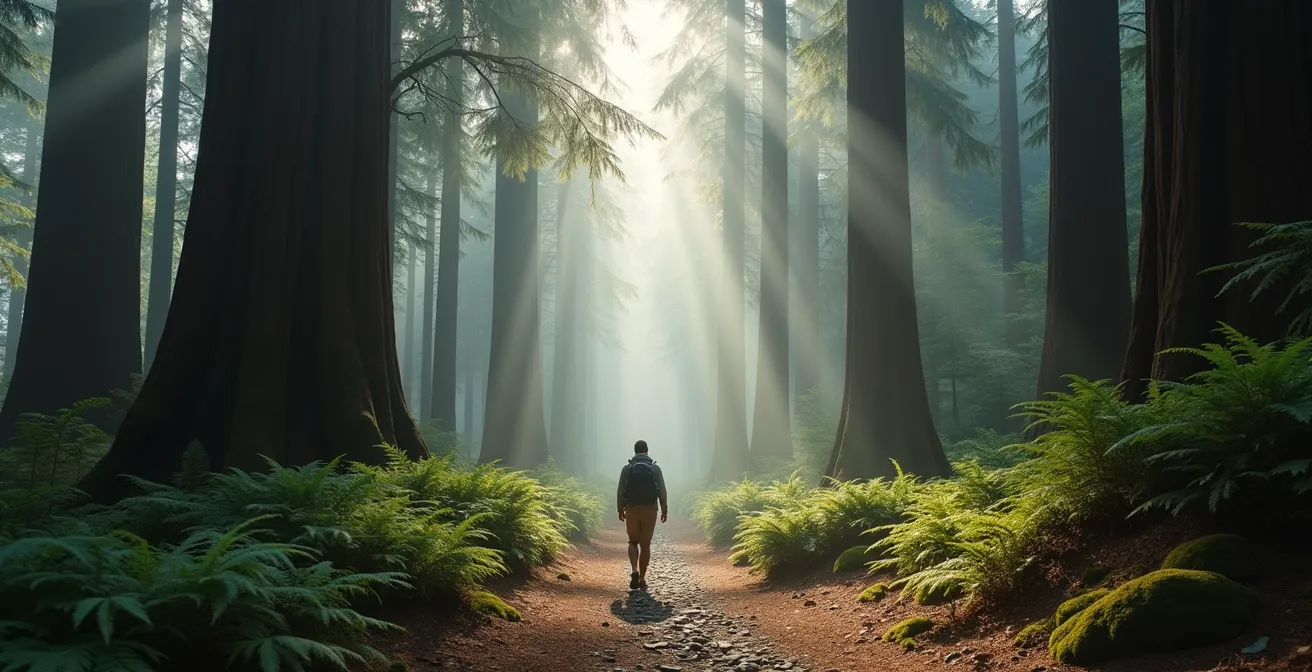
The primary mechanism behind this effect is the reduction of cortisol, the body’s main stress hormone. Chronic high levels of cortisol, driven by the constant low-grade pressures of urban life, are linked to a host of health problems. Natural environments seem to act as a powerful antidote. A systematic review and meta-analysis found that levels of salivary cortisol were significantly lower in individuals after they spent time in a forest compared to an urban environment. This effect is triggered by a combination of sensory inputs: the fractal patterns in foliage, the sound of wind and water, the scent of phytoncides released by trees, and the sheer absence of urban overstimulation.
Why three days? While even a short walk in a park has benefits, a multi-day immersion allows for a deeper and more lasting reset. It takes time for the body’s rhythms to recalibrate and for the mind to quiet down from its default state of high alert. A spa offers temporary relaxation, often in a simulated natural environment. A national park offers the real thing, an authentic and complex sensory experience that engages our minds and bodies on a much deeper level. The perceptual shift away from screens and schedules to the slow, steady rhythms of the natural world is a powerful therapeutic intervention.
For the photographer, this has a dual benefit. First, it improves your well-being, which is an end in itself. Second, a less-stressed, more present mind is a more creative mind. When your cortisol levels drop, your prefrontal cortex—responsible for higher-order thinking and creativity—functions more effectively. You become more attuned to subtle changes in light and shadow, more patient in waiting for the right moment, and better able to see the compositions that elude a hurried and stressed-out eye.
How to Get the ‘Edge Shot’ Without Actually Risking Your Life?
The “edge shot”—a lone figure perched heroically on a cliff edge, gazing into a vast abyss—has become a dominant trope in landscape photography. It’s a powerful visual shorthand for adventure and contemplation. Unfortunately, it has also led to a tragic number of accidents as photographers and influencers take literal risks for a virtual reward. The secret of professional photographers is that the most dramatic edge shots are almost always an illusion. They are the result of clever technique, not careless bravery.
The most powerful tool for creating a safe edge shot is a telephoto lens. By using a long focal length (e.g., 200mm to 400mm) and positioning yourself far away from your subject, you can create an effect called lens compression. This effect makes the background appear much closer and larger relative to the subject than it really is. You can place your subject several meters back from a dangerous edge, on perfectly safe and stable ground, and the compression will make it look as though they are right on the brink. This technique is the cornerstone of responsible adventure photography.
Another effective method involves manipulating your camera angle. By shooting from a very low angle on a safe, wide path that overlooks a valley, you can create a powerful sense of vertigo without ever placing your subject in danger. The foreground of the path is excluded from the frame, and the viewer’s eye is drawn directly to the subject and the drop-off beyond. The key is to create the *feeling* of exposure without the reality of it. You can also create contemplative, powerful shots by including the subject’s feet, showing them firmly planted on the ground, with the abyss serving as a backdrop. It changes the mood from daredevil to thoughtful observer.
For those with post-processing skills, composite photography offers a completely safe alternative. This involves taking a dramatic landscape shot and a separate, safely-shot portrait, then carefully blending them together in software. When done well, the result is seamless and allows for ultimate creative control without a moment of risk. The following table breaks down the risk-reward profile of these techniques.
| Technique | Apparent Risk Level | Actual Risk | Visual Impact |
|---|---|---|---|
| Forced Perspective | High | None | Very High |
| Telephoto Compression | High | None | High |
| Low Angle on Path | Medium | None | Medium |
| Composite Shot | High | None | Very High |
| Actual Edge Position | Extreme | Extreme | High |
Key takeaways
- Shift your mindset from “taking a photo” to engaging in an “environmental dialogue” to enhance both your experience and your images.
- Prioritize solitude and deep observation by using smarter scouting tools and avoiding crowded, over-photographed viewpoints.
- Make conscious gear choices, understanding that a traditional camera often fosters a more intimate and ethical connection to the landscape than a drone.
How to Plan a National Park Trip That Avoids the ‘Disneyland’ Effect?
Many national park trips devolve into a frantic checklist of iconic spots, connected by traffic jams and crowded parking lots. This “Disneyland effect” is the antithesis of the restorative experience we seek. A truly successful photography trip is not measured by the number of famous locations you visit, but by the quality of the time you spend in them. Escaping the crowds requires a paradigm shift in planning: from a location-based itinerary to an experience-based strategy.
This starts by redefining your goals. Instead of “See Point A and Point B,” plan for “Four hours of solitude on an east-facing ridge” or “A full afternoon exploring a river valley with interesting geology.” This forces you to research the park’s lesser-known areas and aligns your plan with a desired feeling, not just a landmark. This approach naturally leads you away from the main arteries of the park and into places where an authentic environmental dialogue is possible. Staying inside the park, whether at a campsite or a lodge, is a powerful enabler of this strategy, granting you access during the quietest hours of early morning and late evening when day-trippers are gone.
The National Park Service itself provides clues. As they state regarding certain activities, their goal is to enhance visitor experience while protecting resources. The restrictions are in place because of real, negative impacts.
The National Park Service embraces many activities in national parks because they enhance visitor experiences with the iconic natural, historic and cultural landscapes in our care. However, due to serious concerns about the negative impact that flying uncrewed aircraft can have for safety of visitors, staff, and wildlife, they have been restricted.
– National Park Service, Uncrewed Aircraft in the National Parks
This official stance underscores the delicate balance parks must maintain. By planning a trip that aligns with conservation principles—seeking out solitude, minimizing impact, and respecting closures—you become a partner in preservation rather than just a consumer of scenery. The following audit will help you structure a trip plan that achieves this.
Action Plan: Your Trip-Planning Audit
- Define Experience Goals: List desired experiences (e.g., solitude, wildlife observation, dramatic light) instead of just locations. This will be your guiding principle.
- Map Potential Zones: Using topographic maps and ranger intelligence, identify several potential zones in the park that could deliver your desired experiences, far from the main tourist hubs.
- Build a Timing Strategy: For each potential zone, plan your visit for off-peak times. Will you go at sunrise? During the week? In the shoulder season? Assign specific time windows.
- Formulate Smart Questions: Prepare specific, intelligent questions for park rangers (e.g., “Which trails in the northern sector are least trafficked on weekday mornings?”) to get high-quality, non-obvious advice.
- Create Contingency Plans: Have a Plan B and C. If a chosen spot is unexpectedly crowded or conditions are poor, what is your alternative? This prevents you from defaulting back to the crowded “A-list” spots.
Ultimately, the path to creating breathtaking landscapes without ruining the moment is to stop seeing the camera as a tool for extraction. It is a tool for focus. It prompts you to ask: Where is the light coming from? How does this line lead the eye? What story does this landscape tell? These are not technical questions; they are questions of deep observation. By engaging in this environmental dialogue, the photograph ceases to be the goal. It becomes the beautiful, inevitable artifact of you having been truly, profoundly present.