In summary:
- Authentic food is a map to a city’s soul; learning to read its economic and social signals is the key.
- Prioritize stalls with high turnover, single-dish specialization, and cash-only payments—these are hallmarks of a local favorite.
- Master a few non-verbal ordering techniques and basic food safety checks (hot food hot, cold food cold) to eat confidently anywhere.
- Balance your budget between immersive street food for daily meals and selective fine dining for special culinary experiences.
- Plan your food tour by cross-referencing social media with local blogs, and always travel with an ethical mindset.
Every discerning traveler knows the feeling: the sinking disappointment of a mediocre, overpriced meal in what should be a gastronomic paradise. You’ve been ensnared by a tourist trap, a culinary mirage designed to attract visitors and extract cash, leaving you with little more than a bland taste and a lighter wallet. The common advice—”go where the locals go” or “walk a few blocks off the main square”—is well-intentioned but hopelessly vague. It treats finding authentic food like a matter of luck, a random stroll in the right direction.
But what if the solution wasn’t about wandering aimlessly, but about reading the signs? What if a city’s food scene was a living, breathing map of its social and economic life? The real skill for a foodie traveler isn’t just having a good palate; it’s developing a kind of culinary forensics. It’s about learning to decode the subtle signals that separate a multi-generational food stall from a cynical tourist-facing operation. This is the shift from passive tourist to active investigator.
This guide abandons the platitudes. Instead, it provides a framework for navigating any city’s culinary topography. We will explore why street food tells a deeper story than a museum, how to order with confidence when faced with a foreign menu, and where to strategically allocate your food budget. We’ll cover the non-negotiable hygiene checks, the ethics of food tourism, and the specific tells of a trap, from a seaside town to the heart of a bustling market. Forget luck; it’s time to learn the system.
This article provides a complete roadmap for the traveler determined to eat authentically. The following sections break down the essential strategies, from understanding the cultural significance of street food to mastering the art of pre-trip planning.
Summary: Your Guide to a City’s Culinary Soul
- Why Does Local Street Food Tell You More Than a Museum?
- How to Order Confidence-Boosting Dishes When You Can’t Read the Menu?
- Street Stalls or Fine Dining: Where Should You Spend Your Budget?
- The Hygiene Mistakes That Cause Food Poisoning on Day 1
- How to Map Out a 3-Day Food Tour Before You Even Arrive?
- The Poverty Tourism Trap: What to Avoid in Developing Nations
- How to Spot a “Tourist Menu” Trap in a Seaside Town?
- How to Eat Fresh Seafood on Your Trip Without Getting Sick?
Why Does Local Street Food Tell You More Than a Museum?
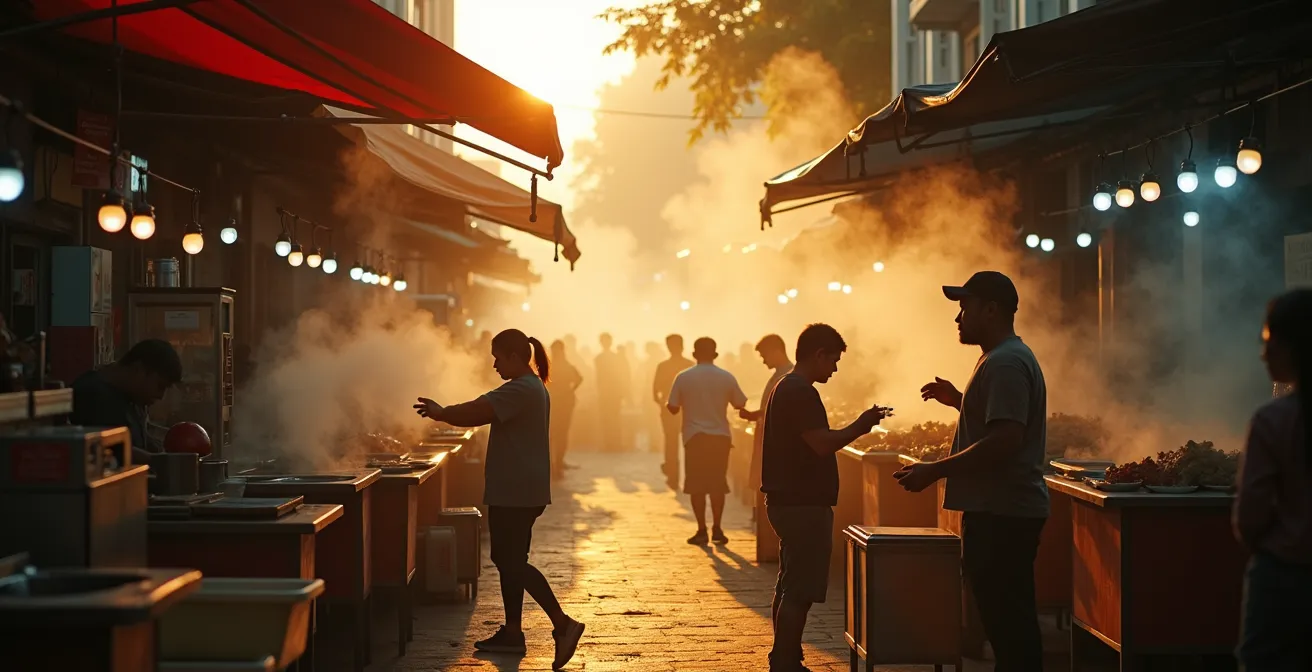
A museum curates the past, presenting a polished, static version of a city’s history. Street food, in contrast, is the city’s living, breathing diary. It is the most honest expression of its culture, economy, and social rhythms, updated in real-time. Where a museum displays artifacts behind glass, a street stall serves up the very fuel of daily life. The morning rush for a specific breakfast soup tells you about the local work commute. The location of vendors reveals the city’s culinary topography, mapping out blue-collar lunch spots versus late-night social hubs.
This gastronomic narrative is written in economic signals. A vendor specializing in a single dish often guards a recipe passed down through generations, a testament to tradition and mastery. A cash-only policy isn’t a sign of being outdated; it’s a strong indicator that the business primarily serves a local clientele, unconcerned with the foreign credit cards of tourists. These are not just places to eat; they are micro-economies that offer a raw, unfiltered view into the city’s soul.
Case Study: The Evolution from Local Gem to Tourist Magnet
The story of the All’Antico Vinaio sandwich shop in Florence is a perfect lesson in this dynamic. What began as a humble local institution became an international sensation, expanding into a multi-million-dollar business with global outposts. Today, however, you’ll find few Florentines in the queue. Its evolution perfectly demonstrates how street food is a barometer for real-time urban economic shifts, showing how a local necessity can transform into a global tourist attraction, fundamentally changing its role within the city.
To truly understand a city, you must learn to read these signs. Observe who eats where and when. Notice the tools, the payment methods, and the rhythm of the queue. Each detail is a word in the city’s story, far more vibrant and current than any museum plaque.
How to Order Confidence-Boosting Dishes When You Can’t Read the Menu?
Standing before a menu filled with incomprehensible script can be one of the most intimidating moments of food travel. But it’s also a gateway to discovery, not a barrier. The first rule is to abandon the paralysis of the unknown and embrace observational strategies. Your eyes are your most powerful tool. Before you even approach the vendor, take a moment to survey the scene. What are most people eating? What looks and smells incredible? This isn’t being nosy; it’s conducting field research.
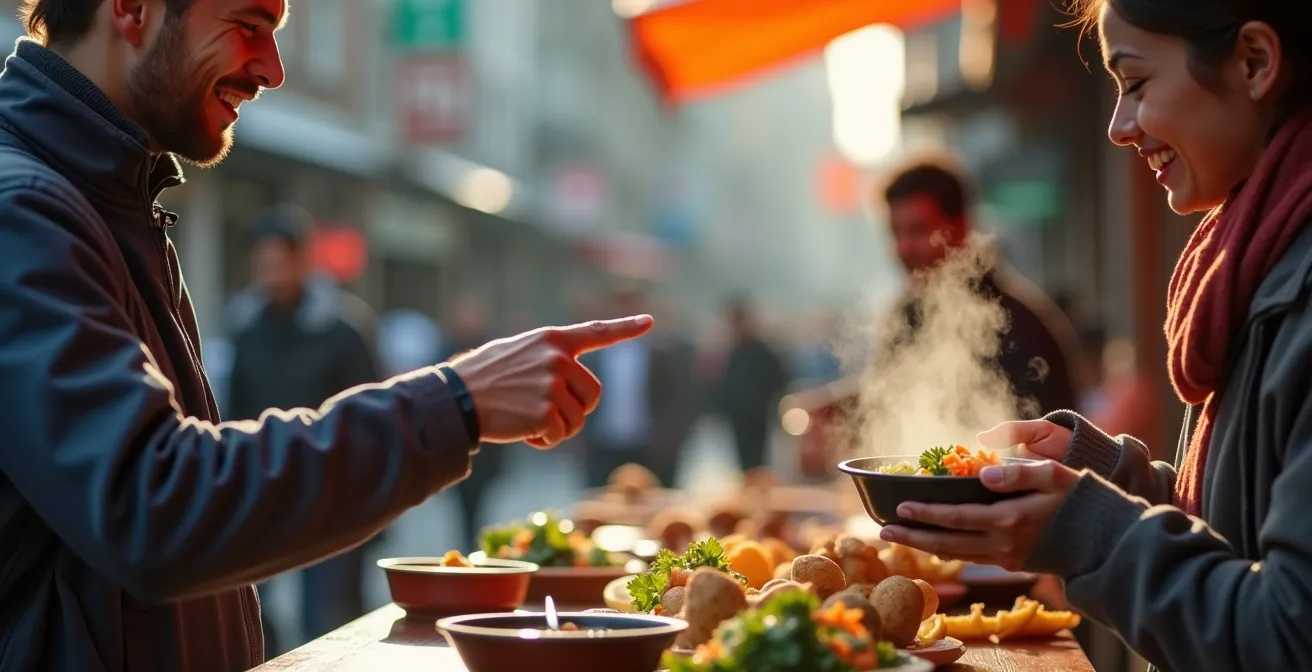
When you’re ready to order, the “point and smile” method is a universal language. It’s a gesture of trust and curiosity that is almost always met with warmth. Point confidently to a dish being enjoyed by a local, or directly at the bubbling pot or sizzling grill. This simple act communicates, “I want what’s good here, and I trust you.” It bypasses the need for translation and often results in you trying the vendor’s true specialty, not a dish simplified for foreign palates.
To bolster your confidence, prepare a small digital arsenal. Before your trip, download the offline language pack for your translation app and create a visual dictionary on your phone with pictures of key local ingredients (e.g., beef, chicken, cilantro, chili). Learning a single phrase like “What is your specialty?” in the local language can also work wonders. Combining these techniques—observation, pointing, and minimal digital aids—transforms a potentially stressful encounter into a confident and rewarding interaction.
Street Stalls or Fine Dining: Where Should You Spend Your Budget?
The debate between splurging on a Michelin-starred meal and diving into the world of street food is not an either/or proposition. For the discerning traveler, it’s a question of strategic allocation. A successful culinary journey requires a portfolio approach, balancing the immersive, high-frequency experience of street stalls with the targeted, high-impact splurge of fine dining. Street food is your daily bread; fine dining is the special occasion, the deep dive into culinary artistry.
Street food offers unparalleled value in cultural immersion. For a few dollars, you are participating in a daily ritual, eating shoulder-to-shoulder with locals and tasting the city’s authentic flavor profile. It’s the most budget-efficient way to get a pulse on the local palate. Fine dining, on the other hand, offers a different kind of value: innovation, comfort, and a curated narrative. It’s where you see a chef’s interpretation of the local terroir, often pushing boundaries and showcasing ingredients in a new light. It’s less about the daily rhythm and more about a pinnacle culinary statement.
A smart approach is to dedicate the majority of your food budget to exploring the breadth of the street and market food scene, allowing for multiple meals and discoveries each day. Then, select one or two fine dining establishments for a special occasion or to experience the work of a chef you admire. This hybrid strategy ensures you don’t miss either end of the authenticity spectrum—the raw, unfiltered soul of the street, and the refined, artistic expression of high-end cuisine.
The following table breaks down the value proposition of each, helping you decide where your dollars will deliver the best return on experience.
| Aspect | Street Food | Fine Dining |
|---|---|---|
| Average Cost | $5-10 per meal | $50-150 per meal |
| Cultural Authenticity | High – locals eat here daily | Variable – often adapted for tourists |
| Menu Flexibility | Limited but specialized | Extensive options |
| Experience Type | Quick, immersive, social | Leisurely, comfortable, service-focused |
| Best For | Daily meals, cultural immersion | Special occasions, culinary innovation |
The Hygiene Mistakes That Cause Food Poisoning on Day 1
Nothing ruins a trip faster than a bout of food poisoning. While the fear of getting sick can push travelers toward sterile, soulless restaurants, the truth is that some of the busiest street stalls are safer than a hotel buffet. The key is not to avoid street food, but to become a shrewd observer of hygiene practices. The risk is real; studies show that between 30% and 70% of travelers experience traveler’s diarrhea, making food safety a non-negotiable skill.
Your primary tool is sensory forensics. The two most critical factors are temperature and turnover. Busy stalls with long lines of locals are your best friend; high turnover means food is constantly being cooked and hasn’t been sitting around. Next, use your eyes. Hot food should be visibly steaming, kept on a hot grill or over a flame, not languishing in a lukewarm tray. Cold items should be on ice or in a refrigerated display. Avoid anything sitting at room temperature, as this is the “danger zone” where bacteria multiply rapidly.

Observe the vendor’s hands. Do they handle money and then food without washing their hands or using gloves? This is a major red flag. Look for separate people handling cash and food, or a clear hand-washing station in use. Finally, ease your system into it. On your first day, stick to fully cooked items. Introduce fermented foods on day two, and save raw or fresh items for later in your trip once your gut has had time to acclimate. A little bit of observation goes a long way in ensuring your culinary adventures are memorable for the right reasons.
Your 5-Point Hygiene Audit Checklist: Before You Eat
- Assess the temperature: Is hot food visibly steaming (above 140°F/60°C)? Is cold food on ice or refrigerated (below 40°F/4°C)?
- Check for high turnover: Is there a steady line of customers, ensuring food is freshly prepared and not sitting out?
- Observe hand hygiene: Does the vendor wash hands between handling money and food, or are these tasks separated between staff?
- Inspect the workstation: Is the cooking area generally clean and organized, with raw and cooked foods kept separate?
- Trust your instincts: Does the food look and smell fresh? If anything seems off, walk away. There is always another option.
How to Map Out a 3-Day Food Tour Before You Even Arrive?
The most rewarding food journeys are never accidental. They are the result of deliberate, pre-trip reconnaissance. Arriving in a city with a well-researched culinary map transforms you from a wandering tourist into a traveler on a mission. This doesn’t mean having a rigid, minute-by-minute itinerary, but rather a curated list of potential targets that gives your exploration purpose and direction. The planning phase is a treasure hunt in itself.
Your research should follow a method of triangulation, cross-referencing sources to filter out the noise. Start with modern tools, but use them critically. A great starting point is what can be called “digital ethnography.”
The Digital Ethnography Method for Food Discovery
This modern planning technique involves using social media as a starting point for intelligence gathering. As one effective travel hacking strategy suggests, search for hashtags like #[city]food or #[city]eats on Instagram. But don’t just look at the polished posts from influencers. The real gold is in the “tagged photos” section of a restaurant’s profile. This shows you unfiltered images from real customers. Cross-reference promising spots with reviews on local food blogs (not just international travel sites) and Google Maps. Finally, save every potential gem to an offline Google Map, creating a personalized food atlas you can access anywhere.
Structure your map thematically to create a narrative for your trip. A great framework is a three-day, theme-based tour:
- Day 1: The Classics. Target 3-4 historic establishments known for the city’s defining, traditional dishes. This builds your foundational palate.
- Day 2: The Modern Wave. Seek out new-generation chefs, fusion restaurants, or stalls that are re-imagining local cuisine. This shows you where the culture is headed.
- Day 3: Market to Table. Spend the morning at a major food market. Identify the freshest ingredients, then eat at nearby stalls that are using that same produce. This connects you directly to the local terroir.
This structured approach ensures you experience the full breadth of a city’s gastronomic identity—its past, present, and future.
The Poverty Tourism Trap: What to Avoid in Developing Nations
The quest for authenticity can sometimes lead travelers down a morally ambiguous path, particularly in developing nations. There is a fine but critical line between supporting a local community and engaging in “poverty tourism,” where hardship is consumed as part of the travel experience. This is not about avoiding poorer areas, but about engaging with them ethically and with dignity. True support empowers, it does not exploit.
The most insidious form of this is the restaurant or tour that sensationalizes poverty for profit. These establishments often have no real connection to the community they operate in, with profits flowing to outside owners rather than locals. The key is to shift your focus from passive observation to active participation in the local economy. As one expert on the topic notes, the ethical misstep is profound.
The trap isn’t looking at poverty, but consuming it as an attraction.
– Ethics in Tourism Expert, in a discussion on ethical travel engagement
To avoid this trap, your money must be your voice. Make a conscious effort to patronize businesses that are community-owned or have a clear social mission. Look for social enterprises, restaurants that run training programs for local youth, or eateries that source their ingredients directly from small-scale farmers in the region. Your photography should also be respectful; focus on the food, the craft, and the artistry, and always ask for permission before taking pictures of people, especially in a way that highlights their hardship. The goal is to be a customer, a supporter—not a spectator.
Follow these guidelines for a more ethical engagement:
- Choose community-owned eateries and cooperatives over poverty-themed tourist restaurants.
- Support social enterprises and restaurants with documented training or give-back programs.
- Prioritize businesses that source directly from small, local farmers and producers.
- Focus your photography on food and craft with permission, not on surrounding hardship.
- Research and patronize establishments known for fair wage practices.
Key Takeaways
- Your best defense against tourist traps is not avoidance, but active observation of economic signals like customer flow, vendor specialization, and payment methods.
- Food safety is a skill, not a gamble. Prioritize stalls with high turnover and always verify that hot foods are steaming and cold foods are properly chilled.
- A balanced culinary strategy involves dedicating most of your budget to immersive street food exploration while saving for one or two high-end dining experiences.
How to Spot a “Tourist Menu” Trap in a Seaside Town?
In a seaside town, the promise of fresh seafood is the ultimate siren’s call, and also the most common bait for a tourist trap. The classic trap is a restaurant with a sprawling, laminated menu featuring every fish imaginable, often accompanied by pictures and translated into six languages. This is a red flag. A truly authentic seafood restaurant’s menu is not a static document; it’s a dynamic reflection of the day’s catch. Its brevity and simplicity are its greatest strengths.
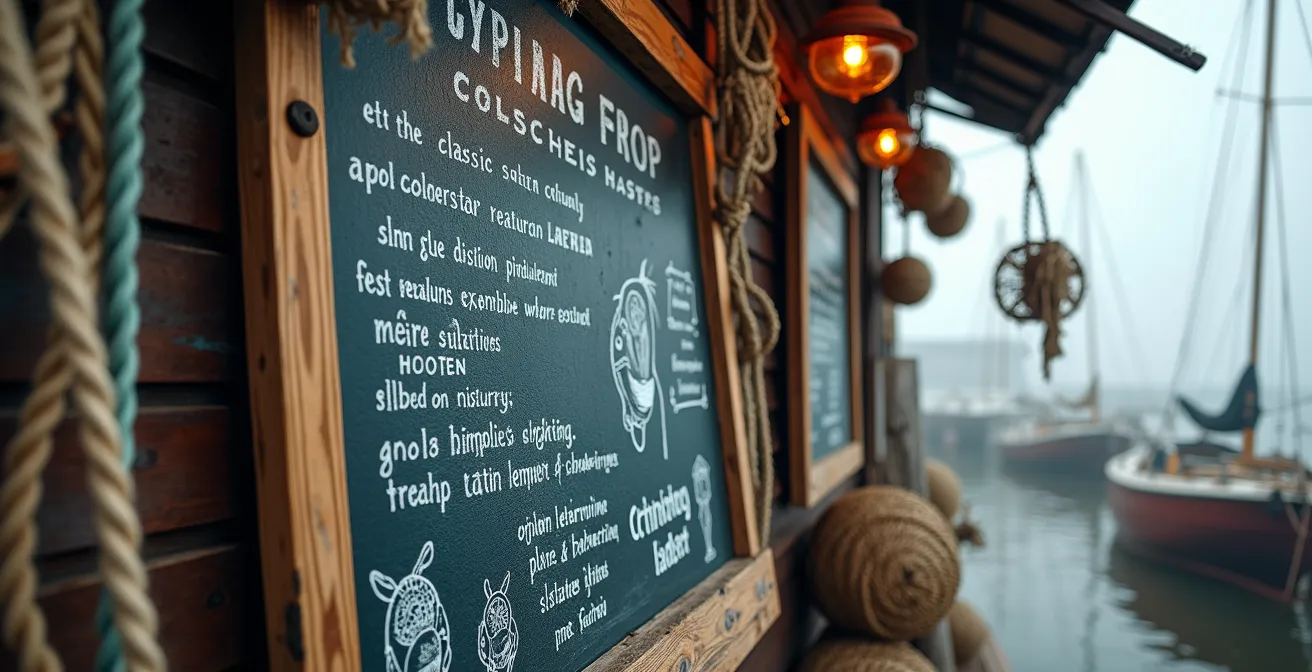
The most telling sign of a genuine establishment is a small, handwritten menu, perhaps on a chalkboard, that changes daily. This signals that the chef is buying what is fresh and in season from the local fishing fleet, not what is popular and easily sourced from a freezer. An overly extensive menu featuring popular but out-of-season fish is a guarantee that you will be eating something that was frozen. This is a critical insight for any seafood lover.
Case Study: Using Seasonal Fish Availability as a Trap Detector
Tourist-focused restaurants will often promote popular fish like sea bass or cod year-round, regardless of local fishing seasons. A quick, 30-second search on your phone for “local fishing season chart [region]” can be incredibly revealing. As astute travel blogs point out, if the “catch of the day” being heavily promoted is not actually in season, you have uncovered a trap. An authentic restaurant will build its menu around what the boats actually brought in that morning, highlighting the true seasonal bounty.
Look for restaurants located near the fishing docks, but not necessarily the ones with the most prominent signage. The best spots are often unassuming, confident in their quality and their local following. They don’t need to lure you in with glossy photos; the quality of their product speaks for itself. The shorter and more ephemeral the menu, the higher the likelihood of an authentic, fresh-off-the-boat experience.
How to Eat Fresh Seafood on Your Trip Without Getting Sick?
The reward of eating fresh seafood is immense, but so is the risk if it’s not handled properly. Beyond the general hygiene rules, selecting fresh seafood requires a specific set of observational skills. The risk is not uniform across the globe; a 2024 analysis of online searches by WellnessPulse highlights vast differences, with some destinations like India showing significantly higher search volumes for food poisoning remedies than countries like Italy. This underscores the need for vigilance, especially in high-risk regions.
When selecting whole fish from a market or a display, let your senses be your guide. The fish’s eyes should be your first checkpoint: they must be clear, plump, and bulging, not cloudy, sunken, or hazy. Next, if you can, look at the gills. They should be a vibrant, bright red, similar to the color of fresh blood. Brown, gray, or slimy gills are a definitive sign of decay. The flesh itself should be firm and springy to the touch; when pressed, it should bounce back immediately. If your fingerprint remains, the fish is not fresh.
For shellfish, the rules are different but equally important. Clams, mussels, and oysters should have tightly closed shells. If a shell is slightly open, give it a firm tap. If it’s alive, it will snap shut. Any that remain open or have broken shells should be discarded without question. When you’re eating raw preparations like ceviche or crudo, pay attention to the preparation. The high acidity from citrus juices, like lemon or lime, not only adds flavor but also helps to kill surface bacteria, adding a small layer of safety.
Mastering these visual and tactile checks is the best way to ensure your seafood experience is delicious and safe.
- Whole Fish: Look for clear, bulging eyes and bright red gills. The flesh should spring back when pressed.
- Shellfish: Shells should be tightly closed. If slightly open, they should close when tapped. Discard any that stay open.
- Fillets: The flesh should be firm and translucent, not opaque or discolored.
- Smell: Fresh seafood should smell of the ocean, clean and briny. Avoid anything with a strong, “fishy,” or ammonia-like odor.
By transforming your mindset from a passive consumer to a culinary detective, you can unlock a deeper, more rewarding layer of travel. The goal is not just to avoid bad meals, but to actively find the great ones that tell the true story of a place. Start putting these forensic techniques into practice on your next journey to truly taste the world.
Frequently Asked Questions About Navigating Food Abroad
How can I identify the main sections of a menu in any language?
Look for visual breaks and price patterns—appetizers are usually grouped at the top with lower prices, mains in the middle with higher prices, and desserts at the bottom, often with the lowest prices again.
What’s the safest ordering strategy when completely lost?
Use the ‘point and smile’ method: observe what locals are enjoying, point at their dish when ordering, and show the vendor a photo on your phone of what you want to try.
Should I rely only on translation apps?
No, combine multiple strategies: pre-download offline languages, create a visual dictionary of local ingredients on your phone, and learn one key phrase like ‘What is your specialty?’ in the local language.