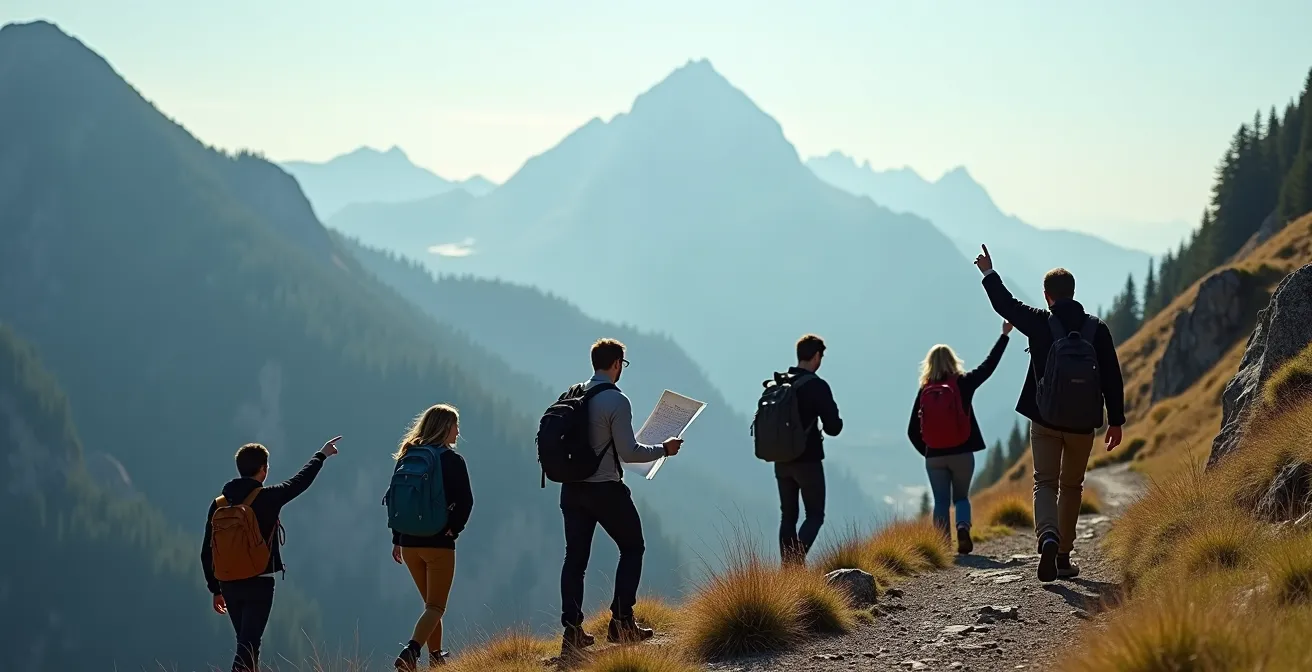
Contrary to popular belief, team bonding isn’t forged over comfortable dinners but through intentionally designed shared adversity.
- Genuine trust emerges from navigating controlled chaos, not from structured, predictable social events.
- The goal is to dismantle professional masks by creating situations that require authentic communication and mutual reliance.
Recommendation: Stop planning “fun” trips and start engineering meaningful challenges that test and build your team’s collaborative muscle.
Most corporate retreats and group trips follow a tired script: a nice dinner, some planned activities, and forced conversation. The result? A temporary truce, but rarely a fundamental shift in team dynamics. The friction that existed in the office often resurfaces the moment everyone is back at their desks. This approach fails because it mistakes comfort for connection. It assumes that simply placing people in a new environment is enough to build bonds, ignoring the psychological barriers that maintain distance.
The common advice to “communicate more” or “do activities together” is too generic to be useful. It doesn’t address the core issue: a lack of genuine, shared experience where stakes are real, however small. True coordination is not built on a perfectly executed itinerary but in the messy, unscripted moments of problem-solving. It’s about creating an environment where team members must rely on one another in a new and unfamiliar context, stripping away the usual workplace hierarchies and personas.
This guide offers a different perspective. What if the key to unlocking deep team coordination wasn’t avoiding problems, but embracing them? We will explore how to leverage the inherent challenges of travel—from getting lost to navigating high-stress sports—as powerful tools for team building. This is not about seeking out danger, but about using shared adversity in a controlled way to foster psychological safety, empathy, and a level of trust that no boardroom exercise can replicate. We’ll break down the principles of designing these experiences, assigning roles, managing communication, and, most importantly, processing the outcomes to ensure the bonds forged on the road translate back to the workplace.
To help you navigate these principles, this article is structured to guide you from the foundational theory of shared challenges to the practical application of running a successful team-building road trip. Each section addresses a critical component of engineering a transformative group travel experience.
Summary: A Facilitator’s Guide to Team Coordination with Travel Challenges
- Why Getting Lost Together Bonds a Group Faster Than a Dinner?
- How to Assign Roles in a Raft or Hike Based on a Personality?
- Competition or Collaboration: Which Activity Style Fixes Group Conflict?
- The Silence Mistake That Leads to Accidents in High-Stress Sports
- When to Discuss the Experience to Cement the Bond?
- Why Deep Conversations Happen Easier When Looking at the Road?
- How to Rotate Drivers to Keep Everyone Fresh and Safe?
- What Defines a Successful Road Trip and How to Achieve It?
Why Getting Lost Together Bonds a Group Faster Than a Dinner?
The power of shared adversity lies in its ability to disrupt established social patterns. A formal dinner reinforces existing hierarchies and encourages polite, surface-level interaction. Conversely, an unscripted challenge, like navigating with a map after taking a wrong turn, forces the group into a state of collective problem-solving. This is where genuine team formation begins. It moves the group from a collection of individuals into a cohesive unit with a single, urgent goal.
In these moments, professional masks fall away. The focus shifts from individual performance to group survival, fostering a raw and authentic form of communication. Team members see each other not as their job titles, but as resourceful, vulnerable, or resilient human beings. This shift is crucial for building the deep, interpersonal trust that underpins effective collaboration. It’s the shared memory of overcoming an unexpected hurdle—not the memory of the steak or the wine—that becomes the foundation of a stronger bond.
Case Study: MIT’s Research on Unstructured Interaction
Research from the MIT Human Dynamics Laboratory provides a compelling explanation for this phenomenon. Their work revealed that the most significant factor contributing to team success is not formal meetings or structured events, but the quality of conversations that happen outside of them. Teams that engage in shared, informal problem-solving, particularly in unpredictable settings, develop a much deeper level of trust and mutual understanding. This confirms that engineered moments of “getting lost” are far more potent for team building than any planned social gathering.
Therefore, the objective is not to avoid disorientation but to create a safe container for it. The challenge should be significant enough to require collaboration but not so severe as to cause genuine distress. It is this delicate balance that transforms a potential negative experience into a powerful catalyst for connection.
How to Assign Roles in a Raft or Hike Based on a Personality?
Once you embrace shared adversity, the next step is to structure it for success. Simply throwing a group into a challenge without a framework can lead to chaos and resentment. A strategic approach to role assignment, particularly one based on personality and natural strengths, is essential. This isn’t about rigid labels but about creating a system of dynamic role-fluidity, where responsibilities are clear but individuals also have the opportunity to stretch beyond their comfort zones.
Before an activity like rafting or a long hike, use a simple framework to understand your team’s inclinations. You don’t need a formal psychometric test; a simple conversation about who enjoys planning, who is detail-oriented, who keeps morale high, and who is a natural leader can suffice. Models like Belbin Team Roles can provide a useful lens, identifying strengths such as “Resource Investigator,” “Implementer,” or “Teamworker.” The goal is to assign initial roles that play to these strengths, ensuring the team starts with a sense of competence and psychological safety.
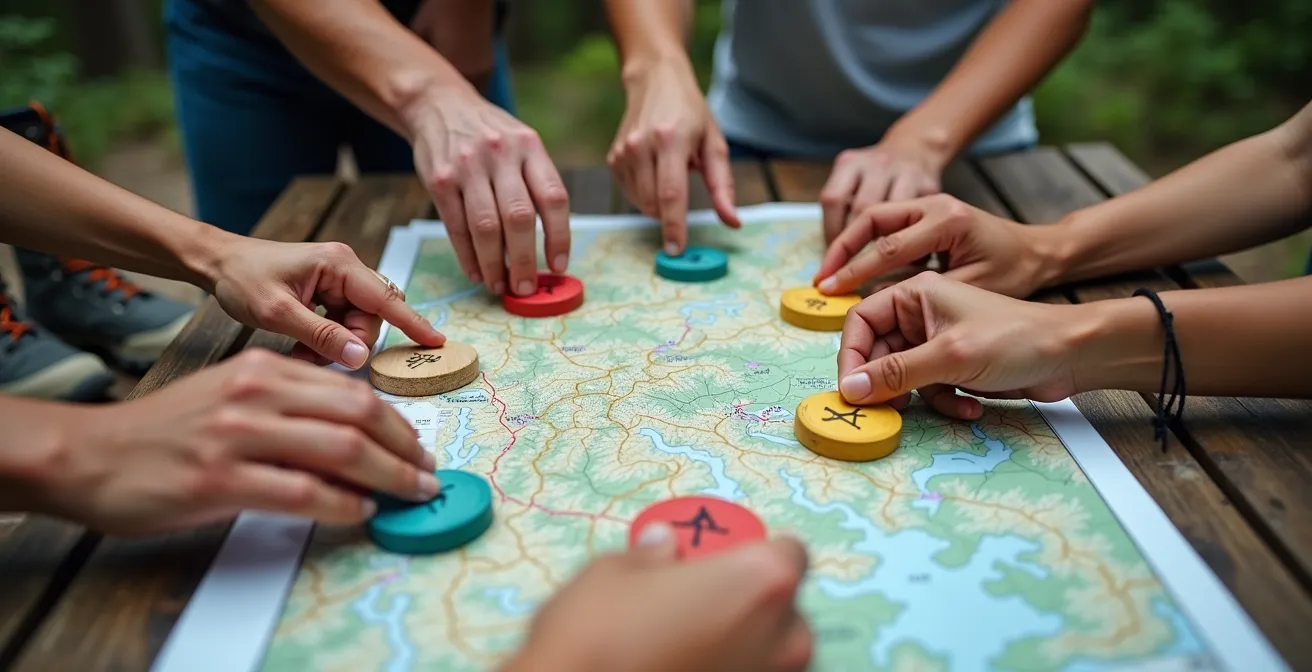
However, the real bonding happens when these roles are rotated. On a multi-day hike, the “Navigator” for the first day might become the “Pacesetter” or “Morale Officer” on the second. This rotation builds empathy. The big-picture thinker who gets frustrated with details learns to appreciate the meticulous planner. The quiet implementer gains confidence by taking a leadership role. This intentional shuffling of responsibilities ensures that everyone appreciates the diverse contributions needed for the group’s success.
Here is a simple system for implementing this:
- Pre-Activity Assessment: Use a light framework (like Belbin) to identify natural strengths.
- Initial Assignment: Assign roles based on complementary skills (e.g., pair a detail-oriented member with a big-picture thinker).
- Implement Rotation: Set predetermined checkpoints (e.g., every two hours, or at each major trail junction) for role rotation.
- Designate an ‘Observer’: Have one person step back in each rotation to monitor team dynamics and provide feedback later.
- Debrief Each Rotation: Briefly discuss what worked and what was challenging for each person in their temporary role.
Competition or Collaboration: Which Activity Style Fixes Group Conflict?
The choice between competitive and collaborative activities is not a matter of preference; it’s a strategic decision that should be based on the specific type of conflict present within the group. A common mistake is to assume collaboration is always the answer. While it is incredibly powerful, misapplied collaboration can sometimes exacerbate existing tensions, whereas controlled competition can be a surprisingly effective tool for resolving certain issues.
To make the right choice, you first need to diagnose the conflict. Is it task conflict (disagreements about the work itself), relationship conflict (personal animosity or friction), or process conflict (disagreements about how to get things done)? Each type responds differently to the pressures of competition and collaboration. For instance, forcing a collaborative task on two people with high relationship conflict can be disastrous. Instead, putting them on the same team against an external challenge can unite them against a common “enemy.”
Teams that promote collaborative working are 5 times more likely to perform at a high level.
– Stanford University Study, Forbes analysis of workplace collaboration research
While collaboration is the high-performance ideal, the path there may require different tools. The following table, based on an analysis of workplace dynamics, breaks down which approach is most effective for each type of conflict.
| Conflict Type | Best Approach | Effectiveness Rate | Recommended Activities |
|---|---|---|---|
| Task Conflict | Collaboration | 64% longer engagement | Shared problem-solving, escape rooms |
| Relationship Conflict | Controlled Competition | 40% reduction in tensions | Team vs external challenges, races against time |
| Process Conflict | Co-opetition | 36% higher retention | Mixed competitive-collaborative challenges |
This data shows that a one-size-fits-all approach is ineffective. The most skilled facilitators don’t just pick an activity; they select a game dynamic—collaborative, competitive, or a hybrid “co-opetition”—that is precisely engineered to address the group’s underlying fractures. For small groups, activities like escape rooms (collaboration) or a friendly scavenger hunt against another team (controlled competition) are particularly effective.
The Silence Mistake That Leads to Accidents in High-Stress Sports
In high-stress activities like rock climbing, kayaking, or backcountry skiing, silence is not golden; it’s dangerous. The most common mistake teams make is assuming that everyone is on the same page. This assumption, born from a lack of explicit communication protocols, can lead to misunderstandings, errors, and even accidents. The antidote is not just “more communication,” but a specific, structured system known as closed-loop communication.
This system, borrowed from aviation and emergency services, ensures that every message is not just sent but also received and correctly understood. It eradicates ambiguity. When team members feel their opinions count and are actively heard, safety and performance skyrocket. In fact, Gallup research indicates that highly engaged teams can see a 40% decrease in safety incidents, a testament to the power of robust communication systems.
In a group travel context, this means establishing clear rules of engagement before the activity begins. For example, an instruction like “Pull the rope!” is met with the response, “Pulling the rope.” This confirmation closes the communication loop, eliminating the risk that the instruction was misheard or ignored. It also builds a culture of psychological safety, where team members feel empowered to speak up, ask for clarification, or even pause the activity if they feel unsafe, without fear of judgment.
Your Action Plan: Implementing a Closed-Loop Communication Protocol
- Establish Call-Outs: Define clear, concise terms for key actions and ensure every instruction is verbally acknowledged by the receiver.
- Use the ‘Check Back’ Method: The receiver must repeat the core instruction back to the sender to confirm full understanding before acting.
- Create a Safety Codeword: Agree on a specific, no-questions-asked word (e.g., “Pause” or “Red Light”) that any team member can use to halt the activity immediately if they feel uncertain or unsafe.
- Designate Communication Roles: In complex situations, assign a ‘primary caller’ responsible for instructions and a ‘backup communicator’ to reduce noise and confusion.
- Practice in Low-Stress Scenarios: Rehearse the protocol with a simple task, like setting up a tent, before applying it in a high-stakes environment like a river rafting expedition.
This protocol transforms communication from a passive hope into an active, verifiable process. It is the single most important tool for ensuring both the physical and psychological safety of the group during a challenging adventure.
When to Discuss the Experience to Cement the Bond?
The bonding benefits of a shared challenge are not fully realized during the activity itself; they are cemented during the reflection that follows. An intense experience without a structured debrief is just a story. An experience with an intentional debrief becomes a source of actionable learning and lasting connection. The timing and structure of these conversations are critical. Discussing things too early can be chaotic, while waiting too long can lead to lost insights and faded emotions.
The key is to use a multi-stage approach. The first debrief should be an immediate “hot wash” within minutes of completing the challenge. This is not the time for deep analysis but for capturing raw, in-the-moment feelings and key events. Questions like “What was the most intense moment for you?” or “What’s one word to describe that experience?” are perfect for this stage. It allows the team to collectively acknowledge the intensity of what they just accomplished.
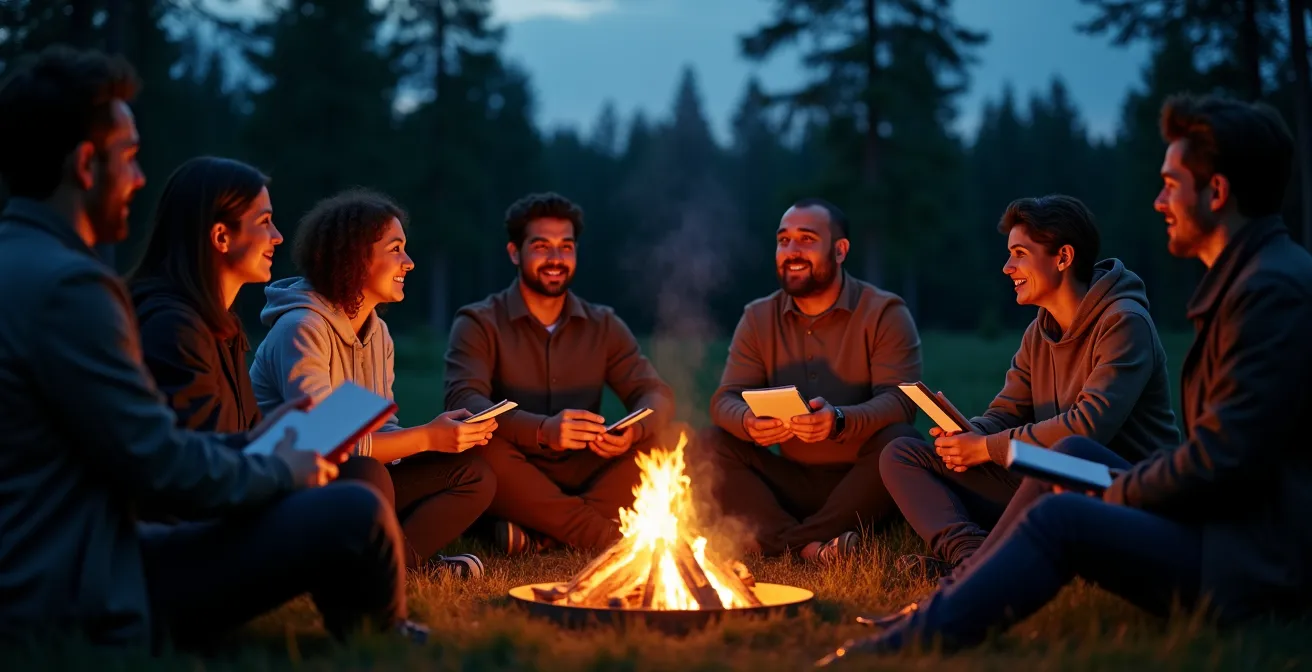
A more structured debrief should happen later that day, perhaps around a campfire or over a relaxed meal. This is where you move from feeling to meaning. A powerful framework for this is “What? So What? Now What?”.
- What? Objectively recount the events. What actually happened? What did we do?
- So What? Analyze the patterns and implications. Why did that happen? What does it tell us about how we work together?
- Now What? Translate the insights into future action. How can we apply this learning to our next project or challenge?
This structured reflection is what turns a fun or challenging experience into a true team-building breakthrough. It creates a shared narrative and a common language for discussing team dynamics, which is invaluable long after the trip is over. A final, brief follow-up a week later can help integrate these lessons back into the daily work environment.
Why Deep Conversations Happen Easier When Looking at the Road?
A long road trip often produces moments of surprising vulnerability and honesty. Conversations that feel forced or impossible in a formal meeting room flow naturally when two people are sitting side-by-side, watching the scenery go by. This isn’t a coincidence; it’s a psychological phenomenon known as the Parallel Activity Principle. The shared, low-intensity task of driving and navigating removes the pressure of direct, sustained eye contact, which can feel confrontational and inhibit openness.
When cognitive resources are not entirely focused on the social interaction, it frees up mental space for more profound and vulnerable conversation. The road provides a neutral, forward-facing focus, allowing individuals to speak their minds without the added social burden of managing facial expressions and interpreting micro-expressions. This dynamic is a powerful, often overlooked, aspect of team travel. Research from the Kenexa Research Institute found that up to 50% of positive changes in workplace communication stem from these informal, side-by-side conversations.
The Psychology of Parallel Activity in Team Building
Psychological studies on team dynamics confirm that when team members are away from the formal office environment, they feel more relaxed and open to sharing. The act of engaging in a parallel activity, like driving, fishing, or even hiking, creates a unique conversational space. It lowers social defenses and allows for the kind of breakthrough discussions about strategy, culture, and interpersonal dynamics that are rarely achieved in a structured setting. Companies that incorporate road trips into their team-building efforts frequently report these unscripted conversations as the most valuable outcomes of the entire trip.
As a facilitator or team leader, you can leverage this by being intentional about seating arrangements. Pair individuals who need to resolve a conflict or build a stronger rapport for a leg of the drive. Don’t force the conversation; simply create the conditions for it to emerge naturally. The shared journey, both literal and metaphorical, becomes a powerful vehicle for connection.
How to Rotate Drivers to Keep Everyone Fresh and Safe?
On a long road trip, driver fatigue is the single greatest threat to safety. A successful team trip requires a proactive system for managing energy and alertness, and this goes far beyond simply “taking turns.” An effective strategy involves creating a “two-person safety team” for the front of the vehicle and rotating drivers based on individual biological rhythms, or chronotypes.
The first step is to formally define the role of the co-pilot. This person is not a passive passenger. Their responsibilities include monitoring the driver’s alertness, managing navigation and communication, and controlling the cabin environment (music, temperature) to optimize focus. This approach transforms driving from a solo task into a collaborative responsibility, significantly enhancing safety.
A two-person safety team approach, with active co-pilot responsibilities, significantly reduces travel incidents and improves team coordination.
– Corporate Travel Safety Institute, Business Travel Safety Guidelines 2024
The second layer of this strategy is a rotation system based on chronotypes. Some people are “morning larks,” most alert in the early hours, while others are “night owls,” who peak later in the day. Matching driving shifts to these natural energy patterns is far more effective than a rigid, arbitrary schedule. Shorter shifts (e.g., 90 minutes to 2 hours) should be implemented for more demanding conditions like city traffic or mountain roads. A pre-trip survey can easily identify team members’ chronotypes, allowing you to build a smart, safe, and efficient driving schedule.
A robust system should include these key elements:
- Chronotype Assessment: A quick pre-trip survey to identify morning larks and night owls.
- Shift Matching: Assign driving shifts that align with individual peak alertness times.
- Formal Co-Pilot Duties: The co-pilot is responsible for alertness monitoring, navigation, and all communications.
- ‘Tap-Out’ Rule: Implement a no-questions-asked rule allowing any driver to request an immediate switch if they feel fatigued.
- Mandatory Breaks: Schedule 15-minute breaks at every driver switch to ensure everyone gets to stretch and reset.
Key Takeaways
- Team bonding is an outcome of intentionally designed shared adversity, not comfort.
- The best activities are chosen strategically to resolve specific types of conflict (task, relationship, or process).
- Structured communication protocols and intentional debriefing sessions are what turn an experience into a lasting bond.
What Defines a Successful Road Trip and How to Achieve It?
A successful team-building road trip is not defined by a flawless itinerary or a lack of problems. On the contrary, it is defined by the group’s ability to navigate challenges together, a shared sense of purpose, and the creation of lasting positive memories. It’s the difference between a trip that people endure and one they talk about for years. This success is not accidental; it is the result of careful, front-loaded planning focused on alignment, flexibility, and processing.
The foundation of a successful trip is a co-created “trip charter.” This is a short document or simple agreement, created by the whole team before departure, that outlines the shared goals for the trip. Is the goal to solve a specific strategic problem, improve interpersonal relationships, or simply decompress? Aligning on this “why” prevents the common failure of assumed consensus. When everyone is working toward the same outcome, minor frustrations on the road become less significant. In fact, well-planned team activities can have a massive impact, with research showing that 79% of employees report stronger workplace relationships as a result.
Flexibility is the second pillar. A rigid, minute-by-minute schedule is a recipe for stress and frustration. Successful trips build in a “serendipity buffer”—a block of unplanned time each day (e.g., 20% of the day) for spontaneous exploration or rest. This allows the team to capitalize on unexpected opportunities, whether it’s a scenic overlook or an interesting local shop, turning the journey itself into part of the adventure.
Finally, daily processing rituals are essential. This doesn’t need to be a long, formal meeting. A simple 10-minute ritual each evening where everyone shares one highlight and one hardship from the day can prevent small frustrations from building into major conflicts. The following table highlights the key differences between trips that succeed and those that fail.
| Success Factor | Successful Trips | Failed Trips | Implementation Strategy |
|---|---|---|---|
| Pre-Trip Alignment | Co-created trip charter with shared goals | Assumed everyone wants the same thing | Hold charter creation session 1 week before |
| Flexibility Budget | Built-in 2-hour daily serendipity buffer | Rigid minute-by-minute schedule | Block 20% of time as ‘unplanned exploration’ |
| Daily Processing | 10-minute highlight & hardship ritual | Let frustrations build silently | Set fixed time each evening for sharing |
| Role Clarity | Rotating responsibilities clearly defined | Informal ‘figure it out as we go’ | Create role cards with specific duties |
By shifting your focus from planning a perfect vacation to engineering a meaningful shared challenge, you can transform a simple group trip into a powerful catalyst for building a more resilient, coordinated, and connected team. Start today by defining the charter for your next adventure.
Frequently Asked Questions About Team Building Travel
When should the first debrief happen after an intense team challenge?
The first debrief should be an immediate ‘hot-wash’ happening within 5-10 minutes after the activity. The focus should be on capturing raw emotions and key events while memories are still fresh and vivid.
What’s the ideal structure for end-of-day team reflection?
A 30-minute session using the ‘What? So What? Now What?’ framework is ideal. This structure helps the team analyze patterns from the day’s events and extract actionable learnings to apply going forward.
How long should teams wait before the final integration session?
Waiting about one week is optimal for a final integration session. This provides enough time for individual reflection while memories are still strong enough to apply specific lessons to upcoming work projects and team dynamics.