In summary:
- True cultural respect comes from understanding the ‘why’ behind customs, not just memorizing rules.
- A significant portion of communication is non-verbal; observing local body language is crucial to avoid unintended offense.
- Learning a few key phrases shows effort and builds an “empathy bridge,” opening doors to genuine connection.
- Engage with communities by supporting local businesses and participating respectfully, turning your visit into a positive exchange.
The feeling is familiar to any thoughtful traveler: that slight knot in your stomach as you step into a new culture. You’re excited, but also cautious, weighed down by a fear of making a mistake. You want to connect, to understand, to be a respectful guest, but you’re worried about committing an unknown faux-pas. The internet is full of lists of “don’ts”—don’t show the soles of your feet, don’t use your left hand, don’t dress a certain way. While well-intentioned, these lists often amplify anxiety, turning travel into a stressful exercise in avoiding errors rather than a joyful process of discovery.
But what if the key to respectful travel wasn’t about memorizing an endless list of prohibitions? What if, instead, it was about proactively understanding a culture’s “grammar”—the unwritten rules of its social interactions? This guide is built on that principle. As a cross-cultural communication trainer, I’ll help you move beyond the fear of getting it wrong and toward the confidence of getting the *intention* right. We won’t just list what to do; we’ll explore the ‘why’ behind the customs, empowering you to navigate any cultural landscape with empathy and grace.
This approach transforms you from a passive tourist into an active, engaged visitor. It’s about recognizing that your genuine effort to understand is often more valued than the perfect execution of a local custom. We will explore how to decode body language, master essential phrases with minimal effort, and engage with communities in a way that is appreciative, not appropriative. By the end, you will have a framework not just for avoiding offense, but for building the authentic human connections that make travel so profoundly rewarding.
For those who prefer a visual format, or perhaps a musical interlude, the following video offers a classic piece of internet culture. While not directly about travel, it’s a reminder that shared experiences, even online ones, can connect us across the globe.
To guide you on this journey from cautious visitor to confident cultural participant, this article is structured to build your skills step by step. Below is a summary of the key areas we will cover, each designed to give you practical tools and a deeper understanding of respectful travel.
Summary: A Guide to Confident Cultural Engagement
- Why Your Body Language Might Be Offending Locals Without You Knowing?
- How to Master 10 Essential Phrases in Any Language in 1 Hour?
- Hiring a Local Guide vs. Self-Discovery: Which Offers True Insight?
- The Poverty Tourism Trap: What to Avoid in Developing Nations
- How to Navigate Complex Interactions When You Don’t Speak the Language?
- How to Connect With Locals Without Being an Intrusive Tourist?
- The Fine Line Between Appreciation and Appropriation When Traveling
- How to Plan a City Trip Focused Entirely on Specific Artistic Movements?
Why Your Body Language Might Be Offending Locals Without You Knowing?
You might have the kindest intentions, but your body could be saying all the wrong things. This is because every culture has its own unwritten “cultural grammar” for non-verbal communication, and what’s friendly in one place can be offensive in another. In fact, research suggests that 55% of communication is nonverbal, making body language the most significant part of any interaction. Simple acts like pointing with a finger, making direct eye contact, or even the distance you stand from someone are all loaded with cultural meaning.
The key isn’t to become a robot, afraid to move, but to become an active observer. Before you interact, watch how locals greet each other. Do they shake hands, bow, or press their palms together? How close do they stand when talking? This practice of observation is the first step to decoding the local non-verbal language. It provides you with the foundational knowledge to adapt your own behavior respectfully.
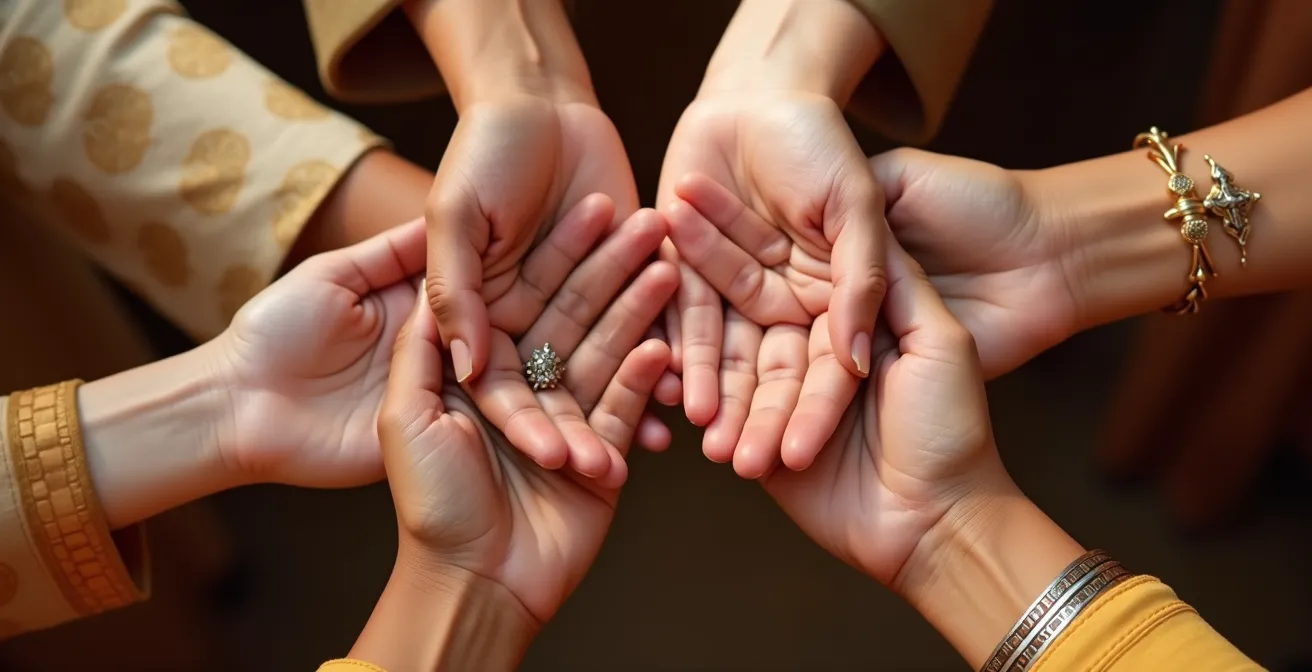
To make this process less intimidating, you can use the “Observe, Mirror, and Ask” framework. First, observe patterns. Then, mirror them subtly—not as a caricature, but as a gentle adaptation of your own habits. For instance, if people speak more softly, lower your own volume. Finally, if you’re unsure about a gesture, it’s often appropriate to ask with genuine curiosity. Framing it as “I’m interested in your culture, could you explain this gesture to me?” shows respect and a willingness to learn, which is always appreciated. This proactive approach transforms fear into confident engagement.
Ultimately, understanding that your body language speaks volumes is the first step toward ensuring your non-verbal communication aligns with your respectful intentions.
How to Master 10 Essential Phrases in Any Language in 1 Hour?
The thought of learning a new language before a trip can be daunting, but the goal isn’t fluency; it’s connection. You don’t need to conjugate verbs perfectly to show respect. The 80/20 rule applies perfectly here: a small amount of linguistic effort can yield an enormous return in positive first impressions and goodwill. Mastering a few key phrases builds an “empathy bridge,” signaling to locals that you see them as people to connect with, not just as part of the scenery.
Case Study: The 80/20 Rule of Language Learning
Renowned traveler Drew Binsky demonstrates how focusing on a handful of basic phrases can build incredible rapport. His experiences in nearly every country show that mastering ‘hello’, ‘please’, ‘thank you’, ‘excuse me’, and numbers with proper pronunciation covers 80% of what’s needed for a positive first impression. This simple act communicates a fundamental respect and a desire to connect on a human level, often leading to warmer, more meaningful interactions that go far beyond a typical tourist experience.
To get started, don’t just memorize a random list. Prioritize phrases based on their cultural impact. The goal is to equip yourself for the most common and important interactions you’ll have. This strategic approach ensures your one-hour investment is as effective as possible.
The following matrix breaks down which phrases to learn and why they matter, helping you focus your efforts for maximum impact.
| Phrase Category | Examples | Cultural Impact | Learning Time |
|---|---|---|---|
| Functional Empathy | ‘I am trying to learn your language’, ‘Pardon my mistake’ | Shows respect and effort | 10 mins |
| Basic Politeness | ‘Hello’, ‘Please’, ‘Thank you’, ‘Excuse me’ | Essential for all interactions | 15 mins |
| Cultural Appreciation | ‘This is delicious’, ‘Beautiful place’, ‘What is this called?’ | Opens conversations | 20 mins |
| Practical Needs | Numbers 1-10, ‘How much?’, ‘Where is…?’ | Daily navigation | 15 mins |
Remember, your pronunciation doesn’t have to be perfect. The very act of trying is a powerful gesture of respect that locals will almost always appreciate.
Hiring a Local Guide vs. Self-Discovery: Which Offers True Insight?
The modern traveler often faces a dilemma: should you wander freely, hoping for serendipitous discoveries, or hire a local guide for a curated experience? There’s no single right answer, as the “true insight” you seek depends on your goals. Self-discovery offers the thrill of the unexpected and the freedom to follow your own curiosity. However, it can also lead to misunderstandings or leave you skimming the surface of a culture you wish to understand more deeply.
A good local guide, on the other hand, can be a cultural translator. They can unlock doors—both literal and metaphorical—that would otherwise remain closed. As traveler Drew Binsky notes, a guide’s role goes far beyond just pointing out landmarks. In an interview, he explained their value:
They can introduce you to the culture, help with language barriers, and keep you safe
– Drew Binsky, KTLA Interview on Travel Tips
The key is finding an authentic guide, not just a tour operator. An authentic guide is a member of the community who offers genuine interactions, not just rehearsed spiels. To find one, consider the following:
- Verify their connection: Does the guide live in the community they show, or just work there? True insight often comes from someone with deep roots.
- Check for authenticity: Do their tours promise genuine interactions with locals, or just sightseeing? Look for experiences like sharing a meal or learning a craft.
- Look for credentials: Certifications from local tourism or cultural associations can be a sign of professionalism and legitimacy.
- Use vetted platforms: Websites like GetYourGuide.com or ToursByLocals.com often vet their guides, offering a layer of security and quality control.
- Consider a hybrid approach: Hire a guide for your first day to get your bearings, learn key customs, and ask questions. Then, use that newfound knowledge to explore independently with more confidence.
Ultimately, the best approach might be a blend of both: guided experiences for depth and context, and solo exploration for personal discovery and adventure.
The Poverty Tourism Trap: What to Avoid in Developing Nations
When traveling in developing nations, a natural sense of empathy can sometimes lead us into a complicated ethical area known as “poverty tourism.” This term often describes tours that treat communities experiencing poverty as an attraction, where outsiders come to observe hardship without contributing positively. This can feel exploitative and reinforces stereotypes, turning people’s lives into a spectacle. The trap is that it often stems from a good-intentioned desire to understand the world, but results in a one-sided, voyeuristic experience.
The antidote to this trap is to shift your mindset from passive observation to respectful participation and economic empowerment. Instead of just looking, seek to engage. This means making conscious choices that directly benefit the people and preserve their cultural dignity. The goal is to ensure your presence is a form of positive exchange, not extraction. As one responsible tourism organization notes, supporting local businesses preserves cultural heritage and ensures tourism benefits the community directly.
Here’s how to avoid the trap and engage constructively:
- Shop at local markets and family-owned stores. Buying directly from artisans ensures your money goes to them, not a middleman.
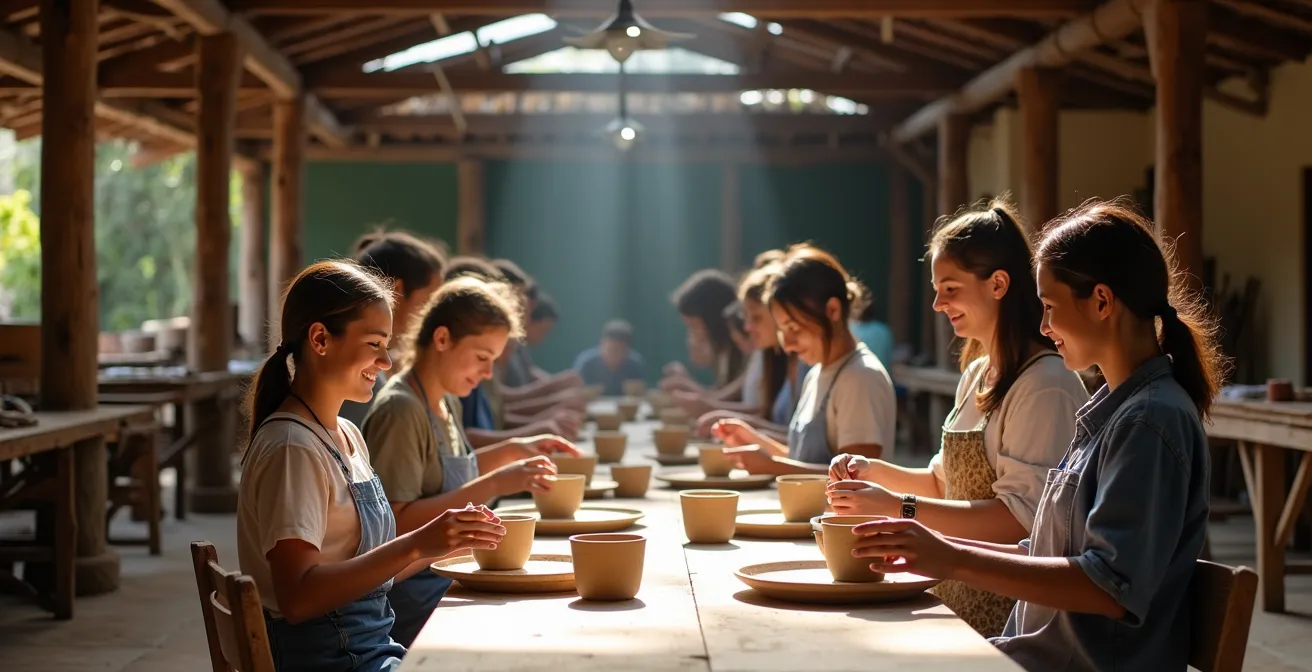
- Take a class, don’t just take a picture. Participate in a cooking, weaving, or pottery class. This creates a two-way exchange of skills and stories, and you pay for a service, not a spectacle.
- Avoid unvetted “slum tours.” If you are interested in understanding social issues, seek out NGOs or community-led organizations that can provide context ethically and ensure your visit contributes to solutions.
- Focus on shared humanity. Engage with people based on shared interests—music, food, sports, or family—rather than focusing on their economic status.
By focusing on genuine human connection and fair economic exchange, you can ensure your travels are a force for good, fostering mutual respect and understanding.
How to Navigate Complex Interactions When You Don’t Speak the Language?
One of the biggest fears for travelers is finding themselves in a complex situation—needing medical help, navigating a confusing bureaucracy, or simply trying to order a specific meal—without the words to explain themselves. In these moments, it’s easy to feel helpless and frustrated. However, the key is to remember that your intent to communicate respectfully is your most powerful tool. Locals are often more willing to help someone who is clearly trying their best, even if their words are clumsy or non-existent.
Before you can communicate, you must understand that gestures are not universal. A “thumbs up” might be positive in the West, but it’s offensive in parts of the Middle East. Even a smile can mean embarrassment in some Asian cultures. This isn’t meant to scare you, but to reinforce the need for active observation and caution with broad gestures.
Understanding these potential pitfalls is the first step. The table below highlights how common gestures can have very different interpretations across cultures.
| Gesture Type | Universal Meaning | Cultural Variations | Safe Alternative |
|---|---|---|---|
| Smile | Generally positive | Can mean embarrassment in Asia | Gentle closed-mouth smile |
| Open palm | Usually peaceful | Offensive in Greece | Hands at sides |
| Head movement | Varies widely | Nodding means ‘no’ in Bulgaria | Verbal confirmation |
| Eye contact | Attention in West | Aggressive in Asia | Brief glances |
When you inevitably make a mistake or find yourself stuck, your recovery is what matters. A universal gesture of humility, like a hand over your heart and a soft, apologetic tone, can instantly defuse tension. For more complex needs, carry a small notebook and pen. Drawing simple icons—a bed, a bus, a fork with a question mark—is a surprisingly effective method. These simple, non-verbal tools can bridge the language gap when you need it most, turning a moment of potential panic into a shared, problem-solving experience.
Ultimately, navigating these interactions is less about having a perfect script and more about having a toolkit of respectful, non-verbal strategies and a humble attitude.
How to Connect With Locals Without Being an Intrusive Tourist?
The desire for authentic connection is at the heart of meaningful travel, but there’s a fine line between being friendly and being intrusive. Many tourists default to an extractive mindset: asking for photos, directions, or information without offering anything in return. This can make locals feel like part of the tourist infrastructure rather than individuals. The most important rule of respectful travel is to shift this dynamic by offering value first. This doesn’t have to be monetary. A genuine compliment, a purchase at a shop, or simply participating in a community event are all ways of contributing before you ask for something.
This approach builds a foundation of goodwill and transforms the interaction from a transaction into an exchange. It shows you’re there to participate, not just to take. The following plan outlines concrete actions to foster these authentic connections.
Your Action Plan for Building Authentic Local Connections
- Offer Value First: Before asking for a photo or information, make a purchase, offer genuine praise about their craft, or simply thank them for the atmosphere they’ve created.
- Use Indirect Questions: Instead of direct personal questions (“How much do you earn?”), ask about shared observations (“This market is so lively, what is the best day to come?”).
- Participate, Don’t Interrogate: Join in on a local pickup soccer game, listen to a street musician, or attend a community festival. Participation is a silent form of connection.
- Learn Greetings and Use Them: A simple “hello” and “thank you” in the local language is a powerful gesture that opens doors and shows you’ve made an effort.
- Respect Photography Etiquette: Always ask for permission before taking a close-up photo of someone. A raised camera with a questioning look is a universal gesture. Respect a “no.”
Another powerful, low-pressure method is to become a “temporary regular.” This simple but effective strategy can help you move from being a tourist to being a familiar, welcome face.
Case Study: The Temporary Regular Strategy
This strategy involves choosing one local café, park, or small shop and visiting it daily. By becoming a familiar face, you create a low-pressure environment for organic conversations to emerge. The barista starts to recognize your order; the shopkeeper gives you a nod of acknowledgment. These small, repeated interactions build a sense of community and can lead to deeper cultural exchanges and even friendships. It allows you to experience the natural rhythms of daily life, transforming you from an anonymous tourist into a temporary part of the neighborhood fabric.
By focusing on gentle, consistent, and respectful engagement, you create the space for the truly memorable human connections that you’ll cherish long after your trip is over.
The Fine Line Between Appreciation and Appropriation When Traveling
As travelers, we are often captivated by the beauty of other cultures—their art, clothing, music, and ceremonies. We want to participate, to buy souvenirs, to bring a piece of that culture home with us. This is cultural appreciation. However, it can sometimes cross a fine line into cultural appropriation, which happens when a dominant culture takes elements from a minority culture without understanding, acknowledging, or respecting their original context, often for personal gain or as a costume. As The Travel Tinker advises, the key is to “Engage with cultural practices respectfully and avoid imitating sacred symbols.”
Navigating this line can feel tricky, but it becomes much clearer when you use a simple framework: Context, Credit, and Compensation. Before you buy that traditional garment, participate in a ceremony, or adopt a local symbol, ask yourself these three questions:
- Context: Is this item or practice sacred or secular? Is it a piece of daily life (like a market bag) or a religious artifact with deep spiritual meaning? Wearing a sacred ceremonial headdress as a fun festival accessory is appropriation; buying a hand-woven scarf from a local weaver is appreciation.
- Credit: Are you acknowledging the source? When you share a photo or tell a story about the item, are you giving credit to the culture and artisans who created it? Erasing the origin story is a form of appropriation.
- Compensation: Is your purchase or participation benefiting the source community? Buying a mass-produced knock-off in a tourist shop does not support the culture; buying directly from a local artisan does. Fair compensation is a cornerstone of respectful appreciation.
This framework empowers you to make thoughtful decisions, ensuring your engagement is respectful and supportive.
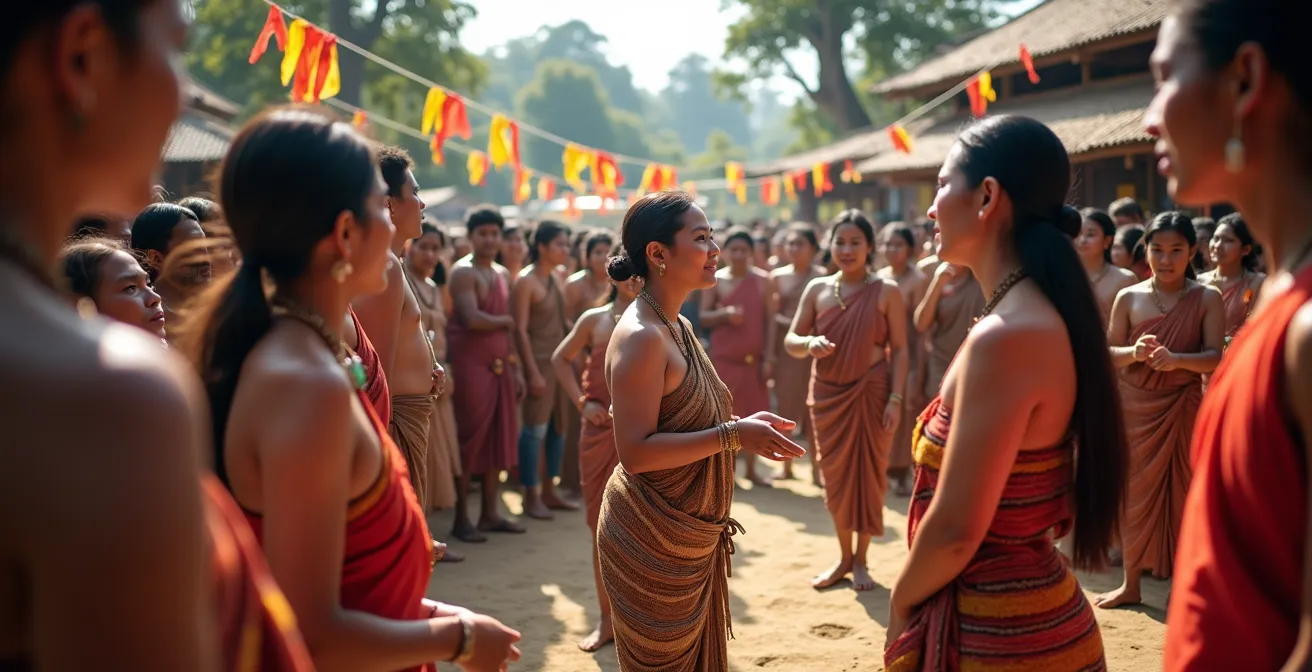
The image above illustrates this perfectly: travelers can be present and even participate in local festivities in a way that is clearly respectful. They are observers or invited participants, not the main event. Their modest dress and deferential posture show they understand their role as guests. This is the essence of true cultural appreciation.
By engaging with culture through this lens of respect, you not only avoid causing harm but actively contribute to the preservation and celebration of the traditions you admire.
Key takeaways
- Intent Over Perfection: Your genuine effort to be respectful is more important than flawlessly executing every custom. Humility and a willingness to learn are universally appreciated.
- Observe Before You Act: The most powerful tool for understanding a new culture is active observation. Watch how locals interact before you engage to learn the unwritten “cultural grammar.”
- Engage Through Reciprocity: Shift from a tourist mindset (taking photos, asking questions) to a participant mindset by supporting local artisans, learning a new skill, and offering value first.
How to Plan a City Trip Focused Entirely on Specific Artistic Movements?
Engaging with a local culture can go beyond daily interactions and social etiquette. One of the most profound ways to connect with a place’s soul is through its art. Planning a trip focused on a specific artistic movement—like Art Nouveau in Prague, the Harlem Renaissance in New York, or Bauhaus in Berlin—transforms a standard city break into a deep, thematic immersion. This type of travel allows you to see a city not as a collection of sights, but as a living museum, and to understand the hopes, anxieties, and innovations of a particular era.
This isn’t a niche pursuit; it’s a growing part of the travel industry. The global cultural tourism market is expected to reach $16.95 billion by 2032, growing at 11.20% CAGR, which shows a clear demand for more meaningful, story-driven travel experiences. To plan such a trip, you need to think like a curator, building an itinerary that connects art, history, and daily life. It’s an approach that combines intellectual curiosity with the joy of discovery.
Here are some strategies for an artistic movement immersion:
- Create a “Day in the Life” Itinerary: Research the cafes, bars, and public squares where the artists of the movement gathered. Sitting in the same café where Frida Kahlo and Diego Rivera debated can be more powerful than just viewing their paintings.
- Connect Past to Present: Look for contemporary galleries or street artists in the city who are influenced by the historical movement you’re studying. This creates a fascinating dialogue between different eras.
- Book Thematic Tours: Many cities offer specialized walking tours focused on specific artistic or architectural periods. With data showing that 55% of tourists booked city walking tours in 2023, there is likely a tour that fits your theme.
- Explore the Culinary Context: Research what people, and particularly the artists of that era, would have eaten. Exploring old restaurants or traditional dishes adds another sensory layer to your historical immersion.
By focusing your trip around an artistic movement, you’re not just sightseeing; you’re engaging in a deep cultural dialogue with the past. This is the ultimate act of respectful travel: listening to the stories a city tells through its most creative expressions and allowing them to change your perspective.