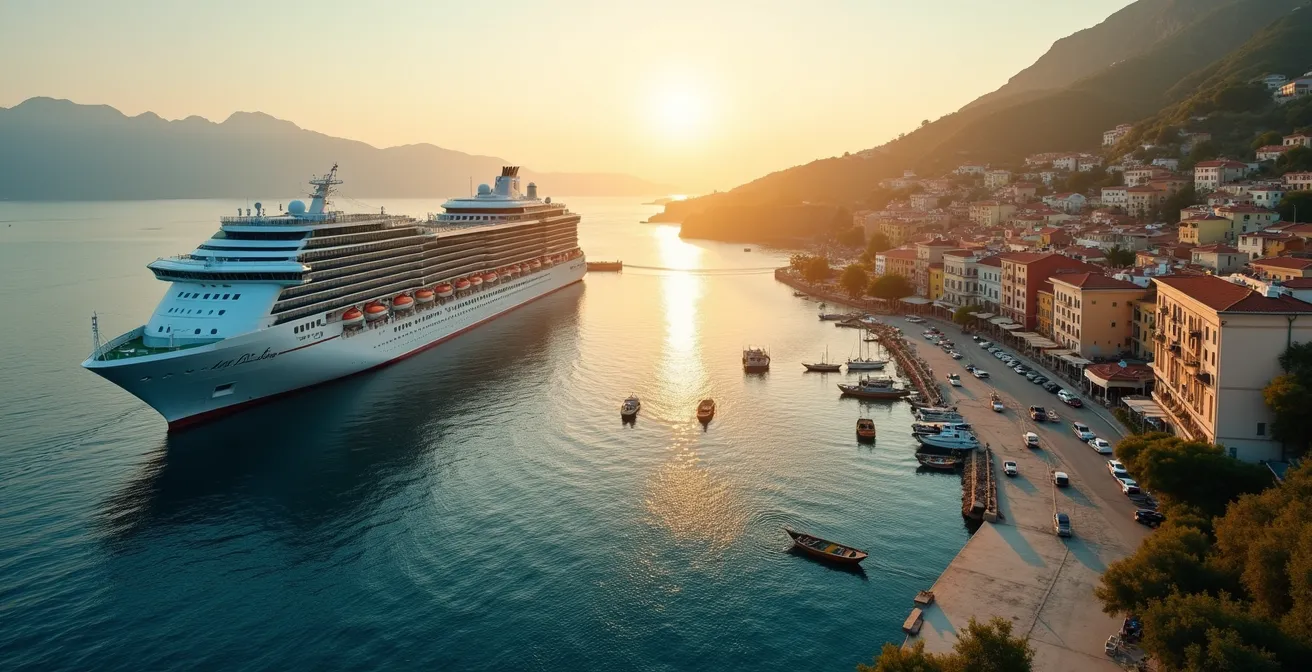
The frustration of a rushed, superficial port day isn’t due to a lack of time, but a lack of strategy. The key is to shift from a tourist’s checklist to a tactical explorer’s mission plan.
- Prioritize “value-density” over seeing everything, focusing on one major sight or a themed wandering path.
- Execute a pre-planned “First 60 Minutes” strategy to bypass the port’s tourist trap zone efficiently.
- Implement a “Triple Time Buffer” system for a guaranteed, stress-free return to the ship.
Recommendation: Stop trying to beat the clock. Instead, adopt a tactical mindset to control your time, discover authentic culture, and make your limited hours ashore truly count.
The ship’s horn sounds, and the clock starts ticking. You have eight hours—480 minutes—to capture the essence of a new country. For many cruise passengers, this precious window becomes a frantic blur of crowded tour buses, generic souvenir shops, and the constant, nagging fear of being left behind on the dock. The result is often exhaustion and a collection of photos, but little sense of genuine discovery. The common advice to “plan ahead” or “get off the ship early” falls flat because it doesn’t address the core problem: a flawed strategy.
Most travelers approach a port day with a tourist’s checklist, attempting to cram in as many “must-see” sights as possible. This approach inevitably leads to feeling rushed and disconnected. The fundamental shift required is to think like a strategic expert on a time-sensitive mission. It’s not about moving faster; it’s about moving smarter. This involves making conscious, deliberate choices before you even step on the gangway, from vetting local guides with surgical precision to identifying a “decompression spot” just beyond the port’s initial chaos.
This guide abandons generic tips in favor of a concrete operational framework. We will dismantle the port day into tactical phases: the initial decision, the crucial first hour, the core exploration strategy, and the failsafe return plan. By adopting this methodical approach, you can transform limited time from a source of stress into your greatest asset, ensuring every minute contributes to an authentic and memorable experience.
This article provides a complete tactical framework for your next port day. From the initial choice between a ship tour and an independent guide to the final, stress-free walk back to the ship, each section offers a concrete strategy to maximize your time and experience.
Summary: How to Explore Exotic Ports in Under 8 Hours Without Feeling Rushed?
- Ship Tour or Local Guide: Which Offers Better Value and Safety?
- How to Escape the “Tourist Trap Zone” at the Port Gate Safely?
- One Big Sight or Wandering the Streets: Which Strategy Fits a Port Day?
- The Visa Mistake That Can Trap You on the Ship in Exotic Ports
- When to Start Heading Back to Avoid Being Left Behind on the Dock?
- How to Balance Must-See Sites With Aimless Wandering in 24 Hours?
- How to Use Public Transit to Feel the Real Pulse of a Modern City?
- How to Navigate a Vibrant Culinary Scene Without Falling for Tourist Traps?
Ship Tour or Local Guide: Which Offers Better Value and Safety?
The first strategic decision you’ll make dictates the entire tone of your port day. The choice between a cruise line’s sanctioned tour and hiring an independent local guide isn’t just about money; it’s a fundamental choice between guaranteed logistics and potential authenticity. Ship tours offer a crucial safety net: the ship will not leave without you. However, this peace of mind comes with large groups, a rigid schedule, and often, a higher price tag. For example, recent price comparisons show that a cruise line tour in Santorini can cost $129 per person, while an equivalent independent tour is just $45.
Opting for a local guide unlocks the potential for a more personalized, flexible, and culturally immersive experience. You can escape the crowds and discover places the tour buses can’t reach. The risk, however, shifts to you. This is where tactical vetting becomes non-negotiable. Don’t just book a guide with good reviews; qualify their expertise and preparedness for the time constraints of a cruise passenger. Use a targeted questioning method to separate the true professionals from the amateurs.

As seen in the image, the connection with a knowledgeable local can transform a simple market visit into a rich cultural exchange. To ensure you find such a guide, ask them specific, probing questions. “What is your backup plan for heavy traffic?” reveals their operational readiness. “What’s a recent change in the city most tourists don’t know about?” tests their current, on-the-ground knowledge. Their answers will tell you more than any online review about their ability to deliver a high-value, secure experience within your limited timeframe.
How to Escape the “Tourist Trap Zone” at the Port Gate Safely?
The moment you step off the gangway, you enter the “tourist trap zone”—a chaotic gauntlet of aggressive taxi drivers, souvenir hawkers, and generic tour operators. Your first 60 minutes in port are the most critical; wasting them here drains both your time and your energy. The most effective strategy is not to navigate this chaos, but to bypass it entirely with a pre-planned escape route. The objective is to reach a designated “decompression spot” 5 to 10 minutes away from the port gates where you can orient yourself in peace.
This isn’t about aimless walking; it’s a tactical maneuver. Before your trip, use offline maps to identify a specific, quiet landmark—a small park, a specific bakery, or a metro station—as your true starting point. This “Three-Block-Deep Technique” allows you to exit the port gates with purpose, ignoring the touts because you already have a destination.
The Three-Block-Deep Technique Success Story
In Barcelona, a common challenge is the chaotic port exit. By pre-researching a specific bakery three blocks inland as their first destination, savvy cruisers successfully bypassed the entire high-pressure vendor zone. This simple tactic saved them time and stress, allowing them to start their exploration feeling calm and in control, rather than frazzled and defensive.
Your goal is to be decisive. A polite but firm “We have a plan, thank you” is your best defense against persistent vendors. Once you reach your decompression spot, you can calmly review your day’s plan, confirm your bearings, and begin your exploration on your own terms. This transforms the start of your day from a reactive struggle to a proactive and controlled mission launch.
Your Action Plan: First 60 Minutes Port Escape Strategy
- Exit port gates decisively without stopping for vendors, with your first destination already in mind.
- Walk purposefully to your pre-identified “decompression spot” located 5-10 minutes away from the main gate.
- Use pre-downloaded offline Google Maps with starred quiet streets or squares to navigate away from the port zone.
- Take a moment at your decompression spot to orient yourself calmly with your map and day’s plan before exploring further.
- Employ the phrase “We have a plan, thank you” to politely but firmly deflect any persistent touts or vendors.
One Big Sight or Wandering the Streets: Which Strategy Fits a Port Day?
With limited time, you face a fundamental strategic choice: do you dedicate your day to one major “bucket list” landmark, or do you embrace spontaneous discovery by wandering the city’s streets? There is no right answer, only the one that aligns with your travel style and goals for the day. Trying to do both is a recipe for feeling rushed and unfulfilled. The key is to consciously choose one primary strategy and commit to it.
The “One Big Sight” strategy is ideal for first-time visitors or those with a must-see landmark like the Colosseum or the Acropolis. It provides a clear objective and guarantees a highlight experience. The downside is often significant crowds and less opportunity for authentic local interaction. Conversely, “Thematic Wandering”—exploring with a loose theme like “street art” or “local cafes” rather than a specific destination—is perfect for return visitors or those seeking a deeper cultural connection. It offers unique, unscripted discoveries but carries the risk of missing the city’s famous sights.
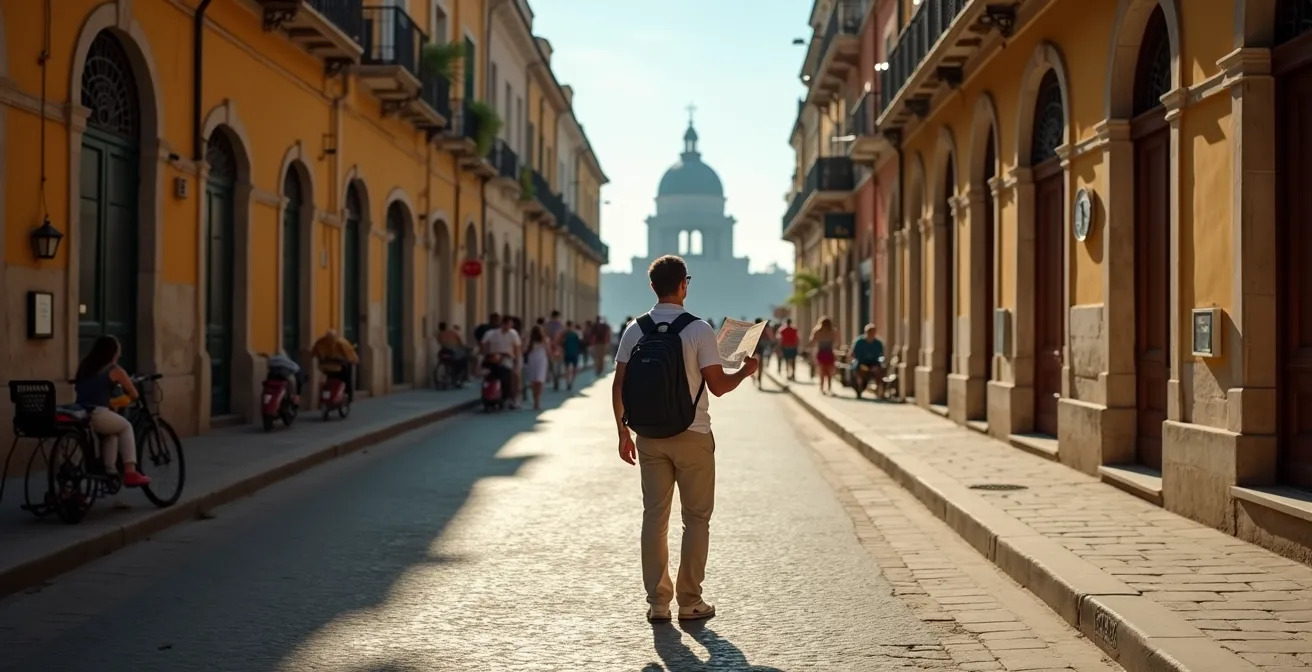
A hybrid approach, the “Anchor & Explore” model, offers a potential middle ground. This involves dedicating a short, fixed amount of time to one well-defined “anchor” sight and then using the remaining hours for free-form exploration in the surrounding area. This requires disciplined planning but can deliver the best of both worlds. The following table breaks down these strategic options to help you decide which is best for your next port day, based on an insightful analysis of port day planning.
| Strategy | Best For | Time Required | Pros | Cons |
|---|---|---|---|---|
| One Big Sight | First-time visitors, bucket list destinations | 4-6 hours | Guaranteed must-see experience, photo opportunities | Less authentic local feel, crowds |
| Anchor & Explore Hybrid | Balanced travelers | 2 hours anchor + 4 hours explore | Best of both worlds, flexibility | Requires good planning |
| Thematic Wandering | Return visitors, culture seekers | 6-8 hours | Authentic discoveries, unique experiences | May miss famous sights |
The Visa Mistake That Can Trap You on the Ship in Exotic Ports
In the rush to plan exciting activities, a critical administrative detail is often overlooked: the visa. This isn’t a concern in common ports like the Caribbean or Mediterranean, but for itineraries in Southeast Asia, South America, or other exotic regions, a visa mistake is the one thing that can unequivocally ruin your day by preventing you from disembarking. Many passengers incorrectly assume they are “in-transit” and don’t need a full visa for an 8-hour stop. This is a costly and trip-altering assumption.
For most countries, a cruise ship docking and its passengers going ashore constitutes a formal entry, requiring a proper tourist visa. Relying on a “Visa on Arrival” (VOA) is also a high-risk strategy. VOA processing lines can take hours, eating up a significant portion of your limited port time. Worse, if there’s an issue with your application, the ship will not wait. You will be denied entry and confined to the ship while everyone else explores.
The only safe approach is to research and secure all necessary visas or e-visas well in advance. Be aware that requirements can be complex, sometimes depending on the sequence of ports visited. A multi-port stop within the same country can also trigger different rules, as many learned the hard way in Vietnam.
The Multi-Port Itinerary Visa Trap in Vietnam
On cruises with stops in both Ho Chi Minh City and Hue, passengers discovered their “in-transit” assumptions were wrong. Each port visit counted as a separate land entry, requiring a full Vietnam visa. Those who had planned on getting a visa on arrival were caught in a bureaucratic nightmare. Many were denied disembarkation at one or both ports for not having a pre-approved e-visa, completely missing their chance to explore the country.
The golden rule is to never assume. Check the official consular website for every single country on your itinerary, and cross-reference this with your cruise line’s specific guidance. A few hours of administrative work at home can save you from being trapped on the ship, watching your dream port day slip away from behind the glass.
When to Start Heading Back to Avoid Being Left Behind on the Dock?
The number one fear of every independent explorer is the nightmare scenario of “pier running”—sprinting down the dock as the ship pulls away. Avoiding this fate isn’t about nervously checking your watch every five minutes. It’s about implementing a systematic “Triple Time Buffer” framework that builds in layers of safety, ensuring a calm, unhurried return to the port.
This framework consists of three distinct buffers you must add to your return travel time. First is the Travel Buffer: add a minimum of 30-45 minutes to your estimated travel time to account for unexpected traffic, a missed bus, or a crowded metro. Second is the Port Buffer: add another 20-30 minutes for the realities of the port itself, which can include long walks down the pier, unexpected security lines, or tender boat queues. Finally, the Psychological Buffer: an extra 15 minutes to simply sit at a cafe near the port, relax, and transition from “explorer” mode back to “passenger” mode before the final boarding. This final buffer is what eliminates the stress.
Combined, this means you should plan to be back at the port area a full 60 to 90 minutes before the “all-aboard” time. As a simple rule of thumb, use the 50% Rule: when half of your total shore time has elapsed, you should only be engaging in activities that naturally lead you back in the direction of the ship. This prevents you from starting a new, far-flung activity with insufficient time.
The all-aboard time is typically 30 minutes to 1 hour before the ship’s departure, and this is non-negotiable.
– Ilana, Life Well Cruised, Cruise Port Excursion Planning Guide
Adopting this structured approach removes the guesswork and anxiety from your return journey. You are no longer racing against the clock; you are managing a schedule with built-in redundancies. This is the difference between a frantic, stressful end to the day and a relaxed, confident stroll back to your floating home.
How to Balance Must-See Sites With Aimless Wandering in 24 Hours?
For the traveler who wants both the iconic photo and the serendipitous discovery, the challenge is one of structure, not of speed. The key is to create a framework that accommodates both, preventing the day from becoming a chaotic tug-of-war between a checklist and a desire for spontaneity. An effective method is the “1-3-1 Rule,” a simple time-blocking strategy that carves out dedicated space for different types of experiences within your limited 8-hour window.
The rule allocates your time as follows: one primary “must-see” attraction, three smaller “discovery” moments, and one “restorative” break. This structure provides a balanced diet of activity. The “must-see” satisfies your tourist duty, the “discoveries” allow for authentic, off-the-beaten-path experiences, and the “restorative” moment prevents burnout. This approach requires you to make some hard choices before you even leave the ship, a process known as Strategic Abandonment.
The 1-3-1 Rule in Practice: An 8-Hour Jamaica Port Day
A Royal Caribbean guide for Jamaica illustrates this perfectly. The “one must-see” is Dunn’s River Falls (approx. 2 hours). The “three discoveries” could be finding an authentic jerk chicken stand, browsing a local craft market, and a brief walk on a non-tourist beach (3 hours total). The “one restorative moment” is relaxing at a beach bar with a cold drink (1 hour). This uses 6 hours, leaving a 2-hour buffer for transfers and logistics—a perfectly balanced and achievable day.
To successfully implement this, you must consciously decide what you are choosing *not* to see. Before your port day, list all potential sights, mark your absolute #1, and then formally “abandon” the rest. This psychological exercise is crucial. By mentally grieving the missed sights beforehand, you free yourself to fully enjoy the experiences you’ve chosen, replacing the “fear of missing out” with the joy of being present. It’s a powerful shift from a mindset of scarcity to one of purposeful quality.
How to Use Public Transit to Feel the Real Pulse of a Modern City?
Taxis and tour buses isolate you from your destination, whisking you from one sanitized point to another in a tourist bubble. To truly feel the pulse of a modern city, you must travel as its residents do: on public transit. Using the local metro, tram, or bus system is more than just a cost-saving measure; it’s an act of cultural immersion. It’s where you’ll see daily life unfold, overhear local conversations, and discover neighborhoods you’d never find otherwise. And the financial benefit is undeniable; independent travelers report saving up to $596 for a family of four on a Rome port day by using public transport instead of a cruise line tour.
Success, however, depends on preparation. Navigating a foreign transit system under time pressure can be daunting without the right tools. Your smartphone is your command center. Before you leave the ship’s Wi-Fi, your mission is to assemble a “Digital Transit Toolkit.” This includes downloading the local transit app (like Citymapper or a city-specific one), purchasing digital tickets in advance to skip lines, and saving offline maps of key routes. Taking screenshots of your planned journey is a crucial backup in case of connectivity issues.
Here are the key components of your pre-port day transit preparation:
- Download Citymapper or the official local transit app while on ship’s Wi-Fi.
- Purchase digital day-passes or tickets through the app to bypass station queues.
- Save offline maps of the city’s transit system and your planned routes on Google Maps.
- Take screenshots of key route information (line numbers, stop names, transfer points) as a failsafe backup.
- Research “Above-Ground Loop” routes—trams or buses that do a scenic circle—for a cheap and authentic orientation tour.
- Always have the port agent’s contact number saved in your phone for a worst-case scenario.
By preparing this toolkit, you transform a potentially stressful experience into a seamless and enriching adventure. You’re not just a tourist passing through; you’re a temporary participant in the city’s daily rhythm, gaining a level of insight that is impossible to achieve from the window of a cab.
Key Takeaways
- Strategic planning is more critical than speed; adopt a “tactical touring” mindset.
- Escape the port’s “tourist trap zone” immediately using a pre-planned route to a “decompression spot.”
- Avoid “pier runner” anxiety by implementing a “Triple Time Buffer” system for a stress-free return.
How to Navigate a Vibrant Culinary Scene Without Falling for Tourist Traps?
One of the greatest travel joys is discovering authentic local food, but in a busy port, you’re more likely to find overpriced, mediocre meals served from a laminated menu with pictures. Escaping these culinary tourist traps requires a specific intelligence-gathering strategy. The secret is to follow the locals, not the guidebooks. Your mission begins not at a restaurant, but at the source: the local food market.
By observing what residents are buying and then engaging with the vendors, you can get invaluable, on-the-ground recommendations. A simple question like, “This looks amazing. Where would you go to eat this prepared well?” can lead you to a hidden gem just a few streets away from the main tourist drag. This “Market-to-Table Method” bypasses the entire tourist-focused restaurant ecosystem and takes you directly to where the locals eat.
The Market-to-Table Method Success in Barcelona
A traveler in Barcelona started their culinary quest at the famous La Boqueria market. Instead of eating at the tourist-priced stalls, they observed locals buying specific seafood. They asked a fishmonger where he would go for a great seafood lunch. The vendor pointed them to a small, family-run restaurant two streets off Las Ramblas. The result was a genuinely Catalan meal, bursting with flavor, at nearly 60% less than the tourist-facing establishments nearby.
In addition to this on-the-ground tactic, you can conduct “culinary forensics” using Google Maps before you even arrive. Use Street View to look for red flags like multilingual touts and picture menus. A powerful technique is to filter reviews to show only those written in the local language, then use Google Translate to read what residents are *really* saying. A handwritten menu or one that changes daily is a strong sign of authenticity. This digital reconnaissance, combined with the Market-to-Table method, is your best defense against a disappointing and overpriced meal.
By shifting your mindset from a rushed tourist to a strategic explorer, you transform the 8-hour port day from a stressful countdown into a rich, rewarding mission. Start planning your next port day not by asking “What can I see?” but “What is my tactical plan?”
Frequently Asked Questions About How to Explore Exotic Ports in Under 8 Hours Without Feeling Rushed?
What’s the difference between ‘in-transit’ and ‘making entry’ for cruise passengers?
Cruise ships stopping for 8 hours require full entry visas in most countries, unlike airport transit passengers who remain in international zones. Each port visit counts as a formal entry.
Why is Visa-On-Arrival risky for cruisers?
VOA queues can take 2-3 hours, eating into your 8-hour port time. If issues arise, you cannot wait for resolution as the ship won’t delay departure.
How does port sequence affect visa requirements?
Some countries require different visa types based on your previous ports. Visiting Country A before B might need single-entry, but B before A could require multi-entry visas.