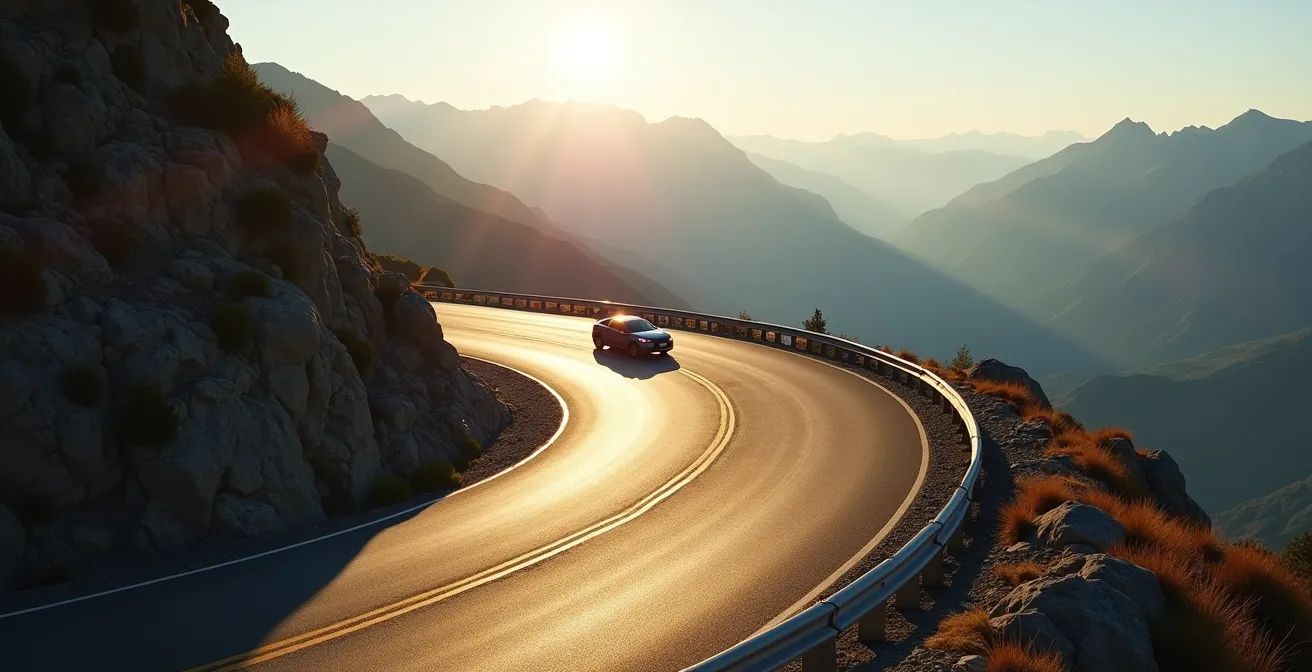
The common advice to “use a lower gear” is an oversimplification; true mountain driving safety comes from understanding and managing the thermal and atmospheric physics acting on your vehicle.
- Brake failure is not random; it’s a predictable result of converting kinetic energy into excessive heat that boils your brake fluid and glazes your pads.
- Engine braking isn’t just a “helper”; it’s the primary tool for controlling descent speed by using your engine as an air compressor to dissipate energy without touching the brakes.
Recommendation: Stop thinking like a driver and start thinking like an engineer. Actively manage your vehicle’s energy, gear selection, and momentum to control the mountain, instead of letting it control you.
The first time a driver from the flatlands encounters a sign that reads “Steep Grade, 7% for next 8 miles,” a knot of anxiety forms. The instinct is to ride the brakes, keeping a foot hovering over the pedal as the car picks up alarming speed. Conventional wisdom offers vague advice like “take it slow” or “be careful,” but this does little to build real confidence. The fear of brakes failing or the car running away on a steep descent is palpable, turning a scenic drive into a white-knuckle ordeal.
The root of this anxiety isn’t the mountain; it’s a lack of understanding of the vehicle’s mechanics under extreme stress. Most guides list tips, but they fail to explain the fundamental physics at play. They tell you *what* to do, but not *why* it works. This leaves drivers unprepared for the realities of brake fade, atmospheric power loss, and the specific techniques required to maintain absolute control when gravity is working against you.
But what if the key to mastering mountain passes wasn’t just following a checklist, but truly understanding the forces you’re managing? This guide takes a different approach. We will move beyond platitudes and dive into the engineering principles of mountain driving. We will explore the thermodynamics of your braking system, the mechanics of using your transmission to control speed, and the atmospheric science that affects your engine’s performance. By the end, you won’t just have a list of rules; you will have the technical knowledge to analyze any mountain road and make informed, safe decisions, transforming anxiety into authoritative control.
This article breaks down the critical technical challenges of high-altitude driving into clear, manageable topics. The following summary outlines the key areas we will cover to build your expertise from the ground up.
Summary: How to Drive Mountain Passes Without Overheating Your Brakes?
- Why Riding Your Brakes Downhill Will Cause Them to Fail?
- How to Handle Passing on a Single-Lane Mountain Road?
- Drive Mode or Low Gear: Which Is Safer for Automatic Cars?
- The Power Loss Surprise: Why Your Car Feels Sluggish at 3000m?
- Why It Might Be Snowing at the Top When It’s Raining at the Bottom?
- Why Altitude Sickness Hits Fit Travelers Harder Than You Think?
- Why Waze Is Better Than Google Maps for Speed Traps?
- Do You Really Need a Rugged 4×4 for Your Road Trip?
Why Riding Your Brakes Downhill Will Cause Them to Fail?
Brake failure on a mountain pass is not a random mechanical fault; it’s a predictable outcome of mismanaged physics. When you descend, your vehicle’s immense kinetic energy must be converted into another form to control speed. Relying solely on your brakes forces them to convert this energy into heat. Under the continuous load of a long, steep grade, this heat generation overwhelms the system’s ability to dissipate it. In extreme conditions, brake temperatures can reach 500-800°C, leading to two primary failure modes: brake fade and fluid boil.
Brake fade occurs when the brake pads and rotors become so hot that the friction material glazes over, drastically reducing its ability to grip. The pedal may feel firm, but the car simply won’t slow down effectively. The second, more catastrophic failure is fluid boil. Brake fluid is hygroscopic, meaning it absorbs moisture over time. This water lowers the fluid’s boiling point. When the heat from the brakes transfers to the fluid, it can boil, creating compressible vapor bubbles in the hydraulic lines. As a technical report on brake fluid specifications shows, even high-performance DOT 4 fluid has a minimum dry boiling point of around 450°F (232°C), a temperature easily surpassed during mountain descents. When this happens, pressing the brake pedal compresses the vapor instead of applying force to the calipers, and the pedal sinks to the floor with no braking action.
The only way to prevent this is to use your engine and transmission as the primary tool for speed control, a technique known as engine braking. This uses the engine’s internal compression to slow the vehicle, keeping the service brakes cool and ready for when you truly need them.
Action Plan: Mastering Engine Braking on Descents
- Set Your Speed Early: Before the descent begins, use the footbrake to slow your vehicle to a safe target speed for the grade.
- Select a Low Gear: Shift your automatic transmission from Drive (D) into a lower gear (e.g., ‘L’, ‘2’, or use paddle shifters/manual mode to select 1st or 2nd gear). For moderate slopes, ‘2’ is often sufficient; for very steep grades, ‘1’ is necessary.
- Listen to the Engine: The engine RPM will rise and get louder. This is normal and indicates it’s working to hold the car back. Do not be afraid of the high revs; this is what the system is designed for.
- Use Brakes Intermittently: If the car still gains speed, apply the brakes firmly for a few seconds to scrub off 5-10 mph, then release them completely. This “on-off” method allows them to cool, preventing overheating. Avoid gentle, continuous pressure.
- Downshift Further if Needed: If you find yourself braking too frequently, it means you are in too high a gear. Brake firmly to slow down, then shift to an even lower gear.
How to Handle Passing on a Single-Lane Mountain Road?
Negotiating a narrow mountain road where two cars can barely fit is one of the most stressful situations a driver can face. Visibility is limited by hairpin turns, and one side often features a sheer rock wall while the other is a terrifying drop-off. In this high-stakes environment, courtesy is not enough; you must know the universally accepted (and in some places, legally mandated) rules of right-of-way. The primary rule is simple: the vehicle traveling uphill has the right-of-way. The logic is that it is far more difficult and dangerous for the uphill driver to stop, lose momentum, and then try to restart on a steep, potentially slippery grade. The downhill driver has gravity’s assistance for braking and can more easily control a stop and reverse maneuver if necessary.
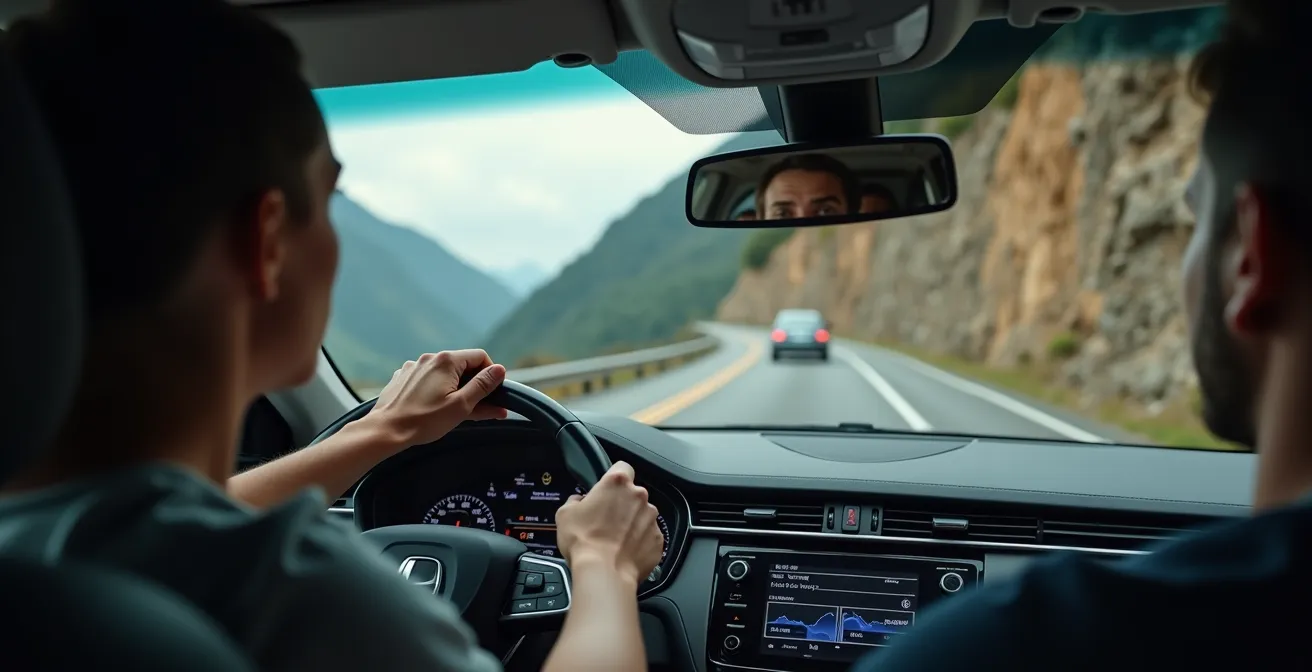
When you are the downhill vehicle and you meet an upcoming car, your responsibility is to find the first safe place to pull over, even if it means backing up to a designated turnout. These turnouts are specifically placed to facilitate passing. Honking your horn lightly before entering a blind corner is also a wise, low-tech way to alert unseen drivers of your presence. Beyond the uphill/downhill rule, there are other specific situations to be aware of, particularly regarding slower traffic and emergency vehicles.
The following table, based on common mountain driving regulations, clarifies who must yield in different scenarios. According to an authoritative guide on mountain driving etiquette, these rules are designed to ensure safety and traffic flow in a challenging environment.
| Situation | Who Has Right of Way | Action Required |
|---|---|---|
| Uphill vs Downhill | Uphill Vehicle | Downhill vehicle must yield and reverse if necessary |
| 3+ Cars Behind You | Following Traffic | Pull over at first safe turnout (legally required in some states) |
| Emergency Vehicle | Emergency Vehicle | All vehicles pull to right and stop |
| Equal Ground/Flat | Standard Rules Apply | Follow normal road priority rules |
Drive Mode or Low Gear: Which Is Safer for Automatic Cars?
For a driver accustomed to flat terrain, the automatic transmission is a “set it and forget it” system. However, in the mountains, leaving your car in ‘Drive’ (D) during a steep descent is one of the most dangerous mistakes you can make. The car’s computer is programmed for one primary goal in ‘D’: fuel efficiency. To achieve this, it will constantly try to shift to the highest possible gear to keep engine RPMs low. This is the exact opposite of what you need when descending a mountain.
When you need to control your speed, you require engine braking, which is only effective at higher RPMs. By manually selecting a lower gear (‘L’, ‘2’, ‘1’, or using a manual shifting mode), you override the transmission’s fuel-saving logic. You are giving the car a direct command: “Hold this gear, no matter what.” This forces the engine to spin at 2000, 3000, or even 4000 RPM without any throttle input. At these speeds, the pistons are working against the engine’s compression, effectively turning the engine into an air compressor that absorbs the vehicle’s momentum. This is the force that slows you down without you ever touching the brake pedal.
In contrast, ‘Drive’ mode will see the car picking up speed and will do nothing to stop it. It might downshift briefly if you tap the brakes, but as soon as the car stabilizes, it will upshift again to save fuel, forcing you back onto the brakes. Therefore, the choice is clear: manually selected low gears are fundamentally safer because they give the driver ultimate control over the vehicle’s speed and energy, preserving the brakes for emergencies. ‘Drive’ mode delegates control to a computer that is optimizing for the wrong variable.
The Power Loss Surprise: Why Your Car Feels Sluggish at 3000m?
If you’ve ever driven to a high-altitude pass, you’ve felt it: you press the accelerator to climb a grade, and the car feels weak, asthmatic, and unresponsive. This isn’t a sign of mechanical failure; it’s a predictable consequence of physics. A gasoline engine is an internal combustion engine, meaning it works by igniting a precise mixture of fuel and air. The “air” component is critical, as it contains the oxygen needed for combustion. At sea level, the air is dense, packed with oxygen molecules. As you climb in altitude, atmospheric pressure decreases, and the air becomes “thinner,” meaning there are fewer oxygen molecules in any given volume of air.
Your car’s engine is essentially trying to breathe in this thin air. The engine control unit (ECU) detects the lower oxygen intake and reduces the amount of fuel injected to maintain the correct air-fuel ratio. Less fuel and less air means a less powerful combustion event in each cylinder. The result is a significant and measurable drop in horsepower. As a general rule, a naturally aspirated (non-turbocharged) engine will experience a significant power reduction as it gains altitude. According to driving safety resources, vehicles lose approximately 3% of their horsepower for every 1,000 feet (305 meters) of elevation gain.
This means that at 10,000 feet (approx. 3000m), your engine could be producing 30% less power than it does at sea level. This impacts everything from acceleration to passing ability. You must anticipate this power loss by downshifting earlier when climbing to keep the engine in its power band and allowing for much greater following distances. Turbocharged or supercharged engines are less affected because they force compressed air into the engine, compensating for the lower atmospheric pressure, but even they will experience some performance degradation.
Why It Might Be Snowing at the Top When It’s Raining at the Bottom?
Driving up a mountain pass can feel like traveling through multiple seasons in a matter of minutes. You may start your ascent in a mild, rainy valley only to find yourself in a full-blown snowstorm at the summit. This dramatic shift is not random; it’s governed by a fundamental meteorological principle known as the environmental lapse rate. As air rises, it expands due to lower atmospheric pressure. This expansion requires energy, which the air draws from itself in the form of heat. The result is a consistent and predictable drop in temperature with increasing altitude.
On average, the temperature in the troposphere (the lowest layer of the atmosphere where weather occurs) decreases at a rate of about 9.8°C per 1,000 meters, or as a driving guide notes, the temperature typically drops about 5.4°F for every 1,000 feet of elevation gain. This means that if it’s a cool 45°F (7°C) and raining at the base of a pass at 2,000 feet, by the time you climb to a 7,000-foot summit, the temperature could have dropped by over 27°F (15°C), putting you well below freezing at 18°F (-8°C). The rain you were driving through at the bottom will have turned to sleet, then freezing rain, and finally snow at the higher elevations.
This phenomenon creates some of the most treacherous driving conditions, especially in the transition zones where “black ice” can form. Black ice is a thin, transparent layer of ice that is nearly invisible on the road surface, and it often occurs where the temperature is hovering right at the freezing point. A driver must be constantly aware of their elevation and anticipate that wet roads below could be icy roads above.
| Elevation Zone | Typical Weather | Road Conditions | Visibility |
|---|---|---|---|
| Base (0-3000ft) | Rain/Clear | Wet/Dry | Good |
| Mid-Level (3000-6000ft) | Mixed Rain/Sleet | Slippery Transition | Variable |
| Transition (6000-8000ft) | Freezing Rain/Snow | Black Ice Risk | Poor |
| Summit (8000ft+) | Snow/Blizzard | Snow/Ice Pack | Very Poor |
Why Altitude Sickness Hits Fit Travelers Harder Than You Think?
It’s a common and dangerous misconception that physical fitness provides immunity to altitude sickness, also known as Acute Mountain Sickness (AMS). In fact, the opposite can often be true. Fit and athletic individuals are frequently more susceptible to severe AMS for a simple, behavioral reason: they are accustomed to pushing their bodies and ignoring early signs of discomfort. While a less fit person might slow down or stop at the first sign of a headache or shortness of breath, a conditioned athlete may push through these symptoms, believing it’s just part of the exertion. This leads them to ascend too quickly, not allowing their bodies the crucial time needed to acclimatize to the lower oxygen levels.
Acclimatization is a physiological process where the body adapts to lower oxygen pressure by increasing respiration, producing more red blood cells, and other adjustments. This process takes time. When a person ascends too rapidly, the body cannot keep up, leading to symptoms like headaches, nausea, dizziness, and fatigue. Dehydration, which is common at altitude due to dry air and increased respiration, can exacerbate these symptoms. Because fit travelers can physically sustain a faster ascent rate, they often climb into a state of severe AMS before realizing how sick they are.
For a driver, even mild AMS can be dangerous, as it can impair judgment, slow reaction times, and even affect vision. The key to prevention for everyone, regardless of fitness level, is a slow, gradual ascent with planned breaks. Here are some driver-specific protocols for acclimatization:
- Stop for a 10-15 minute break every 2,000 feet of elevation gained.
- During stops, walk slowly around the vehicle to promote circulation and adaptation.
- Proactively hydrate, drinking plenty of water even before you feel thirsty.
- Pay close attention to subtle symptoms like changes in peripheral vision or a feeling of mental fog.
- If you or a passenger develops a persistent headache or nausea, the only effective treatment is to descend immediately. Driving down just 1,000-2,000 feet can often provide significant relief.
Why Waze Is Better Than Google Maps for Speed Traps?
When navigating mountain passes, your choice of navigation app can have a significant impact on your safety and awareness. While Google Maps is an excellent all-around navigator, Waze holds a distinct advantage in one critical area for mountain driving: real-time, crowdsourced hazard reporting. This makes it superior for identifying dynamic issues like speed traps, but also far more valuable for other mountain-specific dangers.
Waze’s core strength is its community. Millions of users actively report incidents as they see them, including police presence, objects on the road, potholes, stopped vehicles on the shoulder, and even weather-related hazards like fog or ice. On a winding mountain road with limited visibility, getting a two-mile advance warning about a rockslide or a car stopped in a blind corner is a massive safety advantage that Google Maps’ more static traffic data cannot provide. This is particularly true for speed traps, which are often set up in the long, straight stretches between mountain towns where drivers are tempted to speed up after a slow, winding section.
However, this strength is also Waze’s primary weakness: it is almost entirely dependent on a cellular data connection to function. Mountainous regions are notorious for spotty or non-existent cell service. If you lose signal, Waze becomes nearly useless. This is where other apps shine. Google Maps allows for the pre-downloading of large offline map areas, ensuring you still have routing even with no signal. More specialized apps like Gaia GPS or Maps.me are built for offline use and often include detailed topographic data, including elevation and road grade, which can be invaluable for planning ascents and descents. The ideal strategy, therefore, is not to choose one app, but to use them in tandem: use Waze when you have a signal for its real-time hazard alerts, and have an offline map from Google or Gaia ready as a reliable backup for the inevitable dead zones.
Key Takeaways
- Heat is the Enemy: Your brakes convert motion into heat. On a mountain, this heat can exceed 500°C, boiling your brake fluid and making your brake pedal useless. Engine braking is your primary cooling system.
- Weight is a Multiplier: A heavier vehicle (like a large SUV or a loaded-down car) has exponentially more kinetic energy to manage on a descent, placing a much greater strain on your brakes. Lighter is often safer.
- Air is a Component: Your engine needs oxygen to make power. At high altitude, the “thin” air can rob your engine of 30% or more of its horsepower, making your car feel sluggish and requiring you to downshift much earlier when climbing.
Do You Really Need a Rugged 4×4 for Your Road Trip?
There’s a pervasive image of mountain adventure that involves a large, rugged 4×4 vehicle with knobby tires and a roof rack. While this is great for marketing, it can be misleading for the average driver. The truth is, for driving on paved mountain passes, you almost certainly do not need a four-wheel-drive (4WD) or all-wheel-drive (AWD) vehicle. In fact, in some situations, a larger, heavier 4×4 can be a liability. The most important factor in mountain safety is not the number of driven wheels, but a driver’s skill and understanding of vehicle dynamics.
4WD and AWD systems are designed to improve traction during acceleration. They are incredibly useful for getting moving on slippery surfaces like snow, mud, or ice, particularly when going uphill. However, they provide absolutely no advantage when it comes to braking or turning on a descent. A 4WD truck will stop no faster on a steep, icy road than a front-wheel-drive sedan; in both cases, the limiting factor is the grip of the tires on the road surface. This is where a vehicle’s weight becomes a critical, and often misunderstood, factor.
A heavier vehicle has more mass, and therefore more kinetic energy that must be dissipated during a descent. As one vehicle safety analysis points out, if you add a small trailer to your car, you dramatically increase the workload on your brakes; the same principle applies to simply having a heavier vehicle to begin with. As an example from a driving resource illustrates, a car weighing 1.5 tonnes with a 750kg trailer means the brakes must slow down 50% more mass. A large, heavy 4×4 inherently puts far more stress on its brakes than a lighter compact car, making it more susceptible to overheating and fade if the driver relies on them instead of proper engine braking. For paved mountain passes, a well-maintained front-wheel-drive or rear-wheel-drive car with good all-season or winter tires and a driver skilled in engine braking is a far safer combination than a beastly 4×4 driven by an inexperienced operator.
By mastering these technical principles, you shift from being a passive passenger to an active pilot of your vehicle. The next time you face a steep mountain pass, approach it not with anxiety, but with the confidence of an engineer, ready to manage the forces of physics and enjoy the drive.