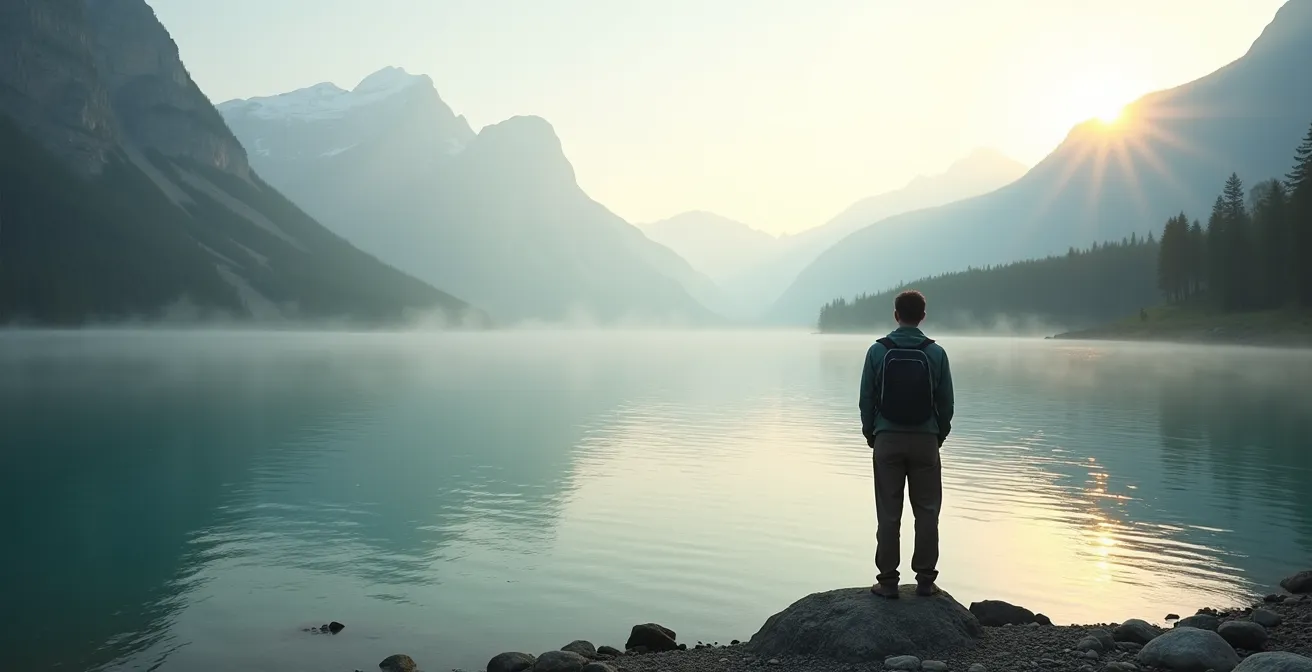
True burnout recovery is not about passive rest, but an actively designed protocol to systematically reset your nervous system from the ground up.
- Exposure to specific natural environments demonstrably lowers cortisol and boosts immune function more effectively than a generic spa day.
- Strategic isolation and a structured digital disconnection are critical for allowing your nervous system to find its true physiological baseline, free from constant external stimuli.
Recommendation: Stop booking “vacations” and start designing “environmental recovery protocols” using the structured, science-backed methods in this guide.
You booked the vacation. You endured the final push at work, dreaming of the moment you could finally switch off. Yet, you’ve returned feeling just as drained, if not more so. This is the paradox of the modern getaway for a burnt-out professional: the pressure to relax and the unstructured nature of “time off” can often amplify the very anxiety you’re trying to escape. Standard advice—book a spa, sleep in, just unplug—misses a fundamental point. Burnout isn’t just mental exhaustion; it’s a deep-seated dysregulation of your nervous system.
The cycle of high-stress work followed by a chaotic or unfulfilling vacation is a common experience. Recent workplace mental health statistics reveal that 76% of employees experience burnout at least occasionally, and a significant portion of these are millennials, with some data suggesting 84% of Millennials report experiencing burnout in their current roles. This state is characterized by elevated cortisol, a weakened immune response, and a brain stuck in a high-alert feedback loop. A passive vacation doesn’t address these physiological realities. It’s like trying to fix a complex software bug by simply turning the monitor off and on.
But what if the solution wasn’t passive relaxation, but active, intentional design? What if you could architect your trip not as a simple escape, but as a precise environmental protocol engineered to systematically reset your neurochemistry? This guide moves beyond generic travel tips. It provides a structural framework for designing a truly restorative journey. We will explore how to leverage specific environments, manage sensory input, and structure your time to dismantle burnout at its physiological source, ensuring you return not just rested, but genuinely restored.
This article provides a structured approach to transform your next trip into a powerful tool for recovery. Below, you will find a complete guide covering the science-backed principles and actionable steps to design your restorative journey, from understanding the power of water and nature to implementing a non-negotiable digital shutdown.
Summary: How to Design a Restorative Trip That Actually Fixes Your Burnout?
- Why Being Near Water Lowers Your Heart Rate Instantly?
- How to Lock Your Phone Away for 3 Days Without Panicking?
- Hiking or Sleeping: Which Recovers Your Brain Faster?
- The Sleep Mistake That Makes You More Tired on Vacation
- How to Structure Your First 24 Hours to Switch Off Work Mode?
- Why 3 Days in a National Park Lowers Cortisol More Than a Spa?
- Why Does Total Isolation Reset Your Nervous System Faster?
- How to Choose an Exclusive Island Destination That Ensures Total Privacy?
Why Being Near Water Lowers Your Heart Rate Instantly?
The calming effect of water is more than just a poetic notion; it’s a documented neurological phenomenon often referred to as “Blue Mind.” When you are near or in water, your brain shifts away from the high-alert state of “Red Mind” (anxiety, overstimulation) toward a state of calm alertness. This is partly due to the auditory environment water creates. The gentle, rhythmic sounds of waves or a flowing river are a form of “pink noise,” which contains a consistent mix of high and low frequencies. This sound profile is proven to reduce brain wave complexity and induce a more meditative state, promoting the production of alpha brainwaves associated with relaxed focus.

This sensory input is a direct antidote to the digital cacophony of a burnt-out life. Your brain, accustomed to processing sharp, unpredictable sounds from notifications and city life, can finally downshift. The visual input of water—its vastness and simple patterns—also reduces the cognitive load required for processing, freeing up mental resources. To maximize this effect, you must be intentional about the type of water environment you choose, as each serves a different restorative purpose.
- Calm lake: Best for cognitive overload and mental fatigue. Choose still waters when your mind needs quieting.
- Flowing river: Ideal for emotional stagnation. The continuous movement helps process stuck feelings.
- Ocean waves: Perfect for gaining perspective on overwhelming problems through experiencing awe.
- Thermal springs: Optimal for physical tension and stress-related muscle pain.
- Waterfall environments: Excellent for breaking negative thought patterns through sensory immersion.
Choosing the right water-based environment is the first step in designing a trip that actively works to lower your physiological stress markers. It’s not just about being near water; it’s about prescribing the right kind of water for your specific burnout symptoms.
How to Lock Your Phone Away for 3 Days Without Panicking?
The advice to “just unplug” during a restorative trip is simplistic and often counterproductive. For a professional on the edge of burnout, the phone represents a lifeline of control and connection. Forcibly severing that tie without a plan can induce panic, not peace. The root of this anxiety is the loss of autonomy driven by constant connectivity. A 2025 survey found that 60% of therapists linked burnout directly to loss of autonomy driven by nonstop digital notifications. This “always-on” culture prevents the nervous system from ever entering its crucial recovery mode.
Therefore, successful disconnection isn’t an act of will, but a structured process of tapering. You need to retrain your nervous system to tolerate the absence of digital input. Abruptly going “cold turkey” on day one of your trip is like trying to run a marathon without training—it’s a recipe for failure and added stress. The key is to gradually reduce your digital dependency in the week leading up to your departure, making the final “lock-away” feel like a natural and welcome final step, not a terrifying leap into the void.
This protocol desensitizes your brain to the absence of notifications and rebuilds your capacity for undivided attention. By the time you arrive at your destination, your nervous system is already primed for disconnection, allowing you to lock the phone away without triggering a fight-or-flight response.
Your 7-Day Digital Tapering Protocol:
- Days 1-2: Turn off all non-essential push notifications (social media, news, retail apps).
- Days 3-4: Set your phone to ‘Do Not Disturb’ for two separate 2-hour blocks during the day.
- Day 5: Remove social media and email apps from your home screen. Log out of all accounts to create friction.
- Day 6: Practice leaving your phone in another room during meals and for the last 90 minutes before bed.
- Day 7 (Pre-Trip): Conduct a full 8-hour phone-free practice run. Inform key contacts this is a drill for your upcoming trip.
Hiking or Sleeping: Which Recovers Your Brain Faster?
The burnt-out mind craves rest, leading many to believe that maximizing sleep is the ultimate goal of a restorative trip. However, this overlooks a crucial distinction between passive and active recovery. While both are essential, they serve fundamentally different neurological functions. Choosing the right one at the right time is key to accelerating brain recovery. Passive rest, like sleeping, is for consolidation. Active recovery, like hiking, is for clearing and regeneration.
Hiking, especially in a natural environment, is a form of active recovery. It stimulates blood flow to the brain and triggers the release of Brain-Derived Neurotrophic Factor (BDNF), a protein that acts like fertilizer for your brain cells, promoting neurogenesis (the growth of new neurons). This process is vital for recovering cognitive function and mental flexibility lost to chronic stress. Conversely, deep sleep is a passive recovery state where the brain’s glymphatic system activates. This is like a waste-disposal crew that flushes out metabolic byproducts and toxins, including beta-amyloid, which can impair cognitive function. Sleep also consolidates memories and prunes weak synaptic connections, making the brain more efficient.
The question is not which is better, but how to sequence them. The following table breaks down the distinct roles of different recovery modalities, allowing you to design a schedule that optimizes both neurochemical clearing and structural repair.
As this comparison of neural recovery methods shows, a balanced protocol is most effective.
| Recovery Type | Primary Function | Neurological Process | Best Timing | Duration Needed |
|---|---|---|---|---|
| Hiking (Active) | Clearing cortisol | Stimulates BDNF for neurogenesis | Morning | 60-90 minutes |
| Deep Sleep (Passive) | Consolidating memories | Activates glymphatic system | Night | 7-9 hours |
| Strategic Nap | Locking in benefits | Synaptic pruning | Afternoon | 20-90 minutes |
| Nature Awe | Breaking rumination | Reduces self-referential processing | Anytime | 15-30 minutes |
An ideal recovery day might start with an active recovery hike to clear cortisol and stimulate BDNF, followed by an afternoon strategic nap to consolidate gains, and end with a full night of deep sleep for systemic cleanup. Simply sleeping in and remaining sedentary misses the crucial “clearing” phase that active recovery provides.
The Sleep Mistake That Makes You More Tired on Vacation
You arrive at your serene destination, ready for a week of blissful sleep, only to spend the first night tossing and turning. This frustrating experience is known as the “first-night effect,” a common sleep disturbance that makes you more tired just when you need rest the most. It’s a key mistake to assume that a new, quiet environment automatically equals better sleep. Your brain, hardwired for survival, perceives an unfamiliar setting as potentially threatening. It keeps one hemisphere partially awake and vigilant, preventing you from entering the deepest, most restorative stages of sleep.

This evolutionary safety mechanism, while useful for our ancestors, sabotages the modern restorative trip. The exhaustion you feel on day two isn’t just from travel; it’s from a genuine lack of deep, recuperative sleep. The solution is not to simply “try harder” to sleep but to proactively signal to your brain that the new environment is safe. This involves tricking your nervous system with familiar sensory cues, essentially recreating the “sensory signature” of your home bedroom. This tells your vigilant brain hemisphere that it can stand down, allowing you to bypass the first-night effect and get quality rest from the very beginning.
Implementing these strategies is a critical part of your arrival protocol. They are small, simple actions that have a disproportionately large impact on your overall energy levels for the entire trip.
- Bring a familiar pillowcase: Scent is a powerful trigger for the brain. The familiar smell of your home laundry detergent signals safety.
- Pack a travel diffuser: Use the same essential oil (like lavender) that you use in your bedroom at home.
- Replicate your pre-sleep routine: If you read for 20 minutes and then do 5 minutes of stretching at home, do it in the exact same order and for the same duration.
- Use a white noise app: Match the sound and volume to what you’re used to at home to create a consistent auditory environment.
- Arrive early: Get to your accommodation at least three hours before bedtime to allow your nervous system time to acclimate to the space while you’re still awake.
How to Structure Your First 24 Hours to Switch Off Work Mode?
The transition from a high-stakes work environment to a state of rest is not a simple on/off switch. The first 24 hours of your trip are the most critical period for intentionally downshifting your nervous system. Without a clear structure, the momentum of work-related stress and rumination will carry over, sabotaging your recovery before it even begins. This is where an “arrival ritual” becomes a non-negotiable part of your restorative protocol. This isn’t just a quaint idea; it’s a proven method for accelerating detachment.
Research in the field of restorative travel shows that this structured transition has measurable physiological effects. A key finding from My Restorative Travel indicates that travelers who implement a structured 60-minute arrival ritual report 40% faster psychological transition from work mode to vacation mindset. This is often accompanied by a measurable reduction in cortisol levels within the first 24 hours. The ritual works by interrupting the brain’s default stress loop and replacing it with novel, grounding sensory inputs. It sends a clear signal to your body and mind: “The performance is over. You are safe. You can now switch to recovery mode.”
The goal of this “Work Mode Shutdown Protocol” is to move you from your head (analysis, planning, worrying) into your body (sensing, feeling, being). Each step is designed to engage a different sensory pathway and ground you in the present moment and your new, safe environment.
- Last Work Day: Before you sign off, create a detailed “brain dump.” List every open task, worry, and idea, along with the very next action for each. This externalizes the mental load. Then, set a clear out-of-office message that designates an emergency contact who is not you. This severs your responsibility.
- Hour 1 on Arrival: Before you even unpack fully, take your shoes off. Walk barefoot on a natural surface—grass, sand, dirt, even a wooden deck. This practice, known as grounding or earthing, helps to regulate your nervous system.
- Hours 2-3: Perform a “sensory scan” exercise. Sit quietly and consciously identify 5 things you can see, 4 things you can hear, 3 things you can feel (the breeze, the chair), 2 things you can smell, and 1 thing you can taste. This pulls your focus away from internal rumination.
- Hours 4-24: Intentionally schedule one high-awe experience. This could be watching a sunset from a viewpoint, standing at the base of a waterfall, or looking out over a vast landscape. Awe has been shown to quiet the brain’s “default mode network,” which is responsible for self-referential thought and worry.
Key Takeaways
- Effective burnout recovery requires designing an “environmental protocol,” not just booking a relaxing destination.
- A successful protocol strategically combines active recovery (like hiking in nature to clear cortisol) with passive recovery (like deep sleep for brain cleanup).
- A structured digital tapering plan before your trip and a deliberate arrival ritual in the first 24 hours are non-negotiable for truly switching off from work mode.
Why 3 Days in a National Park Lowers Cortisol More Than a Spa?
A spa offers a controlled, predictable environment designed to soothe. While pleasant, it often fails to address a core component of burnout: a depleted immune system and a brain locked in narrow, ruminative thought patterns. A national park, by contrast, offers a complex, unpredictable, and awe-inspiring sensory environment that triggers a more profound and lasting physiological reset. The difference lies in the active biochemical exchange between your body and the natural world.
The most compelling evidence for this comes from the Japanese practice of ‘Shinrin-yoku’ or “forest bathing.” It’s more than just a walk in the woods; it’s a process of sensory immersion. Scientific research on this practice has revealed a remarkable mechanism: trees and plants emit airborne essential oils, called phytoncides, to protect themselves from insects and decay. When humans inhale these compounds, they have a direct, measurable impact on our immune system. As highlighted in a Country Living article on “calmcations,” studies on ‘Shinrin-yoku’ demonstrate its powerful effects.
Case Study: Forest Bathing and Immune System Enhancement
Research on the effects of forest environments on the human body found that inhaling phytoncides significantly boosts immune function. One key study showed that participants who spent three days and two nights in a forest environment experienced a 50% increase in the activity of Natural Killer (NK) cells—a type of white blood cell crucial for fighting off viruses and tumors. Remarkably, these elevated levels of NK cell activity were sustained for up to 30 days after the trip, providing a long-lasting defense against the physical toll of chronic stress.
This offers a stark contrast to a spa day, where the benefits (like reduced muscle tension) are often transient. The national park experience provides a systemic, neuro-immune upgrade. Furthermore, the sheer scale and complexity of natural landscapes—vast canyons, ancient forests, towering mountains—induce a state of awe. Awe has been shown to decrease activity in the brain’s default mode network, pulling us out of self-referential worry and making our personal problems feel smaller and less significant. A spa pampers the body; a national park recalibrates the entire human organism.
Why Does Total Isolation Reset Your Nervous System Faster?
In a world of hyper-connectivity, the idea of total isolation can seem extreme. Yet, for a nervous system ravaged by burnout, it’s one of the most powerful and rapid reset tools available. Burnout isn’t just about being busy; it’s about the relentless barrage of external inputs—emails, social cues, news, demands—that force your nervous system into a constant state of reaction. Even positive social interaction requires cognitive and emotional energy. Isolation removes *all* of these inputs, forcing your system to stop reacting and finally find its own equilibrium.
This process is about re-establishing your physiological baseline. As a leading expert in the field explains, this is a state that many professionals haven’t experienced in years.
Isolation removes all external inputs, forcing the nervous system to find its own true baseline (homeostasis) for the first time in potentially years.
– Dr. Nigel Lester, Global Burnout Recovery Program
When you’re alone, your brain’s attentional resources are no longer consumed by interpreting social signals or managing external expectations. This frees up immense cognitive capacity and allows for a process of interoception to flourish—the ability to sense your body’s internal signals like your heartbeat, your breath, and your emotional state. For someone with burnout, who is often profoundly disconnected from their own physical and emotional needs, this is a vital part of recovery. It’s the difference between being co-regulated by your environment and learning to self-regulate from within.
The data supports the unique efficacy of this approach. While group retreats or spa visits show moderate benefits, they cannot match the deep reset offered by true solitude. The following data from intensive therapy retreats illustrates the quantitative difference.
| Recovery Environment | Cortisol Reduction (48hrs) | Interoception Enhancement | Nervous System Regulation | Optimal Duration |
|---|---|---|---|---|
| Group Retreat | 15-20% | Moderate | Co-regulated | 7-10 days |
| Spa with Staff Interaction | 10-15% | Low | Partially regulated | 3-5 days |
| Total Isolation | 25-35% | High | Self-regulated baseline | 3-5 days |
| Solo in Nature | 20-30% | Very High | Nature-assisted regulation | 5-7 days |
How to Choose an Exclusive Island Destination That Ensures Total Privacy?
The principle of isolation is powerful, but its effectiveness hinges on execution. Choosing a destination that *promises* privacy is not enough; you must verify that it can *deliver* total sensory and social seclusion. An “exclusive” resort where you can still hear neighbors, see day-trippers on your beach, or get interrupted by over-eager staff is not a true restorative environment. It’s a performance of luxury, not a protocol for recovery. Designing this part of your trip requires a meticulous, almost forensic, level of due diligence.
You must shift your mindset from that of a tourist to that of a security professional vetting a safehouse. Your goal is to eliminate all potential sources of unplanned sensory or social input. This means asking specific, uncompromising questions that go far beyond what’s advertised in a glossy brochure. True privacy is not a feature; it’s a comprehensive operational policy that touches every aspect of the guest experience, from acoustic design to staff protocols.
To ensure your chosen destination meets the stringent requirements for a nervous system reset, you must “stress-test” its privacy claims. Use the following checklist during your booking and inquiry process. A destination’s willingness and ability to answer these questions transparently is the first and most important indicator of its suitability.
- Verify a strict no-drone policy: Ask about enforcement measures. A policy without enforcement is useless.
- Check for external access: Can day-trippers or non-guest boats access the property’s waters or beaches?
- Confirm staff media policies: Inquire about their rules regarding staff photography and social media posting.
- Ask about “invisible service” options: Do they have hidden service corridors or allow for scheduling all service (housekeeping, maintenance) at specific times to avoid interruptions?
- Inquire about private dining flexibility: Beyond room service, are there multiple private dining locations available to avoid seeing other guests?
- Verify villa-specific privacy: Confirm separate, private entrances and ask about acoustic privacy measures between accommodations. What is the minimum distance between villas?
- Confirm exclusive access: Can you book exclusive time slots for pools or other shared amenities?
This level of detail is not excessive; it is essential. You are not just booking a room; you are commissioning an environment specifically engineered to have zero unpredictable human interaction, allowing your recovery protocol to run without interference.
Now that you are equipped with the principles and protocols, the next step is to move from theory to action. Begin designing your next restorative journey with this structural framework, treating it as the most important project you’ll work on this year: the recovery of your own well-being.