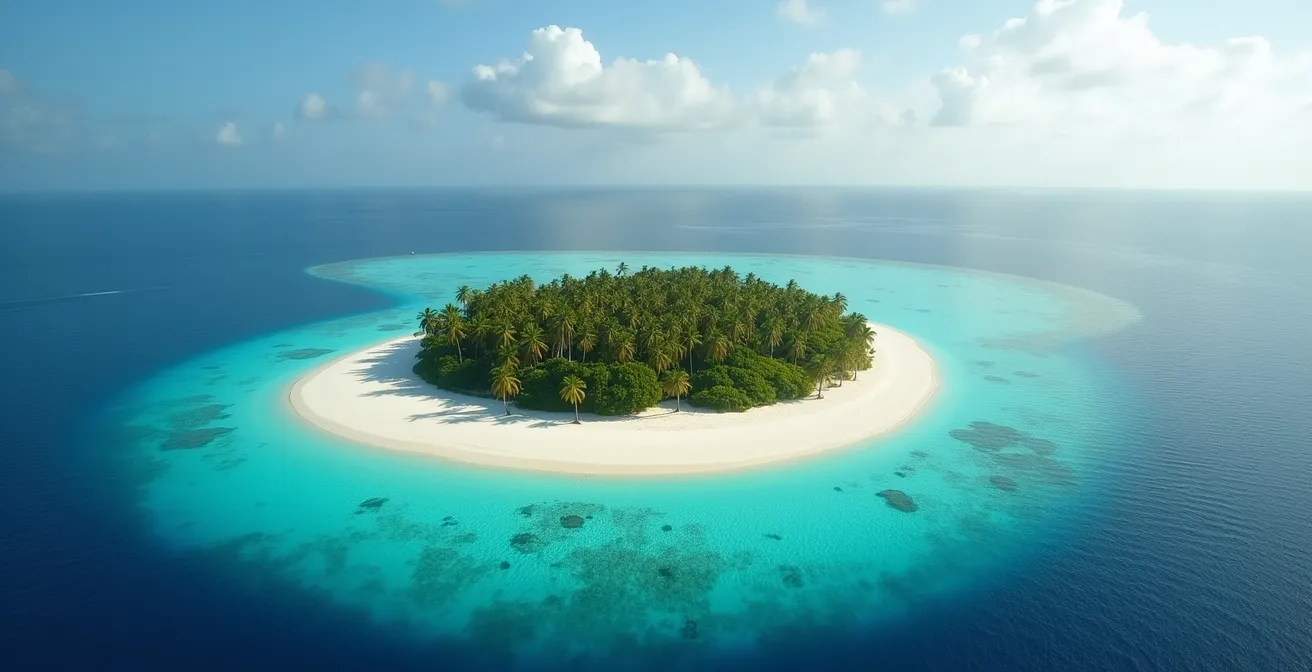
Securing a truly private island experience depends less on the price tag and more on a strategic vetting of its operational privacy.
- “Private” is a marketing term; true seclusion is a ratio of space, staff, and guests that must be verified.
- Hidden costs, especially in transfers, can eclipse accommodation fees if not meticulously planned.
Recommendation: Shift your focus from brochure promises to a critical analysis of logistics, service models, and seasonal conditions to guarantee the sanctuary you seek.
For the discerning traveler, the promise of a “private island” is the ultimate allure—a sanctuary of silence, separated from the world by an expanse of turquoise water. Yet, the reality often falls short of the marketing. Many arrive at their exclusive destination only to find that “private” means sharing a beach with dozens of other guests, or that the tranquility is interrupted by the constant churn of resort activity. The pursuit of seclusion becomes a frustrating exercise in navigating crowded amenities and compromised solitude. This common disappointment stems from a fundamental misunderstanding of what constitutes genuine privacy.
Most selection processes are guided by glossy photographs, brand reputation, and price—metrics that say little about the actual experience of being there. But what if the key to unlocking true isolation wasn’t about choosing the most expensive or well-known resort, but about adopting a new framework for evaluation? The secret lies in assessing a destination’s operational privacy: the verifiable, functional reality of being undisturbed. It requires moving beyond the brochure to analyze the invisible logistics that orchestrate a seamless escape, from the guest-to-acreage ratio to the acoustics of the environment.
This guide provides that framework. We will deconstruct the elements of true seclusion, offering a concierge’s methodology for vetting your next retreat. We will explore the neurological benefits of profound isolation, provide tools to verify an island’s privacy claims, and analyze the nuances of service. Furthermore, we will uncover the hidden financial traps in transfers, pinpoint the ideal booking windows for perfect conditions, and compare financial models to help you make the most informed decision possible. Finally, we will look at modern alternatives to traditional islands, ensuring your choice is not just luxurious, but perfectly aligned with your desire for absolute peace.
To navigate this complex decision, this guide is structured to walk you through every critical checkpoint. The following summary outlines the key areas we will explore to ensure your investment in privacy yields the profound return on experience you deserve.
Summary: A Strategic Framework for Choosing Your Private Sanctuary
- Why Does Total Isolation Reset Your Nervous System Faster?
- How to Verify if a “Private” Island Is Actually Private Before Booking?
- Private Villa or Resort Suite: Which Offers Better Service?
- The Transfer Trap: Why Getting There Can Cost More Than the Flight?
- When to Book to Ensure the Ocean Is Calm Enough for Swimming?
- All-Inclusive or Pay-As-You-Go: Which Is Cheaper for Non-Drinkers?
- Why Modern Floating Resorts Don’t Feel Like They Move at All?
- How to Choose Between a Floating Resort and a Traditional Cruise Ship?
Why Does Total Isolation Reset Your Nervous System Faster?
The profound sense of peace experienced in true isolation is not merely a feeling; it is a measurable neurological and physiological response. In our daily lives, the nervous system operates in a state of low-grade hypervigilance, constantly processing a barrage of stimuli—traffic noise, digital notifications, social interactions. This state elevates cortisol levels and maintains a “fight or flight” readiness. Total isolation acts as a hard reset by systematically removing these triggers. When the brain is no longer required to filter constant, man-made noise, it can downshift from the beta wave state (active concentration) to the alpha wave state, which is associated with calm and meditative relaxation.
This environmental shift is particularly powerful when it involves natural sounds. The auditory cortex responds differently to the predictable, gentle patterns of waves, wind, or birdsong than it does to the jarring, unpredictable nature of urban noise. This “auditory solitude” allows the parasympathetic nervous system—the body’s “rest and digest” mechanism—to take over. The result is a cascade of benefits: a lower heart rate, reduced blood pressure, and a decrease in muscle tension. It is a state of deep restoration that a busy hotel, no matter how luxurious, can rarely facilitate.
Achieving this state requires a conscious effort to disconnect. It’s about more than just being in a remote location; it’s about curating your sensory input to favor restorative, natural patterns over stimulating, artificial ones. Key practices include:
- Scheduling a dedicated period—even just 24 hours—without digital devices to significantly reduce anxiety-inducing cortisol.
- Choosing an environment where human-made noise is minimal, allowing natural soundscapes to dominate.
- Engaging in mindful, tactile activities like journaling to keep the mind engaged without digital overstimulation.
- Practicing focused breathing exercises during the initial hours to help your nervous system transition away from its default state of hypervigilance.
Ultimately, the speed at which your system resets in isolation is a direct function of how completely you can eliminate the chronic stressors of modern life. It’s an immersive therapy that allows the body and mind to return to their natural, unstressed baseline.
How to Verify if a “Private” Island Is Actually Private Before Booking?
The term “private island” is one of the most misused in luxury travel. To ensure you are booking a sanctuary of solitude rather than a crowded resort on a remote piece of land, a rigorous vetting process is essential. This requires moving beyond marketing materials and performing your own digital reconnaissance. The key metric to establish is the Privacy-to-Guest Ratio, a concept that weighs the island’s total size and the number of staff against the maximum guest capacity. A resort with 25 villas on a 3,500-acre island like COMO Laucala offers a vastly different experience of privacy than one with 35 villas on 300 hectares.
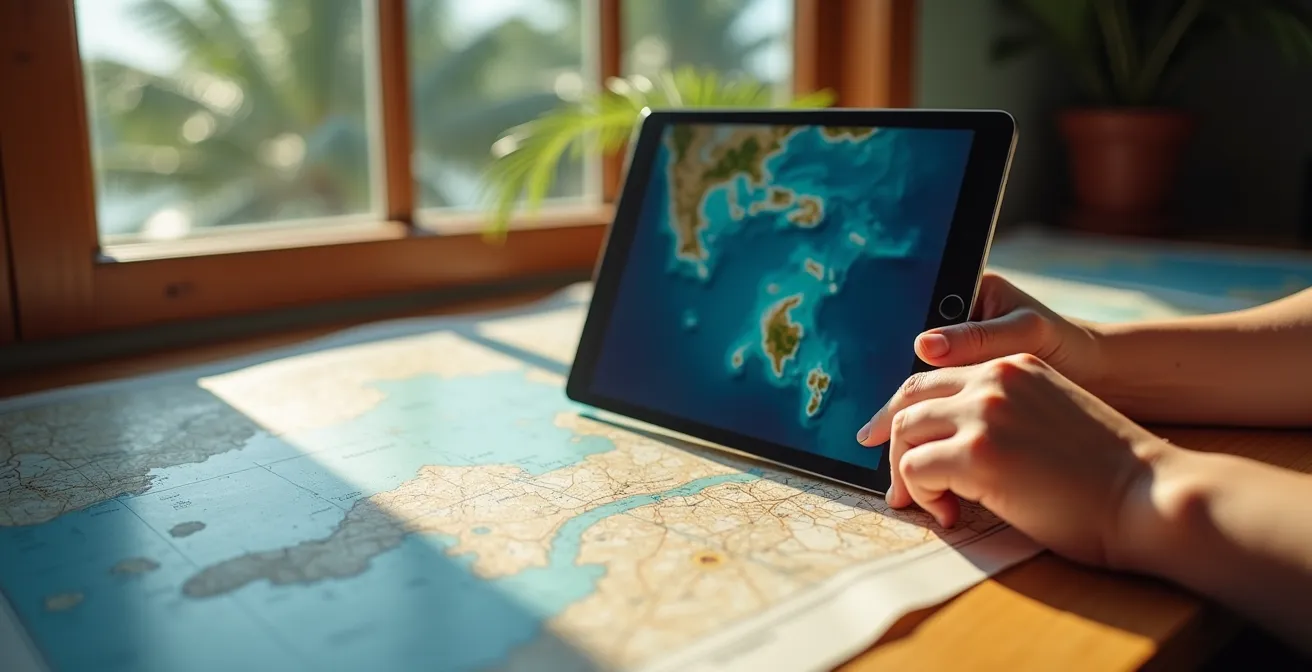
Your verification should start with satellite imagery. Use tools like Google Earth to examine the island’s layout. Look for the proximity of villas to each other, the location of central facilities like restaurants and bars, and the presence of any other settlements or public-access beaches. This visual audit will quickly reveal whether the “private” villa you are considering is overlooked by its neighbors. Secondly, scrutinize guest photos and videos on review sites and social media. Look for what is *not* shown in the professional shots—are there other people in the background of beach photos? Does the main pool seem crowded?
A prime example of true operational privacy is a destination like Islas Secas in Panama, which hosts a maximum of 32 guests across 14 islands. This extreme limitation ensures that the experience is defined by solitude, whether one is exploring the archipelago’s rich birdlife or enjoying world-class fishing. The most exclusive resorts provide clear data on their guest limits, a key indicator of their commitment to genuine privacy.
This table offers a comparative glance at the capacity of several top-tier resorts, illustrating how the number of guests can vary significantly. Analyzing this data is a crucial first step, as shown in a recent comparative analysis of exclusive island resorts.
| Resort | Maximum Guests | Number of Accommodations | Island Size |
|---|---|---|---|
| Bawah Reserve Indonesia | 70 | 35 tented villas | 300 hectares |
| &Beyond Mnemba Island | 24 | 12 bandas | Small isle |
| COMO Laucala Island | 80 | 25 villas | 3,500 acres |
| Four Seasons Voavah | 22 | 7 bedrooms | 5 acres |
Finally, do not hesitate to ask direct questions during the booking process. Inquire about average occupancy rates during your intended travel dates, the staff-to-guest ratio, and policies regarding day-trippers or external visitors. A resort dedicated to privacy will welcome this scrutiny.
Private Villa or Resort Suite: Which Offers Better Service?
The choice between a fully-staffed private villa and a suite within an exclusive resort is a critical decision that hinges on your preferred Service Signature. It is not a question of which is “better,” but which style of service—dedicated and intimate versus flexible and on-demand—best aligns with your vision of a perfect escape. The market for these escapes is robust; according to one report, the private island resort market has grown 20% since 2020, with travelers seeking increasingly personalized experiences.
A private villa typically offers a dedicated team—often including a private chef, butler, and housekeeping staff—whose sole focus is your party. This model excels at providing a highly personalized, anticipatory service. Your preferences are learned and remembered, meals are crafted to your exact tastes, and the rhythm of the day is entirely yours. This is the ideal choice for those who value ultimate discretion and a “home away from home” feeling, where the staff become a seamless, almost invisible part of your environment. It is particularly well-suited for families or groups who desire a shared, intimate experience without the structure of a larger resort.
Conversely, a suite within a high-end resort provides access to a wider array of amenities and a larger, specialized service team. While you may not have a dedicated chef, you gain access to multiple world-class restaurants, extensive spa facilities, and a diverse team of experts, from sommeliers to marine biologists. The service is less intimate but more expansive. This model is perfect for travelers who enjoy variety, social opportunities, and the convenience of having a broad spectrum of activities and dining options available on demand. Resorts like Kokomo Private Island in Fiji exemplify this by offering various villa sizes, each with access to the full resort infrastructure, ensuring a tailored experience whether you are a couple or a large group.
To make the right choice, consider your social preferences. Do you wish to see no one but your own party, or do you enjoy the subtle energy of other discerning guests at a distance? Your answer will determine whether the focused attention of a villa or the expansive optionality of a resort constitutes superior service for you.
The Transfer Trap: Why Getting There Can Cost More Than the Flight?
The journey to a secluded island paradise is often romanticized, but it can conceal a significant logistical and financial challenge: the “last mile” transfer. For the most exclusive destinations, the cost of getting from the nearest international airport to the island itself can easily exceed the price of your long-haul flight. This is the Transfer Trap, where the complexity and expense of seaplanes, helicopters, or private boat charters are underestimated. Understanding and planning for this phase is critical to protecting both your budget and your peace of mind.
The high costs are driven by several factors: the use of specialized aircraft or vessels, the limited availability of pilots and captains qualified for remote routes, high fuel costs, and the logistics of operating in isolated areas. For instance, some exclusive island rentals like Necker Island command $102,500 per night, and the bespoke transfer arrangements required contribute significantly to the overall investment. A 30-minute seaplane ride for two can cost several thousand dollars, a fee that is often not included in the nightly rate and can come as a surprise if not clarified in advance.
Beyond the cost, there is the issue of transfer friction. Luggage restrictions on small aircraft are strict, often limited to 15-20kg in soft-sided bags only. Weather can cause significant delays or cancellations, particularly for seaplanes, potentially disrupting your itinerary. The most seamless experiences are typically arranged directly through the resort, which can coordinate logistics and provide contingency plans. Some high-end resorts have transformed the transfer into part of the experience, offering “arrival rituals” or private yacht journeys that set the tone for the stay. To avoid the transfer trap, a thorough audit of the logistics is not just recommended; it is essential.
Your Transfer Logistics Audit: 5 Key Verification Points
- Air Access Evaluation: Research the available transfer methods, such as seaplane versus helicopter, and weigh the scenic benefits of a seaplane against its higher dependency on weather conditions.
- Coordination and Contingency: Confirm if booking transfers directly through the resort provides seamless coordination and, crucially, what level of medical evacuation coverage is included.
- Alternative Route Verification: Inquire if the resort offers private yacht transfers, which can serve as a luxurious and often more weather-resilient alternative to air travel.
- Baggage Compliance Check: Verify the exact luggage restrictions for the transfer aircraft—size, weight, and type (soft vs. hard case)—to avoid last-minute repacking or excess fees.
- Experience Integration: Ask if the resort offers any “arrival ritual” packages that transform the transfer from a simple commute into an integral and memorable part of your luxury experience.
Ultimately, treating the transfer with the same level of scrutiny as the accommodation itself is the key to a truly stress-free beginning and end to your private island escape.
When to Book to Ensure the Ocean Is Calm Enough for Swimming?
Securing a private island escape is about more than just finding a beautiful beach; it’s about ensuring the conditions are perfect for enjoying it. A key element of this is what can be called Atmospheric Calm—a state where the ocean is placid, the winds are gentle, and the water is ideal for swimming, snorkeling, and water sports. Booking during the wrong season can mean facing rough seas, strong currents, and murky water, completely undermining the purpose of your trip. The timing of your visit is therefore a critical strategic decision that must be guided by regional microclimates, not just general weather forecasts.
Different parts of the world are governed by distinct meteorological patterns. In the Maldives, the northeast monsoon (from December to April) brings dry weather and the calmest seas, making it the prime window for travel. Conversely, the southwest monsoon (from May to November) can bring rain and choppier waters. In the Caribbean, the primary concern is hurricane season, which officially runs from June to November. While a hurricane is not a daily threat, the season is characterized by higher humidity, more frequent rain, and less predictable sea conditions. The dry season, from December to May, is reliably calm and sunny.
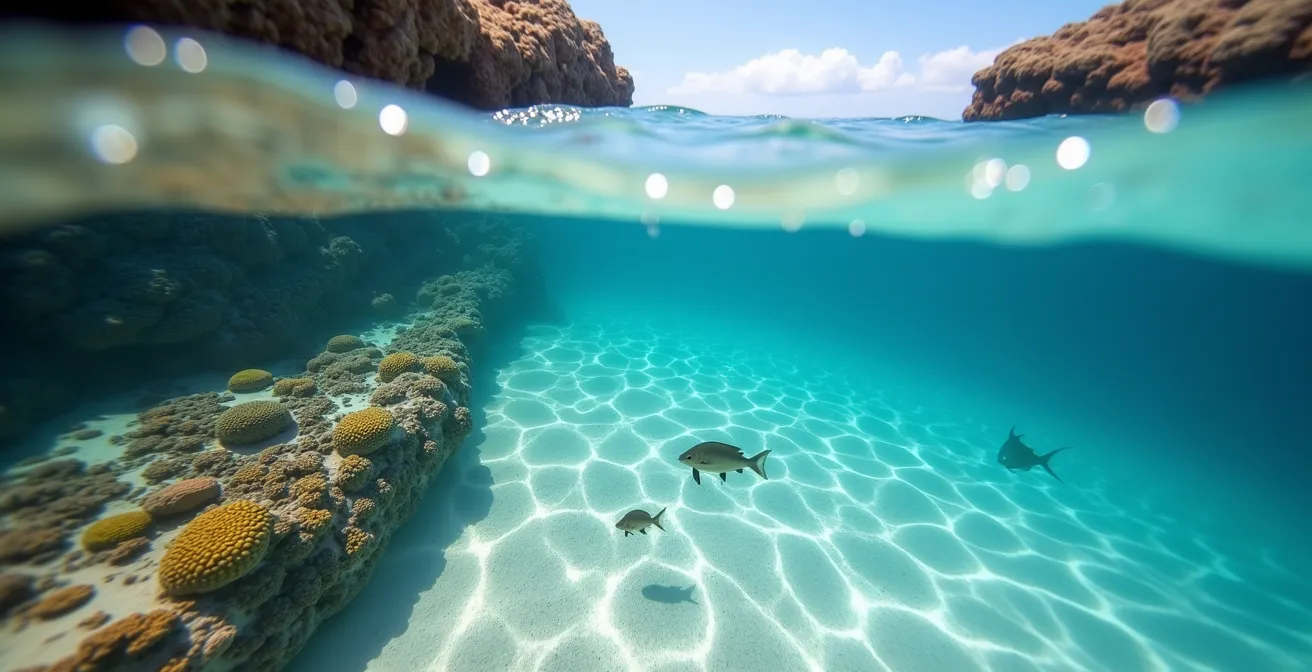
Even within a season, local topography plays a crucial role. In the Seychelles, which is affected by two opposing trade winds, one side of an island can have rough seas while the other side is perfectly sheltered and calm. An expert concierge will know which resorts offer protected lagoons or are situated on the leeward side of the island during specific months. Barrier reefs also create naturally protected, pool-like swimming areas, regardless of the conditions in the open ocean. Therefore, researching the specific geography of your chosen island is just as important as knowing the regional climate patterns.
The following table, based on data from travel experts and climate reports like those found in guides to luxury private islands, provides a general framework for planning. However, it should always be supplemented with resort-specific advice.
| Region | Best Months | Avoid | Key Considerations |
|---|---|---|---|
| Maldives | December-April | May-November | Northeast monsoon brings calm seas |
| Caribbean | December-May | June-November | Hurricane season affects water conditions |
| Seychelles | April-May, October-November | December-March | Trade winds affect different sides of islands |
| French Polynesia | May-October | November-April | Dry season offers calmest lagoons |
By aligning your booking with these climatic windows and understanding the unique geography of your destination, you can guarantee that the tranquil, crystalline waters you see in the brochure are the ones you will actually get to experience.
All-Inclusive or Pay-As-You-Go: Which Is Cheaper for Non-Drinkers?
When selecting an ultra-luxury island, the pricing model—all-inclusive versus pay-as-you-go (PAYG)—can have a significant impact on the overall value of your stay, especially for non-drinkers. The conventional wisdom that all-inclusive is only worthwhile for those who consume large amounts of alcohol often breaks down at the highest end of the market. Here, “all-inclusive” transcends simple food and beverage to encompass a vast array of activities, services, and experiences that can offer substantial value regardless of your drinking habits.
Destinations at the pinnacle of luxury, such as Banwa Private Island in the Philippines, which can command $100,000 per night, operate on a fundamentally all-inclusive basis. This price typically includes not just fine dining with premium ingredients but also access to a marine sports center, a golf course, expert guides, and a fleet of boats. For non-drinkers, the calculation shifts from “Will I drink enough to make it worth it?” to “Will I utilize enough of the included experiences to justify the rate?” When water sports, spa treatments, private excursions, and wellness activities are bundled in, the PAYG alternative of paying for each activity separately could quickly become far more expensive.
The key is to request a detailed list of what “all-inclusive” covers. Does it include motorized water sports, private guided hikes, daily spa treatments, or cooking classes? As one luxury travel expert notes, the value proposition is often misunderstood.
When you break down what’s included (all meals, drinks, activities, water sports, often spa treatments), and compare it to what you’d spend at an all-inclusive luxury resort, the gap isn’t as insane as you’d think.
– Carmen Edelson, Caribbean’s Most Exclusive Private Island Resorts
Conversely, a PAYG model might seem appealing for its flexibility, but it can introduce a transactional element that detracts from the escapist experience. Constantly considering the cost of another activity or a specific dish can create mental friction. For non-drinkers, the ideal scenario may be a “hybrid” all-inclusive resort that offers a lower rate for a package excluding alcohol or provides a significant resort credit in lieu of it. Always inquire about such possibilities; the most exclusive resorts are masters of bespoke arrangements.
Therefore, for the non-drinker, the better value is not automatically PAYG. It is the model that best aligns with your planned activities, providing a frictionless experience where you can fully immerse yourself without calculating the cost of every choice.
Why Modern Floating Resorts Don’t Feel Like They Move at All?
For travelers who love the idea of being surrounded by water but are hesitant about the motion of a traditional vessel, the modern floating resort presents a compelling paradox: a structure that is on the water but feels as stable as if it were on land. This remarkable stability is not an accident; it is the result of a suite of advanced marine engineering technologies designed specifically to counteract the very sensations of movement—roll, pitch, and yaw—that can lead to discomfort or seasickness.
Unlike traditional cruise ships, which primarily use fins that require forward motion to work effectively, the most advanced floating resorts employ zero-speed gyroscopic stabilizers. These are essentially massive, fast-spinning flywheels mounted low in the hull. Their powerful gyroscopic force resists the rolling motion of the waves, holding the vessel steady even when it is stationary. This technology is a game-changer for at-anchor comfort, creating a serene, land-like environment perfect for activities like yoga or fine dining.
This stability is further enhanced by several other key innovations:
- Dynamic Positioning Systems: Using GPS and a network of computer-controlled thrusters, these systems automatically make micro-adjustments to the vessel’s position, holding it perfectly in place against wind and currents without the need for a noisy, ecologically damaging anchor.
- Advanced Sound Dampening: The low-frequency vibrations and noise from engines are a major source of subliminal discomfort. Modern resorts use specialized, multi-layered insulation and sophisticated engine mounting systems that isolate mechanical noise from guest areas entirely.
- Proactive Weather Monitoring: These resorts are integrated with real-time meteorological systems. The stabilization technology does not just react to waves; it proactively adjusts its settings based on predicted changes in sea state, ensuring a consistently smooth experience.
The cumulative effect of these systems is a structure that offers the 360-degree ocean views and immersive water experience of a boat, but with the unshakable tranquility of a land-based villa. It is this technological mastery that makes modern floating resorts a viable and supremely comfortable option for even the most motion-sensitive individuals.
Key Takeaways
- True privacy is an operational metric, not a marketing slogan; it must be verified through guest-to-acreage ratios and satellite reconnaissance.
- The “last mile” transfer is a significant hidden cost and potential friction point that requires meticulous planning to ensure a seamless arrival.
- The ideal pricing model (All-Inclusive vs. Pay-As-You-Go) depends entirely on your activity level, not just alcohol consumption.
How to Choose Between a Floating Resort and a Traditional Cruise Ship?
The distinction between a floating resort and a traditional cruise ship is as vast as the one between a private dinner party and a stadium concert. While both operate on water, they offer fundamentally different experiences in terms of scale, focus, and social dynamics. Making the right choice depends on understanding that a floating resort is designed for destination immersion, while a cruise ship is built for multi-port transit.
The most immediate difference is capacity. A floating resort is an intimate affair, typically hosting between 20 and 100 guests. This fosters a curated community where you may recognize fellow travelers, creating a subtle social dynamic without ever feeling crowded. In stark contrast, a modern cruise ship is a floating city, carrying anywhere from 2,000 to 6,000 passengers. The experience is one of anonymity within a crowd, with a focus on a vast array of onboard entertainment and amenities designed for mass appeal.
Their purpose also diverges completely. A floating resort is semi-permanently positioned in a single, extraordinary location—a pristine coral reef, a secluded bay—allowing for deep exploration of that specific environment. A cruise ship’s model is based on movement, visiting multiple ports for short periods, offering a sampler of destinations rather than an in-depth experience of one. Consequently, the environmental impact differs significantly; the low-impact positioning of a floating resort contrasts sharply with the high-impact footprint of mass tourism brought by a large cruise vessel. As a result, the price points reflect these philosophies, with floating resorts commanding a premium for their exclusivity and focus.
There’s The Brando and COMO Laucala Island in the South Pacific; Song Saa and Six Senses Laamu in Asia; Cayo Espanto and Islas Secas in Latin America. Each of these exclusive island resorts invites you to leave your worries behind for a while, stepping into a sanctuary of sunlight and silence.
– Jacada Travel, Top 11 Private Island Resorts Around the World
Ultimately, the choice is one of intention. If your goal is to see many places in a bustling, high-energy environment, a cruise ship is the logical choice. If your desire is to connect deeply with one spectacular location in an atmosphere of intimate tranquility and exclusivity, the floating resort is unequivocally the superior option.