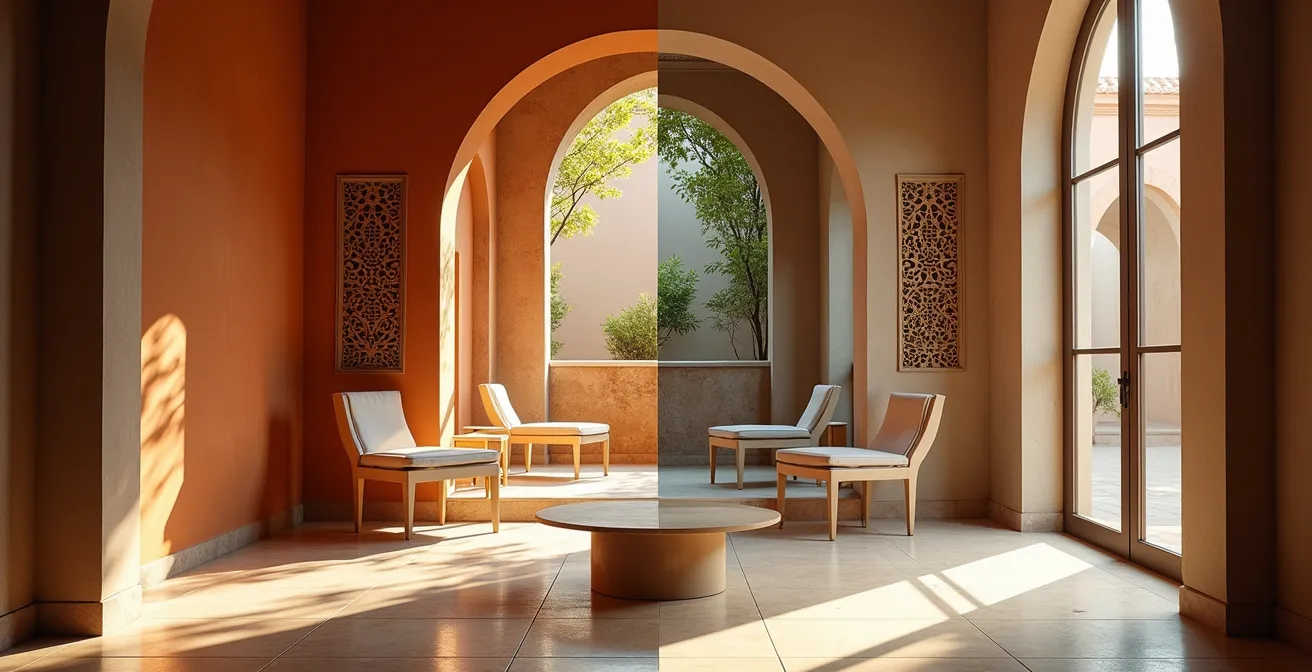
The most memorable travel accommodation isn’t just beautiful; it’s a living document of a region’s culture and history.
- Authentic buildings use intelligent design, not just technology, for comfort, like the passive cooling of a stone riad.
- Learning to spot genuine material aging (patina) versus artificial finishes is the key to avoiding “heritage” fakes.
- Architectural features like internal courtyards and even staircases reveal the social and practical priorities of the culture that built them.
Recommendation: Shift your focus from simply looking at a building’s style to actively “reading” its architectural features to understand its story and function.
The modern traveler often faces a subtle disappointment. You journey to a city steeped in history, only to sleep in a glass and steel box that could be anywhere in the world. The search for “authenticity” can feel abstract, leading many to rely on vague online reviews or generic advice to simply “stay in the old town.” While well-intentioned, this approach barely scratches the surface. It overlooks the rich stories that buildings tell about the climate they endure, the social lives they shelter, and the materials they are made from.
The true art of choosing a meaningful place to stay lies not in finding something that looks old, but in understanding *why* it looks the way it does. It involves a shift in perspective, from that of a consumer to that of a curious historian. But what if the key wasn’t about finding a checklist of “authentic” features, but about learning to read a building’s cultural DNA? This guide proposes a new way to select accommodation: by understanding the language of architecture itself. We will decode the practical genius behind traditional design, learn to distinguish genuine history from modern pastiche, and see how the very layout of a space shapes human experience.
This article will guide you through the essential elements to consider when seeking accommodation that is not just a room, but a destination in itself. From the thermal science of ancient walls to the social dynamics of a courtyard, you will learn how to make choices that enrich your travel experience, connecting you more deeply to the culture of the place you visit.
Summary: How to Choose Accommodation with True Architectural Character
- Why Staying in a Stone Riad Is Cooler Than an AC Hotel?
- How to Spot Fake “Heritage” Style Built Last Year?
- Charm or Soundproofing: Which Matters More for Sleep?
- The Staircase Surprise That Ruins the Trip for Seniors
- Why the Internal Courtyard Is the Social Hub of Traditional Homes?
- Why Visiting Rome Without Reading History Is a Waste of Time?
- Why Did 1920s Paris Create Such a Specific Artistic Explosion?
- What Is Contemporary Urban Tourism and Why Should You Try It?
Why Staying in a Stone Riad Is Cooler Than an AC Hotel?
In the sweltering heat of a Marrakesh summer, the choice between a modern, air-conditioned hotel and a traditional stone riad seems obvious. Yet, seasoned travelers know the riad often offers a more profound and sustainable form of cool. This isn’t magic; it’s the science of passive climatology, an architectural intelligence developed over centuries. Before the advent of energy-hungry HVAC systems, buildings were designed to work *with* their environment, not against it. A riad is a masterclass in this principle.
The secret lies in a combination of features designed to manage heat. The most important is thermal mass. The thick, stone or earth-packed walls of a riad absorb the intense daytime heat very slowly. By the time the heat begins to penetrate the interior, the cool desert night has arrived, and the walls start to release their stored warmth, creating a comfortable ambient temperature. This natural cycle is often enhanced by a central, open-air courtyard. As the sun heats the air in the courtyard, it rises, pulling cooler air from the shaded rooms and arcades in a continuous, silent process of natural ventilation.
This design philosophy extends to every detail. Water features, like a small fountain in the courtyard, provide evaporative cooling. Windows are often narrow and positioned high on the walls, allowing hot air to escape while minimizing direct sun exposure. Covered walkways and deep-set doorways create shaded transition zones that further cool the air before it enters living spaces. Choosing such a building is not just an aesthetic decision; it’s an embrace of a climate-responsive design that has been refined for generations.
How to Spot Fake “Heritage” Style Built Last Year?
In the booming market of heritage tourism, a new challenge has emerged: the “faux-historic” property. These are recently constructed buildings meticulously designed to look old, often using artificial aging techniques to mimic the charm of a genuine period property. While they can be visually appealing, they lack the true story and material honesty of a building that has genuinely withstood the test of time. The key to distinguishing the authentic from the artificial lies in understanding patina.
Genuine patina is the surface narrative of a material. It’s the soft, greenish layer on a copper roof, the smooth, worn texture on a stone step, or the deep, rich color of aged wood. It develops slowly and unevenly, a direct result of the material’s interaction with its specific environment—sun, rain, wind, and human touch. An artificial finish, by contrast, is an applied layer designed to fake this history. It often looks too uniform, like a coat of paint, and may show signs of peeling or fading in a way that is inconsistent with natural wear.
Look for irregularities. Authentic patina is rarely homogenous; it will be more pronounced in areas exposed to the elements or frequent contact. A stone wall will be weathered differently at its base than under the eaves. A metal railing will be worn smooth where hands have gripped it for decades. Faux finishes lack this localized, use-based story. They apply a single “aged” look across the entire surface. Examining these details allows you to read the building’s true age and history, not just its manufactured aesthetic.
Case Study: The Science of Real Patina
To understand how specific environments create unique patinas, consider a four-year study on copper alloys in Dubai. When exposed to the marine-desert conditions, the metals developed a distinct yellow-reddish appearance with reduced lightness, a direct result of sand particles adhering to the surface. This demonstrates that genuine patina formation is a complex, environment-specific process that cannot be convincingly replicated with artificial treatments.
Charm or Soundproofing: Which Matters More for Sleep?
The dream of sleeping in a centuries-old building—with its exposed beams, original floorboards, and period windows—is a powerful one. However, this romantic ideal often collides with a practical reality: traditional construction was not designed for the acoustic expectations of the modern world. This creates a fundamental trade-off for the traveler: the immersive charm of history versus the quiet comfort of contemporary soundproofing. Understanding this conflict is key to making a choice that aligns with your personal priorities for a good night’s sleep.
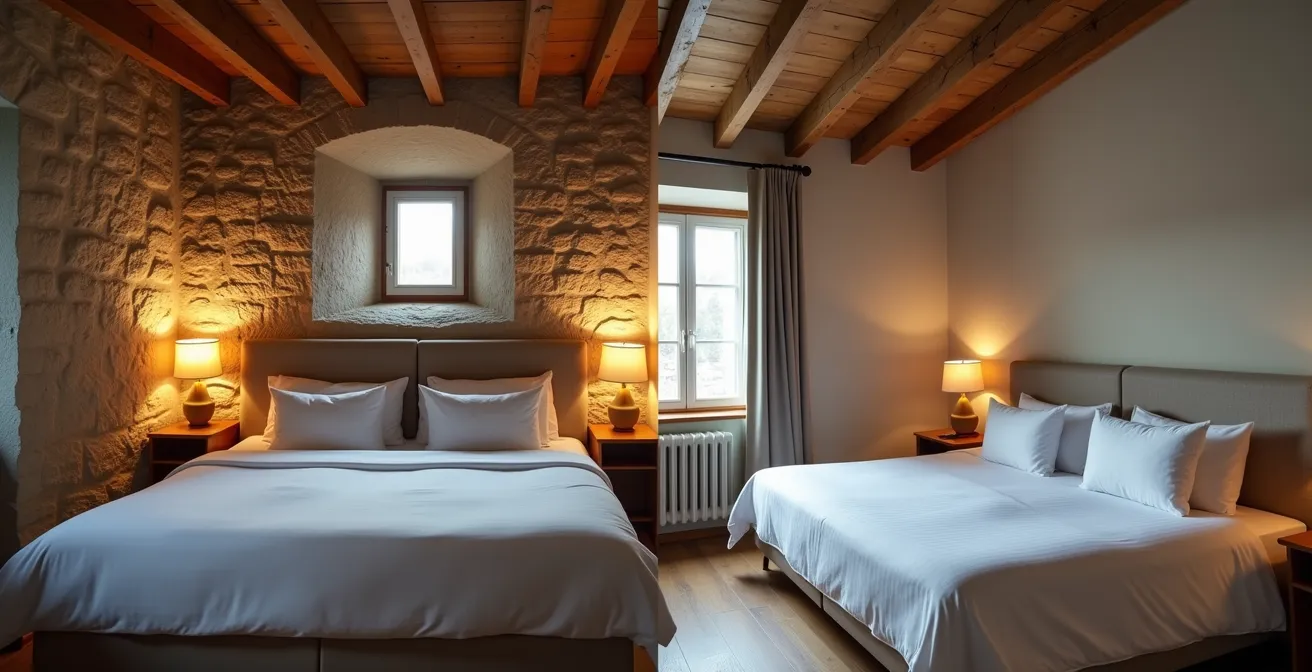
As the visual contrast suggests, the materials that give a heritage building its character are often poor sound insulators. Single-pane glass windows, while beautiful, do little to block street noise. Hardwood floors, though authentic, can transmit every footstep from the room above. Thick stone walls are excellent at blocking outside noise but can be flanked by poorly sealed doors and windows. In contrast, a modern hotel is an exercise in environmental control. It uses double-glazed windows, heavy-duty insulation, carpeted floors, and solid-core doors to create a predictable, if sterile, acoustic cocoon.
The choice is not about which is “better,” but what kind of experience you seek. Are you willing to trade a bit of ambient noise—the distant church bells, the murmur of the street below—for the embodied experience of living within a piece of history? Or is a guaranteed, disruption-free sleep essential for you to enjoy your travels? Recognizing this inherent compromise allows you to set realistic expectations and choose accommodation based on what truly matters to you.
This trade-off can be broken down into specific factors, as detailed in a comparative analysis of building materials and their acoustic properties.
| Feature | Traditional Building | Modern Hotel |
|---|---|---|
| Sound Insulation | Single-pane windows, hardwood floors | Double-glazed windows, carpeted floors |
| Ambient Noise | Natural sounds, street life | Controlled environment, white noise |
| Sleep Quality Factors | Authentic experience, variable conditions | Consistent temperature, minimal disruption |
| Mitigation Options | Earplugs, room selection, acceptance | Built-in solutions, room controls |
The Staircase Surprise That Ruins the Trip for Seniors
For many travelers, especially seniors or those with mobility concerns, the most significant architectural feature isn’t the grand façade or the ornate ceiling—it’s the staircase. In historic properties, stairs are often more than just a way to get from one floor to another; they are character-defining elements that can be narrow, winding, steep, or uneven. What a property listing might romantically call a “charming spiral staircase” can be a major, trip-altering obstacle if you’re not prepared for it.
The “staircase surprise” happens when the reality of navigating a historic building clashes with a traveler’s physical needs. These properties were built long before modern accessibility standards. You might encounter steep, ladder-like stairs in a Dutch canal house, worn and irregular stone steps in a Tuscan villa, or a complete lack of handrails. Even seemingly minor features like raised thresholds between rooms or uneven cobblestones in a courtyard can pose challenges. These are not flaws in the building; they are integral parts of its historic fabric. However, failing to anticipate them can lead to discomfort, anxiety, or even the inability to access your room safely.
The responsibility, therefore, falls to the traveler to become a proactive investigator before booking. Photos can be deceiving, and descriptions often gloss over accessibility details. Learning to virtually assess a property for potential mobility issues is an essential skill for ensuring a comfortable and enjoyable stay. It requires looking beyond the beautiful pictures to analyze the practicalities of movement within the space, asking direct questions, and using digital tools to get a clearer picture of the building’s layout.
Your Action Plan: Virtual Property Assessment for Mobility
- Use Google Street View to check for steep approaches and external steps leading to the building’s entrance.
- Analyze all listing photos specifically for stair types: look for spiral staircases, uneven stone steps, and narrow passages.
- Scrutinize interior photos for raised thresholds between rooms, a common feature in older homes.
- Be wary of descriptions that mention “character features,” as this can often be a euphemism for uneven floors or low doorways.
- Don’t hesitate to request specific photos of all staircases and transitions from the hosts before booking.
- Inquire directly about the availability of ground-floor rooms and the accessibility of bathrooms.
Why the Internal Courtyard Is the Social Hub of Traditional Homes?
Across diverse cultures and climates, from the Roman atrium to the Spanish patio and the Middle Eastern sahn, one architectural feature consistently emerges as the heart of the home: the internal courtyard. Far from being just an open space, the courtyard is a sophisticated design element that functions as a private, multi-purpose social hub. It is a socio-petal space—a term architects use to describe environments that naturally pull people together and encourage interaction.
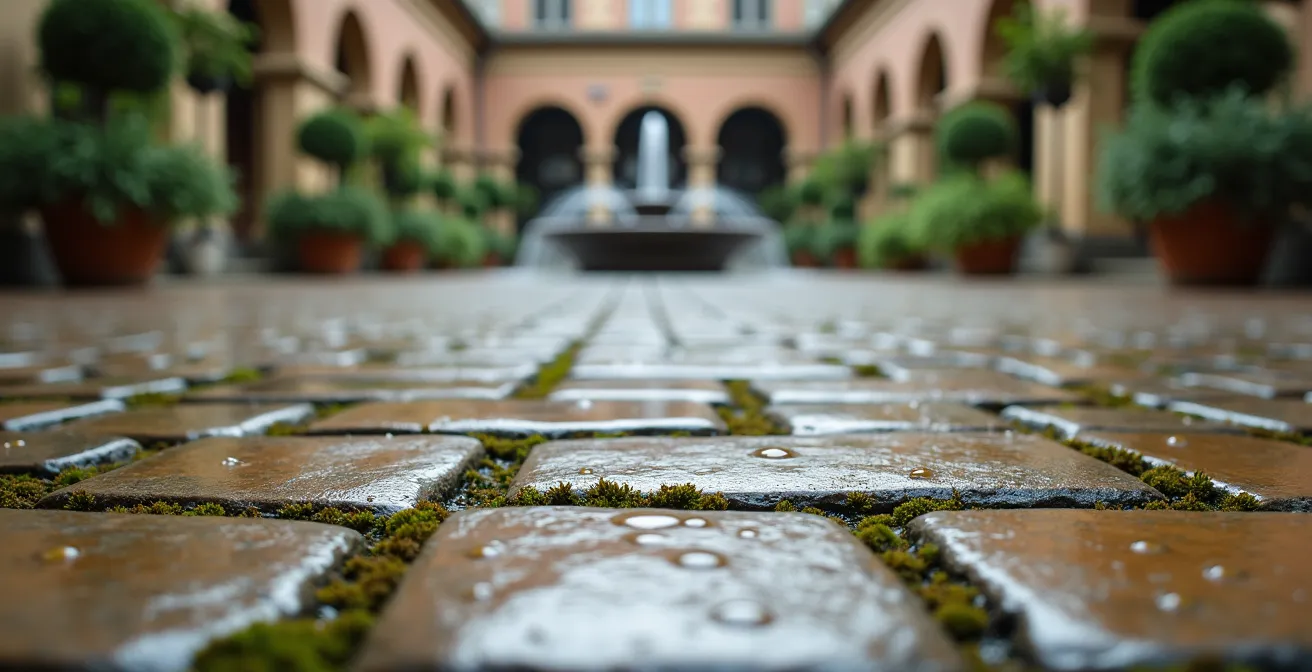
The genius of the courtyard lies in its inward-facing design. In dense urban environments, it offers a secure, private slice of the outdoors, shielded from the noise and chaos of the street. All the important rooms of the house—living areas, kitchens, and sometimes bedrooms—open onto this central space. This layout creates constant, informal opportunities for social connection. Family members cross the courtyard to move between rooms, creating a natural flow of activity that fosters a sense of community. It becomes the default location for dining, conversing, and children’s play, all within a safe and semi-private environment.
The design also provides a comfortable microclimate, as discussed earlier, making it a pleasant place to gather for much of the year. It is both a passageway and a destination, the primary source of light and air for the surrounding rooms, and the symbolic center of domestic life. When you stay in a building with a traditional courtyard, you are not just occupying a room; you are participating in a social structure that has been proven effective for millennia.
Case Study: Social and Acoustic Design of Courtyards
The social power of enclosed spaces is evident even in modern conversions. An analysis of repurposed industrial buildings shows how former schoolyards and factory yards, when enclosed by surrounding structures, naturally become vibrant social hubs. The architecture contains sound, creating a more intimate atmosphere that encourages gathering and community formation, demonstrating the timeless effectiveness of the courtyard model.
Why Visiting Rome Without Reading History Is a Waste of Time?
Walking through a city like Rome can be a tale of two experiences. For the unprepared visitor, it is a procession of old stones and crowded monuments—impressive, but ultimately silent. For the visitor who has done their reading, the same stones speak. A seemingly random brick wall reveals its Roman origins, a window arch whispers of the Renaissance, and a low doorway hints at its medieval past. To visit a historic city without a basic understanding of its timeline is to see a library full of books but be unable to read. The real value is not just in seeing the history, but in comprehending it.
The most fascinating buildings are often an architectural palimpsest—a manuscript that has been written on, erased, and written on again, with traces of earlier layers still visible. A single church in Rome can contain a Roman foundation, a medieval nave, a Renaissance façade, and a Baroque chapel. Each layer tells a story of the city’s changing fortunes, beliefs, and aesthetic values. Learning to identify these layers transforms a simple walk into a detective story. You begin to see the city not as a static museum, but as a living organism that has grown and changed over millennia.
This “reading” of architecture doesn’t require a degree in history. It begins with paying attention to key details. Construction materials, window shapes, doorway heights, and even the texture of plaster can all be clues to a building’s age and story. By learning a few basic principles, you can start to decode the architectural timeline embedded in the walls around you, turning every corner into a discovery and every building into a history lesson.
You can start reading a building’s timeline by looking for specific clues. For instance, the thickness and continuity of plaster patina can help determine the relative age of different sections of a wall. The process involves looking for:
- Foundations: Start in the basement if possible. Look for massive, rough-hewn Roman stonework or elegant medieval vaulting.
- Windows: Notice the shapes. Pointed Gothic arches give way to the symmetrical, rounded arches of the Renaissance.
- Doorways: Lower entryways often indicate earlier, medieval origins when average heights were shorter.
- Materials: Observe the brickwork patterns and stone-cutting techniques, which changed significantly from one era to another.
Why Did 1920s Paris Create Such a Specific Artistic Explosion?
The Paris of the 1920s holds a mythical place in our cultural imagination—a time and place of unparalleled artistic ferment. But this explosion of creativity was not a historical accident; it was deeply rooted in the city’s architectural and urban fabric. The unique combination of high-density living, walkable neighborhoods, and a concentration of cultural spaces created a fertile ground for the exchange of ideas. The city itself became a catalyst for innovation, a principle that still holds true today.
The key ingredient was proximity. Artists, writers, and thinkers from around the world were drawn to neighborhoods like Montparnasse, where they lived and worked in close quarters. The affordability of small apartments and studios, combined with the abundance of cafés, galleries, and salons, created a dynamic ecosystem. A painter could debate aesthetics with a poet in a café, a writer could get feedback from a composer over dinner, and ideas could cross-pollinate at an astonishing rate. The physical layout of the city—with its dense, mixed-use streets—facilitated these spontaneous and essential interactions.
This concept, that architectural density can foster creative communities, is not limited to 1920s Paris. It is a recurring pattern in urban history. When a city provides spaces for both private creation and public interaction in a concentrated area, it creates a powerful engine for culture. Choosing to stay in such a district allows a traveler to tap into this energy, to feel the pulse of a neighborhood where the streets themselves seem to buzz with ideas.
Case Study: Architectural Density and Creative Communities
Paris remains a prime example of this phenomenon. A study on architectural wanderlust and its connection to creativity notes that the city’s unique blend of historical landmarks and bold modern marvels, like the Centre Pompidou, continues to foster a high concentration of cultural spaces. This density sustains the very same kind of creative exchange that fueled the artistic explosion of the 1920s.
Key Takeaways
- True architectural authenticity is about function and history, not just aesthetics. A building’s design reveals how a culture adapted to its climate and social needs.
- Learn to be an architectural detective: distinguish genuine, time-worn patina from artificial finishes and identify the different historical layers of a building (its “palimpsest”).
- Every architectural choice involves a trade-off. Acknowledge the compromise between historic charm (with potential noise or accessibility issues) and modern, sterile comfort.
What Is Contemporary Urban Tourism and Why Should You Try It?
Having explored how to read the history, climate, and social function in a building’s design, we can now apply this knowledge to a more modern and deeply immersive form of travel: contemporary urban tourism. This approach moves beyond the traditional tourist checklist and embraces the idea of the “neighborhood as a resort.” It’s about choosing accommodation that is not an isolated bubble, but an integrated part of a living, breathing urban fabric.
The core philosophy is to use your accommodation as a home base for experiencing the daily life of a residential area rather than a tourist district. This often means choosing a stay in a converted industrial building that tells a story of urban transformation, a stylish apartment in a post-war block, or a room in a townhouse in a non-central but vibrant neighborhood. The goal is to engage with the local rhythm—visiting the corner bakery in the morning, having a coffee at the neighborhood café, and using the local park. This style of travel prioritizes walking and cycling, allowing you to understand the city’s texture and flow on a human scale.
This approach is the ultimate expression of the principles discussed throughout this guide. It is the conscious choice to embed oneself in an authentic context, to learn from the architecture and the community it houses. It’s a shift from being a passive observer of a city’s highlights to an active participant in its daily life. By choosing your stay with this mindset, you are not just finding a place to sleep; you are curating a richer, more meaningful, and more personal travel experience.
Begin to apply this perspective on your next trip by actively seeking out accommodation in neighborhoods that tell a story, and you will transform not only where you stay, but how you travel.
Frequently Asked Questions About How to Choose Accommodation That Reflects the Local Architectural Style?
How do I ask about stairs without offending the host?
Try framing your question with appreciation for the property’s character. For example: “We’re very excited about the historic character of your property. To help us enjoy it fully, could you please describe the access from the entrance to the bedroom?”
What specific details should I request?
For clarity, it’s best to ask for specifics. Inquire about the number of steps, the availability of handrails, the consistency of step height, the width of doorways, and whether the bathroom is on the same level as the bedroom.
Are there alternatives to avoiding stairs entirely?
Absolutely. Many travelers with mobility concerns actively seek out ground-floor accommodations, historic properties that have been retrofitted with an elevator, or modern conversions of old buildings that were required to include accessibility updates during renovation.