True ethical travel isn’t about guilt-tripping or skipping beloved destinations; it’s about systematically re-engineering your travel habits for a more positive impact.
- Most tourist money never reaches the local community due to “economic leakage,” making where you spend as important as what you see.
- Switching from a “bucket list” of sights to a “thematic list” of experiences is the key to discovering unique, crowd-free alternatives.
Recommendation: Instead of focusing on avoiding places, focus on deconstructing your travel desires to find smarter, more sustainable ways to fulfill them in second cities or during the authentic off-season.
You’ve seen the images: a river of people shuffling through a historic European street, a single landmark obscured by a forest of selfie sticks, a once-pristine beach littered with bodies. This is overtourism, and for the conscious traveler, it presents a difficult paradox. You want to experience the world’s beauty and history, but you don’t want to be part of the problem that erodes local culture, strains infrastructure, and turns authentic places into theme parks.
The standard advice often feels like a set of vague platitudes. “Travel in the off-season,” they say. “Support local businesses.” While well-intentioned, this advice rarely addresses the systemic issues or provides a practical framework for making better choices. It leaves you feeling guilty without offering a clear path forward. What if the solution isn’t just about making a few minor adjustments, but about fundamentally changing your approach to travel planning?
This guide moves beyond the basics. We’re not just going to tell you *what* to do; we’re going to explain the *why* behind the strategies that genuinely make a difference. It’s about deconstructing the “tourist” mindset—one focused on consumption and box-ticking—and adopting a “traveler” mindset rooted in connection, curiosity, and positive impact. By understanding the systems at play, from housing markets to economic flows, you can make smarter, more sustainable choices without sacrificing the magic of discovery.
This article provides a pragmatic roadmap to transform your next trip. We will explore how to choose your accommodation ethically, find incredible “dupe” destinations, re-evaluate timing, and shift your entire travel philosophy. Get ready to leave the crowds—and the guilt—behind.
Summary: A Pragmatic Guide to Avoiding Overtourism
- Why Your Airbnb Rental Might Be Pushing Locals Out of the City?
- How to Find “Dupe” Destinations That Are Just as Beautiful but Empty?
- Shoulder Season or Winter: Which Is the Real Cure for Overtourism?
- The “Bucket List” Mindset That Concentrates Crowds in One Spot
- How to Schedule Your Day to Be Where the Tour Buses Aren’t?
- Why Your City Tour Ticket Money Doesn’t Reach the Locals?
- Why Visiting the Second Largest City Is Often Better Than the Capital?
- How to Transition From a Tourist to a Traveler on Your Next Trip?
Why Your Airbnb Rental Might Be Pushing Locals Out of the City?
The choice of where you sleep has a direct impact on the fabric of a city. While short-term rental platforms offer convenience and a “live like a local” promise, they can inadvertently contribute to serious urban problems. When entire apartments are converted into full-time tourist accommodations, they are removed from the long-term rental market. This scarcity drives up rent prices, making it increasingly difficult for local residents—students, artists, service workers, and families—to afford living in their own city. This phenomenon, often called digital gentrification, can hollow out vibrant neighborhoods, replacing community hubs with transient populations.
The key is to distinguish between participating in a true sharing economy and fueling a commercial one. Renting a spare room in someone’s primary residence is the original, more sustainable model. The host earns supplemental income, and no housing unit is lost. Conversely, renting from a host who manages dozens of properties is essentially booking with a commercial hotel that operates without the same regulations, taxes, or contributions to the local community. These “ghost hotels” are often the primary drivers of the negative impacts associated with short-term rentals.
Being an ethical renter requires a bit more diligence, but it allows you to support residents directly. Look for listings with personal descriptions and reviews that mention host interaction. Platforms are also emerging that prioritize this ethical distinction. For example, some cooperatives like Fairbnb.coop reinvest a portion of their commission into local social projects, ensuring your stay contributes positively to the neighborhood you’re visiting.
Ultimately, a conscious traveler asks: “Is my stay displacing a resident, or am I supporting one?” The answer to that question is the first step in ensuring your visit is a welcome addition to the city, not a burden.
How to Find “Dupe” Destinations That Are Just as Beautiful but Empty?
The magnetic pull of iconic destinations is strong, but often the reality is a disappointing battle with crowds. The solution isn’t to give up on experiencing culture and beauty, but to get smarter about where you find it. The concept of “Destination Dupes”—or alternative locations that offer a similar vibe without the overtourism—is a powerful strategy. This involves a technique called thematic pairing: breaking down what you desire from a famous spot and finding those qualities elsewhere.
Do you dream of Santorini for its white-washed villages and stunning sea views? Instead of joining the queue for a sunset photo, consider lesser-known Cycladic islands like Amorgos or Folegandros, which offer the same architectural charm and breathtaking vistas with a fraction of the visitors. This approach was successfully used by travel companies in Greece. As a case study on visitor dispersal shows, while Santorini and Mykonos were often rated as travelers’ least favorite stops due to overcrowding, promoting similar but less famous islands led to higher visitor satisfaction and spread the economic benefits of tourism more evenly.
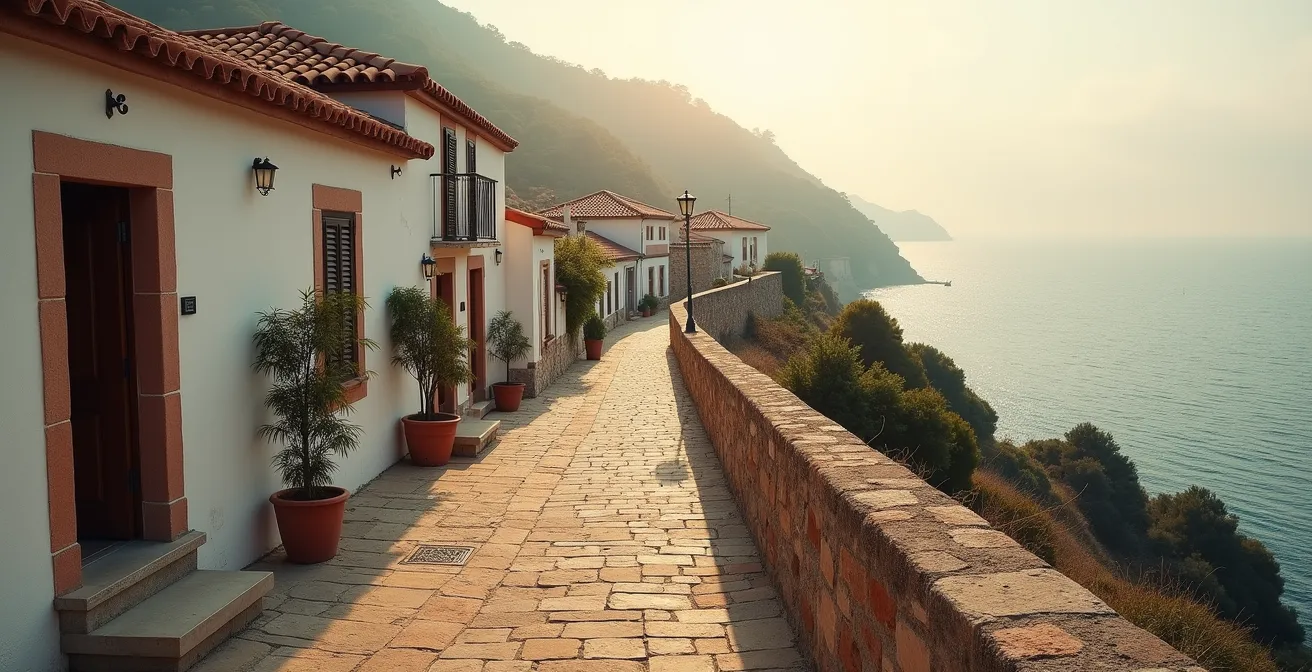
As the image above illustrates, the magic of a place is often found in its quiet moments, something impossible to achieve in an over-saturated location. The goal is to shift your search from a specific place-name to a specific experience. Instead of searching for “holidays in Tuscany,” try searching for “agriturismo with rolling hills in Umbria” or “medieval wine towns in Le Marche.” This method not only helps you avoid crowds but often leads to more authentic and affordable experiences, where your presence is a welcome boost to the local economy rather than another strain on overburdened infrastructure.
By becoming a travel detective and looking for the “dupe,” you transform your trip from a predictable tourist trek into a unique adventure of discovery.
Shoulder Season or Winter: Which Is the Real Cure for Overtourism?
Traveling outside the summer peak is one of the most cited solutions to overtourism, but not all “off-seasons” are created equal. There’s a crucial difference between the shoulder season (spring and autumn) and the true off-season (winter). While both help distribute visitor load, they offer vastly different experiences and have distinct impacts on a destination’s economy and culture.
Shoulder season is often seen as the perfect compromise: the weather is pleasant, most attractions are open, and the crowds are thinner than in July or August. However, due to climate change and increasing demand, these periods are becoming the “new peak” in many popular European destinations. While this helps create more year-round employment, you may find that you’re still sharing the city with plenty of other visitors. It’s a less crowded version of the tourist-oriented town.
Winter travel, on the other hand, is where you find true authenticity. This is when cities revert to their local rhythm. You’ll witness neighborhood festivals, daily routines, and a pace of life not dictated by tourist schedules. While the weather can be a challenge and some tourist-specific services may be closed, the trade-off is a deeply immersive cultural experience. This aligns with a growing trend where tourism authorities are increasingly promoting ‘slow tourism,’ encouraging travelers to connect more deeply with fewer places. The following table breaks down the key differences:
| Aspect | Shoulder Season | Winter/Off-Season |
|---|---|---|
| Economic Impact | Smooths annual revenue, provides year-round employment | May not generate enough income to keep businesses open |
| Weather Quality | Often becoming the new ‘perfect’ season due to climate change | Can be challenging but authentic |
| Cultural Experience | Less crowded version of tourist-oriented town | Authentic local life, neighborhood festivals, daily routines |
| Infrastructure Availability | Most services remain open | Some tourist services may close |
If your goal is simply a less crowded version of a summer holiday, the shoulder season is ideal. But if you’re seeking to truly escape the tourist bubble and experience a place as it is, not as it performs for visitors, embracing a winter trip is the most powerful choice you can make.
The “Bucket List” Mindset That Concentrates Crowds in One Spot
At the heart of overtourism lies a simple but powerful psychological driver: the “bucket list.” This mindset reduces travel to a checklist of famous sights to be “done” and photographed, concentrating millions of people into the exact same square kilometers. It prioritizes the “what” (the Eiffel Tower, the Colosseum) over the “why” (experiencing Parisian romance, understanding Roman history). This consumerist approach is fueled by social media, where the pressure to capture the same iconic shot creates a feedback loop of overcrowding.
As travel writer Taylor Mallaber notes, this phenomenon is predictable and destructive. In a comment for No Trace Travel, he states:
Once a place is listed on a ‘top Instagrammable locations’ list, it will fall victim to overtourism. Kelingking Beach in Nusa Penida sees thousands daily for the same photo, while nearby Guaynagan waterfall is far better with no crowds.
– Taylor Mallaber, No Trace Travel
To break this cycle, you must deconstruct your bucket list. This means identifying the core desire behind each item and finding alternative, more meaningful ways to fulfill it. It’s about shifting from an agenda of interest-points to one of experiences. This “Anti-Bucket List” approach is not about deprivation; it’s about upgrading your travel experience from passive observation to active engagement.
Action Plan: The Anti-Bucket List Challenge
- Define your trip’s intention first (e.g., learning a skill, deep relaxation, cultural immersion), not the sights.
- For each landmark on your list, brainstorm three alternative experiences that fulfill the same underlying desire.
- Example: Instead of just seeing the Colosseum, take a walking tour of the Roman Forum with an archaeologist to truly understand daily life.
- Explore the ruins of Ostia Antica, Rome’s ancient port, for an equally impressive historical experience without the crowds.
- Take a mosaic-making class from a local artisan to connect with Roman artistry on a tactile level.
When you stop chasing the same photos as everyone else, you start creating unique memories that are yours alone.
How to Schedule Your Day to Be Where the Tour Buses Aren’t?
Even in the most popular destinations, it’s possible to find moments of peace and authenticity. The key is strategic scheduling, or “crowd-hacking.” This goes beyond the simple advice to “wake up early.” It requires understanding the daily flow of mass tourism and intentionally positioning yourself outside of it. Tour buses, cruise ship excursions, and large school groups operate on predictable, rigid schedules, creating human traffic jams at specific places and times.
Your goal is to adopt a counter-cyclical rhythm. While the masses flock to the main attraction between 10 a.m. and 4 p.m., you can be exploring a residential neighborhood, enjoying a long lunch at a local-frequented trattoria, or visiting a smaller, secondary museum. As one travel industry expert points out, local knowledge is key: “‘We’re not going to San Marco at 10 am when all the madness is there,’ says Grisdale.” This insider approach involves knowing not just what to see, but when to see it.
Start by researching the opening hours of major attractions and identifying when they are likely to be busiest. Often, the late afternoon, just before closing, is quieter than the early morning rush. Consider a reverse itinerary: start your day in a peripheral neighborhood and work your way to the center in the evening, when day-trippers have departed. Use the main meal times to your advantage. While most tourists eat between 12 p.m. and 2 p.m., this can be a golden window to visit a popular square or monument. A late lunch at 3 p.m. will not only be more relaxed but will also align you with local customs in countries like Spain or Italy.
This isn’t just about avoiding frustration; it’s about reclaiming the serendipity and quiet observation that make travel so rewarding.
Why Your City Tour Ticket Money Doesn’t Reach the Locals?
One of the most common justifications for travel is that it “supports the local economy.” While this can be true, it’s often a comforting myth. The reality is that in many mainstream tourism models, a huge portion of the money you spend never actually benefits the local community. This phenomenon is known as economic leakage. It occurs when tourist revenue is “leaked” out of the host country to pay for imported goods or repatriated to foreign-owned companies that operate hotels, tour agencies, and airlines.
The numbers are staggering. In-depth research on tourism economic leakage shows that in some developing destinations, as little as $5 out of every $100 spent by a tourist remains in the local economy. While the figures for developed European nations are less extreme, the principle remains the same. When you book a tour with a large, multinational corporation, a significant slice of your ticket price goes to overseas headquarters, marketing budgets, and international shareholders, rather than to the local guide or the community whose culture you are there to experience.
To combat this, you must be intentional about where your money flows. Seek out small, locally-owned and operated businesses. This could mean hiring an independent guide, taking a cooking class run by a local family, or eating at restaurants that source their ingredients from nearby farms. For example, some forward-thinking tour operators now partner with organizations like Planeterra to integrate social impact into their itineraries. A tour in Jordan might include a meal at Beit Khayrat Souf, a café founded and run by local women to combat unemployment and foster female leadership. This ensures your spending directly empowers the community.
Choosing a locally-owned tour over a corporate one is one of the most direct and powerful ways to turn your tourism into a force for good, ensuring your visit is a genuine exchange, not just an extraction of value.
Why Visiting the Second Largest City Is Often Better Than the Capital?
A simple yet incredibly effective strategy for avoiding overtourism is to bypass the capital and head for the nation’s “second city.” These cities—like Marseille in France, Porto in Portugal, or Manchester in the UK—often provide a more authentic, manageable, and rewarding travel experience. While capital cities are burdened with the weight of being the “official” face of a nation, second cities are frequently the hubs of innovation, subculture, and a more dynamic local identity.
From a practical standpoint, second cities operate well below their tourism carrying capacity. This means you get a better value-to-experience ratio across the board. Accommodation is typically more affordable, you’ll spend less time in queues for attractions, and securing a table at a top-rated restaurant doesn’t require booking weeks in advance. More importantly, the atmosphere is different. As one tourism expert notes, “During slower times, there is less rush, and locals have more availability to connect, fostering immersive experiences.” The interactions feel more genuine because the city isn’t overwhelmed by or jaded from mass tourism.
This isn’t to say these cities lack world-class attractions. They simply exist in a more balanced ecosystem where tourism is a part of the city’s life, not its sole reason for being. The table below highlights the fundamental differences in the visitor experience.
| Factor | Capital Cities | Second Cities |
|---|---|---|
| Tourism Capacity | Far beyond social and infrastructural limits | Below tourism carrying capacity with robust infrastructure |
| Cultural Identity | Official narrative, tourist-oriented | Dynamic, innovative, authentic local identity |
| Value-to-Experience Ratio | High prices, long queues, crowded attractions | Better accommodation, affordable dining, less time in queues |
| Examples | Paris, London, Lisbon | Marseille, Manchester, Porto |
By making this choice, you not only enjoy a less stressful trip but also contribute to a more sustainable distribution of tourism, supporting a city that has the infrastructure and desire to welcome you.
Key Takeaways
- The “bucket list” mindset is the root cause of overcrowding; deconstructing it into experiences is the solution.
- A significant portion of tourist spending “leaks” out of local economies; choosing locally-owned businesses is crucial for real impact.
- Second cities and the true off-season (winter) offer the most authentic and sustainable alternatives to overcrowded capitals in peak season.
How to Transition From a Tourist to a Traveler on Your Next Trip?
The transition from a tourist to a traveler isn’t about where you go, but *how* you are in a place. It’s a fundamental shift in mindset from passive consumption to active engagement. A tourist collects sights; a traveler collects experiences and connections. This final step synthesizes all the previous strategies—ethical accommodation, thoughtful scheduling, and conscious spending—into a holistic philosophy. It’s about cultivating curiosity, embracing discomfort, and prioritizing human interaction over a pre-planned itinerary.
This means developing a new set of micro-skills. Instead of defaulting to a ride-sharing app, try mastering the local public transport system. Instead of sticking to English-menu restaurants, try ordering food using gestures and a few basic words in the local language. Spend an afternoon simply observing life in a park or café without a phone. These small acts build confidence and open the door to unscripted moments of connection that are impossible to plan. One of the most impactful modern practices is “soft sharing”—when you post about your trip online, be vague about specific, fragile locations to avoid turning a hidden gem into the next overcrowded hotspot.
Ultimately, a traveler understands that their presence has an impact and takes responsibility for making it a positive one. This involves a commitment to supporting businesses that prioritize social and environmental well-being, respecting local customs, and choosing low-impact transportation whenever possible. It’s about seeing your trip not as an escape from your life, but as an opportunity to learn and contribute to the life of another place. It’s a move away from extractive tourism and towards a more regenerative and respectful form of travel.
Your next trip is an opportunity. Instead of just planning what you want to see, start by defining the kind of traveler you want to be. That single decision will change everything.