In summary:
- The most authentic cultural events are often located just outside major tourist hubs, accessible via commuter transport.
- Mastering travel logistics, especially planning your return trip first, is the key to unlocking these experiences confidently and safely.
- Simple tools like learning 10 specific phrases and observing local patterns (like street food vendor hours) are powerful navigation aids.
- Choosing the right transport—from public buses to shared shuttles—is a strategic decision that balances cost, flexibility, and cultural immersion.
You’ve seen the pictures online: a vibrant local festival, a bustling night market, or a unique community celebration, happening just outside the city you plan to visit. The energy is palpable, the experience promises to be unforgettable. There’s just one problem—it’s miles from any tourist center, and the thought of navigating unfamiliar transport to get there and, more importantly, get back, feels daunting. The usual advice to “get off the beaten path” and “talk to locals” seems to fall short when faced with the practical challenge of a late-night bus schedule in a language you don’t speak.
This guide is built on a simple but powerful premise: the secret to accessing authentic cultural experiences isn’t just about finding them, it’s about mastering the logistics that connect you to them. It’s about shifting your mindset from being a passive passenger to an active navigator. The true adventure lies not just in the destination, but in the journey itself—a journey that, when planned correctly, becomes a rich cultural lesson in its own right. We believe in a strategy of Return-First Planning, where securing your way home is the first and most crucial step.
This article provides a practical framework for exactly that. We’ll move beyond generic tips and delve into the concrete strategies that turn transport from an obstacle into your greatest tool for cultural immersion. From decoding commuter train maps to understanding the hidden language of street food vendors, you’ll learn to navigate the world like a local coordinator, opening up a world of experiences that most travelers miss.
Summary: A Practical Guide to Reaching Authentic Local Events
- Why the Best Local Festivals Are Often One Train Stop Away?
- How to Ensure You Can Get a Ride Back From a Remote Event?
- Shared Shuttle or Private Car: Which Is Best for Festival Access?
- The Translation Mistake That Puts You on the Wrong Bus
- Why You Should Plan Your Return Trip Before You Even Leave?
- Why Does Local Street Food Tell You More Than a Museum?
- How to Master 10 Essential Phrases in Any Language in 1 Hour?
- How to Engage With Local Cultures Without Being a Disrespectful Outsider?
Why the Best Local Festivals Are Often One Train Stop Away?
The allure of cultural travel is undeniable; in fact, over 40% of international tourists engage in cultural tourism, seeking experiences that go beyond the typical sightseeing itinerary. The irony is that the most authentic of these events—the ones truly for the community, by the community—rarely happen in the shadow of major monuments. They thrive in the suburbs and surrounding towns where space is affordable, traditions are deeply rooted, and the celebration is part of the local fabric, not a performance for visitors.
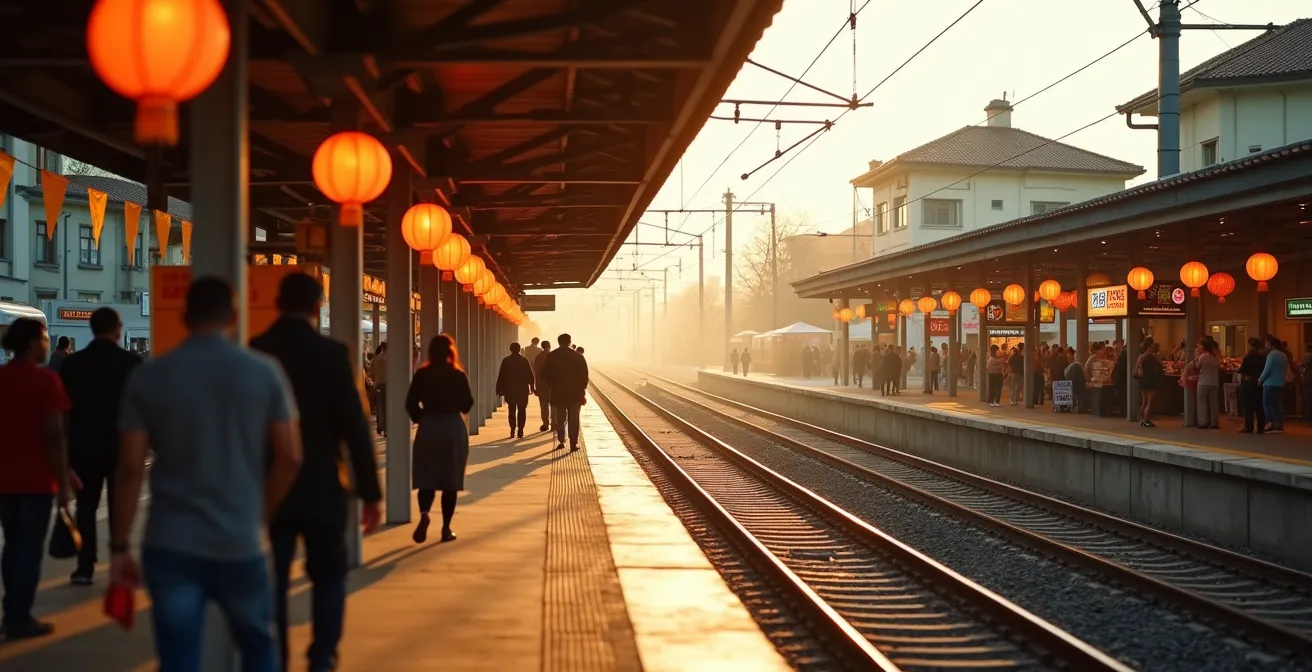
This is where commuter transport becomes your secret weapon. These networks are the arteries of local life, connecting residential areas to city centers. By learning to read them, you gain access to a hidden map of cultural hotspots. Instead of seeing a train line as just a way to get from A to B, see it as a string of potential discoveries. Each stop is a potential gateway to a neighborhood festival, a weekly market, or a community event that isn’t listed in any glossy travel guide. The key is to shift your perspective from a tourist’s to a commuter’s.
This “Commuter Line Reconnaissance” is a proactive method for unearthing local gems. It’s about using public infrastructure to find private culture. Here’s a simple method to get started:
- Base yourself in a small town near a major city rather than in the tourist center. This immerses you in a local pace of life from the start.
- Study the public transport map for junction points where regional trains meet local buses. These are hubs of local activity.
- Look for stations near community squares, local sports fields, or places that host traditional market days. These are often the epicenters of local festivals.
- Take exploratory day trips to surrounding towns using only local transport, getting a feel for the rhythm and flow.
- Ask locals at coffee shops or small stores for recommendations on festivals and events in their own or nearby communities. They are your best resource.
How to Ensure You Can Get a Ride Back From a Remote Event?
The euphoria of an amazing festival can quickly turn to anxiety when you realize it’s 11 PM, the last official bus left an hour ago, and you’re miles from your accommodation. This is the “last mile problem” of cultural travel, and failing to solve it beforehand can ruin an otherwise perfect experience. The importance of a solid return plan cannot be overstated. When logistics fail, the entire event can be jeopardized, as seen in a cautionary tale from the US.
Case Study: The Minnesota Renaissance Festival Transport Crisis
The consequences of poor transport planning were highlighted when, in 2022, the Minnesota Renaissance Festival’s traffic jams became so severe that county officials threatened to shut it down. The organizers were forced to completely overhaul their parking and transport plans, demonstrating that a successful event hinges on getting people home safely and efficiently. This case, detailed in analyses of transport plans for neighborhood festivals, underscores the critical need for pre-planning your return from any remote event.
So, how do you avoid being stranded? The solution often lies in the informal networks that spring up around events. As the official transport winds down, a secondary system of local taxis, ad-hoc shared rides, and knowledgeable vendors often emerges. The key is knowing how to find and tap into this network. These impromptu hubs are where you’ll get the most reliable, real-time information.
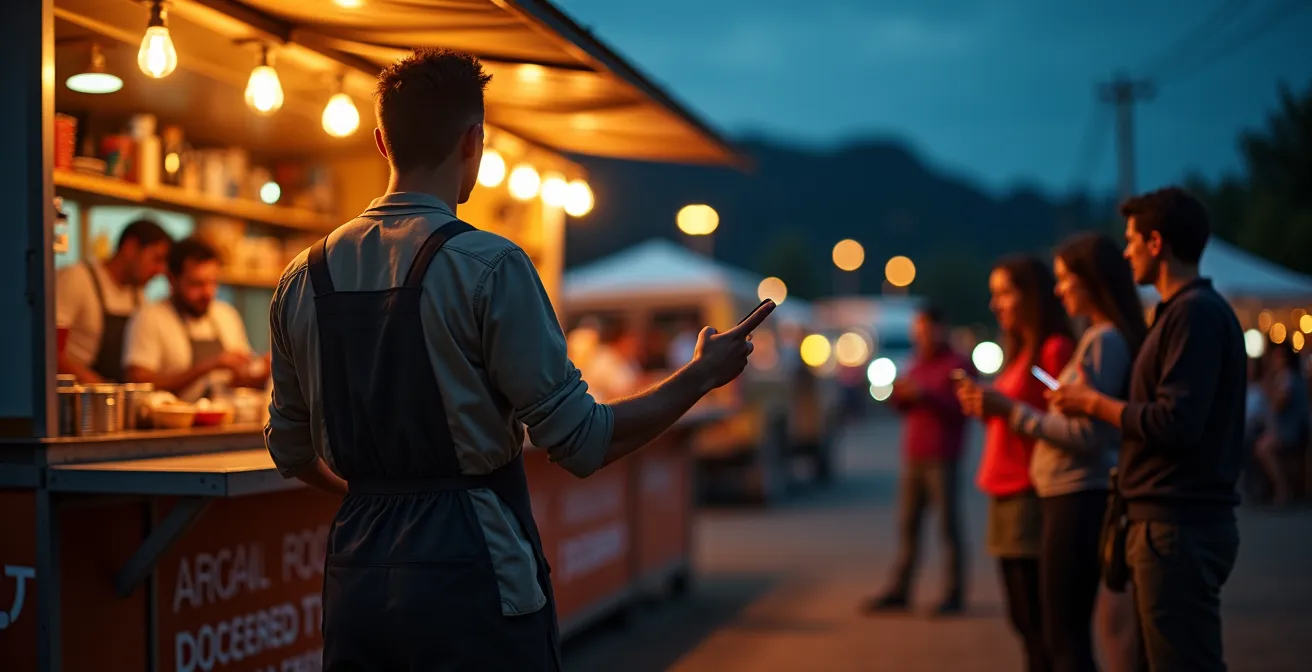
As the image above suggests, the end of the night at a local festival is a dynamic scene. Food vendors, often packing up themselves, become invaluable sources of information, pointing travelers towards informal transport gathering points. Observing where other locals are heading and confidently asking for guidance is a crucial skill. This moment is not a failure of planning but a different kind of connection—a human solution to a logistical puzzle. The goal is to anticipate this phase and approach it with curiosity, not panic.
Shared Shuttle or Private Car: Which Is Best for Festival Access?
Once you’ve found an event and confirmed its feasibility, the next question is tactical: what’s the best way to get there? Your choice of transport is more than just a logistical detail; it shapes your entire experience. It’s a trade-off between flexibility, cost, and the level of cultural immersion you’re seeking. The three primary options—private car, shared shuttle, and public transport—each offer a distinct set of advantages and disadvantages.
A private car or taxi offers maximum flexibility. You leave when you want, return when you want, and travel on your own terms. This is ideal for travelers with tight schedules, families with young children, or anyone for whom convenience is the top priority. However, it’s also the most expensive option and offers virtually zero cultural immersion. You’re in a bubble, separated from the local flow.
A shared shuttle, often organized by the festival itself or by local entrepreneurs, strikes a middle ground. It’s more structured than public transport but more social and affordable than a private car. It can be a great way to meet fellow festival-goers and build excitement on the way there. Your flexibility is limited to the shuttle’s schedule, but it’s a reliable and often fun option.
Finally, public transport is the budget-friendly choice that offers the highest potential for cultural immersion. It’s how most locals will be traveling. It requires the most planning and the least flexibility, but it forces you to engage with the local system on its own terms, turning the journey itself into part of the experience. The following table breaks down the decision-making process based on a recent comparative analysis of travel modes.
| Transport Mode | Flexibility | Cost | Cultural Immersion | Best For |
|---|---|---|---|---|
| Private Car/Taxi | Maximum | $50-100 | Zero | Time-sensitive travelers, families with children |
| Shared Shuttle | Medium | $15-30 | Medium | Social travelers, pre-party atmosphere seekers |
| Public Transport | Low | $3-10 | High | Budget travelers, cultural experience seekers |
The Translation Mistake That Puts You on the Wrong Bus
Navigating a foreign transport system can feel like a high-stakes puzzle, and language is often the most challenging piece. A single word, misunderstood or mispronounced, can be the difference between arriving at your festival and ending up in an industrial park on the other side of town. It’s a classic traveler’s pitfall, as one expert notes:
“Centro might mean the historic center to you, but to the bus driver, it’s the new commercial center.”
– Language navigation specialist, French Transportation Vocabulary Guide
This simple example highlights a profound truth: words have local context. Your direct translation of “center,” “station,” or “square” might not align with the local vernacular. This is why relying on a single method of communication is risky. To combat this, you need a system of verification—a way to ensure your message has been received and understood correctly before the bus doors close.
This is where the Triple-Check Method comes in. It’s a simple, robust process for confirming your destination that relies on redundancy and non-verbal cues. It’s not about being fluent; it’s about being clear. By layering verbal, written, and gestural communication, you create a safety net that catches most common misunderstandings. It’s a small ritual that can save you hours of confusion and frustration.
Your Action Plan: The Triple-Check Method for Transport
- Show the destination written in the local script to the driver or ticket agent. Have it ready on your phone or a piece of paper.
- Attempt to say the name of the destination out loud. Your pronunciation might be wrong, but the attempt shows effort and provides another data point.
- Visually confirm with the driver and at least one other passenger using pointing gestures (“This bus? To [Destination]?”). A nod is a universal sign of confirmation.
- Always confirm the final destination’s name, not just the route number. Route numbers can have variations or short-turn versions.
- If given fast verbal directions, repeat back the key points you understood (e.g., “Three stops? Turn left?”) for verification.
Why You Should Plan Your Return Trip Before You Even Leave?
It sounds counter-intuitive, but the most important part of your journey to a remote cultural event is planning how you’ll leave it. This is the core principle of Return-First Planning. Why? Because the availability, frequency, and cost of your return options dictate the entire feasibility and enjoyment of your trip. Knowing you have a guaranteed, safe way back at 1 a.m. allows you to fully immerse yourself in the experience without a nagging voice of anxiety in the back of your head.
Ignoring this can lead to serious issues, especially when language barriers are in play. As research from NYU Wagner shows, limited English proficiency (or proficiency in any local language) can directly cause riders to miss stops, get lost, or board the wrong trains. When you’re tired after a long day at a festival, your cognitive load is high, and your language skills are at their lowest—precisely when you need them most. Planning your return in advance, when you are fresh and thinking clearly, mitigates this risk.
This doesn’t just mean checking the last train time. It means building a “transport tech stack” and a social safety net before you even depart. This involves a multi-layered approach:
- Primary Plan: The ideal return (e.g., the 11:30 PM train). Have the ticket bought, the platform number noted, and an alarm set on your phone.
- Backup Plan: What if you miss the train? Know the location of the designated taxi rank, have a local ride-sharing app downloaded and set up, or know the number for a reputable local car service.
- Social Plan: Leverage modern tools for local knowledge. Before your trip, use services like Meetup.com or local “greeter” programs. These platforms are designed to connect travelers with residents who can provide invaluable insider knowledge about transport options that don’t appear on official websites, helping you navigate unfamiliar areas with confidence.
Building this multi-layered strategy transforms your return from a source of stress into a solved problem, freeing you to enjoy the cultural experience you came for.
Why Does Local Street Food Tell You More Than a Museum?
While museums curate the past, street food reveals the present. The carts and stalls clustered around a transport hub or lining the path to a festival are not just serving food; they are living indicators of the community’s daily rhythm. As one expert puts it, this is where culture is lived, not just displayed.
“The type of food being sold reveals the daily pulse of a neighborhood, including when transport is likely to be most and least available.”
– Cultural Travel Expert, Worldpackers Cultural Travel Guide
This is a profound insight for the savvy traveler. These food vendors are socio-temporal markers—clues that help you decode the local schedule. A vendor selling coffee and pastries at 6 a.m. tells you this is a major commuter rush hour with frequent transport. A noodle stall that stays open until midnight signals that it’s catering to people heading home after the last train has likely departed. By observing what’s being sold, and when, you can build a surprisingly accurate picture of the local transport ecosystem.
Think of it as learning to read the city’s unofficial timetable. The flow of people to and from these vendors is a physical manifestation of the transport schedule. You can use this to your advantage to make informed decisions. Here’s how to start reading the patterns:
- Morning Pastries & Coffee: Indicate a morning commuter rush. Transport will be frequent and crowded from roughly 6-9 a.m.
- Lunch-Hour Specials: Signal a midday peak. This is a good time to travel as services are still running regularly before the afternoon lull.
- Late-Night Noodle & Grill Stalls: These are your best friends. Their presence signals that there is still significant foot traffic late at night, and they are often located near late-night bus stops or taxi ranks.
- Food Trails: The path from a train station to a festival ground is often marked by an unofficial “food trail” of vendors. Following it is a safe bet for finding the main pedestrian route.
- Peak Vendor Activity: The busiest times for vendors directly correlate with the busiest times for public transport. If the vendors are packing up, it’s a strong sign that transport options are about to dwindle.
How to Master 10 Essential Phrases in Any Language in 1 Hour?
The idea of learning a language before a trip can be overwhelming. But the goal isn’t fluency; it’s functional communication for logistical problem-solving. You don’t need to discuss philosophy, you need to know if you’re on the right bus. The 80/20 principle applies perfectly here: a small number of key phrases can solve a vast majority of your potential problems. In fact, language learning research indicates that mastering just 10-15 transport-specific phrases can handle 80% of navigation situations.
The key is to focus your one hour of study not on generic pleasantries, but on a curated list of logistical questions and statements. These are your tools. Your goal is to have them memorized and easily accessible, written down on a card, and saved as a note on your phone. Practice saying them out loud, even if your pronunciation is clumsy. The attempt itself signals your intention and makes locals more willing to help.
Forget “The sky is blue.” Focus on the phrases that will get you from A to B and back again. Here are the 10 essential logistical problem-solving phrases that you should prioritize for any language:
- Does this go to [Destination]?
- When is the last one (bus/train)?
- How much to go here?
- Please write the price.
- I need to go to [station/hotel/airport/center].
- Where do I change/transfer?
- Which platform/stop?
- Is this the right direction?
- How long does it take?
- Can you show me on the map?
Mastering this small arsenal of phrases gives you an incredible amount of agency. It moves you from being a passive, and potentially lost, tourist to an active participant in your own journey. This is the single most effective hour you can spend preparing for your trip.
Key takeaways
- The most authentic cultural experiences are rarely in tourist centers; they are found in the suburbs and surrounding towns where communities live and celebrate.
- Your most critical planning task is securing your return trip. A “Return-First” mindset removes anxiety and allows for full immersion in the event.
- Language and observation are transport tools. Mastering 10 key logistical phrases and learning to read cues like street vendor hours can be more useful than a traditional guidebook.
How to Engage With Local Cultures Without Being a Disrespectful Outsider?
The ultimate goal of seeking these unique cultural experiences is to connect, not just to observe. But this connection comes with a responsibility. Being a respectful outsider goes beyond learning to say “please” and “thank you.” It’s about demonstrating what can be called Logistical Empathy—understanding that your presence has an impact on the local community and its resources, including its transport system.
Every traveler who gets lost and requires help, who misunderstands a fare and holds up a bus, or who contributes to a massive post-festival traffic jam, places a small burden on the local system. While locals are often gracious, a core part of respectful travel is minimizing that burden. This is where all the strategies we’ve discussed converge. By planning your return trip, learning key phrases, and understanding local rhythms, you are not just making your own life easier; you are actively choosing to be a considerate guest.
A festival’s relationship with its host community is a delicate balance. The most successful events are those that design their entire experience, especially movement and transport, to protect community interests while enhancing the attendee’s journey. When you do your homework, you are aligning yourself with this goal. You are showing that you value the community’s time and resources as much as you value the experience it is providing.
This is the final layer of authentic travel. It’s the realization that how you navigate a place is a reflection of your respect for it. By taking your own logistics seriously, you free up locals to engage with you on a cultural level, rather than a crisis-management one. You move from being a “problem” to being a welcome visitor who has taken the time to understand the rules of the road—both literally and figuratively.
So, the next time you plan a trip, don’t just look for destinations; look for journeys. Start planning your first authentic cultural expedition today by mastering its logistics. The most memorable experiences are waiting for you, just one well-planned train stop away.