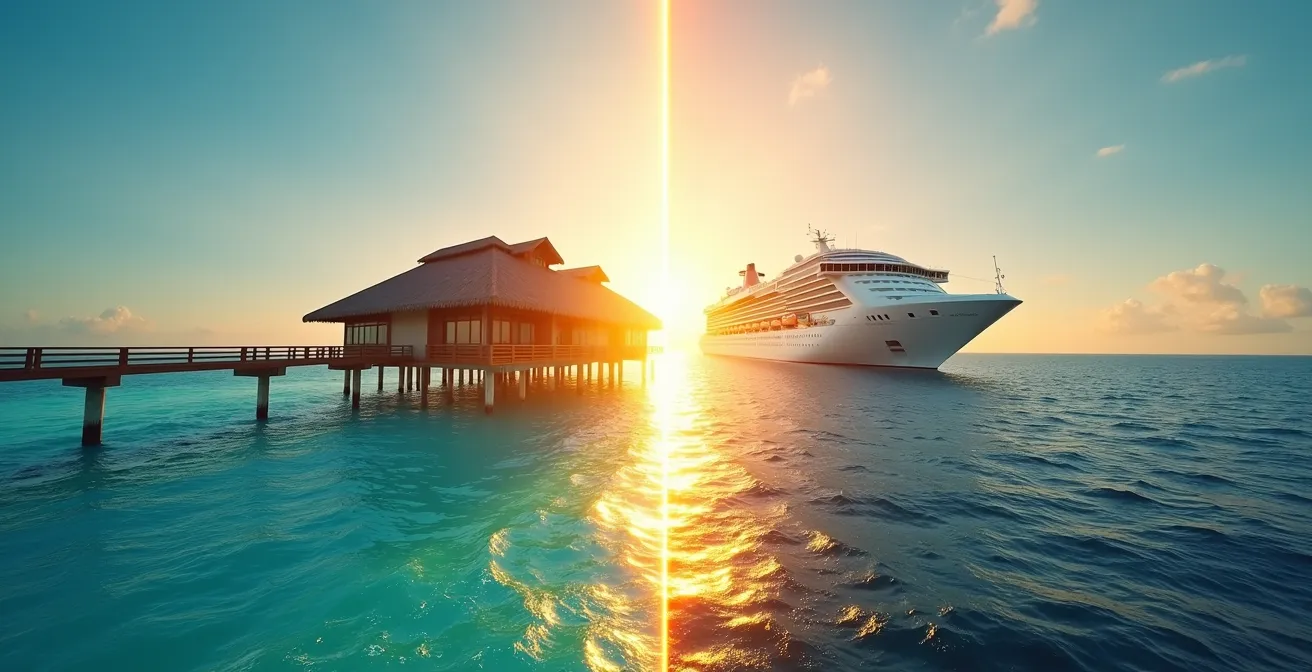
The choice between a stationary overwater villa and a moving luxury vessel is not about motion, but about two opposing philosophies of experiencing a destination.
- A floating resort offers a single, perfectly framed “masterpiece view,” engineered for absolute stability and immersion in one specific environment.
- A luxury cruise or yacht delivers an “evolving narrative,” a cinematic journey through ever-changing landscapes, prioritizing discovery over stationary perfection.
Recommendation: Choose the floating resort for deep, tranquil immersion in a single, flawless location. Opt for the moving vessel if your priority is a dynamic story of exploration and varied perspectives.
For the discerning traveler, the modern maritime landscape presents a captivating dilemma. The choice is no longer simply between land and sea, but between distinct modes of aquatic existence. On one side stands the serene, iconic overwater villa—a fixture of Maldivian dreams. On the other, the sleek, boutique luxury cruise or private yacht, promising a journey of discovery. The common assumption is that this is a simple trade-off: stillness versus movement, intimacy versus scale. This line of thinking, however, misses the fundamental point.
The debate isn’t about whether your accommodation moves, but about the very philosophy of your escape. It’s a strategic decision between securing a single, static ‘masterpiece’ view, meticulously engineered for perfection, and embracing an ‘evolving narrative’ where the scenery is a dynamic character in your travel story. This core difference dictates everything that follows, from the nuances of stability and engineering to the very nature of the service you receive and your environmental footprint. The question is not which is better, but which philosophy aligns with the experience you truly seek.
This guide deconstructs the common platitudes to reveal the critical considerations for your next maritime sojourn. We will explore the engineering that makes stillness possible, the truth about views, the realities of environmental impact, and the subtle but profound differences in luxury service. By understanding these distinctions, you can make a choice that transcends a simple itinerary and defines the very essence of your travel experience.
Summary: A Discerning Traveler’s Guide to Maritime Stays
- Why Modern Floating Resorts Don’t Feel Like They Move at All?
- How to Know if Your Floating Resort Is Stuck in a Marina or at Sea?
- Fixed Overwater Villa or Moving Yacht Hotel: Which Is Better for Views?
- The Environmental Truth About Floating Hotels in Sensitive Lagoons
- When to Book a Floating Resort to Avoid Motion Sickness Season?
- Why Staying on a Local Island Changes Your Perspective of the Maldives?
- Private Villa or Resort Suite: Which Offers Better Service?
- How to Plan a Maldives Trip on a Budget Under $2000?
Why Modern Floating Resorts Don’t Feel Like They Move at All?
The sensation of absolute stillness in a modern floating resort is not an accident of calm waters; it is a triumph of sophisticated engineering. The very appeal of these structures lies in their ability to deliver an overwater experience without the perpetual, subtle motion associated with a vessel at sea. This perceived stability is the primary differentiator from a cruise ship, no matter how luxurious, and is achieved through advanced foundation and mooring technologies designed to counteract environmental forces. This sector is rapidly innovating, with the floating hotel market projected to grow at an 8.7% CAGR through 2035.
Unlike a ship, which is designed for hydrodynamic movement, a floating resort is engineered for stasis. Leading resorts employ solutions that go far beyond simple anchors. Consider the Smart Floating Foundation Systems pioneered by properties like Soneva Jani in the Maldives. These systems for its 60 overwater villas are designed to offer superior stability by adapting to changing sea levels. They are part of a broader Maldivian initiative to create resorts resilient to environmental shifts. Instead of being at the mercy of the ocean’s whims, these structures use intelligent, multi-point mooring and tension-leg platforms that create a fixed-feeling connection to the seabed, effectively isolating the villa from minor wave and current action.
The result is a structure that feels as solid as its land-based counterparts. This engineered stability is what allows for features impossible on a moving ship, such as expansive glass floor panels offering clear, unshaken views of the marine life below, or private infinity pools whose water lines remain perfectly level with the horizon. The experience is not one of floating *on* the water, but of being seamlessly integrated *within* it, a crucial distinction for travelers sensitive to motion or seeking profound tranquility.
How to Know if Your Floating Resort Is Stuck in a Marina or at Sea?
The term “floating resort” can be misleading, as it encompasses a spectrum of structures from permanently docked hotel boats in urban marinas to true overwater villas in remote atolls. For the luxury traveler, the distinction is paramount. A true floating resort experience is defined by its location: not merely on water, but in a geographical sanctuary—a protected lagoon or a sheltered bay where the natural environment itself provides the first and most effective layer of stabilization.
Discerning the quality of a floating resort’s location begins with understanding its relationship to the open ocean. A premier overwater villa is almost always situated within a calm, turquoise lagoon, shielded from the powerful swells of the deeper sea by a natural barrier, typically a coral reef. This placement is a deliberate strategic choice. The reef acts as a natural breakwater, dissipating wave energy long before it reaches the villas. The result is a vast, tranquil swimming pool, offering the beauty of the ocean without its raw power. This is the environment that allows for the iconic images of steps leading directly from a private deck into placid, crystal-clear water.
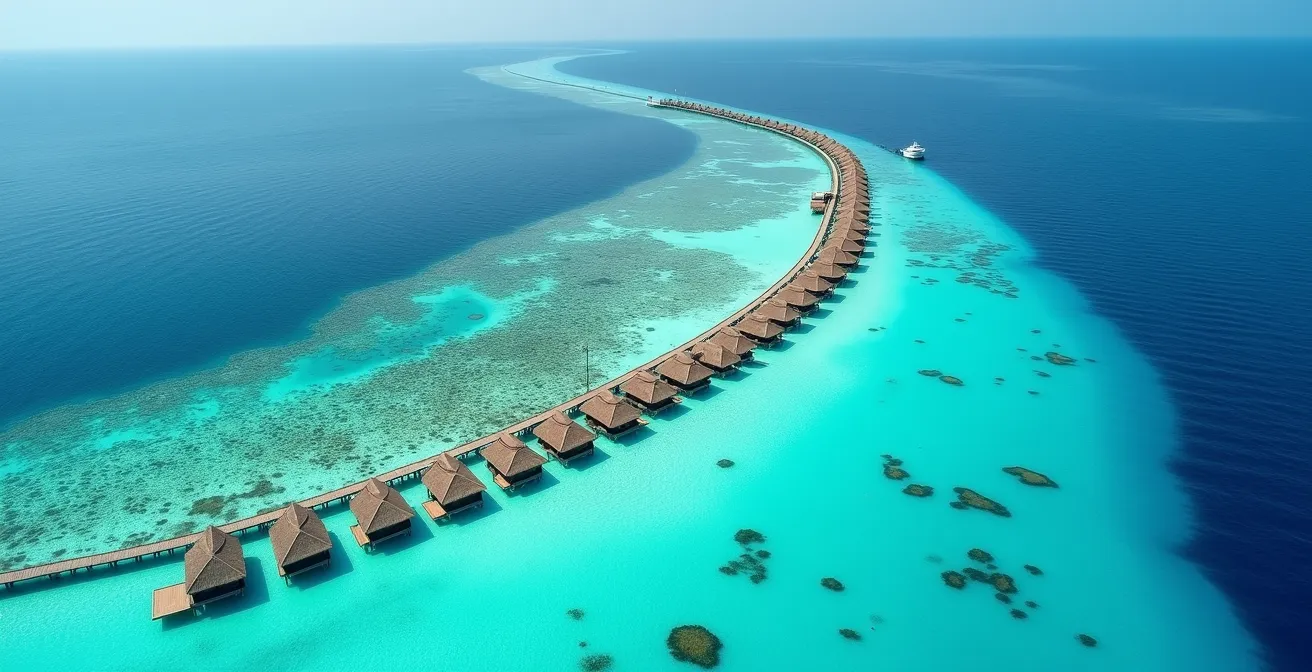
In contrast, a resort positioned on an exposed coastline or a floating hotel simply moored in a harbor is subject to a completely different set of forces. Without a natural barrier, it is directly exposed to wind, chop, and currents, making a truly tranquil experience far less certain. Before booking, a traveler should scrutinize aerial photographs and resort maps. Look for that distinct ring of a protective reef and the clear demarcation between the deep blue of the open sea and the light turquoise of the sheltered lagoon. This geographical context is a far better indicator of tranquility than any marketing promise.
Fixed Overwater Villa or Moving Yacht Hotel: Which Is Better for Views?
The debate over views is where the philosophical divide between fixed and mobile maritime stays becomes most apparent. It’s not a question of which is “better,” but which visual narrative a traveler wishes to inhabit. The fixed overwater villa is designed to deliver a single, perfected “masterpiece view,” while the moving yacht offers an “evolving narrative.” This fundamental difference is eloquently captured by travel experts, as noted in AFAR Magazine’s “Hotels We Love Series 2024”:
A fixed villa offers a single, perfectly curated ‘masterpiece’ view, while a moving yacht offers an ‘evolving narrative’—a cinematic sequence of different landscapes, sunrises, and sunsets
– AFAR Magazine Travel Experts, Hotels We Love Series 2024
The “masterpiece view” of an overwater bungalow is an exercise in curatorial perfection. Architects and designers orient each villa with painstaking precision to frame a specific, unchanging vista—a perfect sunset channel, a sunrise over a distant island, or an endless expanse of turquoise. The view is a static work of art, designed for prolonged contemplation. It encourages a state of meditative stillness, where the subtle shifts in light and weather across a single canvas provide the day’s entertainment. It is an experience of deep immersion in one place.
The “evolving narrative” of a yacht or luxury cruise is, by contrast, cinematic. Each day brings a new scene. A sunrise over a volcanic island is followed by a midday sail past dramatic cliffs, culminating in a sunset over a bustling port. The view is a story, with a beginning, middle, and end. The captain can even position the vessel to optimize for light or to frame a specific landmark. This experience prioritizes discovery and variety over static perfection. The following table breaks down this core distinction.
| Aspect | Fixed Overwater Villa | Moving Yacht Hotel |
|---|---|---|
| View Type | Single ‘masterpiece’ view (sunset/sunrise channel) | Evolving narrative of changing landscapes |
| Underwater Visibility | Glass floor panels showing marine life below | Deep ocean, no underwater viewing |
| Light Orientation | Fixed sunrise or sunset side | Captain can position for optimal lighting |
| Privacy | Permanent seclusion in one spot | Changing neighbors at each port |
| Weather Impact | Cannot escape local weather patterns | Can navigate away from storms |
The Environmental Truth About Floating Hotels in Sensitive Lagoons
The idyllic image of an overwater villa perched above a pristine coral reef belies a complex environmental reality. For the conscious luxury traveler, understanding the ecological footprint of these structures is a critical part of the decision-making process. Historically, the construction of overwater bungalows has been criticized for its impact on sensitive marine ecosystems, including direct damage to coral during construction and the disruption of marine life patterns. However, the leading edge of the industry is now defined by a profound commitment to sustainable innovation, turning these resorts into platforms for conservation rather than consumption.
Modern floating resorts are increasingly designed with ecological harmony as a core principle. This goes beyond simple “greenwashing” to encompass fundamental aspects of their operation. Energy consumption, a major challenge for isolated resorts, is being addressed through renewable sources. A prime example is the 15-villa Kudadoo Maldives, which powers its entire resort with a dedicated bank of solar panels, demonstrating that luxury and carbon neutrality can coexist. Waste management is another key area, with advanced wastewater treatment systems ensuring that nothing is discharged into the surrounding lagoon.
Furthermore, top-tier resorts actively contribute to the preservation of their environment. Six Senses Laamu, for instance, not only utilizes locally sourced, sustainable building materials but also employs a dedicated team of marine biologists who work with environmental groups on coral restoration and species protection. They even offer sustainability tours to guests, transforming the vacation into an educational experience. These properties understand that the health of the lagoon is their single greatest asset. While no construction is without impact, choosing a resort with a demonstrable, transparent, and science-backed commitment to environmental stewardship ensures that your stay contributes positively to the preservation of these fragile paradises.
When to Book a Floating Resort to Avoid Motion Sickness Season?
A common concern for prospective guests of floating resorts is the risk of motion sickness, leading many to meticulously plan their trips around so-called “calm seasons.” While seasonal weather patterns do exist, a sophisticated analysis reveals that for a well-designed overwater resort, geography trumps seasonality. The key to a stable, motion-free stay lies not in the time of year you book, but in the resort’s precise location within a protected geographical sanctuary.
Maldivian tourism data illustrates seasonal fluctuations, showing February occupancy near 95% versus just 50% in June, reflecting the dry versus monsoon seasons. However, this data correlates more with sunshine and rain than with wave action inside the atolls. A floating villa inside a protected lagoon experiences minimal swell year-round, as the outer reefs absorb the brunt of any ocean energy, regardless of the season. The primary difference between seasons is more likely to be the sound of rain on the roof than any discernible motion.
This principle is a cornerstone of overwater resort design worldwide. The following case study highlights its importance.
Case Study: The Protected Atoll Geography Impact
An analysis of Caribbean overwater bungalows, such as the Royalton properties in protected bays, confirms the principle. These resorts demonstrate that strategic positioning within sheltered coves and behind natural reef barriers results in minimal wave action throughout the year. Even during the Caribbean’s more turbulent seasons, the water within these sanctuaries remains remarkably calm. In contrast, structures on more exposed coastlines can face significant swells regardless of the season. This proves conclusively that for a motion-sensitive traveler, choosing a resort in a well-protected lagoon is a far more effective strategy than simply avoiding the rainy season.
Therefore, the most critical question is not “when” to go, but “where” the resort is located. Prioritize properties nestled deep within calm atolls or sheltered bays. Scrutinizing the resort’s geography will provide a much more reliable guarantee of tranquility than a calendar.
Why Staying on a Local Island Changes Your Perspective of the Maldives?
The prevailing image of the Maldives is one of exclusive, isolated luxury—private resort islands that exist as self-contained bubbles of paradise. While this experience has its allure, it presents a highly curated and incomplete picture of the nation. For the traveler seeking a more authentic and impactful journey, opting to stay on a locally inhabited island offers a profound shift in perspective. It transforms the visitor from a mere consumer of luxury into an active participant in the local culture and economy, revealing the true soul of the archipelago.
The economic reality of Maldivian tourism is stark. The industry is the lifeblood of the nation, generating over USD 5.6 billion in 2024. However, the distribution of this wealth is heavily skewed. An analysis of 2024 tourism data reveals that private resorts captured 83.6% of the revenue, while local guesthouses on inhabited islands accounted for a mere 1.77%. Choosing a guesthouse means your tourist dollars directly support local families, small business owners, and community projects, rather than flowing primarily to international hotel corporations.
Beyond the economic impact, the cultural immersion is invaluable. A resort experience is, by design, insulated. On a local island, you shop at the same stores as residents, eat at “hedhikaa” shops serving authentic snacks, and witness daily life unfold. You can engage in conversations that go beyond the pleasantries of resort service, learning about the challenges and joys of life in one of the world’s most unique and climate-vulnerable nations. This experience replaces the polished veneer of resort life with a genuine, human connection, offering a perspective on the Maldives that is richer, more complex, and ultimately more memorable.
Private Villa or Resort Suite: Which Offers Better Service?
In the upper echelons of luxury travel, excellent service is a given. However, there is a subtle but critical distinction in the *philosophy* of service between a private floating villa and a suite on a luxury cruise. While a luxury cruise might boast an impressive crew-to-passenger ratio, often approaching 1:1, the nature of the experience remains fundamentally reactive. In contrast, the service at an elite overwater villa is designed to be deeply and proactively anticipatory.
On a luxury cruise, even in the most opulent suite, a guest is one of many. The service is exceptional, on-demand, and efficient. Your requests are met promptly and with a smile. The staff is trained to a high standard, but their attention is necessarily divided among a number of guests. The service is a well-oiled machine designed for responsive luxury.
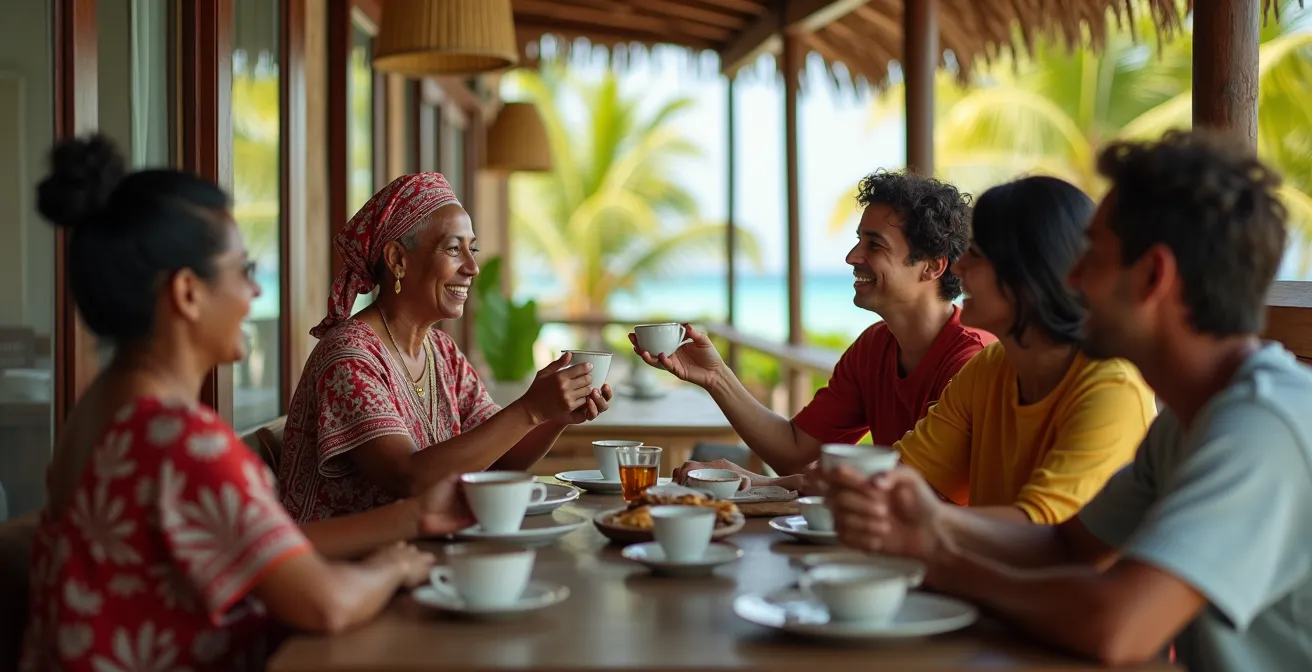
The service philosophy in a top-tier private villa, particularly one with a dedicated butler (or “Thakuru” in the Maldives), operates on a different plane. Here, the staff-to-guest ratio can often exceed 2:1. The goal is not simply to react to requests but to anticipate needs before they are even articulated. Your butler learns your preferences—how you take your coffee, your favorite spot by the pool, the time you prefer your privacy. The service becomes a highly personalized relationship. It’s the difference between having a request fulfilled and having a desire preempted. This deep level of personal recognition and customization is the hallmark of true anticipatory service, a level of intimacy that is structurally difficult to achieve on even the most luxurious of ships, as the following comparison illustrates.
| Service Aspect | Private Floating Villa | Luxury Cruise Suite |
|---|---|---|
| Staff Ratio | Often 2:1 or higher | Typically 1:1 to 1:2 |
| Service Style | Anticipatory (learns preferences) | Reactive (on-demand) |
| Personal Recognition | Staff knows name, preferences, story | One among many, even in suites |
| Butler Service | Dedicated, 24/7 availability | Shared among suite guests |
| Customization | Highly personalized experiences | Standardized luxury offerings |
Key takeaways
- The core choice is between a fixed “masterpiece view” (villa) and a moving “evolving narrative” (yacht).
- True stability in a floating resort comes from engineered foundations and a protected lagoon location, not the season.
- Staying on a local Maldivian island offers a more authentic cultural and economic impact than an isolated resort stay.
How to Plan a Maldives Trip on a Budget Under $2000?
The Maldives is synonymous with exorbitant luxury, but a breathtaking and authentic trip for under $2000 is not only possible, it is arguably a more enriching way to experience the nation. The key is to eschew the private resort island model and embrace the vibrant culture and hospitality of the local inhabited islands. This approach requires strategic planning, focusing on guesthouses, local ferries, and mindful spending, but the rewards are immense.
The cornerstone of a budget Maldivian trip is accommodation. Instead of a $1000-per-night overwater villa, comfortable and charming guesthouses on islands like Maafushi, Thulusdhoo, or Dhiffushi can be found for $50-$100 per night. These are not basic hostels; many offer private rooms, air conditioning, and a warm, personal level of hospitality that is often missing from larger resorts. Transportation is the next major cost-saver. Forego the expensive seaplane transfers ($500+ round trip) in favor of the public ferry network. A journey that costs hundreds by air can be made for a few dollars by sea, offering a scenic and authentic travel experience alongside locals.
Finally, be mindful of taxes and food costs. The Maldives has a significant tourism tax structure, and even departure taxes for economy class rose by 67% in late 2024 to $50. Factor these into your budget. For meals, eating at local cafes (“hotaas”) offers delicious, authentic Maldivian cuisine for a fraction of the price of resort restaurants. A trip built on this framework not only saves thousands of dollars but also provides a genuine connection to the people and culture of this incredible island nation.
Your Maldives Budget-Lockdown Checklist: Securing a Trip Under $2000
- Guesthouse Research: Identify 3-5 guesthouses on well-connected local islands (e.g., Maafushi) and compare nightly rates for your travel dates. Finalize and book one.
- Ferry Schedule Audit: Download the public ferry schedule from the Atoll Transfer website. Map your international flight arrival time to a feasible ferry departure time to avoid needing a costly speedboat.
- Activity Pre-Budgeting: Price out key excursions (snorkeling, sandbank trip) with at least two local providers on your chosen island. Allocate a fixed amount for activities in a spreadsheet.
- Tax & Fee Calculation: Add a line item in your budget for all mandatory taxes: green tax per night, TGST on all purchases, and the final departure tax. Do not estimate; use the current figures.
- Cash Plan: Plan to withdraw or exchange a set amount of Maldivian Rufiyaa upon arrival for local cafes and small purchases where cards may not be accepted, to avoid poor exchange rates on the island.
Ultimately, the choice between these magnificent maritime experiences is a deeply personal one. Armed with a clearer understanding of the philosophies that drive their design and service, you are now equipped to select the journey that best aligns with your own definition of paradise. Evaluate your priorities, from visual stimulation to service intimacy, and choose the path that will create your most treasured memories.