Most travelers believe a 4×4 is essential for any nature trip, but this is a costly misconception. This guide, written from an off-road instructor’s perspective, reveals that understanding fundamental concepts like ground clearance, tire pressure, and rental insurance clauses provides far more capability and safety than a 4WD system alone. The key to a successful adventure isn’t the vehicle’s drivetrain, but the driver’s knowledge.
The debate is a classic road trip dilemma. On one side, the allure of a rugged, go-anywhere 4×4 like a Jeep Wrangler, promising access to remote vistas and untamed wilderness. On the other, the pragmatic, budget-friendly choice of a standard sedan, which saves hundreds of dollars on rental fees and fuel. The common advice is simple: if you plan to go off-road, get the 4×4. If you’re sticking to pavement, a sedan is fine. This binary thinking, however, misses the most critical variable in the equation: you, the driver, and your understanding of the machine and the environment.
The decision to rent an expensive 4×4 is often based on an emotional desire for security, a belief that four-wheel drive is a magic bullet that solves all problems. Yet, a driver with a basic understanding of a vehicle’s mechanical limitations can take a simple two-wheel-drive car further and more safely than an inexperienced driver in a top-of-the-line 4×4. True capability isn’t bought, it’s learned. It’s about knowing when ground clearance matters more than powered axles, how to use tire pressure as a tool, and how to read the fine print on a rental agreement that can instantly void your insurance.
This guide will deconstruct the 4×4 myth from a technical and practical standpoint. We will move beyond the simple “4WD vs. 2WD” debate and into the realm of mechanical sympathy and risk assessment. We will explore the specific situations where a 4×4 is indispensable, the far more common scenarios where it’s an expensive and unnecessary burden, and the smart strategies you can use to get the best of both worlds without breaking your budget.
To navigate this decision with the precision of an experienced driver, this article breaks down the essential factors you must consider. The following sections will equip you with the technical knowledge and strategic mindset to choose the right vehicle for your specific adventure.
Summary: Rethinking Your Road Trip Vehicle Needs
- Why Ground Clearance Matters More Than 4WD on Rocky Roads?
- How to Switch to 4WD Low Without Destroying the Transmission?
- SUV or True 4×4:How to Engage With Local Cultures Without Being a Disrespectful Outsider?
- The Off-Road Mistake That Voids Your Rental Insurance Instantly
- When to Deflate Your Tires to Avoid Getting Stuck in Sand?
- When to Train in Desert Settings to Avoid Heat Stroke?
- How to Pack for a “No-Facilities” Beach Day Without Overloading?
- How to Plan a National Park Trip That Avoids the “Disneyland” Effect?
Why Ground Clearance Matters More Than 4WD on Rocky Roads?
The single most misunderstood concept in off-pavement driving is the difference between traction and clearance. Four-wheel drive is a system for managing traction—distributing power to wheels that have grip. But on a rocky, uneven trail, all the traction in the world is useless if the vehicle’s underbody gets stuck on a rock. This is where ground clearance—the distance between the ground and the lowest part of the vehicle’s chassis—becomes the paramount factor.
A typical sedan might have 5-6 inches of ground clearance, while a crossover SUV might have 7-8 inches, and a true off-roader like a Jeep Wrangler can have over 10 inches. On a forest service road with deep ruts or protruding rocks, those extra inches are the difference between driving through and causing thousands of dollars of damage to your oil pan, transmission, or exhaust system. It’s often better to have a simple two-wheel-drive vehicle with high clearance than an all-wheel-drive SUV with low-profile tires and a low-slung chassis.
Beyond simple height, you must also consider the vehicle’s approach, departure, and breakover angles. The approach angle determines the steepest obstacle you can drive up to without the front bumper hitting first. The departure angle dictates the same for the rear. The breakover angle is the maximum crest you can drive over without the middle of the car getting beached. A long-wheelbase sedan has a terrible breakover angle, making it vulnerable on sharp inclines, even if the road surface itself is smooth.
Therefore, your first assessment of a potential road shouldn’t be “Do I need 4WD?” but “What is the clearance requirement?” Look at photos, read recent trip reports, and understand the geometry of your vehicle before you venture off the pavement.
How to Switch to 4WD Low Without Destroying the Transmission?
Engaging a vehicle’s 4-Low range is one of the most powerful tools in an off-roader’s arsenal, but it’s also one of the most frequently misused by novices, leading to catastrophic transmission damage. Unlike all-wheel drive (AWD) or 4-High, which are designed for slippery on-road conditions or light trails at speed, 4-Low is a specialized gear for slow, high-torque situations like crawling over large rocks or descending a very steep, loose hill. It multiplies the engine’s torque, allowing for incredible control at walking pace.
The critical mistake is trying to shift into 4-Low while the vehicle is moving or while the transmission is in Drive. This grinds the gears of the transfer case, a sound akin to mechanical torture. Proper engagement requires what we call “mechanical sympathy.” You must understand that you are meshing heavy, robust gears that aren’t synchronized like a normal transmission. The process must be deliberate and precise.

For most traditional 4x4s with an automatic transmission, the correct procedure is as follows:
- Come to a complete stop on level ground.
- Shift the main transmission into Neutral (N).
- Firmly move the separate 4WD selector (whether a lever or a dial) to the “4L” or “4-Low” position. You may hear a solid “clunk” as the gears engage; this is normal.
- Shift the main transmission back into Drive (D).
- Slowly release the brake to confirm engagement. The vehicle will want to crawl forward with much more force and less throttle input.
Never use 4-Low on high-traction surfaces like dry pavement. Because the front and rear axles are locked to spin at the same speed, turning on pavement will cause the drivetrain to bind, leading to severe strain and potential damage. It is a tool for loose surfaces and low speeds only.
Understanding when and, more importantly, how to use 4-Low separates a prepared driver from one who is a danger to their vehicle. If you rent a 4×4, have the agent demonstrate this process before you leave the lot.
SUV or True 4×4: How to Engage With Local Cultures Without Being a Disrespectful Outsider?
The choice between a standard SUV and a purpose-built 4×4 extends beyond technical capability; it has a significant impact on how you are perceived and how you interact with local communities, especially in remote areas. A flashy, high-end expedition vehicle can immediately brand you as a wealthy outsider, creating a barrier to authentic connection. Conversely, a more modest, practical vehicle can act as a bridge, signaling a shared understanding of the local environment.
Many travelers mistakenly believe that an “All-Wheel Drive” (AWD) SUV is the same as a true 4×4. It is not. AWD systems are primarily for on-road stability in rain or light snow, automatically sending power to wheels when slippage is detected. A true 4×4 system features a transfer case with selectable 4-High and 4-Low ranges, providing the robust, low-speed torque needed for genuine off-road challenges. However, the social signal your vehicle sends can be just as important as its drivetrain.
Case Study: Vehicle Choice and Cultural Integration in the Australian Outback
An excellent example of this principle comes from Australian off-road guide Eva’s 18-month journey across Australia. According to an account of her trip, she deliberately chose a practical Toyota “troopy” (Troop Carrier), a vehicle commonly used by locals in the Outback. This choice allowed her to blend in, appear more approachable, and foster genuine connections with remote communities. She notes that while the best experiences lie beyond “4WD access only” signs, accessing them respectfully requires an understanding of the local vehicle culture and choosing transportation that is appropriate and not ostentatious.
When planning a trip, research what the locals drive. In many parts of the world, older, reliable, and slightly battered 4x4s like Toyota Hiluxes or Land Cruisers are the norm. Arriving in the latest-model, gadget-laden luxury overlander can be perceived as arrogant or out of touch. Choosing a vehicle that is functional rather than flashy demonstrates respect and a practical mindset, often opening doors that a more imposing vehicle would close.
Ultimately, your vehicle is your ambassador. Choosing one that prioritizes utility over luxury can be a powerful tool for dissolving cultural barriers and enriching your travel experience.
The Off-Road Mistake That Voids Your Rental Insurance Instantly
For the traveler debating a rental, this is the most critical section. The dream of spontaneously turning off the highway and exploring a dirt track can quickly become a five-figure financial nightmare. Virtually all standard rental car agreements—even for 4x4s like Jeeps and 4Runners—have clauses that explicitly prohibit “off-road” use. The single biggest mistake a renter can make is assuming their insurance or collision damage waiver (CDW) will cover them once they leave a maintained road.
The key is in the contract’s wording. Many agreements distinguish between an “unpaved road” (like a graded gravel or dirt county road, which may be permitted) and “off-roading” (driving on beaches, non-designated trails, or open country, which is always forbidden). Violating this clause is not a minor infraction; it typically voids all insurance coverage instantly. This means if you get stuck, roll the vehicle, or even get a small dent from a rock, you are personally liable for the full cost of recovery, repairs, and the rental company’s loss of use for every day the vehicle is out of service.
Making matters worse, many modern rental vehicles are equipped with GPS telematics that can report your location back to the company. If the GPS shows the vehicle was in an area designated as off-road, they can deny your claim even if the damage seems unrelated. It is imperative to understand these critical points before you turn the key:
- Always get written clarification on the company’s policy for dirt and gravel roads.
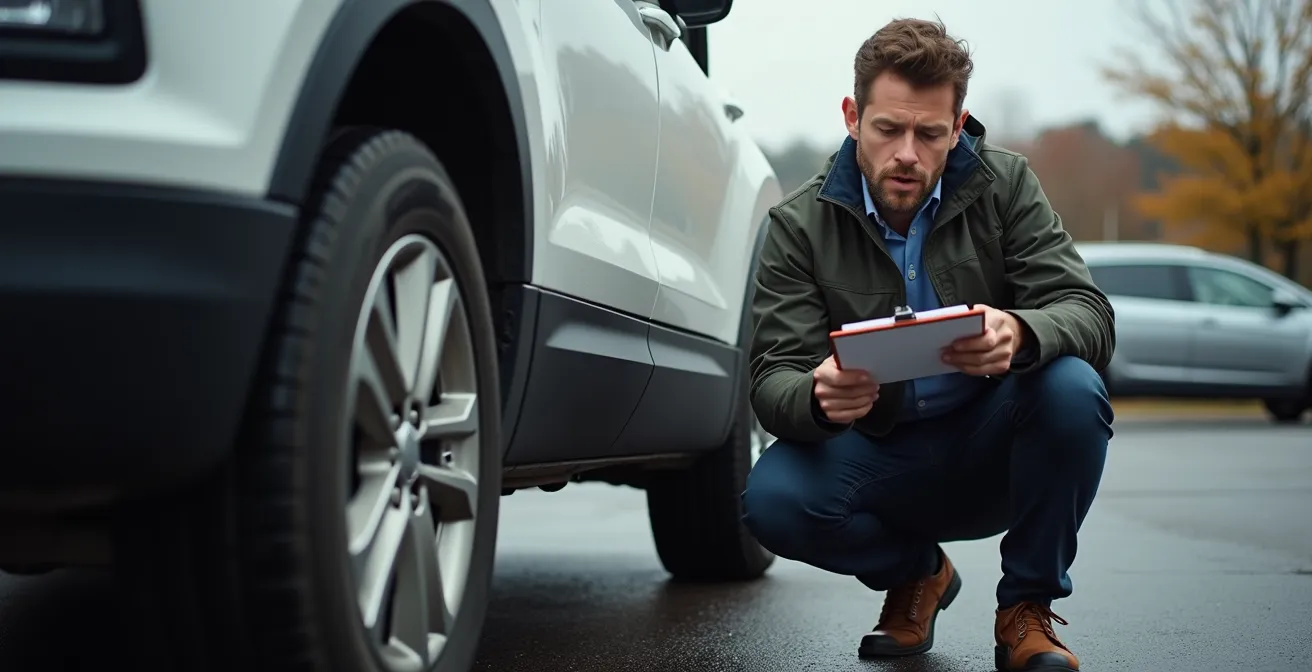
- Thoroughly document any pre-existing underbody damage with photos and video before leaving the lot to prevent false claims.
- Recognize that even on designated trails, your standard insurance may not apply. A review on a popular forum notes that while most off-road trails require street-legal registration and thus are theoretically covered, a rental agreement’s prohibitions supersede this.
- According to a guide on rental car off-roading, violations eliminate all protections, including liability and collision damage waivers, leaving you completely exposed.
The freedom of a 4×4 is an illusion if it’s not backed by a clear understanding of your contractual and financial liability. For most renters, the risk is simply not worth the reward.
When to Deflate Your Tires to Avoid Getting Stuck in Sand?
Driving on sand is a classic off-road challenge where 4WD can be helpful, but tire pressure is king. A vehicle with standard highway tire pressure will dig into soft sand and get stuck almost instantly, regardless of its drivetrain. The technique of “airing down”—-deliberately deflating your tires—is the single most effective way to gain traction on sand.
The principle is simple physics. By reducing the pressure, the tire flattens, dramatically increasing the size of its footprint. This spreads the vehicle’s weight over a larger area, allowing it to “float” on top of the sand rather than digging in. An aired-down tire conforms to the shape of the sand, providing a much larger contact patch for grip. Experts suggest that you can achieve up to a 40% improvement in off-road performance simply by adjusting tire pressure correctly.
However, airing down is not without risks and requires the right equipment: a reliable tire pressure gauge and a portable air compressor to re-inflate before returning to the pavement. Driving at speed on a severely deflated tire can cause it to overheat or even separate from the wheel bead, leaving you stranded. The correct pressure depends on the type of sand, but a general guide is crucial.
| Sand Type | Recommended PSI | Speed Limit | Key Risks |
|---|---|---|---|
| Deep, soft powder sand | 12-15 PSI | Under 25 mph | Bead separation, overheating |
| Wet, packed beach sand | 18-20 PSI | Under 25 mph | Reduced clearance |
| Corrugated/washboard roads | 25-28 PSI | Under 40 mph | Less severe risks |
| Standard pressure (reference) | 32-35 PSI | Highway speeds | Poor sand traction |
This data, highlighted in a guide to core off-road techniques, shows the trade-offs involved. Lowering pressure for soft sand significantly increases traction but requires low speeds and carries the risk of tire damage. A sedan owner would likely never attempt this, but for a 4×4 user, knowing these numbers is as important as knowing how to engage 4WD.
Without a compressor and a gauge, a 4×4 on a sandy beach is just a heavier, more expensive shovel. It’s the driver’s preparation and technique, not the vehicle alone, that ensures a successful outcome.
When to Train in Desert Settings to Avoid Heat Stroke?
In extreme environments like a desert, the greatest threat isn’t getting stuck—it’s the environment itself. A capable 4×4 can give a dangerous sense of overconfidence, leading drivers to underestimate the severe risks of heat exhaustion and heat stroke. The vehicle may be fine, but the human body is the weakest link. Proper planning for desert travel is less about driving technique and more about disciplined time and resource management.
The core strategy is to avoid activity during peak heat. The sun is your biggest enemy. Experienced desert travelers operate on a “Golden Hours” schedule. This means driving and activity are confined to the first few hours after sunrise and the last couple of hours before sunset. The period from late morning to late afternoon is for rest in the shade. Pushing through the midday heat drastically increases water consumption and the risk of mechanical failure, as engines and transmissions work harder to stay cool.
Case Study: The Danger of “AC Complacency”
A critical insight comes from the Summit 4X4 Company, which has served the Arizona desert community since 2012. They warn of a phenomenon they call “AC complacency.” Drivers feel comfortable inside a cool, air-conditioned cabin and fail to realize how rapidly their bodies are dehydrating in the dry desert air. They have observed drivers arriving at their destination severely dehydrated despite feeling fine. Their prescribed solution is a rigid, non-negotiable hydration schedule: mandatory, timed water intake every 30-60 minutes, regardless of perceived thirst. Treat the human body like the vehicle’s engine: it requires scheduled maintenance to prevent catastrophic failure in extreme heat.
Your desert survival plan must be built around a strict timeline and checklist. This includes a non-negotiable hydration schedule, pre-planned rest stops, and regular checks on vehicle fluids and tire pressures, as heat causes the air in tires to expand, dangerously increasing PSI. The minimum water provision is one gallon per person, per day, and this is for survival, not comfort.
In the desert, the most important dial isn’t the 4WD selector; it’s the clock on your dashboard. Respecting the sun is the first and most important rule of survival.
How to Pack for a “No-Facilities” Beach Day Without Overloading?
A remote beach, accessible only by a sandy track, is a perfect destination for a capable vehicle. But “no-facilities” means exactly that: no water, no restrooms, no trash cans, and no help if you get stuck. This requires a packing strategy that is both comprehensive and efficient. The choice of vehicle heavily influences this strategy. The owner of a small sedan is forced into minimalism, while the renter of a large 4×4 is often tempted into the “garage-on-wheels syndrome,” overpacking until the vehicle is dangerously heavy and unstable.
The professional approach is to use a modular go-bag system. Instead of throwing gear in randomly, you organize it into dedicated kits. This ensures you have everything you need for a specific situation without carrying unnecessary weight. For a beach trip, this means prioritizing recovery gear and “Leave No Trace” essentials. A heavy vehicle is more likely to get stuck in sand, so every pound matters. Distribute heavy items like water and recovery gear low and centered in the vehicle to maintain a stable center of gravity.
The goal is to be self-sufficient. This means having the tools to get yourself unstuck (traction boards, tire gauge, compressor, tow strap) and the means to pack out everything you packed in, including human waste. A minimalist mindset is key, focusing on multi-use items. A simple cast-iron skillet can be used on a camp stove or directly in a fire. A wool blanket can provide warmth, serve as a picnic blanket, or pad fragile items.
Your Action Plan: Assembling a Modular Beach Kit
- Recovery Module: Inventory your essential recovery items. This must include traction boards, a quality tire pressure gauge, a portable air compressor, and a rated tow strap.
- Leave No Trace Module: Collect items for responsible waste management. This includes a portable toilet or waste bags, a spill-proof container for grey water (from washing dishes), and multiple heavy-duty trash bags.
- Multi-Use Item Audit: Review your gear. Can one item serve multiple purposes? Swap single-use items for versatile ones like a wool blanket or a cast-iron skillet.
- Weight Distribution Plan: Before loading, create a map of where heavy items (water, recovery kit, cooler) will go. They must be placed low and as close to the vehicle’s center as possible.
- System Integration: Pack your modules into the vehicle. Does the system work? Is everything accessible? A well-organized drawer system can prevent overpacking and keep essentials at hand.
Ultimately, a well-packed sedan whose driver is prepared for the conditions is more capable than an overloaded, disorganized 4×4 with an unprepared driver.
Key Takeaways
- Ground clearance and vehicle geometry are often more critical for avoiding damage on unpaved roads than the drivetrain itself.
- Proper technique, or “mechanical sympathy,” in using features like 4-Low is essential to prevent catastrophic and costly damage to the vehicle.
- Rental agreements almost universally prohibit true off-roading, exposing renters to immense financial liability for any damage incurred off-pavement.
How to Plan a National Park Trip That Avoids the “Disneyland” Effect?
Many travelers seek out a 4×4 to escape the crowds in popular national parks, hoping to find solitude on backcountry trails. However, this often leads to a full-week rental of an expensive vehicle that is only needed for a fraction of the time. The “Disneyland effect”—overcrowded main loops and packed parking lots—is a real problem, but the solution can be more strategic and affordable than simply renting a Jeep for seven days.
The most intelligent approach is the “hub-and-spoke” strategy. Instead of committing to one expensive vehicle for the entire trip, you establish a base in a gateway town near the park using a standard, affordable rental car for your primary travel. This allows you to handle all the paved-road driving and general logistics economically. Then, for the one or two days you want to explore the park’s rugged backcountry, you rent a specialized 4×4 from a local outfitter for a single-day adventure.
Strategy in Action: The Hub-and-Spoke Model
A beginner’s guide from CJ Pony Parts outlines this exact model. They recommend basing yourself in a gateway town with a standard rental and then using local specialist rentals for targeted, single-day off-road excursions. This approach achieves two critical goals: it is vastly more cost-effective, and it filters out the vast majority of tourists. The simple act of navigating a few miles of graded dirt road to reach a remote trailhead is a barrier that 90% of park visitors will not cross, guaranteeing a more solitary and authentic experience. Local outfitters also provide vehicles properly equipped for the specific local terrain, often with the right tires and recovery gear included.
This strategy offers the best of both worlds: the cost-efficiency of a sedan for the bulk of your trip and the high capability of a true 4×4 precisely when you need it, without the week-long financial commitment or the rental insurance risks. It transforms the vehicle from a simple mode of transport into a strategic tool for accessing solitude.
Assess your trip through the lens of terrain, risk, and logistics—not just the vehicle badge. By doing so, you will make a decision based on pragmatic capability and intelligence, ensuring your adventure is both memorable and financially sound.