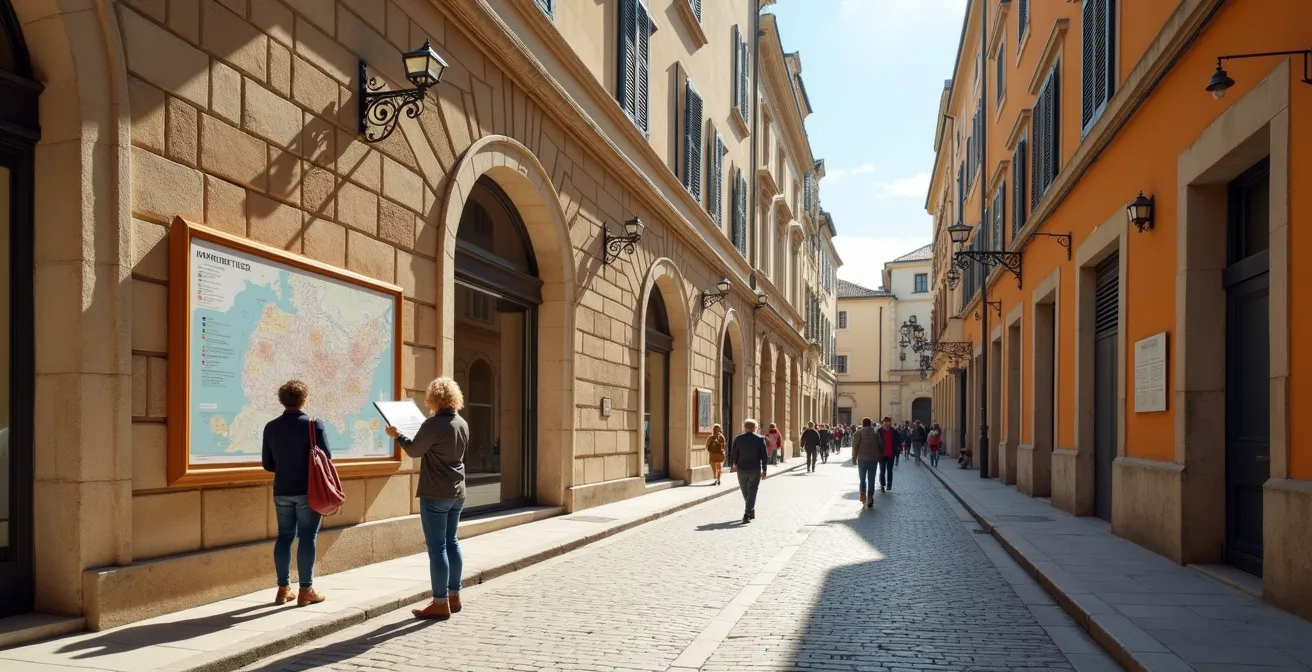
The most profound art travel experience isn’t found by following a checklist of museums, but by curating a thematic journey that treats the city itself as the primary exhibit.
- Focus on the ‘why’ behind the art—the social, economic, and physical environment that allowed a movement to flourish.
- Actively combat ‘museum fatigue’ by prioritizing deep, focused encounters with a few key pieces over superficial surveys of many.
Recommendation: Adopt the mindset of a ‘contemporary urban tourist.’ Learn to read the city as a living text, uncovering the dialogue between its past and present to truly understand its artistic soul.
For the dedicated art lover, the typical city break can feel strangely hollow. You follow the well-trodden path: the Louvre, the Uffizi, the Rijksmuseum. You tick off masterpieces from a list, jostling with crowds to glimpse a famous canvas before being swept along by the current. While you see the art, you rarely feel its pulse. The experience is often one of consumption, not connection, leaving you with a camera roll of images but little of the profound understanding you craved.
The conventional wisdom for art travel revolves around efficiency—buying the all-inclusive city pass, mapping the most direct route between major institutions, and cramming as many viewings as possible into a single day. This approach treats art as a series of isolated objects in sterile rooms, completely divorced from the vibrant, chaotic, and inspiring urban environments that gave them birth. It misses the fundamental point: an artistic movement is not just a collection of works, but a cultural phenomenon rooted in a specific time and place.
But what if the goal was not to see more art, but to understand it more deeply? This guide proposes a new methodology, one borrowed from the world of art curation. It’s about planning your trip not as a tourist, but as a researcher building an exhibition. The objective is to create a thematic cartography, a personal map of ideas, influences, and locations that reveals the story behind the masterpieces. It requires you to trade the museum checklist for a set of investigative questions and to treat the city itself as the primary, living artifact.
For those who prefer a visual format, the following video offers an immersive look into a single, historically rich location. While our guide focuses on planning principles, this tour of the Palacio Massimo exemplifies the deep dive into a specific artistic period—in this case, Ancient Rome—that creates a truly memorable connection.
This guide will walk you through the essential strategies for this curatorial approach to travel. We will explore how to analyze the conditions that create an artistic boom, uncover the authentic spaces where artists worked, and structure your days for maximum absorption rather than exhaustion. By the end, you will have the tools to design a journey that is not just a visit, but a genuine investigation.
Table of Contents: A Curatorial Guide to Art Movement Travel
- Why Did 1920s Paris Create Such a Specific Artistic Explosion?
- How to Find the Ateliers Where Famous Artists Actually Lived?
- City Art Pass or Pay-Per-View: Which Saves More for Art Lovers?
- The Mistake of Ignoring Modern Galleries in Historic Art Cities
- How to Structure a “Van Gogh Day” Without Logistics Killing the Vibe?
- Modern Architecture Tour or Historical Walk: Which Reveals the City’s Future?
- The Fatigue Error: Why Visiting 3 Museums in One Day Destroys Retention?
- What Is Contemporary Urban Tourism and Why Should You Try It?
Why Did 1920s Paris Create Such a Specific Artistic Explosion?
To understand an art movement, one must first act as a cultural archaeologist, examining the soil from which it grew. The Paris of the “Années folles” is a prime example. It wasn’t mere chance that drew an estimated 30,000 artists to the city. A unique confluence of economic, social, and legal factors created an unparalleled ecosystem for creative ferment. The post-war French franc was incredibly weak against the dollar, making the city a haven of affordable luxury for expatriates. As one contemporary observer noted, “The franc was cheap. Because of the favorable exchange rate, good food and good wine were easy to come by.” This economic reality provided the financial runway for artists to experiment without the immediate pressure of commercial success.
Beyond economics, a spirit of intellectual freedom pervaded the city. This was most famously embodied by institutions like Sylvia Beach’s bookshop, Shakespeare and Company. More than a store, it was a salon, a post office, and a publisher for the “Lost Generation.” When no one else dared, Beach published James Joyce’s Ulysses, cleverly leveraging a loophole in French law that made obscenity statutes applicable only to French-language books. This act of defiance highlights a crucial element of the ecosystem: Paris provided not just cheap rent, but a sanctuary where artistic and literary boundaries could be pushed without fear of censorship, a condition that allowed Modernism to flourish.
This combination of a favorable exchange rate, a high concentration of creative minds, and a culture of intellectual tolerance created a perfect storm. Artists were not isolated geniuses; they were part of a dense, interconnected network of cafés, studios, and salons where ideas were exchanged, collaborations were born, and new aesthetics were forged. Understanding this context transforms a trip to Paris from a simple tour of museums into an investigation of the very forces that shaped 20th-century art.
How to Find the Ateliers Where Famous Artists Actually Lived?
Moving from the “why” to the “where” requires a shift from historian to detective. The goal is to transcend the generic “artist quarter” walking tour and locate the specific, often unmarked, spaces where art was actually made. This practice of artistic forensics involves piecing together clues to find the authentic ateliers, apartments, and haunts of your chosen movement. It is the difference between walking through Montmartre and standing before the actual building where Picasso and Braque developed Cubism at the Bateau-Lavoir.
The process begins not on the street, but in digital archives. Start with known gathering places—the cafés and bars immortalized in paintings and literature, such as La Closerie des Lilas where Hemingway put the finishing touches on “The Sun Also Rises.” Use these as anchor points. Then, dive into historical records. Digital libraries like Gallica in France allow you to cross-reference historical addresses from biographies with period maps and directories. This detective work can reveal the exact locations of artists’ homes and studios, many of which are now private residences or businesses, invisible to the average tourist.
Once you have a list of potential addresses, modern technology becomes an invaluable tool. Google Street View’s “time-travel” feature can be used to compare historical photographs with the current streetscape, helping you identify surviving architectural details. On the ground, look for the subtle signs: commemorative plaques are the obvious giveaway, but also pay attention to building layouts. Are there large, north-facing windows characteristic of a painter’s studio? Does the building’s history align with the period of the movement? This methodical search transforms a simple walk into a meaningful pilgrimage, connecting you to the physical reality of an artist’s life.
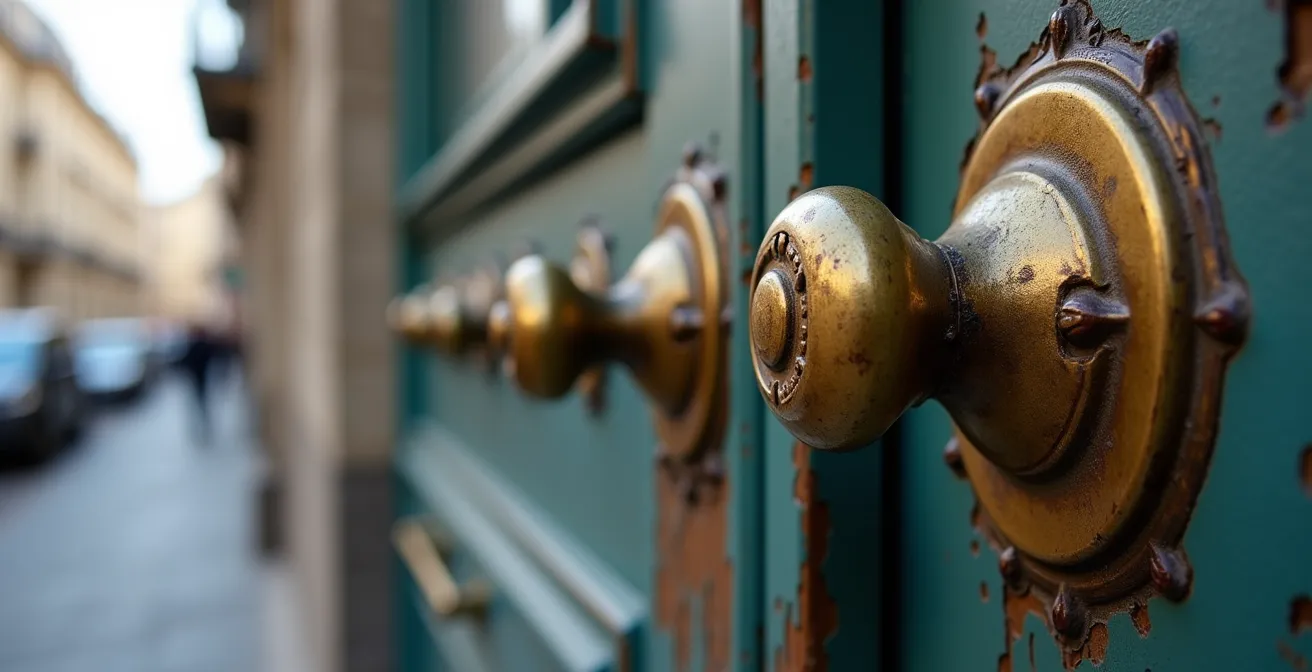
This investigative approach allows you to read the city’s layers. A plaque on a wall, the specific quality of light falling through a large window, or even the preserved nameplate on a barstool becomes a tangible link to the past, offering a far more intimate connection than a museum label ever could.
City Art Pass or Pay-Per-View: Which Saves More for Art Lovers?
A common dilemma for the art-focused traveler is the choice between an all-inclusive city art pass and paying for individual museum entries. On the surface, the pass seems like the logical choice for anyone planning to visit multiple institutions. However, for a curator-minded traveler, the most valuable currency isn’t money, but attention and retention. The decision should be based not on a simple cost calculation, but on your intended viewing strategy.
The best approach depends entirely on your visitor profile. The city pass is ideal for “The Surveyor,” a traveler whose goal is to get a broad overview of a city’s offerings, often visiting many museums superficially. Conversely, “The Deep Diver,” who intends to spend a full day or more immersed in a single collection, will almost always find pay-per-view more economical and focused. A hybrid approach often works best, using a pass for initial survey days and then paying for individual re-entry to institutions that warrant a deeper investigation.
However, one must be wary of the “Checklist Effect.” A formal study on museum visitor behavior revealed that pass holders often experience a subconscious pressure to rush between venues to “get their money’s worth.” This impulse directly contradicts the goal of immersive appreciation. According to research on the “checklist effect” phenomenon, this rush significantly accelerates museum fatigue, leading to decreased enjoyment and poor retention of what was seen. The pass, intended as a tool of freedom, can become a psychological trap, turning a journey of discovery into a frantic race against time.
As this comparative analysis from art museum professionals suggests, aligning your ticketing with your travel philosophy is paramount.
| Visitor Type | Best Option | Reason | Strategy |
|---|---|---|---|
| The Surveyor | City Art Pass | Visits many museums superficially | Maximize venues in limited time |
| The Deep Diver | Pay-Per-View | Spends full day in one museum | Focus on depth over breadth |
| The Hybrid Explorer | Mixed Approach | Combines overview with deep dives | Use pass for survey days, then pay individually for favorites |
The Mistake of Ignoring Modern Galleries in Historic Art Cities
When planning a trip around a historical movement like Impressionism in Paris or the Renaissance in Florence, it is tempting to focus exclusively on the past. This is a critical error. The story of a city’s art scene does not end with its most famous period; it is a continuum. Ignoring contemporary galleries is like reading the first half of a novel and refusing to finish it. The most vibrant understanding comes from observing the structural dialogue between the city’s artistic past and its living present.
Contemporary artists working in historic cities are in constant conversation with their predecessors. They may reference, re-contextualize, or actively rebel against the artistic legacy that surrounds them. Visiting a modern gallery in a historic art quarter allows you to witness this dialogue firsthand. You might see a digital artist using light projection to deconstruct a Renaissance-era building, or a sculptor using industrial materials to comment on themes first explored by the Old Masters. These encounters provide a crucial epilogue—or a new chapter—to the story you are tracing.
A powerful strategy is the “Then & Now” pairing. Start your day at a major historical institution, immersing yourself in the work of the movement you are studying. Then, in the afternoon, seek out contemporary, often artist-run, spaces in the same neighborhood. Use apps like Artsy to identify galleries nearby. The goal is to consciously compare and contrast. How do today’s artists address the same urban landscapes? How have the materials and concerns changed? As one study on urbanism notes, “The city’s future is revealed in the dialogue between old and new. Focus on analyzing the spaces between buildings, where modern structures reference, ignore, or clash with their historical neighbors.” This perspective, confirmed by an analysis of architecture as cultural dialogue, is essential for a complete picture.
This approach prevents your trip from becoming a static history lesson. It transforms it into a dynamic exploration of a living, breathing artistic ecosystem, reminding you that the creative spirit of a city is not a relic to be preserved in a museum, but a force that continues to evolve.
How to Structure a “Van Gogh Day” Without Logistics Killing the Vibe?
Designing a day dedicated to a single artist, like Vincent van Gogh in Amsterdam or Arles, presents a unique challenge. The desire for thematic purity can easily lead to a rigid, over-scheduled itinerary that suffocates the very artistic spirit you seek to embrace. The key is to structure the day around inspiration and emotional connection, not chronological or geographical efficiency. A successful thematic day requires a framework that is both focused and flexible.
An effective framework is the “Anchor and Orbit” method. This strategy involves meticulously planning one “Anchor” location—the Van Gogh Museum, for instance—which serves as the day’s centerpiece. This is the only appointment that is fixed. Surrounding this anchor are several “Orbit” locations: the park he painted, a former address, a view he captured. These orbits are not scheduled. They are visited spontaneously based on your energy levels, the weather, and what you feel drawn to after your anchor experience. This approach eliminates the pressure of a strict timeline while maintaining a strong thematic coherence, allowing for genuine discovery.
The structure of the day itself should follow an emotional or thematic arc rather than a strict biography. Instead of a linear “birth to death” tour, you might organize the day around concepts central to the artist’s work. This allows for moments of creative idleness and reflection, which are crucial for absorbing the experience. True immersion requires unscheduled time to process, sketch, or write, transforming passive viewing into active engagement.
Action Plan: Structuring Your Thematic Art Day
- Morning ‘Light and Color’: Begin the day by visiting sunlit outdoor locations that the artist painted, perhaps during the golden hour, to connect with their study of light.
- Midday ‘Creative Idleness’: Block a mandatory 90-minute period in a café within the artist’s neighborhood. Use this time for journaling, sketching, or simply observing, with no other goal.
- Afternoon ‘Turmoil and Expression’: Explore the more chaotic or emotionally charged urban areas the artist experienced, contrasting them with the morning’s tranquility.
- Evening ‘Contemplation’: End the day at a quiet spot—a bridge, a park bench—for a final moment of reflection, detached from any specific landmark.
- The Golden Rule: The most critical step is to schedule absolutely nothing for at least one 90-minute block. This space is where genuine absorption happens.
Modern Architecture Tour or Historical Walk: Which Reveals the City’s Future?
A common debate for the culturally curious traveler is where to focus their attention: on the historical fabric of a city or on its modern architectural statements. While a historical walk tells you where a city has been, a tour of its modern architecture often provides a more potent vision of where it is going. However, the most insightful approach is not to choose one over the other, but to study the relationship between them. The future of a city is most clearly revealed in the tension and harmony between its past and its present.
High-profile renovations and contemporary additions to historic buildings are not just construction projects; they are public debates about identity, progress, and memory. The glass pyramid at the Louvre, the modern extension of the Royal Ontario Museum, or a new skyscraper piercing a medieval skyline—these are physical manifestations of a city’s ongoing conversation with itself. As the Urban Planning Quarterly states, “The most potent vision of a city’s future is in how it treats its past.” Observing these points of architectural intersection reveals a city’s values: Does it seek to blend, to contrast, to dominate, or to preserve? The answers to these questions are a powerful indicator of its future trajectory.
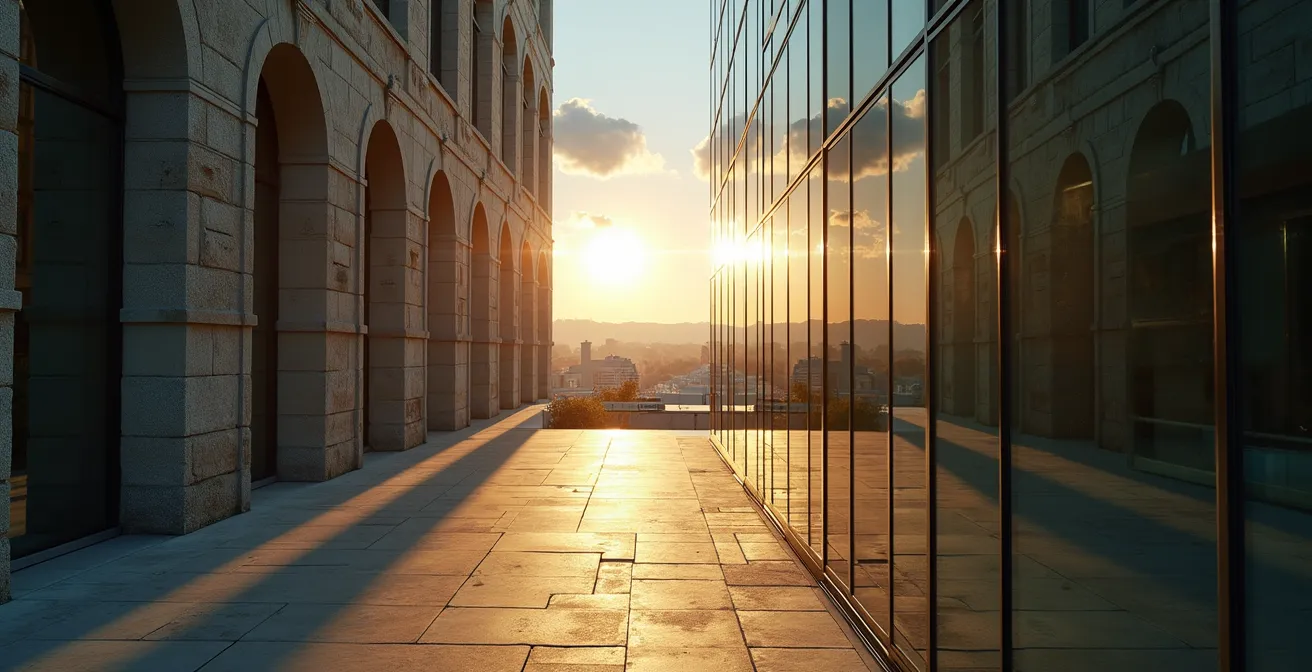
Therefore, a “modern architecture tour” should not be a separate activity. It should be integrated into your historical exploration. When you are in a historic district, actively seek out the modern interventions. Analyze how the new structure responds to the old. Does it use similar lines or materials? Does it reflect the historic facade in its glass, creating a literal dialogue? Or does it stand in stark, intentional contrast? This practice of observing the structural dialogue offers a richer understanding than studying either era in isolation. It allows you to read the city’s narrative not as a series of static chapters, but as a dynamic, evolving story.
The Fatigue Error: Why Visiting 3 Museums in One Day Destroys Retention?
One of the greatest enemies of a meaningful art trip is museum fatigue. This well-documented phenomenon describes the mental and physical exhaustion that sets in during a museum visit, drastically reducing one’s ability to appreciate art and retain information. The common travel impulse to maximize a day by “doing” three or more museums is, from a curatorial perspective, the single most destructive mistake one can make. It guarantees a superficial experience and wastes the very opportunity for connection you traveled so far to find.
The science is clear: our capacity for focused aesthetic appreciation is finite. According to research into visitor attention spans, most museum-goers maintain a high level of interest for only about 30 minutes. After this point, engagement drops sharply. Attempting to power through multiple institutions in a single day means that by the second or third venue, you are merely “seeing” objects without truly processing or connecting with them. Your brain, overwhelmed by stimuli, has effectively shut down its capacity for deep engagement.
The antidote to this is a radical shift in mindset: from quantity to quality. Ambitious museum programs have championed the “One Masterpiece Rule,” an approach where a visitor enters a museum with the goal of spending 30-45 minutes with a single, pre-chosen artwork. This focused viewing creates a far deeper, more memorable connection than a whirlwind tour of an entire gallery. Furthermore, combating fatigue requires scheduling sensory reset activities between cultural engagements. Instead of rushing from one museum to another, take a two-hour break. Engage your other senses: visit a food market, listen to a street musician, or simply walk barefoot in a park. This clears the visual palate and restores your capacity for aesthetic appreciation.
Ultimately, seeing three masterpieces with full attention and presence is infinitely more valuable than seeing three hundred in a state of exhaustion. Acknowledging your cognitive limits is not a failure; it is a strategic decision to ensure the quality of your experience.
Key Takeaways
- Adopt a curatorial mindset: Treat the city itself as the primary exhibit and your itinerary as a thematic investigation.
- Prioritize depth over breadth: Combat museum fatigue by focusing on fewer artworks with greater attention, not by rushing through checklists.
- Plan thematically, not just logistically: Structure your days around creative concepts and allow for unscheduled time for genuine absorption and reflection.
What Is Contemporary Urban Tourism and Why Should You Try It?
All of these strategies—the artistic forensics, the structural dialogues, the fight against museum fatigue—are components of a broader travel philosophy: contemporary urban tourism. This approach marks a fundamental departure from traditional tourism. It reframes the traveler’s role from that of a passive consumer of sights to an active investigator of the urban environment. It is, as the Urban Tourism Research Institute puts it, “the difference between seeing the city as a theme park of past glories and treating it as a living text to be read.”
To be a contemporary urban tourist is to engage with the city on its own terms. It means embracing complexity, ambiguity, and the “in-between” spaces that most tours overlook. It’s about asking questions rather than just seeking photo opportunities. How does a city’s modern transport infrastructure relate to the Futurist movement’s obsession with speed and machines? How do contemporary art galleries occupy and repurpose former industrial spaces, continuing a dialogue about labor and value? This mindset transforms the entire city into a dynamic and interactive museum.
The best way to practice this is to assign yourself small “field research” exercises. Sit in a major public square for twenty minutes and simply map the flow of people and traffic. Follow a piece of infrastructure—an old Roman wall, a modern tram line—to see where it leads and what it connects. Buy a local newspaper and visit a location mentioned in a non-tourist story. These exercises force you to look deeper, to see the patterns, rhythms, and systems that underpin the urban experience. They are the practical application of the curatorial mindset, tools for reading the living text of the city.
This approach is not easier than a conventional tour; it requires more attention, curiosity, and intellectual engagement. But the reward is immeasurably greater: a unique, personal, and deeply contextualized understanding of a place and the art it has produced. It is the ultimate goal for any traveler who seeks not just to see the world, but to understand it.
Embrace these principles on your next journey. Start not with a map of museums, but with a question about the art you love, and let the city itself provide the answers. This is how you transform a simple trip into a lasting intellectual and artistic discovery.