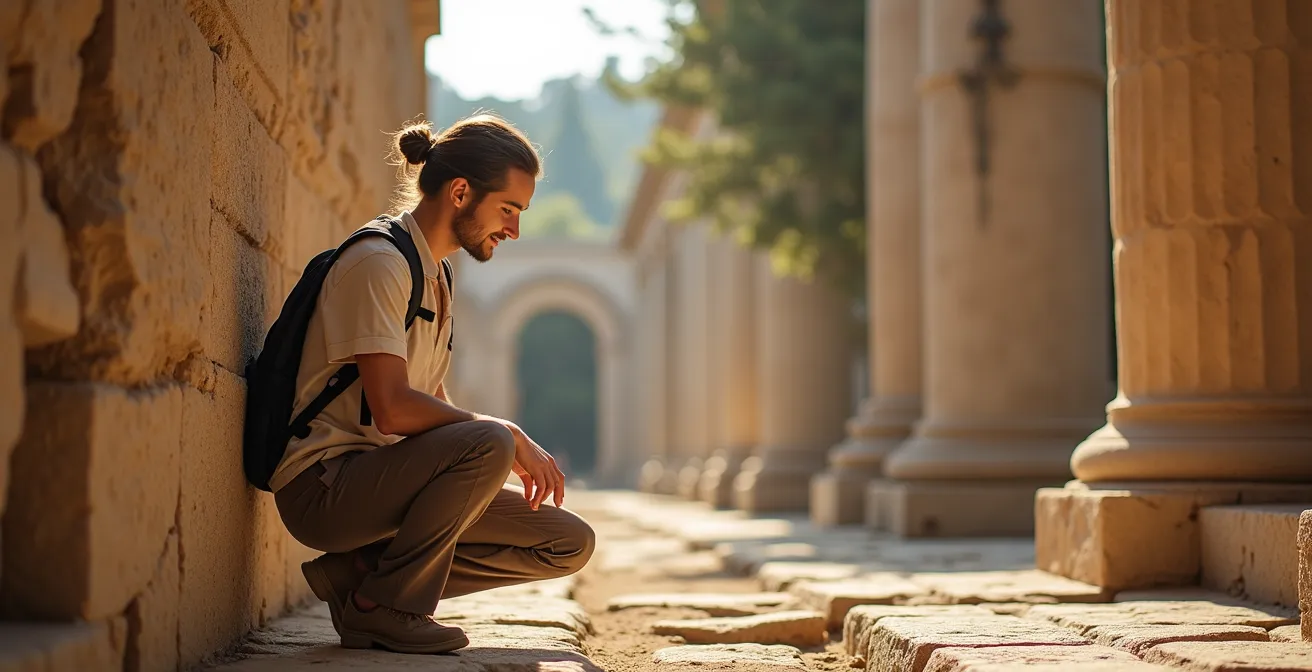
Visiting historic sites often leaves travelers with photos of ruins but little real understanding.
- The key to deep learning is to shift from a passive tourist to an active investigator, using a historian’s methods to decode the past.
- This involves learning to “read” landscapes for clues, finding niche collections, and structuring your journey like a narrative.
Recommendation: Instead of just seeing the sights, use the frameworks in this guide to transform your next trip into an immersive intellectual adventure.
You stand before the Roman Forum, a sprawling field of fractured columns and weathered stone. You know it’s important, the heart of an empire that shaped the world. Yet, the guidebook offers dry facts and the audio tour recites names and dates that fail to connect. You leave with pictures, but a nagging feeling remains: you’ve seen the place, but you haven’t understood its story. This experience is the great paradox of historical travel; we journey thousands of miles to stand in the footsteps of the past, only to find its voice is silent.
The common advice is to simply “read a book beforehand” or “hire a guide.” While helpful, these steps often keep us as passive consumers of information. We are told what to think, rather than taught how to see. We learn about the past, but we don’t connect with the process of history itself—the inquiry, the interpretation, and the discovery. This guide proposes a different path. What if the true key to unlocking history wasn’t just accumulating more facts, but adopting the mindset of a historian on the ground?
This approach reframes you, the traveler, as an active investigator. It’s about building an intellectual toolkit to decode the evidence yourself. It’s about understanding that a city like Rome is a historical palimpsest, with layers of time stacked one on top of the other, waiting to be read. By learning how to spot the clues of a civilization’s collapse, plan a route that follows an empire’s narrative arc, and engage with artifacts in a more meaningful way, you can transform any historical site from a silent ruin into a rich, complex story that you are helping to uncover.
For those who prefer a visual introduction, the following video offers a compelling look at a pivotal moment in history, demonstrating the kind of dramatic narratives that lie hidden within the archaeological record. It serves as a powerful reminder of the stories waiting to be discovered.
This guide is structured to build your historical investigation toolkit, piece by piece. We will explore the grand questions of civilizational collapse, dive into the practicalities of finding real treasures, and provide you with methods to actively see and interpret the past for yourself. The following sections will guide you on this journey from passive tourist to insightful historical explorer.
Table of Contents: A Traveler’s Guide to Understanding the Past
- Why Did Great Civilizations Collapse and What Can We Learn?
- How to Find the Niche Museums That Hold the Real Treasures?
- Audio Guide or Professor-Led Tour: Which Is Best for Deep Learning?
- The “Ancient Alien” Trap: How to Spot Fake History Tours?
- How to Plan a Route That Follows the Timeline of an Empire?
- Why Visiting Rome Without Reading History Is a Waste of Time?
- Why Did 1920s Paris Create Such a Specific Artistic Explosion?
- How to Visit Historical Landmarks and Actually Understand What You See?
Why Did Great Civilizations Collapse and What Can We Learn?
To truly understand a civilization, you must study not only its magnificent peak but also its poignant end. The collapse of great empires like the Maya, Romans, or the Indus Valley Civilization offers profound lessons about resilience, sustainability, and the cyclical nature of power. For the lifelong learner, these sites of decline are not just tragic ruins; they are complex outdoor classrooms. This interest in deeper narratives is reflected in the tourism industry, where studies show that travelers aged 51-70 now represent 58.42% of heritage tourism participants, a demographic often seeking more than just a superficial glance.
Instead of just seeing an abandoned city, the goal is to learn how to read the evidence of its collapse written into the landscape. This is the first tool in your investigator’s toolkit: archaeological literacy. When you visit a site, look for specific clues that tell a story of crisis and transformation. A hastily built defensive wall with mismatched stones speaks of a sudden threat. A thick layer of ash in the soil profile is the unmistakable signature of a destructive fire. These are not just visual details; they are data points.
Learning to spot these signs transforms your experience. You are no longer a passive observer but an active participant in historical inquiry. You begin to ask the same questions archaeologists do: Was the collapse sudden or gradual? Was it caused by external invasion, internal strife, or environmental change? Pay attention to the evidence on the ground:
- Defensive Structures: Look for hastily built walls using mismatched or repurposed materials, suggesting an urgent need for fortification.
- Destruction Layers: Identify deposits of ash or charcoal, which are often clear indicators of destruction by fire.
- Land Use Changes: Notice agricultural terraces that have been abandoned and are now being reclaimed by wild vegetation, a sign of depopulation.
- Material Repurposing: Observe the reuse of stones from grand monuments in later, more utilitarian buildings—a sign that the original symbolic value was lost.
- Artistic Simplification: Document any sudden decline or simplification in pottery or artistic styles between different archaeological layers, which can indicate societal stress or a loss of specialized skills.
By engaging with a site in this way, you move beyond the simple narrative of “a great empire fell” and begin to appreciate the complex, human story of adaptation and change that is etched into the very stones.
How to Find the Niche Museums That Hold the Real Treasures?
While iconic institutions like the Louvre or the British Museum are essential, the journey of a historical investigator often leads to smaller, more specialized collections where the real discoveries are made. These niche museums—university archives, small regional collections, or site-specific displays—offer a depth and focus that larger museums cannot. They are the quiet libraries of history, holding not just the masterpieces, but the everyday objects, the failed experiments, and the unpublished findings that provide a richer, more textured understanding of the past.
These smaller venues allow for a more intimate encounter with artifacts. Without the crowds and grand displays, you have the opportunity to look closer, to notice the fingerprint of a potter on a clay shard or the tool marks on an unfinished statue. This is where you can often find the “real treasures”: the items that tell a personal, human story rather than a grand, imperial one.
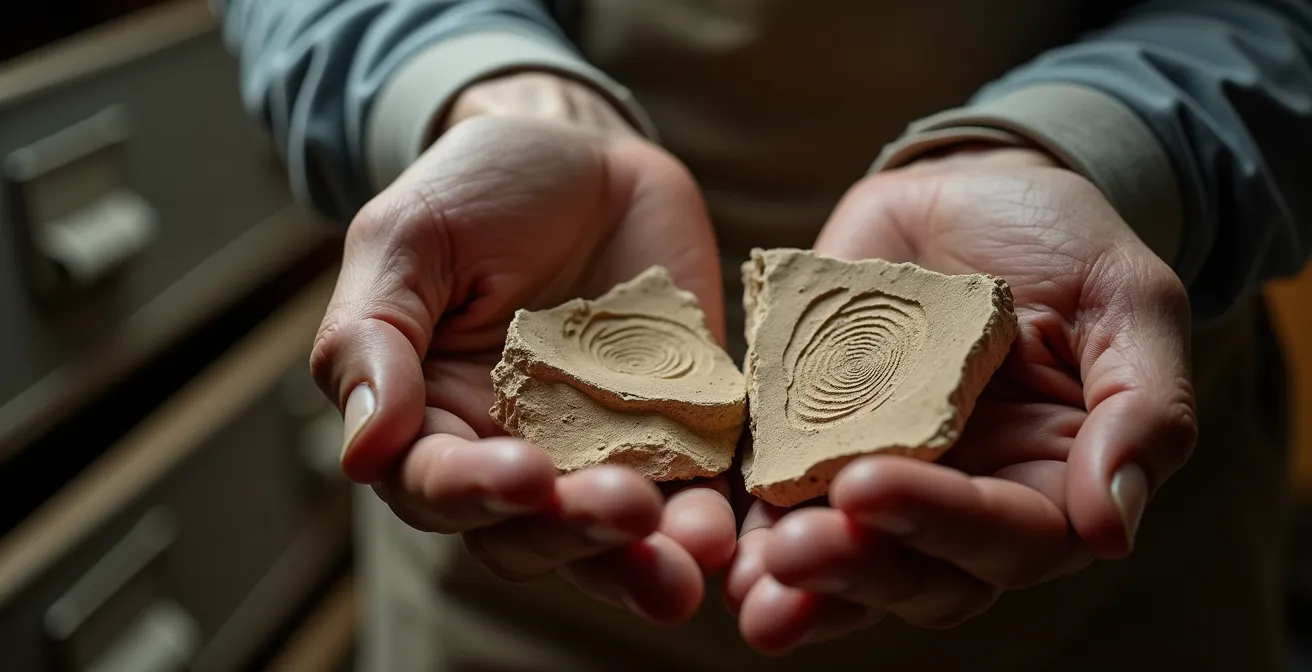
As the image above illustrates, much of the most important archaeological work happens away from the main exhibition halls, in storage and research facilities. Gaining access to this world is a key goal for the serious traveler. One of the best-kept secrets are university-affiliated collections.
Case Study: The Power of University Archaeological Museums
The American Academy in Rome provides a perfect example of how university-affiliated archaeological collections offer unique, research-driven experiences. Institutions like their Gabii Project archives provide direct access to findings from ongoing excavations, including unpublished artifacts that have not yet made it into mainstream narratives. Unlike major museums that prioritize breadth, these collections offer unparalleled depth in specific research areas, often allowing for closer examination of objects and direct interaction with the archaeologists and scholars who study them.
To find these places, look beyond standard tourist maps. Search for university archaeology departments, local historical societies, and the research archives of major excavation projects. An email or call in advance can often open doors that the average tourist doesn’t even know exist.
Audio Guide or Professor-Led Tour: Which Is Best for Deep Learning?
Once you’re at a site, you face a critical choice: how do you consume the information? The options typically range from a standard audio guide to a tour led by a scholar. For the traveler focused on deep learning, the answer isn’t always straightforward. As experts in the field of heritage studies note, the goal is to gain “insights into ancient civilizations through narratives,” and different methods deliver these narratives in vastly different ways. This decision is central to your role as an active investigator.
Archaeotourists share many characteristics of ‘serious’ heritage tourists driven by an interest in archaeological sites, seeking insights into ancient civilizations through narratives shared during site explorations
– Hasan Ali Erdoğan, Aynur Gülenç Birsen, and Yasin Bilim, Conservation and Management of Archaeological Sites
A standard audio guide offers flexibility but often provides only surface-level facts. A professor-led tour provides deep academic context but can be rigid and expensive. However, these are not the only options. The modern historical traveler has a spectrum of choices, each suited to different learning styles and objectives. The key is to match the method to your goal for a particular site or topic.
The following table, based on an analysis of learning methods at archaeological sites, breaks down the strengths and weaknesses of different approaches to help you build a flexible learning strategy.
| Method | Best For | Depth of Learning | Flexibility |
|---|---|---|---|
| Standard Audio Guide | Basic factual information | Surface level | High – self-paced |
| Professor-Led Tour | Academic insights | Very deep | Low – fixed schedule |
| Hybrid Specialist Approach | Targeted deep dives | Deep on specific topics | Medium – partial customization |
| Self-Themed Socratic Tour | Active investigation | Variable – self-directed | Very high – completely customizable |
A powerful, advanced technique is the Self-Themed Socratic Tour. This involves choosing a specific theme or question before you arrive (e.g., “How did the Romans manage water at this site?”) and using your visit exclusively to find answers. This turns the site into a puzzle to be solved, forcing you to actively search for evidence rather than passively receive information.
Ultimately, the best strategy is often a hybrid one. You might use a professor-led tour for a foundational understanding of a complex site like the Acropolis, then return the next day on your own for a self-themed tour focused on a niche interest, like the role of women in religious rituals.
The “Ancient Alien” Trap: How to Spot Fake History Tours?
In the age of information, there is also an age of misinformation. The field of history is rife with pseudoarchaeology and sensationalist theories, most famously the “ancient aliens” hypothesis. These narratives can be entertaining, but they are a trap for the serious learner. They dismiss the ingenuity and achievements of ancient peoples, replacing rigorous evidence with exciting but baseless speculation. A crucial skill for the historical investigator is intellectual self-defense: the ability to distinguish credible historical interpretation from fiction.
Fake history tours often rely on a few common tactics. They present mysteries as “unsolvable” by conventional means, they frequently use words like “impossible” or “inexplicable” to describe ancient engineering, and they cite TV shows or online forums as their sources rather than peer-reviewed research. True historical and archaeological inquiry, by contrast, is a process of celebrating human ingenuity. It seeks to understand *how* ancient people achieved incredible feats with the tools they had, not to attribute them to external forces.
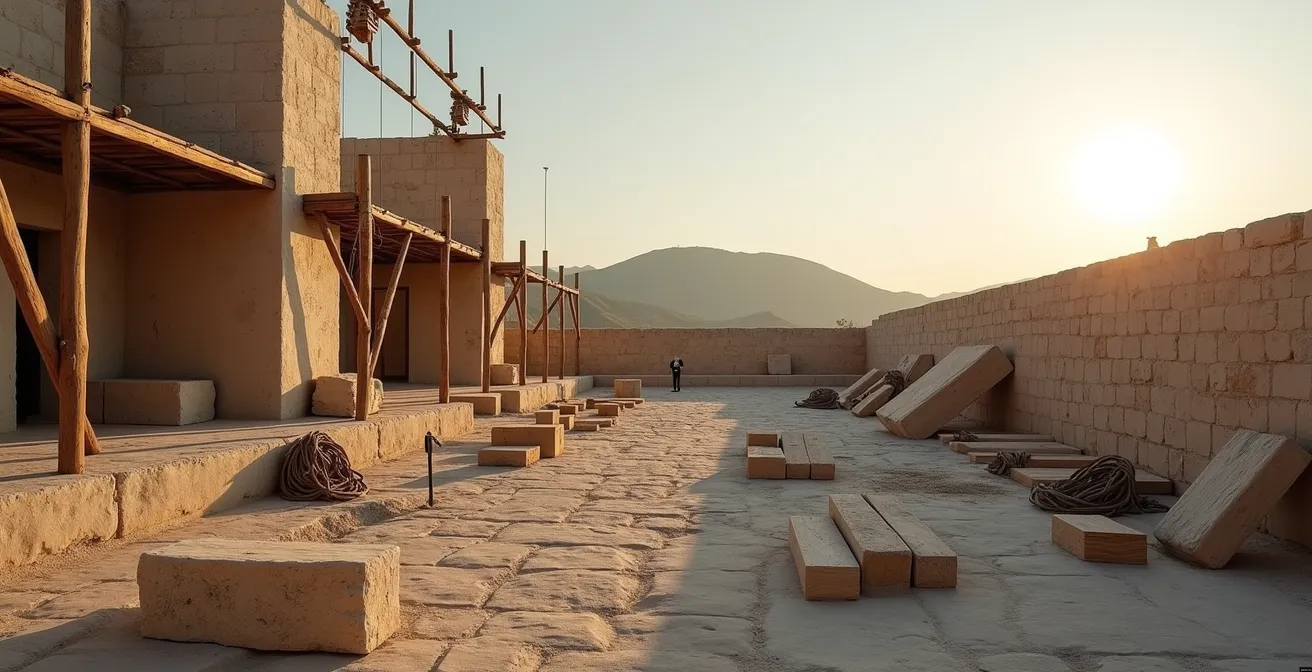
The image above depicts a reconstruction of ancient construction methods, highlighting the ramps, levers, and manpower that made monumental architecture possible. This is the focus of genuine historical inquiry: understanding the process. Credible sources are transparent about what is known, what is inferred, and what remains a genuine mystery, without filling the gaps with fantasy.
Case Study: How Credible Storytellers Maintain Accuracy
The popular YouTube channel Epic History TV, created by a historian with a Master’s degree, serves as a model for maintaining accuracy. Its success is built not on sensationalism but on thorough research, collaboration with historians, and extensive fact-checking. This approach, rooted in documentary production standards, demonstrates how legitimate historical content distinguishes itself by prioritizing credible sources and verifiable facts over speculation. This is the standard to look for in any guide or tour.
Your Checklist for Spotting Pseudoarchaeology Tours
- Source Vetting: Check if guides cite peer-reviewed archaeological journals and university research versus TV shows, blogs, or online forums.
- Framing of Ingenuity: Notice if explanations celebrate ancient human problem-solving or default to claims of “impossible” achievements that hint at outside help.
- Affiliations and Credentials: Look for partnerships with universities, museums, or official archaeological bodies versus associations with esoteric societies or “alternative science” groups.
- Acknowledging Uncertainty: Verify if the tour guide acknowledges genuine gaps in historical knowledge and presents different scholarly theories, rather than filling those gaps with definitive, speculative answers.
- Presenting Consensus: Ask if alternative or fringe theories are presented alongside and in contrast to the mainstream archaeological consensus, or if they are presented as the sole, suppressed “truth.”
Before booking any “special access” or “secret knowledge” tour, vet the guides and their sources. A legitimate guide will be proud to share their research and academic credentials. A purveyor of fiction will be evasive. Your time is too valuable to waste on fantasies.
How to Plan a Route That Follows the Timeline of an Empire?
A truly immersive historical journey is not just a collection of sites; it is a story with a beginning, a middle, and an end. One of the most powerful tools in your investigator’s toolkit is to plan your travel route to follow the narrative arc of a civilization. Instead of jumping randomly between locations, you trace its chronological and geographical development. This transforms a simple trip into an epic, four-dimensional experience. The massive public interest in such deep experiences is clear, with the global cultural tourism market valued at $1.1 trillion in 2024.
To plan a timeline-based route, you start not at the empire’s famous capital, but at its humble origins. To understand the Roman Empire, for instance, you might begin in the Etruscan heartland of Tuscany, then travel to the early Roman settlements, follow the path of the legions to the frontiers in Britain or Germany, and only then conclude in the magnificent but decaying heart of Imperial Rome. This approach allows you to witness the evolution of its art, architecture, and engineering firsthand.
You see the rough, functional buildings of the early republic evolve into the marble-clad monuments of the Augustan age. You see the defensive strategies shift from city walls to continent-spanning frontiers. By experiencing the sites in chronological order, the civilization’s story unfolds organically. You aren’t just told that Rome grew and then declined; you feel it in the changing landscape and architecture.
Case Study: Far Horizons’ Narrative Arc Itineraries
The tour company Far Horizons has built its reputation on this very principle. With over 40 years of experience, their archaeological tours are designed as “immersive intellectual adventures” that follow the timelines of empires. Their Roman Empire tour, for example, traces the civilization’s full development from early Etruscan settlements through its vast frontier fortifications. By having archaeology scholars lead journeys that visit sites in a carefully curated chronological order, they allow travelers to experience the rise, consolidation, and eventual fall of a civilization as a coherent narrative.
This method requires more planning than a standard vacation, but the reward is a level of understanding that can’t be achieved otherwise. You are no longer just a spectator; you are following the ghost of an empire across time and space.
Why Visiting Rome Without Reading History Is a Waste of Time?
Rome is the ultimate test for the historical traveler. No city on Earth presents such a dense and complex layering of history. To visit it without historical context is to see only a chaotic jumble of ruins, churches, and traffic. To visit it with knowledge is to gain an almost superhuman vision, the ability to see 2,000 years of history coexisting in a single view. The key concept to grasp is that Rome is a historical palimpsest—a place where successive layers of civilization have been built on top of each other, with traces of the old always visible beneath the new.
As one expert eloquently described it, this layering is the very essence of the city. Without understanding this, the visual information is overwhelming and meaningless.
Rome is like a big lasagna. From the moment Rome was born until today, it has grown in an irregular manner, with layers of stratification that occurred at different times.
– Adriano Morabito, Roma Sotteranea, National Geographic
This “lasagna” effect is not just a metaphor; it is a physical reality. You can literally descend through the layers of time in many places across the city. Historical knowledge is the key that unlocks this vertical dimension.
Case Study: Descending Through Time at San Clemente Basilica
The Basilica di San Clemente is the perfect physical demonstration of Rome’s palimpsest nature. A visitor begins in a beautiful 12th-century basilica. A staircase leads down to the original 4th-century church directly beneath it. Another staircase leads deeper still, into the world of 1st-century Rome, revealing a pagan Mithraic temple and an ancient Roman apartment building. Without context, it’s just a series of dark, damp basements. With historical knowledge, you are physically walking through 2,000 years of continuous religious history in a single location, from a mystery cult to early Christianity to the medieval church.
This principle applies across the entire city. A simple stone platform in the Forum is transformed when you realize it is the Rostra, where Cicero delivered his fiery speeches. The ground of the Colosseum becomes infinitely more interesting when you know you are standing on what was once Nero’s artificial lake. The following table highlights this dramatic difference in perception.
| Site | Without Context | With Historical Knowledge |
|---|---|---|
| Roman Forum Platform | A ruined stone platform | The Rostra where Cicero delivered speeches against Mark Antony |
| Colosseum Ground | An old amphitheater | Nero’s artificial lake filled in, medieval fortress, Renaissance quarry |
| Arch of Janus | A four-sided arch | Ancient cattle market boundary marking transitions and beginnings |
| Via Latina Tombs | Old burial sites | 2,000 years of funerary art evolution showing cultural shifts |
Visiting Rome without history is not just a missed opportunity; it is a fundamental misunderstanding of the city itself. It is like looking at a page of a dense novel and seeing only the letters, not the words or the story they tell.
Why Did 1920s Paris Create Such a Specific Artistic Explosion?
Historical investigation isn’t limited to ancient ruins and classical empires. Sometimes, the “site” is not a place, but a moment in time—a specific confluence of social, economic, and cultural forces. The Paris of the 1920s, the “Années folles,” is a perfect example. Why did this one city, in this one decade, produce such an astonishing explosion of artistic and literary creativity? To understand it, the historical traveler must investigate the city as a cultural ecosystem.
The conditions were unique. It was a post-war environment, filled with a desperate hunger for life and a rejection of old values. Crucially, a favorable currency exchange rate made Paris incredibly affordable for foreign artists and writers like Hemingway, Fitzgerald, and Picasso. This economic factor cannot be overstated; it was the financial soil in which the artistic seeds could grow. This pattern of cultural renewal following periods of crisis is something we see reflected in modern trends, with a projected annual growth rate of 16.12% in heritage tourism through 2032, suggesting a similar post-pandemic thirst for meaningful cultural experiences.
To understand this ecosystem, your investigation must go beyond visiting museums of modern art. You must map the network of interaction. The real work of the “Lost Generation” wasn’t done in grand studios, but in the smoky cafés of Montparnasse and the cramped apartments of the Latin Quarter. To understand the art, you must understand the community that produced it. Here’s a practical strategy for a self-guided walking tour:
- Map the Network: Pinpoint the exact locations of cafés like La Rotonde and Le Dôme where artists met, argued, and collaborated daily.
- Feel the Psychology: Compare the somber architecture of World War I memorials with the exuberant Art Deco buildings being constructed simultaneously to feel the city’s psychological tension.
- Understand the Economics: Look up the 1920s exchange rates between the dollar and the franc to grasp why an American writer could live a bohemian lifestyle so cheaply.
- Visualize the Community: Trace the walking routes between the known studios and apartments of key figures to understand the density and intimacy of their daily interactions.
- Follow the Money: Document which galleries, like that of Gertrude Stein, first showed which artists to understand the commercial ecosystem that supported the innovation.
This approach reveals that the artistic genius of 1920s Paris was not just a collection of individual talents, but the product of a dense, highly interactive, and economically accessible urban network. It was a moment in time that can be excavated, just like an ancient city.
Key Takeaways
- Transform your role from a passive tourist into an active investigator by using a historian’s toolkit to decode the past on-site.
- View historical landscapes and cities like Rome as a “palimpsest,” learning to identify and read the overlapping layers of different eras.
- Prioritize deep, focused engagement over a rushed checklist; spending an hour with one object can be more rewarding than seeing an entire museum in the same time.
How to Visit Historical Landmarks and Actually Understand What You See?
We have explored the big picture: reading a collapse, planning a narrative route, and understanding historical layers. Now, we arrive at the final and most crucial part of your toolkit: the on-the-ground techniques for active observation. How, in the moment, do you move from simply looking at a landmark to truly seeing and understanding it? The answer lies in methods that force your brain to slow down and engage with the visual information in a structured way.
One of the most effective and time-honored methods is sketching. You don’t need to be an artist. The goal of archaeological or architectural sketching is not to create a beautiful drawing, but to force your eyes to trace every line, proportion, and detail of an object or structure. It bypasses the brain’s tendency to simplify and categorize what it sees, compelling you to notice the specific details—the curve of an arch, the style of a column’s capital, or a subtle repair made centuries ago.
This simple, active method for observation can be structured as a short exercise at any site:
- Focus on One Element: Choose a single architectural element—a column, an archway, or a section of a frieze—and commit to observing it for 15 minutes.
- Sketch the Basic Form: Start by drawing the basic shape, paying close attention to its proportions relative to human scale or other parts of the building.
- Add Key Details: Begin to add the specific decorative elements, actively trying to identify the style (e.g., Doric, Ionic, or Corinthian for a column).
- Note the History: Look for and note any changes in material, visible repairs, or modifications. These are clues to the object’s long life.
- Reinforce with Knowledge: After sketching, compare your drawing and notes with a description in a quality guidebook to connect your visual observations with historical facts.
This same principle of deep, focused engagement can be applied even without a sketchbook, through a technique some call the “one-hour, one-object challenge.”
Case Study: The Success of the ‘Slow Tourism’ Challenge
Recent trends in heritage tourism show that visitors who spend extended, focused time with single artifacts report a much deeper cultural connection and better retention of information. This “slow tourism” approach, where a traveler might dedicate an entire hour to observing one sculpture or pot rather than rushing through a whole gallery, aligns with the steady growth in the heritage market. Museums that encourage this practice report that these visitors ask more complex, insightful questions and engage far more deeply with the educational materials provided, demonstrating that depth of experience trumps breadth every time.
By consciously slowing down and actively engaging your powers of observation, you complete your transformation. You are no longer just a visitor. You are a reader of history, fluent in the language of stone, art, and time itself. Your next journey isn’t just a vacation; it’s a chance to put these skills to the test. Start planning your immersive historical adventure today.