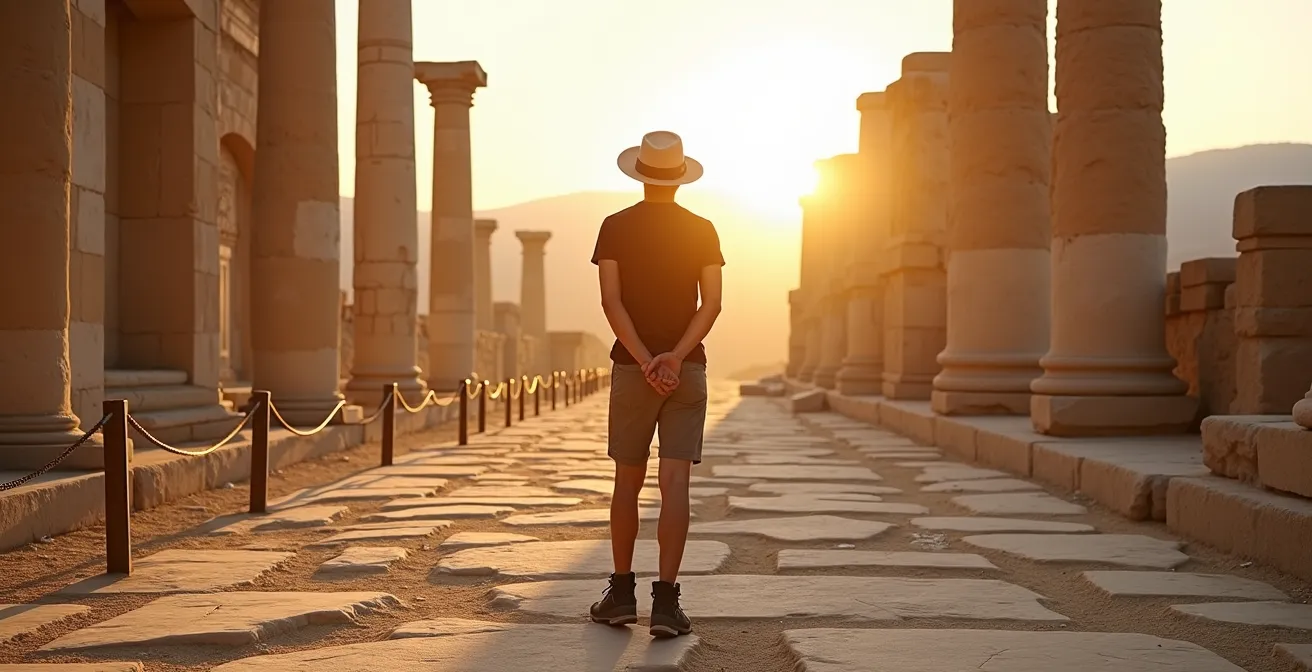
Visiting a historic site is an active engagement with a fragile, non-renewable resource; your safety and its survival are not guaranteed, they are your responsibility.
- Structural collapse and environmental hazards are real, quantifiable risks, not abstract dangers.
- Respect is not a feeling but a series of precise actions based on understanding the site’s cultural and physical properties.
Recommendation: Shift your mindset from tourist to temporary custodian. Learn to identify specific structural warnings and cultural cues before you even step foot on site.
There is an undeniable pull to ancient ruins. It’s a desire to connect with the deep past, to walk where others walked millennia ago. Many guides will offer you simple advice: “don’t touch anything,” “be quiet,” or “take only pictures.” As an archaeological site manager, I can tell you this advice is dangerously inadequate. It treats these sites like a museum exhibit behind glass, when in reality, they are complex, deteriorating environments exposed to immense pressures—from the elements and from you.
These locations are not just collections of old stones; they are documents of history, sacred spaces for living cultures, and often, structurally compromised areas. The standard tourist mindset is insufficient here. It fails to grasp the unseen forces at play: the load-bearing stress on a 2,000-year-old wall, the thermal mass of sun-baked stone that can lead to heatstroke, or the intangible heritage embedded in a space that your actions could inadvertently desecrate. The real key to a profound and responsible visit is not just following a list of “don’ts,” but understanding the fundamental reasons *why* these protocols are in place.
This guide is your official briefing. We will move beyond the platitudes to give you the operational knowledge you need. We will analyze the physical reasons behind a site’s “spiritual” atmosphere, the non-negotiable rules of respectful photography, the critical differences between untouched and reconstructed ruins, and the specific, visible warning signs of imminent structural failure. We will also cover the expert strategies for timing your visit to manage both crowds and environmental risks, and ultimately, show you how to truly learn from a site by engaging with it as a temporary custodian, not a consumer.
This article is structured to build your expertise progressively, from understanding the atmosphere of a site to identifying its physical dangers. Use the summary below to navigate through these essential protocols for safe and respectful exploration.
Summary: A Site Manager’s Guide to Exploring Historic Remnants Safely and Respectfully
- Why Do Certain Ruins Feel “Haunted” or Spiritually Charged?
- How to Photograph Sacred Ruins Without Offending Local Beliefs?
- Reconstructed Sites or Untouched Ruins: Which Offers Better Insight?
- The Structural Risk That Could Collapse a Wall on You
- When to Visit Exposed Ruins to Avoid Heatstroke and Crowds?
- When to Visit Major Landmarks to Have the Place to Yourself?
- Why Did Great Civilizations Collapse and What Can We Learn?
- How to Learn About Past Civilizations Through Travel Instead of Books?
Why Do Certain Ruins Feel “Haunted” or Spiritually Charged?
Many visitors report a palpable atmosphere in ancient places—a sense of presence often described as spiritual or even “haunted.” This feeling is not imagined, but it’s rarely supernatural. It is a product of psychogeography: the powerful effect of a physical environment on human emotion and behavior. The architects of these sites were masters of manipulating space, light, and sound to evoke specific feelings of awe, reverence, or introspection. What you are sensing is the successful execution of their design, resonating across centuries.
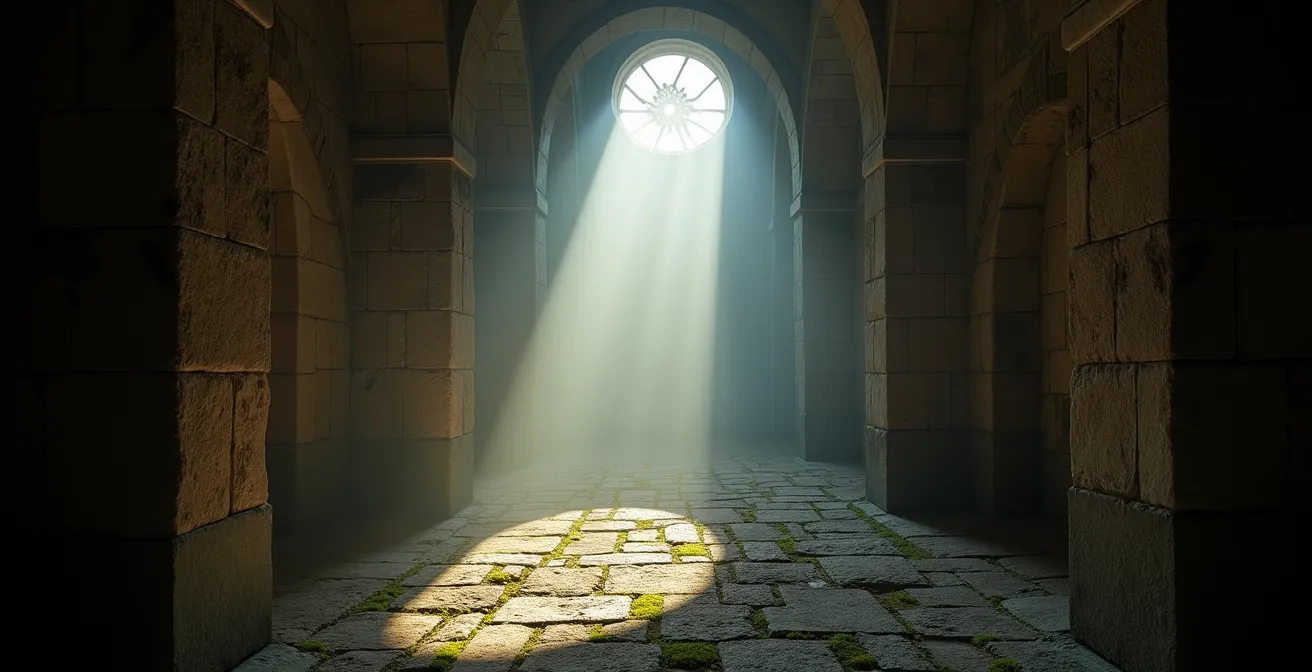
The sensation is often rooted in tangible physics. For example, the precise engineering of ancient theaters can create extraordinary acoustic effects. It has been noted that at the Epidavros theater in Greece, the 2,400-year-old acoustics are still functional, allowing a whisper from the stage to be heard in the highest seats. This acoustic perfection can create a sense of intimacy and presence that feels otherworldly. Similarly, the way light filters through a narrow passage in a megalithic tomb or illuminates a central chamber only on the winter solstice is a deliberate, powerful tool designed to connect the visitor to a larger cosmos. You are not feeling a ghost; you are feeling the intended emotional impact of the architecture itself.
How to Photograph Sacred Ruins Without Offending Local Beliefs?
At a sacred site, your camera is not a neutral tool; it is an intrusion. Photography is an extractive act, and in a place of worship or cultural reverence, it must be governed by strict protocols. The core principle is this: the spiritual and cultural function of the site always, without exception, supersedes your desire for a photograph. Many sites are not “ruins” to local communities but are active places of ritual and connection. Your “photo op” could be a moment of profound personal prayer for someone else. Before you even raise your camera, your first responsibility is to observe and understand.
Case Study: The Osun-Osogbo Sacred Grove Photography Ethics
The Osun-Osogbo Sacred Grove in Nigeria, a UNESCO site, serves as a critical example. After flooding damaged a shrine, local religious leaders and conservationists collaborated to establish photography guidelines. This wasn’t about banning photos but about educating visitors on how to capture the site’s beauty without disrupting its primary function as a sacred space for the goddess Osun. This shows that respect is not intuitive; it is learned and codified through cooperation between managers and community stakeholders.
Therefore, you must adhere to a formal code of conduct. Observe how local people behave and mirror their quiet, respectful demeanor. Never use a flash, as the intense light can damage ancient pigments and artifacts, and is profoundly disrespectful during ceremonies. Maintain a significant distance from worshippers and never photograph them, their rituals, or their religious artifacts without explicit, verbal permission. Drones are almost universally forbidden as they violate both spiritual privacy and site safety regulations. Always follow posted signage; if a sign says “No Photography,” it is not a suggestion, it is a command from the custodians of the site. Violating it is an act of profound disrespect.
Reconstructed Sites or Untouched Ruins: Which Offers Better Insight?
Visitors often face a choice between two types of historical sites: the “untouched” ruin, a romantic landscape of rubble and decay, and the “reconstructed” site, where walls are raised and rooms are rebuilt. There is a common bias that untouched ruins are more “authentic,” but from a site management and educational perspective, this is a simplistic view. Each type offers a different, equally valid form of insight. An untouched ruin is a primary source document on the effects of time, environment, and decay. A reconstructed site is a physical interpretation—a “historical argument,” as one expert put it—of how archaeologists believe the site once functioned.
Neither is inherently superior; they answer different questions. A partially reconstructed site like the Palace of Knossos in Crete, while controversial, allows a visitor to grasp the scale and complexity of Minoan architecture in a way that a field of foundations never could. Conversely, the Roman Forum, left largely as it fell, tells a powerful story of civilizational collapse and nature’s reclamation. Understanding a reconstruction not as a “fake” but as a physical hypothesis based on evidence is key. It provides a glimpse into both the ancient world and the modern science of archaeology that seeks to understand it.
This comparative table, based on principles of archaeological interpretation, helps clarify the distinct educational value each type of site provides, as detailed in analyses of how to best sightsee ancient sites.
| Aspect | Untouched Ruins | Reconstructed Sites |
|---|---|---|
| Historical Authenticity | Primary source documents showing actual decay and time’s passage | Interpretive reconstructions reflecting archaeological theories |
| Visitor Experience | Requires imagination to visualize original state | Easier to understand original function and scale |
| Educational Value | Shows natural deterioration processes | Demonstrates building techniques and daily life |
| Example Sites | Roman Forum (partially untouched) | Knossos Palace (Evans reconstruction) |
| Best For | Understanding archaeology and preservation challenges | Grasping architectural achievements and social organization |
The Structural Risk That Could Collapse a Wall on You
The romantic image of a crumbling ruin masks a stark reality: these are unstable structures. As a site manager, my primary concern is your safety, and the most immediate threat at many sites is gravity. The same forces that brought these structures down over centuries are still active. Ignoring safety barriers or straying from marked paths is not adventurous; it is reckless. The risk of structural collapse is not theoretical. For instance, the official 2024 register from Historic England notes that 4,891 historic sites are at risk in England alone, with structural problems being a primary concern.
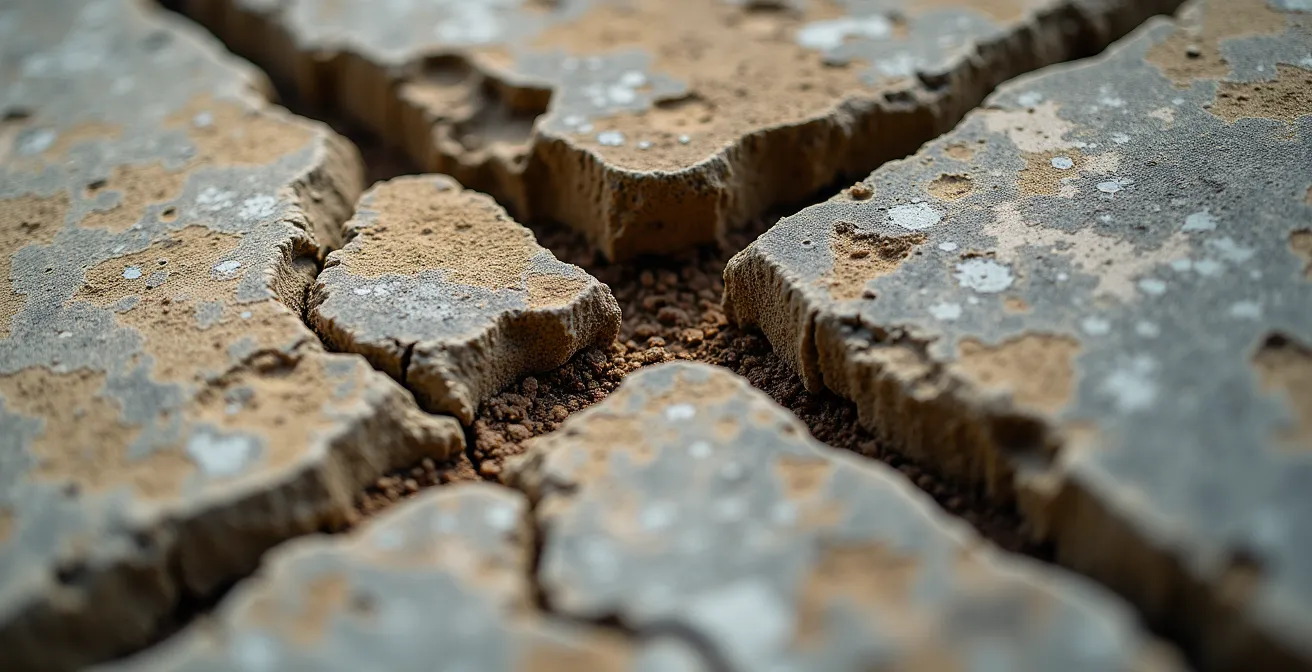
You must become an active observer of your environment. Your safety depends on your ability to recognize the visual warning signs of instability. These structures lack modern foundations and mortar, making them exceptionally vulnerable to water, wind, and even minor tremors. A wall that has stood for a thousand years can fail in an instant under the right conditions. Learning to spot these dangers is not just for your own protection, but it’s a mark of respect for the immense challenge of preserving these sites. The following checklist is not optional; it is a mandatory safety scan you must perform continuously while on site.
Your Field Checklist: 5 Visual Signs of Imminent Structural Danger
- Wall Deformation: Scan vertical surfaces for any unnatural bulging or ‘bellying’ that indicates the wall is curving outward under pressure.
- Critical Cracks: Identify deep, open vertical cracks in masonry, especially any wider than a centimeter, which signal a potential shear or separation.
- Foundation Weakness: Examine the base of walls for crumbling, ‘sugaring’ mortar or signs of water erosion that are undermining the structure’s support.
- Recent Debris: Look for fresh rockfall, dust, or soil disturbance at the base of any cliff or wall, as this is a clear indicator of recent, active movement.
- Biotic Intrusion: Note the presence and size of tree roots growing through or near foundations, as they exert immense pressure that can split stone.
When to Visit Exposed Ruins to Avoid Heatstroke and Crowds?
At an exposed archaeological site, the environment itself is a significant risk factor. The number one medical issue we deal with is heat-related illness. This is not simply due to a hot day; it’s a result of a physical phenomenon known as thermal mass. Stone and earth absorb solar radiation all day and then radiate it back out, creating a microclimate that is significantly hotter than the surrounding area. In fact, some research on thermal mass in archaeological sites reveals that stone ruins can radiate heat up to 5°C above ambient temperature in the late afternoon. Visiting midday is not just uncomfortable; it is a serious health hazard.
The standard advice to “go early” to beat crowds is also often flawed, as it puts you on site with every other “smart” tourist. A more sophisticated, safer approach is required, which manages both environmental and crowd pressures simultaneously.
Case Study: The ‘Split-Shift’ Strategy at Ephesus
At the vast, exposed site of Ephesus in Turkey, a proven strategy has emerged. Experienced guides and travelers practice a ‘split-shift’ visit. They arrive right at opening (e.g., 8 AM) for two to three hours. As peak heat and tour bus crowds descend (11 AM – 3 PM), they retreat to nearby air-conditioned museums or a local town for lunch. They then return for the final two hours before closing. During this second shift, the crowds have vanished, the light is better for photography, and the stones have begun to release their intense thermal load, making the experience far more pleasant and safe.
This strategy is fundamentally about working *with* the site’s environmental rhythm, not against it. It acknowledges that you cannot simply will away the heat or the crowds. Instead, you must plan your engagement around these predictable patterns. This demonstrates a higher level of travel intelligence and a genuine respect for the physical realities of the site.
When to Visit Major Landmarks to Have the Place to Yourself?
The dream of experiencing a major landmark in solitude is achievable, but it requires counter-intuitive thinking. The “early bird” strategy is now so commonplace that the first hour after opening is often one of the busiest times, filled with photographers vying for the same iconic shots in the morning light. The real secret is to understand the full daily rhythm of visitor flow and identify the “gaps” that most people miss. It’s about outsmarting the crowd, not just waking up before them. Strategies like “reverse touring”—starting at the designated exit and working your way backward against the main flow—can be remarkably effective.
Furthermore, don’t underestimate the power of weather. A forecast of light rain can be your greatest ally. While tour groups cancel and casual visitors stay away, a prepared traveler with proper rain gear can often have a world-class site almost entirely to themselves. This requires planning and a willingness to embrace less-than-perfect conditions, but the reward is an intimacy with the site that is impossible to achieve on a sunny day. This strategic timing is less about luck and more about understanding the behavioral patterns of other tourists.
The following table, based on an analysis of crowd patterns at major sites, provides a framework for planning your visit to find those moments of tranquility.
| Time Slot | Crowd Level | Best For | Temperature |
|---|---|---|---|
| First Hour (Opening) | High – ‘Smart’ tourists | Popular photo spots | Cool |
| 60-90 min after opening | Low – Gap period | Entrance areas, overview | Comfortable |
| Midday (11am-2pm) | Highest – Tour groups | Indoor museums nearby | Hottest |
| Late afternoon | Moderate | Golden hour photography | Hot from thermal mass |
| Last hour before closing | Low | Peaceful exploration | Cooling |
Why Did Great Civilizations Collapse and What Can We Learn?
Standing amidst the ruins of a great city, the immediate question is often: “What happened here?” The romantic notion is one of a single, dramatic event—a great battle, a volcanic eruption, a barbarian invasion. The archaeological reality is almost always more complex and more instructive. Civilizational collapse is rarely an event; it is a process. In fact, archaeological evidence from multiple sites indicates that most societal collapses occurred over a protracted period, often lasting 100 to 300 years. They don’t fall; they unravel.
This “slow collapse” is typically a cascade of interconnected failures. A subtle shift in climate leads to agricultural stress, which in turn fuels social unrest and undermines political authority. As the system weakens, it loses its ability to respond to the next crisis, accelerating the decline. This model of complex systems failure is a profound lesson that ruins teach us, and it holds urgent relevance for our own interconnected global society facing similar pressures.
Case Study: The Unraveling of the Mayan Civilization
The classic Maya collapse in the southern lowlands is a prime example. Once thought to be a mystery, modern research paints a clear picture of a systems failure. Sediment analysis reveals evidence of prolonged, severe drought, which crippled their intensive maize agriculture. This environmental crisis triggered a cascade: crop failures led to malnutrition and disease, which fueled social unrest and warfare between city-states. The rigid political and religious system, unable to solve the crisis, lost its legitimacy, and the population dispersed. It wasn’t one thing that doomed cities like Tikal; it was the inflexibility of the entire system in the face of mounting, interconnected stressors—a critical lesson in resilience.
When you explore a ruin, you are not just looking at the result of a disaster. You are looking at a laboratory of societal resilience and fragility. The lesson is not one of dramatic doom, but a more sobering one about the complex, often slow-moving forces that can undermine even the most sophisticated societies when they fail to adapt.
Key Takeaways
- Your primary role at a historic site is that of a custodian; your safety and the site’s preservation depend on your ability to identify specific structural and environmental risks.
- Strategic timing is paramount. Understanding concepts like thermal mass and crowd-flow gaps is more effective than simply arriving early.
- The deepest learning comes from “archaeological empathy”—actively engaging with the site’s physical reality to understand the lives of its former inhabitants.
How to Learn About Past Civilizations Through Travel Instead of Books?
A book can give you facts and timelines, but only a physical site can give you a sense of scale, perspective, and lived reality. The ultimate goal of visiting a ruin is to move beyond passive observation and engage in a process I call “archaeological empathy.” This is the active effort to understand the past by placing yourself, literally, in the footsteps of its people. It’s about asking questions that only the physical space can answer: How long did it really take to walk from the market to the temple? What did the city look like from this doorway? How did the changing light of day affect life in this room?
This is an intellectual and physical discipline. It means walking the ancient roads at a human pace to grasp true distances. It means seeking out not just the monumental temples but also the quarries, the workshops, and the simple homes to understand the complete ecosystem of the society. It involves touching permitted surfaces to feel the texture of the materials and imagine the labor required to build them. This active, sensory engagement transforms rubble into a legible document. It allows you to build a mental model of the past that is richer and more nuanced than any text can provide.
The key to enjoying sights from ancient Rome is to resurrect all that rubble in your mind. These days, you can stroll among the ruins and trace the grid standard for Roman military towns.
– Rick Steves, Ostia Antica: A Peek into Ancient Rome
By using these techniques, you stop being a tourist looking at things and become an investigator deciphering a place. This is the true privilege of visiting these non-renewable resources—the ability to connect with history in a direct, visceral way that no other medium can offer.
Your visit is a temporary privilege. By adopting these protocols of safety, respect, and active observation, you honor the legacy of the people who built these places and ensure that they survive for future generations to learn from.